Finding the Best Particle Characterization
Analyzer for your Application

Mark Bumiller
mark.bumiller@horiba.com

© 2010 HORIBA, Ltd. All rights reserved.
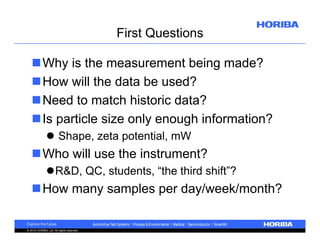
First Questions
Why is the measurement being made?
How will the data be used?
Need to match historic data?
Is particle size only enough information?
 Shape, zeta potential, mW

Who will use the instrument?
R&D, QC, students, “the third shift”?

How many samples per day/week/month?

© 2010 HORIBA, Ltd. All rights reserved.
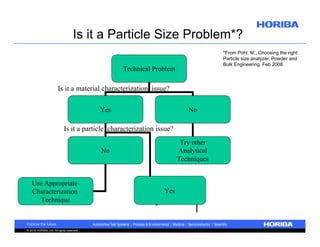
Is it a Particle Size Problem*?
*From Pohl, M., Choosing the right
Particle size analyzer, Powder and
Bulk Engineering, Feb 2008

Technical Problem

Is it a material characterization issue?
Yes

No

Is it a particle characterization issue?
Try other
Analytical
Techniques

No

Use Appropriate
Characterization
Technique

© 2010 HORIBA, Ltd. All rights reserved.

Yes
Is it a Particle Size Problem*?
 Customers complain this batch doesn’t
perform like previous product
 Investigate specific behavior & look for possible
causes
 Chemical or physical difference?

 I have a powder flow problem
 Both particle size & shape influence flow
 But so do other parameters (water content)

 This product isn’t stable
 Could be size and/or zeta potential
 Cause could come from surface chemistry
© 2010 HORIBA, Ltd. All rights reserved.
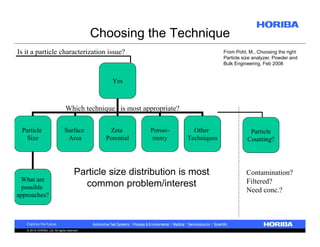
Choosing the Technique
From Pohl, M., Choosing the right
Particle size analyzer, Powder and
Bulk Engineering, Feb 2008

Is it a particle characterization issue?

Yes

Which technique is most appropriate?
Particle
Size

What are
possible
approaches?

Surface
Area

Zeta
Potential

Porosimetry

Other
Techniques

Particle size distribution is most
common problem/interest

© 2010 HORIBA, Ltd. All rights reserved.

Particle
Counting?

Contamination?
Filtered?
Need conc.?
Particle Counting
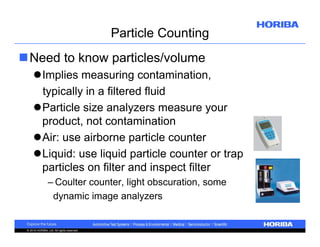
Need to know particles/volume
Implies measuring contamination,
typically in a filtered fluid
Particle size analyzers measure your
product, not contamination
Air: use airborne particle counter
Liquid: use liquid particle counter or trap
particles on filter and inspect filter
– Coulter counter, light obscuration, some
dynamic image analyzers

© 2010 HORIBA, Ltd. All rights reserved.
Electrical Sensing Zone
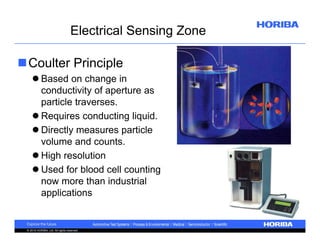
Coulter Principle
 Based on change in
conductivity of aperture as
particle traverses.
 Requires conducting liquid.
 Directly measures particle
volume and counts.
 High resolution
 Used for blood cell counting
now more than industrial
applications

© 2010 HORIBA, Ltd. All rights reserved.
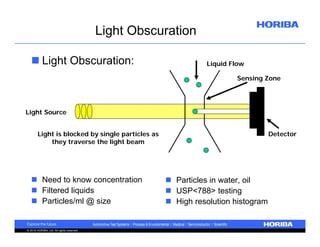
Light Obscuration
 Light Obscuration:

Liquid Flow
Sensing Zone

Light Source
Detector

Light is blocked by single particles as
they traverse the light beam

 Need to know concentration
 Filtered liquids
 Particles/ml @ size

© 2010 HORIBA, Ltd. All rights reserved.

 Particles in water, oil
 USP<788> testing
 High resolution histogram
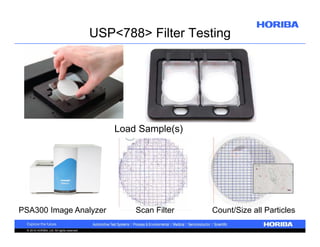
USP<788> Filter Testing

Load Sample(s)

PSA300 Image Analyzer
© 2010 HORIBA, Ltd. All rights reserved.

Scan Filter

Count/Size all Particles
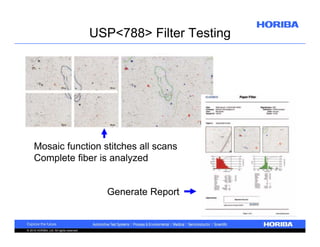
USP<788> Filter Testing

Mosaic function stitches all scans
Complete fiber is analyzed
Generate Report

© 2010 HORIBA, Ltd. All rights reserved.
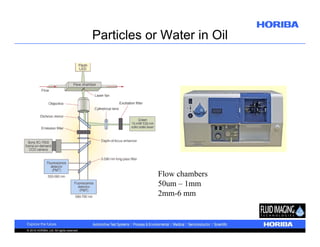
Particles or Water in Oil

Flow chambers
50um – 1mm
2mm-6 mm

© 2010 HORIBA, Ltd. All rights reserved.
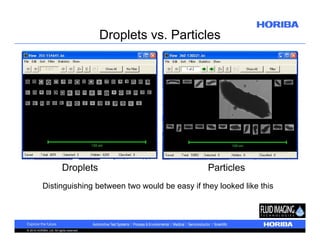
Droplets vs. Particles

Droplets

Particles

Distinguishing between two would be easy if they looked like this

© 2010 HORIBA, Ltd. All rights reserved.
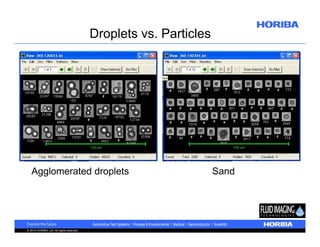
Droplets vs. Particles

Agglomerated droplets

© 2010 HORIBA, Ltd. All rights reserved.

Sand
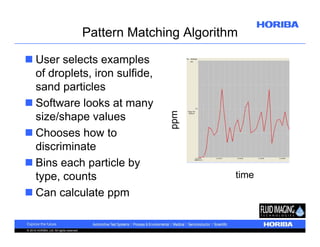
 User selects examples
of droplets, iron sulfide,
sand particles
 Software looks at many
size/shape values
 Chooses how to
discriminate
 Bins each particle by
type, counts
 Can calculate ppm

© 2010 HORIBA, Ltd. All rights reserved.

ppm

Pattern Matching Algorithm

time
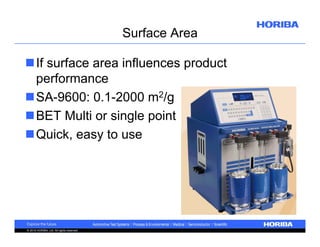
Surface Area
If surface area influences product
performance
SA-9600: 0.1-2000 m2/g
BET Multi or single point
Quick, easy to use

© 2010 HORIBA, Ltd. All rights reserved.
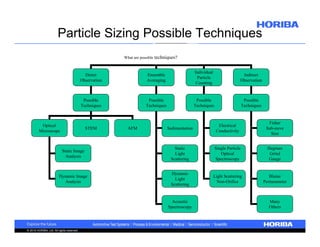
Particle Sizing Possible Techniques
What are possible techniques?

Direct
Observation

Ensemble
Averaging

Individual
Particle
Counting

Indirect
Observation

Possible
Techniques

Possible
Techniques

Possible
Techniques

Possible
Techniques

Sedimentation

Electrical
Conductivity

Fisher
Sub-sieve
Size

Static Image
Analysis

Static
Light
Scattering

Single Particle
Optical
Spectroscopy

Hegman
Grind
Gauge

Dynamic Image
Analysis

Dynamic
Light
Scattering

Light Scattering
Non-Orifice

Blaine
Permeameter

Optical
Microscope

STEM

AFM

Acoustic
Spectroscopy

© 2010 HORIBA, Ltd. All rights reserved.

Many
Others
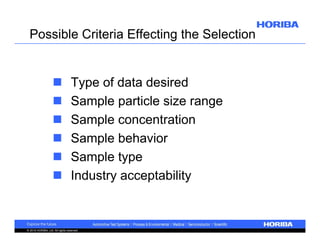
Possible Criteria Effecting the Selection








Type of data desired
Sample particle size range
Sample concentration
Sample behavior
Sample type
Industry acceptability

© 2010 HORIBA, Ltd. All rights reserved.
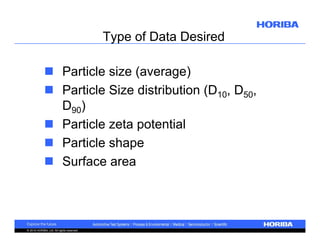
Type of Data Desired
 Particle size (average)
 Particle Size distribution (D10, D50,
D90)
 Particle zeta potential
 Particle shape
 Surface area

© 2010 HORIBA, Ltd. All rights reserved.
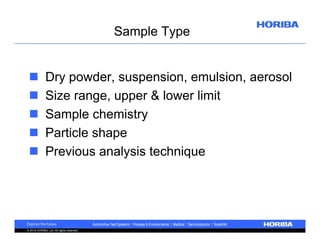
Sample Type






Dry powder, suspension, emulsion, aerosol
Size range, upper & lower limit
Sample chemistry
Particle shape
Previous analysis technique

© 2010 HORIBA, Ltd. All rights reserved.
Sample Behavior
 Is the typical sample stable?
 Is the sample stable at elevated or
reduced temperatures?
 Can the sample be diluted without
changing the particle size?
 Is the sample stable following dilution?
 Does the sample adhere to glass, plastic,
metal, etc.?

© 2010 HORIBA, Ltd. All rights reserved.
Industry Acceptability
 Is there an ASTM or ISO Standard already
in place?
 Is there a trade association standard?
 Is there a supplier or end-user
specification?
 Does it meet company standards?
 Is the technique consistent with a QA
procedure development
© 2010 HORIBA, Ltd. All rights reserved.
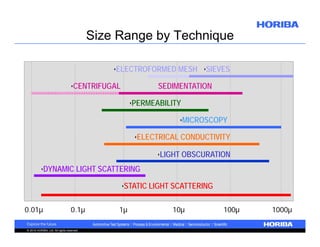
Size Range by Technique
•ELECTROFORMED MESH •SIEVES
•CENTRIFUGAL

SEDIMENTATION
•PERMEABILITY
•MICROSCOPY
•ELECTRICAL CONDUCTIVITY
•LIGHT OBSCURATION

•DYNAMIC LIGHT SCATTERING
•STATIC LIGHT SCATTERING
0.01µ

0.1µ

© 2010 HORIBA, Ltd. All rights reserved.

1µ

10µ

100µ

1000µ
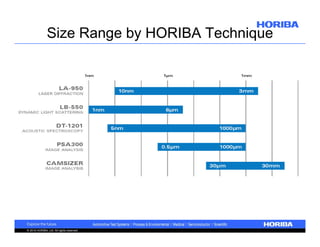
Size Range by HORIBA Technique

© 2010 HORIBA, Ltd. All rights reserved.
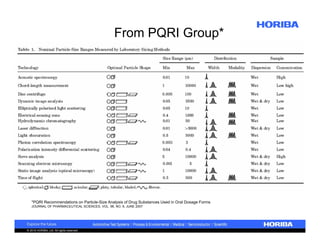
From PQRI Group*

*PQRI Recommendations on Particle-Size Analysis of Drug Substances Used in Oral Dosage Forms
JOURNAL OF PHARMACEUTICAL SCIENCES, VOL. 96, NO. 6, JUNE 2007

© 2010 HORIBA, Ltd. All rights reserved.
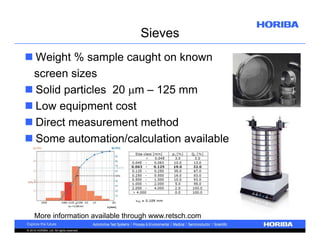
Sieves
 Weight % sample caught on known
screen sizes
 Solid particles 20 m – 125 mm
 Low equipment cost
 Direct measurement method
 Some automation/calculation available

More information available through www.retsch.com
© 2010 HORIBA, Ltd. All rights reserved.
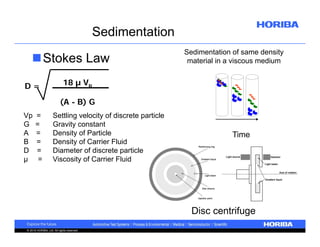
Sedimentation
Stokes Law
D=

Sedimentation of same density
material in a viscous medium

18 µ Vp
(A - B) G

Vp
G
A
B
D
µ

=
=
=
=
=
=

Settling velocity of discrete particle
Gravity constant
Density of Particle
Density of Carrier Fluid
Diameter of discrete particle
Viscosity of Carrier Fluid

Time

Disc centrifuge
© 2010 HORIBA, Ltd. All rights reserved.
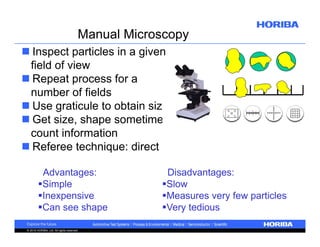
Manual Microscopy
 Inspect particles in a given
field of view
 Repeat process for a
number of fields
 Use graticule to obtain size
 Get size, shape sometimes
count information
 Referee technique: direct
Advantages:
Simple
Inexpensive
Can see shape
© 2010 HORIBA, Ltd. All rights reserved.

Disadvantages:
Slow
Measures very few particles
Very tedious
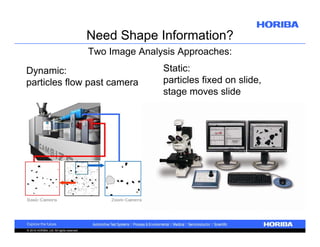
Need Shape Information?
Two Image Analysis Approaches:
Dynamic:
particles flow past camera

© 2010 HORIBA, Ltd. All rights reserved.

Static:
particles fixed on slide,
stage moves slide
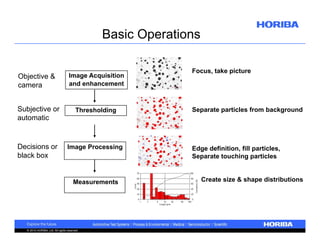
Basic Operations
Objective &
camera

Image Acquisition
and enhancement

Subjective or
automatic

Thresholding

Decisions or
black box

Image Processing

Measurements

© 2010 HORIBA, Ltd. All rights reserved.

Focus, take picture

Separate particles from background

Edge definition, fill particles,
Separate touching particles
Create size & shape distributions
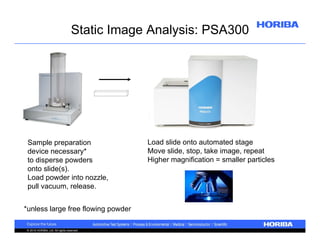
Static Image Analysis: PSA300

Sample preparation
device necessary*
to disperse powders
onto slide(s).
Load powder into nozzle,
pull vacuum, release.
*unless large free flowing powder
© 2010 HORIBA, Ltd. All rights reserved.

Load slide onto automated stage
Move slide, stop, take image, repeat
Higher magnification = smaller particles
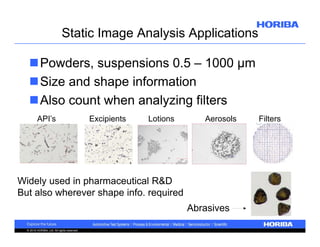
Static Image Analysis Applications
Powders, suspensions 0.5 – 1000 µm
Size and shape information
Also count when analyzing filters
API’s

Excipients

Lotions

Aerosols

Widely used in pharmaceutical R&D
But also wherever shape info. required
Abrasives
© 2010 HORIBA, Ltd. All rights reserved.

Filters
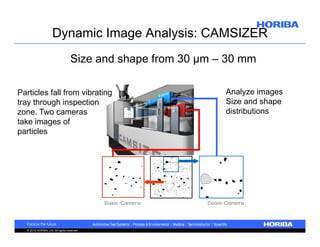
Dynamic Image Analysis: CAMSIZER
Size and shape from 30 µm – 30 mm
Particles fall from vibrating
tray through inspection
zone. Two cameras
take images of
particles

© 2010 HORIBA, Ltd. All rights reserved.

Analyze images
Size and shape
distributions
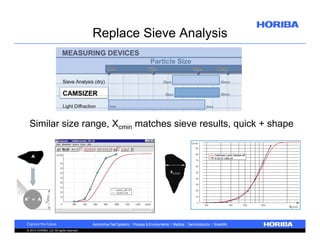
Replace Sieve Analysis

Similar size range, Xcmin matches sieve results, quick + shape

© 2010 HORIBA, Ltd. All rights reserved.
Dynamic Image Analysis Applications
Powders 30 µm – 30 mm
Glass beads

Sugar spheres

Fertilizers

Catalysts

Coating thickness
q3 [%/mm]

Q3 [%]
CoMo2-0,1%Absch_xc_min_001.rdf

90

180

80

160

70

140

60

120

50

100

40

80

30

60

20

40

10

20

0

0
1.4

1.6

1.8

2.0

2.2

2.4

x1
© 2010 HORIBA, Ltd. All rights reserved.

2.6

2.8

x2

x [mm]
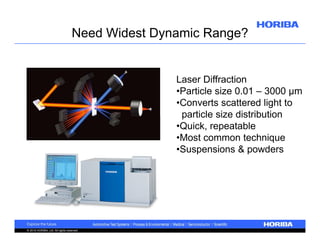
Need Widest Dynamic Range?

Laser Diffraction
•Particle size 0.01 – 3000 µm
•Converts scattered light to
particle size distribution
•Quick, repeatable
•Most common technique
•Suspensions & powders

© 2010 HORIBA, Ltd. All rights reserved.
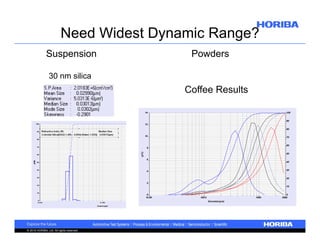
Need Widest Dynamic Range?
Suspension

Powders

30 nm silica

Coffee Results
14

100

90
12
80
10

70

60
q(%)

8
50
6
40

30

4

20
2
10

0
10.00

100.0

1000
Diameter(µm)

© 2010 HORIBA, Ltd. All rights reserved.

0
3000
Sample Volume

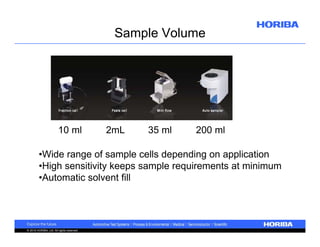
10 ml

2mL

35 ml

200 ml

•Wide range of sample cells depending on application
•High sensitivity keeps sample requirements at minimum
•Automatic solvent fill

© 2010 HORIBA, Ltd. All rights reserved.
Small Sample Volume (MiniFlow)

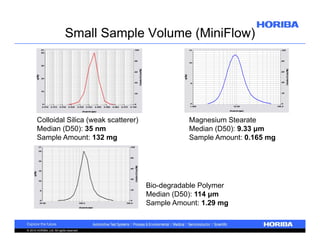
Colloidal Silica (weak scatterer)
Median (D50): 35 nm
Sample Amount: 132 mg

Magnesium Stearate
Median (D50): 9.33 μm
Sample Amount: 0.165 mg

Bio-degradable Polymer
Median (D50): 114 μm
Sample Amount: 1.29 mg

© 2010 HORIBA, Ltd. All rights reserved.
Paste Cell

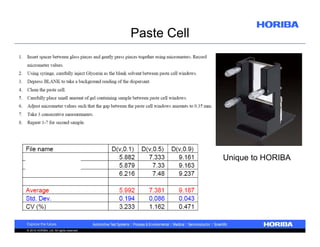
Unique to HORIBA

© 2010 HORIBA, Ltd. All rights reserved.
Dry Powders
Measure as dry powder using dry
powder feeder
Measure in natural state
Quick, easy, no clean up
Increase air pressure to aid dispersion
Minimum size ~ 0.25 µm

Disperse powder in liquid
Liquids reduce surface tension, add
surfactant, use ultrasound to aid dispersion
Lower detection limit (<30 nm)
© 2010 HORIBA, Ltd. All rights reserved.
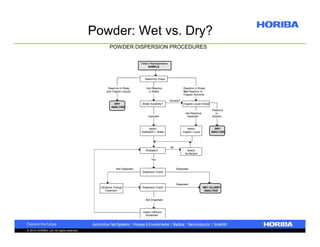
Powder: Wet vs. Dry?
POWDER DISPERSION PROCEDURES
Obtain Representative
SAMPLE

Reactivity Check
Reactive in Water
and Organic Liquids

Not Reactive
in Water

Reactive in Water,
Not Reactive in
Organic Solvents
Soluble?

DRY
ANALYSIS

Water Solubility?

Organic Liquid Check
Not Reactive,
Insoluble

Insoluble

Select
Distilled/D.I. Water

Select
Organic Liquid

Reactive
or
Soluble

DRY
ANALYSIS

No
Wettable?

Select
Surfactant

Yes
Not Dispersed

Dispersed
Dispersion Check

Dispersed
Ultrasonic Energy
Treatment

Dispersion Check

Not Dispersed

Select Different
Surfactant

© 2010 HORIBA, Ltd. All rights reserved.

WET SLURRY
ANALYSIS
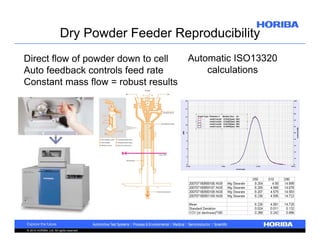
Dry Powder Feeder Reproducibility
Direct flow of powder down to cell
Auto feedback controls feed rate
Constant mass flow = robust results

© 2010 HORIBA, Ltd. All rights reserved.

Automatic ISO13320
calculations
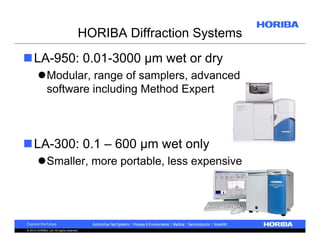
HORIBA Diffraction Systems
LA-950: 0.01-3000 µm wet or dry
Modular, range of samplers, advanced
software including Method Expert

LA-300: 0.1 – 600 µm wet only
Smaller, more portable, less expensive

© 2010 HORIBA, Ltd. All rights reserved.
Measuring at Process Concentration
Light scattering typically requires dilution
Does PSD change with dilution?
Concern when studying dispersion
Some samples are better analyzed without
any alteration
 Implies no sample preparation
 Dispersion stability studies often include zeta
potential and other parameters





 Size, zeta potential, pH, conductivity, temp,
surfactant concentration, titration studies

© 2010 HORIBA, Ltd. All rights reserved.
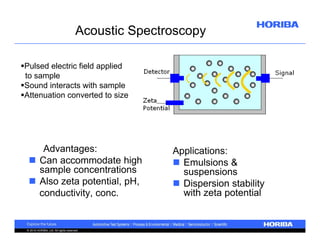
Acoustic Spectroscopy
Pulsed electric field applied
to sample
Sound interacts with sample
Attenuation converted to size

Advantages:
 Can accommodate high
sample concentrations
 Also zeta potential, pH,
conductivity, conc.

© 2010 HORIBA, Ltd. All rights reserved.

Applications:
 Emulsions &
suspensions
 Dispersion stability
with zeta potential
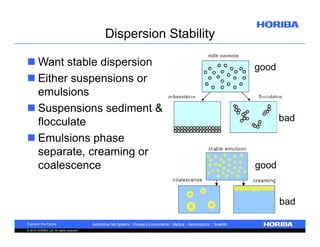
Dispersion Stability
 Want stable dispersion
 Either suspensions or
emulsions
 Suspensions sediment &
flocculate
 Emulsions phase
separate, creaming or
coalescence

good

bad

good

bad
© 2010 HORIBA, Ltd. All rights reserved.
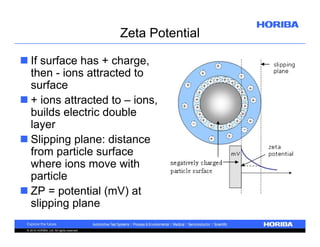
Zeta Potential
 If surface has + charge,
then - ions attracted to
surface
 + ions attracted to – ions,
builds electric double
layer
 Slipping plane: distance
from particle surface
where ions move with
particle
 ZP = potential (mV) at
slipping plane
© 2010 HORIBA, Ltd. All rights reserved.
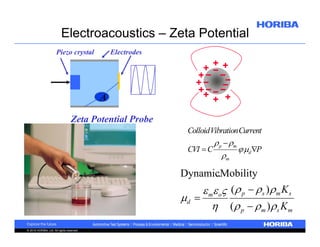
Electroacoustics – Zeta Potential
Piezo crystal

Electrodes

A
Zeta Potential Probe
ColloidVibrationCurrent

 p  m
 d P
CVI  C
m

DynamicMobility
..

 m  o (  p   s )  m K s
d 
 ( p   m ) s K m
© 2010 HORIBA, Ltd. All rights reserved.
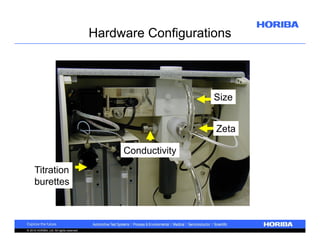
Hardware Configurations

Size
Zeta
Conductivity
Titration
burettes

© 2010 HORIBA, Ltd. All rights reserved.
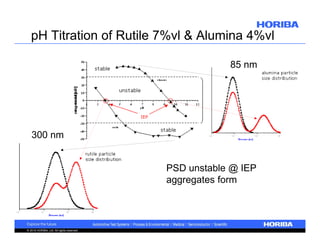
pH Titration of Rutile 7%vl & Alumina 4%vl
85 nm

300 nm
PSD unstable @ IEP
aggregates form

© 2010 HORIBA, Ltd. All rights reserved.
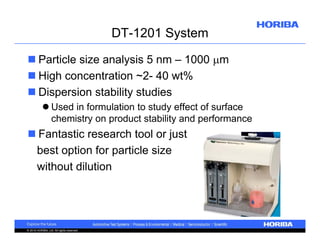
DT-1201 System
 Particle size analysis 5 nm – 1000 m
 High concentration ~2- 40 wt%
 Dispersion stability studies
 Used in formulation to study effect of surface
chemistry on product stability and performance

 Fantastic research tool or just
best option for particle size
without dilution

© 2010 HORIBA, Ltd. All rights reserved.
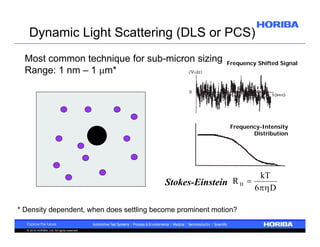
Dynamic Light Scattering (DLS or PCS)
Most common technique for sub-micron sizing
Range: 1 nm – 1 m*

Frequency Shifted Signal

Frequency-Intensity
Distribution

Stokes-Einstein R H 
* Density dependent, when does settling become prominent motion?
© 2010 HORIBA, Ltd. All rights reserved.

kT
6  D
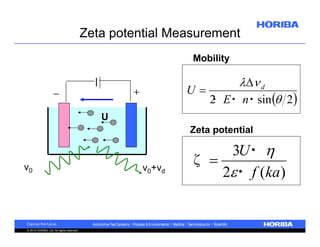
Zeta potential Measurement
Mobility

U

+

-

 d

2 E・ n・ sin  2 
・

U
Zeta potential

ν0

© 2010 HORIBA, Ltd. All rights reserved.

ν0+νd

3U・ 
ζ 

2・ f (ka)
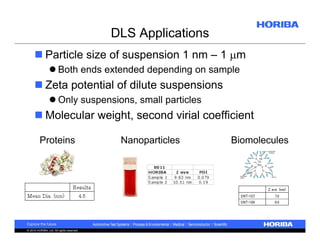
DLS Applications
 Particle size of suspension 1 nm – 1 m
 Both ends extended depending on sample

 Zeta potential of dilute suspensions
 Only suspensions, small particles

 Molecular weight, second virial coefficient
Proteins

© 2010 HORIBA, Ltd. All rights reserved.

Nanoparticles

Biomolecules
Conclusions
One general purpose particle size
analyzer: laser diffraction
Flexible, quick, easy

Want additional shape information:
image analysis
Static: 0.5-1000 µm
Dynamic: 30 µm – 30 mm
– Replace sieve analysis

All particles < 1 µm: DLS, acoustics
© 2010 HORIBA, Ltd. All rights reserved.
Conclusions
Measure without dilution: acoustic
spectroscopy: 3 nm – 1000 µm
Size, zeta potential, conductivity, microrheology

Talk to our applications experts
Have samples run on system of interest
It’s rare for one application to be equally
suited to more than one instrument

© 2010 HORIBA, Ltd. All rights reserved.
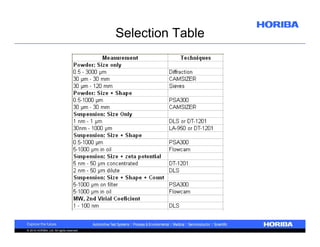
Selection Table

© 2010 HORIBA, Ltd. All rights reserved.
Why Only One Method?
Good idea to have several techniques
If > 1 µm use microscope for reference
Sieves useful to confirm presence of
large particles or to remove particles too
large for another technique
Beware: Use a different technique = get
a different answer
It is important to understand how
analysis methods differ in order to know
how to compare data
© 2010 HORIBA, Ltd. All rights reserved.
Thank-you
Visit the website: www.horiba.com/us/particle
Product information
Many application notes
Previous webinars

© 2010 HORIBA, Ltd. All rights reserved.

Selecting the Best Particle Size Analyzer for your Application

  • 1.
    Finding the BestParticle Characterization Analyzer for your Application Mark Bumiller mark.bumiller@horiba.com © 2010 HORIBA, Ltd. All rights reserved.
  • 2.
    First Questions Why isthe measurement being made? How will the data be used? Need to match historic data? Is particle size only enough information?  Shape, zeta potential, mW Who will use the instrument? R&D, QC, students, “the third shift”? How many samples per day/week/month? © 2010 HORIBA, Ltd. All rights reserved.
  • 3.
    Is it aParticle Size Problem*? *From Pohl, M., Choosing the right Particle size analyzer, Powder and Bulk Engineering, Feb 2008 Technical Problem Is it a material characterization issue? Yes No Is it a particle characterization issue? Try other Analytical Techniques No Use Appropriate Characterization Technique © 2010 HORIBA, Ltd. All rights reserved. Yes
  • 4.
    Is it aParticle Size Problem*?  Customers complain this batch doesn’t perform like previous product  Investigate specific behavior & look for possible causes  Chemical or physical difference?  I have a powder flow problem  Both particle size & shape influence flow  But so do other parameters (water content)  This product isn’t stable  Could be size and/or zeta potential  Cause could come from surface chemistry © 2010 HORIBA, Ltd. All rights reserved.
  • 5.
    Choosing the Technique FromPohl, M., Choosing the right Particle size analyzer, Powder and Bulk Engineering, Feb 2008 Is it a particle characterization issue? Yes Which technique is most appropriate? Particle Size What are possible approaches? Surface Area Zeta Potential Porosimetry Other Techniques Particle size distribution is most common problem/interest © 2010 HORIBA, Ltd. All rights reserved. Particle Counting? Contamination? Filtered? Need conc.?
  • 6.
    Particle Counting Need toknow particles/volume Implies measuring contamination, typically in a filtered fluid Particle size analyzers measure your product, not contamination Air: use airborne particle counter Liquid: use liquid particle counter or trap particles on filter and inspect filter – Coulter counter, light obscuration, some dynamic image analyzers © 2010 HORIBA, Ltd. All rights reserved.
  • 7.
    Electrical Sensing Zone CoulterPrinciple  Based on change in conductivity of aperture as particle traverses.  Requires conducting liquid.  Directly measures particle volume and counts.  High resolution  Used for blood cell counting now more than industrial applications © 2010 HORIBA, Ltd. All rights reserved.
  • 8.
    Light Obscuration  LightObscuration: Liquid Flow Sensing Zone Light Source Detector Light is blocked by single particles as they traverse the light beam  Need to know concentration  Filtered liquids  Particles/ml @ size © 2010 HORIBA, Ltd. All rights reserved.  Particles in water, oil  USP<788> testing  High resolution histogram
  • 9.
    USP<788> Filter Testing LoadSample(s) PSA300 Image Analyzer © 2010 HORIBA, Ltd. All rights reserved. Scan Filter Count/Size all Particles
  • 10.
    USP<788> Filter Testing Mosaicfunction stitches all scans Complete fiber is analyzed Generate Report © 2010 HORIBA, Ltd. All rights reserved.
  • 11.
    Particles or Waterin Oil Flow chambers 50um – 1mm 2mm-6 mm © 2010 HORIBA, Ltd. All rights reserved.
  • 12.
    Droplets vs. Particles Droplets Particles Distinguishingbetween two would be easy if they looked like this © 2010 HORIBA, Ltd. All rights reserved.
  • 13.
    Droplets vs. Particles Agglomerateddroplets © 2010 HORIBA, Ltd. All rights reserved. Sand
  • 14.
     User selectsexamples of droplets, iron sulfide, sand particles  Software looks at many size/shape values  Chooses how to discriminate  Bins each particle by type, counts  Can calculate ppm © 2010 HORIBA, Ltd. All rights reserved. ppm Pattern Matching Algorithm time
  • 15.
    Surface Area If surfacearea influences product performance SA-9600: 0.1-2000 m2/g BET Multi or single point Quick, easy to use © 2010 HORIBA, Ltd. All rights reserved.
  • 16.
    Particle Sizing PossibleTechniques What are possible techniques? Direct Observation Ensemble Averaging Individual Particle Counting Indirect Observation Possible Techniques Possible Techniques Possible Techniques Possible Techniques Sedimentation Electrical Conductivity Fisher Sub-sieve Size Static Image Analysis Static Light Scattering Single Particle Optical Spectroscopy Hegman Grind Gauge Dynamic Image Analysis Dynamic Light Scattering Light Scattering Non-Orifice Blaine Permeameter Optical Microscope STEM AFM Acoustic Spectroscopy © 2010 HORIBA, Ltd. All rights reserved. Many Others
  • 17.
    Possible Criteria Effectingthe Selection       Type of data desired Sample particle size range Sample concentration Sample behavior Sample type Industry acceptability © 2010 HORIBA, Ltd. All rights reserved.
  • 18.
    Type of DataDesired  Particle size (average)  Particle Size distribution (D10, D50, D90)  Particle zeta potential  Particle shape  Surface area © 2010 HORIBA, Ltd. All rights reserved.
  • 19.
    Sample Type      Dry powder,suspension, emulsion, aerosol Size range, upper & lower limit Sample chemistry Particle shape Previous analysis technique © 2010 HORIBA, Ltd. All rights reserved.
  • 20.
    Sample Behavior  Isthe typical sample stable?  Is the sample stable at elevated or reduced temperatures?  Can the sample be diluted without changing the particle size?  Is the sample stable following dilution?  Does the sample adhere to glass, plastic, metal, etc.? © 2010 HORIBA, Ltd. All rights reserved.
  • 21.
    Industry Acceptability  Isthere an ASTM or ISO Standard already in place?  Is there a trade association standard?  Is there a supplier or end-user specification?  Does it meet company standards?  Is the technique consistent with a QA procedure development © 2010 HORIBA, Ltd. All rights reserved.
  • 22.
    Size Range byTechnique •ELECTROFORMED MESH •SIEVES •CENTRIFUGAL SEDIMENTATION •PERMEABILITY •MICROSCOPY •ELECTRICAL CONDUCTIVITY •LIGHT OBSCURATION •DYNAMIC LIGHT SCATTERING •STATIC LIGHT SCATTERING 0.01µ 0.1µ © 2010 HORIBA, Ltd. All rights reserved. 1µ 10µ 100µ 1000µ
  • 23.
    Size Range byHORIBA Technique © 2010 HORIBA, Ltd. All rights reserved.
  • 24.
    From PQRI Group* *PQRIRecommendations on Particle-Size Analysis of Drug Substances Used in Oral Dosage Forms JOURNAL OF PHARMACEUTICAL SCIENCES, VOL. 96, NO. 6, JUNE 2007 © 2010 HORIBA, Ltd. All rights reserved.
  • 25.
    Sieves  Weight %sample caught on known screen sizes  Solid particles 20 m – 125 mm  Low equipment cost  Direct measurement method  Some automation/calculation available More information available through www.retsch.com © 2010 HORIBA, Ltd. All rights reserved.
  • 26.
    Sedimentation Stokes Law D= Sedimentation ofsame density material in a viscous medium 18 µ Vp (A - B) G Vp G A B D µ = = = = = = Settling velocity of discrete particle Gravity constant Density of Particle Density of Carrier Fluid Diameter of discrete particle Viscosity of Carrier Fluid Time Disc centrifuge © 2010 HORIBA, Ltd. All rights reserved.
  • 27.
    Manual Microscopy  Inspectparticles in a given field of view  Repeat process for a number of fields  Use graticule to obtain size  Get size, shape sometimes count information  Referee technique: direct Advantages: Simple Inexpensive Can see shape © 2010 HORIBA, Ltd. All rights reserved. Disadvantages: Slow Measures very few particles Very tedious
  • 28.
    Need Shape Information? TwoImage Analysis Approaches: Dynamic: particles flow past camera © 2010 HORIBA, Ltd. All rights reserved. Static: particles fixed on slide, stage moves slide
  • 29.
    Basic Operations Objective & camera ImageAcquisition and enhancement Subjective or automatic Thresholding Decisions or black box Image Processing Measurements © 2010 HORIBA, Ltd. All rights reserved. Focus, take picture Separate particles from background Edge definition, fill particles, Separate touching particles Create size & shape distributions
  • 30.
    Static Image Analysis:PSA300 Sample preparation device necessary* to disperse powders onto slide(s). Load powder into nozzle, pull vacuum, release. *unless large free flowing powder © 2010 HORIBA, Ltd. All rights reserved. Load slide onto automated stage Move slide, stop, take image, repeat Higher magnification = smaller particles
  • 31.
    Static Image AnalysisApplications Powders, suspensions 0.5 – 1000 µm Size and shape information Also count when analyzing filters API’s Excipients Lotions Aerosols Widely used in pharmaceutical R&D But also wherever shape info. required Abrasives © 2010 HORIBA, Ltd. All rights reserved. Filters
  • 32.
    Dynamic Image Analysis:CAMSIZER Size and shape from 30 µm – 30 mm Particles fall from vibrating tray through inspection zone. Two cameras take images of particles © 2010 HORIBA, Ltd. All rights reserved. Analyze images Size and shape distributions
  • 33.
    Replace Sieve Analysis Similarsize range, Xcmin matches sieve results, quick + shape © 2010 HORIBA, Ltd. All rights reserved.
  • 34.
    Dynamic Image AnalysisApplications Powders 30 µm – 30 mm Glass beads Sugar spheres Fertilizers Catalysts Coating thickness q3 [%/mm] Q3 [%] CoMo2-0,1%Absch_xc_min_001.rdf 90 180 80 160 70 140 60 120 50 100 40 80 30 60 20 40 10 20 0 0 1.4 1.6 1.8 2.0 2.2 2.4 x1 © 2010 HORIBA, Ltd. All rights reserved. 2.6 2.8 x2 x [mm]
  • 35.
    Need Widest DynamicRange? Laser Diffraction •Particle size 0.01 – 3000 µm •Converts scattered light to particle size distribution •Quick, repeatable •Most common technique •Suspensions & powders © 2010 HORIBA, Ltd. All rights reserved.
  • 36.
    Need Widest DynamicRange? Suspension Powders 30 nm silica Coffee Results 14 100 90 12 80 10 70 60 q(%) 8 50 6 40 30 4 20 2 10 0 10.00 100.0 1000 Diameter(µm) © 2010 HORIBA, Ltd. All rights reserved. 0 3000
  • 37.
    Sample Volume 10 ml 2mL 35ml 200 ml •Wide range of sample cells depending on application •High sensitivity keeps sample requirements at minimum •Automatic solvent fill © 2010 HORIBA, Ltd. All rights reserved.
  • 38.
    Small Sample Volume(MiniFlow) Colloidal Silica (weak scatterer) Median (D50): 35 nm Sample Amount: 132 mg Magnesium Stearate Median (D50): 9.33 μm Sample Amount: 0.165 mg Bio-degradable Polymer Median (D50): 114 μm Sample Amount: 1.29 mg © 2010 HORIBA, Ltd. All rights reserved.
  • 39.
    Paste Cell Unique toHORIBA © 2010 HORIBA, Ltd. All rights reserved.
  • 40.
    Dry Powders Measure asdry powder using dry powder feeder Measure in natural state Quick, easy, no clean up Increase air pressure to aid dispersion Minimum size ~ 0.25 µm Disperse powder in liquid Liquids reduce surface tension, add surfactant, use ultrasound to aid dispersion Lower detection limit (<30 nm) © 2010 HORIBA, Ltd. All rights reserved.
  • 41.
    Powder: Wet vs.Dry? POWDER DISPERSION PROCEDURES Obtain Representative SAMPLE Reactivity Check Reactive in Water and Organic Liquids Not Reactive in Water Reactive in Water, Not Reactive in Organic Solvents Soluble? DRY ANALYSIS Water Solubility? Organic Liquid Check Not Reactive, Insoluble Insoluble Select Distilled/D.I. Water Select Organic Liquid Reactive or Soluble DRY ANALYSIS No Wettable? Select Surfactant Yes Not Dispersed Dispersed Dispersion Check Dispersed Ultrasonic Energy Treatment Dispersion Check Not Dispersed Select Different Surfactant © 2010 HORIBA, Ltd. All rights reserved. WET SLURRY ANALYSIS
  • 42.
    Dry Powder FeederReproducibility Direct flow of powder down to cell Auto feedback controls feed rate Constant mass flow = robust results © 2010 HORIBA, Ltd. All rights reserved. Automatic ISO13320 calculations
  • 43.
    HORIBA Diffraction Systems LA-950:0.01-3000 µm wet or dry Modular, range of samplers, advanced software including Method Expert LA-300: 0.1 – 600 µm wet only Smaller, more portable, less expensive © 2010 HORIBA, Ltd. All rights reserved.
  • 44.
    Measuring at ProcessConcentration Light scattering typically requires dilution Does PSD change with dilution? Concern when studying dispersion Some samples are better analyzed without any alteration  Implies no sample preparation  Dispersion stability studies often include zeta potential and other parameters      Size, zeta potential, pH, conductivity, temp, surfactant concentration, titration studies © 2010 HORIBA, Ltd. All rights reserved.
  • 45.
    Acoustic Spectroscopy Pulsed electricfield applied to sample Sound interacts with sample Attenuation converted to size Advantages:  Can accommodate high sample concentrations  Also zeta potential, pH, conductivity, conc. © 2010 HORIBA, Ltd. All rights reserved. Applications:  Emulsions & suspensions  Dispersion stability with zeta potential
  • 46.
    Dispersion Stability  Wantstable dispersion  Either suspensions or emulsions  Suspensions sediment & flocculate  Emulsions phase separate, creaming or coalescence good bad good bad © 2010 HORIBA, Ltd. All rights reserved.
  • 47.
    Zeta Potential  Ifsurface has + charge, then - ions attracted to surface  + ions attracted to – ions, builds electric double layer  Slipping plane: distance from particle surface where ions move with particle  ZP = potential (mV) at slipping plane © 2010 HORIBA, Ltd. All rights reserved.
  • 48.
    Electroacoustics – ZetaPotential Piezo crystal Electrodes A Zeta Potential Probe ColloidVibrationCurrent  p  m  d P CVI  C m DynamicMobility ..  m  o (  p   s )  m K s d   ( p   m ) s K m © 2010 HORIBA, Ltd. All rights reserved.
  • 49.
  • 50.
    pH Titration ofRutile 7%vl & Alumina 4%vl 85 nm 300 nm PSD unstable @ IEP aggregates form © 2010 HORIBA, Ltd. All rights reserved.
  • 51.
    DT-1201 System  Particlesize analysis 5 nm – 1000 m  High concentration ~2- 40 wt%  Dispersion stability studies  Used in formulation to study effect of surface chemistry on product stability and performance  Fantastic research tool or just best option for particle size without dilution © 2010 HORIBA, Ltd. All rights reserved.
  • 52.
    Dynamic Light Scattering(DLS or PCS) Most common technique for sub-micron sizing Range: 1 nm – 1 m* Frequency Shifted Signal Frequency-Intensity Distribution Stokes-Einstein R H  * Density dependent, when does settling become prominent motion? © 2010 HORIBA, Ltd. All rights reserved. kT 6  D
  • 53.
    Zeta potential Measurement Mobility U + - d 2 E・ n・ sin  2  ・ U Zeta potential ν0 © 2010 HORIBA, Ltd. All rights reserved. ν0+νd 3U・  ζ   2・ f (ka)
  • 54.
    DLS Applications  Particlesize of suspension 1 nm – 1 m  Both ends extended depending on sample  Zeta potential of dilute suspensions  Only suspensions, small particles  Molecular weight, second virial coefficient Proteins © 2010 HORIBA, Ltd. All rights reserved. Nanoparticles Biomolecules
  • 55.
    Conclusions One general purposeparticle size analyzer: laser diffraction Flexible, quick, easy Want additional shape information: image analysis Static: 0.5-1000 µm Dynamic: 30 µm – 30 mm – Replace sieve analysis All particles < 1 µm: DLS, acoustics © 2010 HORIBA, Ltd. All rights reserved.
  • 56.
    Conclusions Measure without dilution:acoustic spectroscopy: 3 nm – 1000 µm Size, zeta potential, conductivity, microrheology Talk to our applications experts Have samples run on system of interest It’s rare for one application to be equally suited to more than one instrument © 2010 HORIBA, Ltd. All rights reserved.
  • 57.
    Selection Table © 2010HORIBA, Ltd. All rights reserved.
  • 58.
    Why Only OneMethod? Good idea to have several techniques If > 1 µm use microscope for reference Sieves useful to confirm presence of large particles or to remove particles too large for another technique Beware: Use a different technique = get a different answer It is important to understand how analysis methods differ in order to know how to compare data © 2010 HORIBA, Ltd. All rights reserved.
  • 59.
    Thank-you Visit the website:www.horiba.com/us/particle Product information Many application notes Previous webinars © 2010 HORIBA, Ltd. All rights reserved.