Particle Size Distribution Function
By- Rohit Dixit
Objectives
Significance of Particle Size Distribution
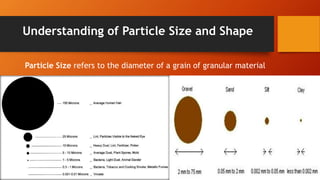
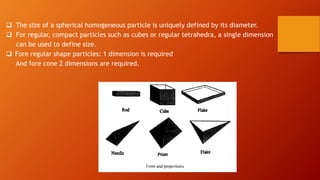
Understanding of Particle Size and Particle Shape
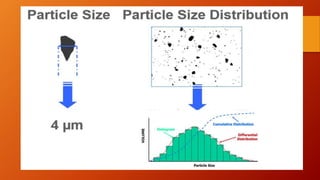
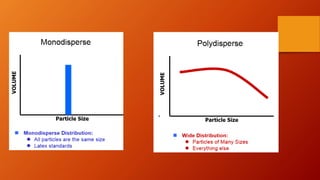
 Particle Size Distribution (PSD)
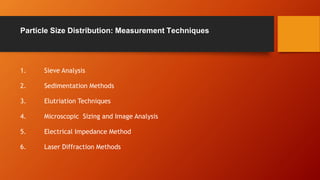
 Particle Size Distribution: Measurement Techniques
Analytical distribution function
Who cares about particle size?
• Pharmaceutical
• Chemical
• Ceramics
• Cement
• Food
• Abrasives
• Cosmetics
• Mining
• Powder metals
• University
• Others
Size terminology
• The most common designation is micrometer or micron.
• For very small size nanometer is used.
Which is the most meaningful size?
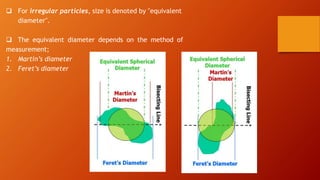
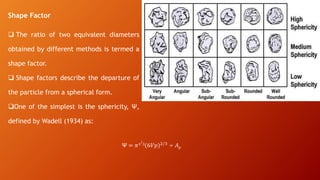
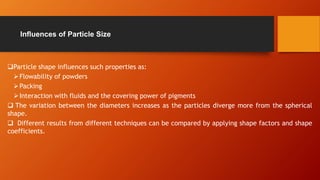
Different size definition Different result
The Basic
• What size can be measured?
Which size to measure?
• Vol. based particle size equals the diameter of the sphere that has a same vol as the
given particle.
D=2*(3
3𝑉/4π)
Weight based particle size equals the diameter of the sphere that has a same weight
as the given particle.
D=2*(3
3𝑊/4π𝑑 𝑔)
Area based particle size equals the diameter of the sphere that has a same weight as
the given particle.
D=2(2
𝐴/4𝜋)
Particle Size Distribution
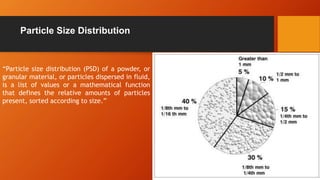
“Particle size distribution (PSD) of a powder, or
granular material, or particles dispersed in fluid,
is a list of values or a mathematical function
that defines the relative amounts of particles
present, sorted according to size.”
Symmetric and Asymmetric distribution
Distribution is along side of the center value Distribution is not same along side of the center value
Mean: Sum of values of a data set divided by number of values
Mode: most frequent set in data set
Median: Middle value separating the greater and lesser halves of a data set
Analytical distribution function
Some analytical distribution funtions are:
• Normal distribution
• Log-normal distribution
• Weibull distribution
Normal distribution
• Probability distribution function:
Where
µ is mean
σ is standard deviation
σ2 is variance
Log- normal distribution function:
Probability distribution function:
Where
µ is mean
σ is standard deviation
σ2 is variance
Weibull distribution
Probability distribution function:
Where
µ is mean
σ is standard deviation
σ2 is variance
Class example
Mean size: 135.9992 nm
Standard deviation :
37.38654
Normal distribution fitting
R^2 : .604
Thanks

Particle size distribution

  • 1.
    Particle Size DistributionFunction By- Rohit Dixit
  • 2.
    Objectives Significance of ParticleSize Distribution Understanding of Particle Size and Particle Shape  Particle Size Distribution (PSD)  Particle Size Distribution: Measurement Techniques Analytical distribution function
  • 3.
    Who cares aboutparticle size? • Pharmaceutical • Chemical • Ceramics • Cement • Food • Abrasives • Cosmetics • Mining • Powder metals • University • Others
  • 4.
    Size terminology • Themost common designation is micrometer or micron. • For very small size nanometer is used.
  • 6.
    Which is themost meaningful size? Different size definition Different result
  • 7.
    The Basic • Whatsize can be measured?
  • 8.
    Which size tomeasure? • Vol. based particle size equals the diameter of the sphere that has a same vol as the given particle. D=2*(3 3𝑉/4π) Weight based particle size equals the diameter of the sphere that has a same weight as the given particle. D=2*(3 3𝑊/4π𝑑 𝑔) Area based particle size equals the diameter of the sphere that has a same weight as the given particle. D=2(2 𝐴/4𝜋)
  • 9.
    Particle Size Distribution “Particlesize distribution (PSD) of a powder, or granular material, or particles dispersed in fluid, is a list of values or a mathematical function that defines the relative amounts of particles present, sorted according to size.”
  • 12.
    Symmetric and Asymmetricdistribution Distribution is along side of the center value Distribution is not same along side of the center value Mean: Sum of values of a data set divided by number of values Mode: most frequent set in data set Median: Middle value separating the greater and lesser halves of a data set
  • 13.
    Analytical distribution function Someanalytical distribution funtions are: • Normal distribution • Log-normal distribution • Weibull distribution
  • 14.
    Normal distribution • Probabilitydistribution function: Where µ is mean σ is standard deviation σ2 is variance
  • 15.
    Log- normal distributionfunction: Probability distribution function: Where µ is mean σ is standard deviation σ2 is variance
  • 16.
    Weibull distribution Probability distributionfunction: Where µ is mean σ is standard deviation σ2 is variance
  • 17.
    Class example Mean size:135.9992 nm Standard deviation : 37.38654
  • 18.
  • 19.