Identifying and selecting aims
How do we define aims?
Aims are what we want learners to learn
or to be able to do at the end of the
lesson, a sequence of lessons or a
whole course. (Pulverness, 2005 p.86)
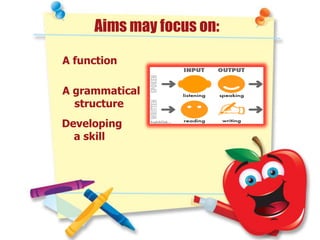
Aims may focus on:
A function
A grammatical
structure
Developing
a skill
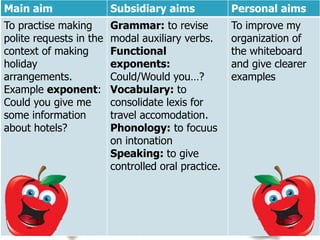
Main aim Subsidiary aims Personal aims
To practise making
polite requests in the
context of making
holiday
arrangements.
Example exponent:
Could you give me
some information
about hotels?
Grammar: to revise
modal auxiliary verbs.
Functional
exponents:
Could/Would you…?
Vocabulary: to
consolidate lexis for
travel accomodation.
Phonology: to focuus
on intonation
Speaking: to give
controlled oral practice.
To improve my
organization of
the whiteboard
and give clearer
examples
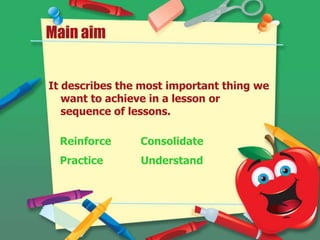
It describes the most important thing we
want to achieve in a lesson or
sequence of lessons.
Main aim
Reinforce Consolidate
UnderstandPractice
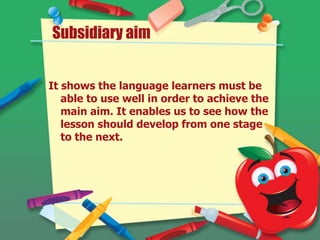
It shows the language learners must be
able to use well in order to achieve the
main aim. It enables us to see how the
lesson should develop from one stage
to the next.
Subsidiary aim
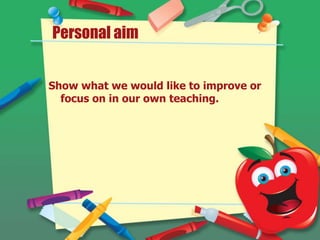
Show what we would like to improve or
focus on in our own teaching.
Personal aim
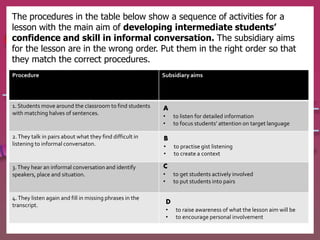
The procedures in the table below show a sequence of activities for a
lesson with the main aim of developing intermediate students’
confidence and skill in informal conversation. The subsidiary aims
for the lesson are in the wrong order. Put them in the right order so that
they match the correct procedures.
Procedure Subsidiary aims
1. Students move around the classroom to find students
with matching halves of sentences.
2.They talk in pairs about what they find difficult in
listening to informal conversaton.
3.They hear an informal conversation and identify
speakers, place and situation.
4.They listen again and fill in missing phrases in the
transcript.
A
• to listen for detailed information
• to focus students’ attention on target language
B
• to practise gist listening
• to create a context
C
• to get students actively involved
• to put students into pairs
D
• to raise awareness of what the lesson aim will be
• to encourage personal involvement
Planning a lesson
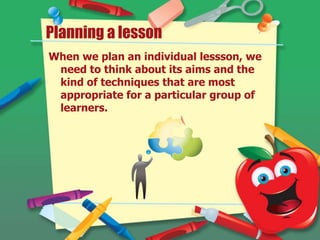
When we plan an individual lessson, we
need to think about its aims and the
kind of techniques that are most
appropriate for a particular group of
learners.
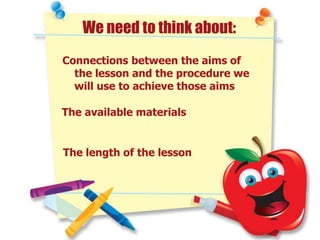
We need to think about:
Connections between the aims of
the lesson and the procedure we
will use to achieve those aims
The available materials
The length of the lesson
Will the topic be interesting and
motivating for my learners?
Are the activities and teaching materials
at the right leve for all the learners?
Have I planned too much for the time
available?
Have I thought about exactly how to
start and end the lesson?
Selecting aims & classroom management

Selecting aims & classroom management

  • 1.
  • 2.
    How do wedefine aims? Aims are what we want learners to learn or to be able to do at the end of the lesson, a sequence of lessons or a whole course. (Pulverness, 2005 p.86)
  • 3.
    Aims may focuson: A function A grammatical structure Developing a skill
  • 5.
    Main aim Subsidiaryaims Personal aims To practise making polite requests in the context of making holiday arrangements. Example exponent: Could you give me some information about hotels? Grammar: to revise modal auxiliary verbs. Functional exponents: Could/Would you…? Vocabulary: to consolidate lexis for travel accomodation. Phonology: to focuus on intonation Speaking: to give controlled oral practice. To improve my organization of the whiteboard and give clearer examples
  • 6.
    It describes themost important thing we want to achieve in a lesson or sequence of lessons. Main aim Reinforce Consolidate UnderstandPractice
  • 7.
    It shows thelanguage learners must be able to use well in order to achieve the main aim. It enables us to see how the lesson should develop from one stage to the next. Subsidiary aim
  • 8.
    Show what wewould like to improve or focus on in our own teaching. Personal aim
  • 10.
    The procedures inthe table below show a sequence of activities for a lesson with the main aim of developing intermediate students’ confidence and skill in informal conversation. The subsidiary aims for the lesson are in the wrong order. Put them in the right order so that they match the correct procedures. Procedure Subsidiary aims 1. Students move around the classroom to find students with matching halves of sentences. 2.They talk in pairs about what they find difficult in listening to informal conversaton. 3.They hear an informal conversation and identify speakers, place and situation. 4.They listen again and fill in missing phrases in the transcript. A • to listen for detailed information • to focus students’ attention on target language B • to practise gist listening • to create a context C • to get students actively involved • to put students into pairs D • to raise awareness of what the lesson aim will be • to encourage personal involvement
  • 12.
    Planning a lesson Whenwe plan an individual lessson, we need to think about its aims and the kind of techniques that are most appropriate for a particular group of learners.
  • 13.
    We need tothink about: Connections between the aims of the lesson and the procedure we will use to achieve those aims The available materials The length of the lesson
  • 15.
    Will the topicbe interesting and motivating for my learners? Are the activities and teaching materials at the right leve for all the learners? Have I planned too much for the time available? Have I thought about exactly how to start and end the lesson?