British Council Resources III 
The following resources are designed by members of the British Council 
and are meant to be implemented thorughout LINGUAVENTURAS, ESL 
Project from SED
AIMS 
• By the end of this session you will 
• …have had a hands on experience on lesson planning 
according to one of the techniques or methodologies you 
just heard a presentation about.
GUIDELINES TO COMPLETE THE LESSON PLAN 
TEMPLATE 
• Decide on a target population and topic. 
Complete the header accordingly. 
• Include the class aim (s) in the lines. 
• Include the period of time you expect students to 
spend in each activity in the first column (time).
GUIDELINES TO COMPLETE THE LESSON PLAN 
TEMPLATE 
• The name of each stage must be according to the 
technique or methodology you were assigned. 
• The column aim is meant to be completed with the 
specific aim of each stage, one that will be related 
and point at the general aim (s) of the class. 
• The procedure refers to the step to step that will be 
followed to develop each of the activities.
GUIDELINES TO COMPLETE THE LESSON PLAN 
TEMPLATE 
• The interaction column corresponds to the type of 
interaction (T-SS, S-S, etc.) and the size of the groups 
if any. 
• In the comments column you may include things to 
keep in mind or things you notice you could improve 
as you execute the lesson plan.
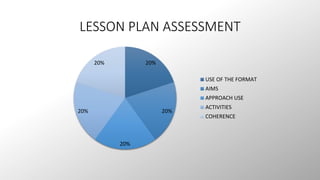
LESSON PLAN ASSESSMENT 
20% 
20% 
20% 
20% 
20% 
USE OF THE FORMAT 
AIMS 
APPROACH USE 
ACTIVITIES 
COHERENCE
AIMS 
• By the end of this session you will… 
• … have recognized what planning and carrying out 
communicative activities and games involves.
GUIDELINES TO PLAN YOUR COMMUNICATIVE ACTIVITIES 
 Define the type of population you will address this 
activity to. 
 Plan the way you will display instructions. 
 Remember you must include lots of student-student 
interaction during the development of the activity. 
 Keep in mind the recommendations given in the 
“Ingredients” and “Creative games for the language 
class” texts. 
 Demonstrations must last 7 minutes only.
SESSION AIM 
• By the end of the session you will have practised 
identifying types of errors students could make during 
spoken interaction, and suitable responses to them.
WHAT IS INVOLVED IN EFFECTIVE 
COMMUNICATION? 
1. Phonological features of speech. 
2. Following rules of language. 
3. Communicative functions of the language. 
4. Social meaning. 
5. Paralinguistic devices.
ERROR CORRECTION TECHNIQUES 
Peer correction: Correction is done by other members of the class. 
Gestures and mime: A gesture (for example a wobbling hand), may be enough to indicate that something does not 
quite work. 
Facial expression: The teacher’s facial expression shows that something is wrong. 
Non-verbal sounds: a simple Humm… or any other noises to point the error. 
Simple phrases: We simply say That’s not quite right, Almost, Nearly. 
Finger correction: Fingers are used to represent words or syllables to help students’ keep track of their error. 
Echoing: We repeat what the student has said emphasising the part of the utterance that was wrong. Ex: *Flight 
309 GO to Paris? (said with a questioning intonation). 
Reformulation: the teacher to repeat what the student has said correctly, reformulating the sentence, but without 
making a big issue of it. 
Post activity correction: Correction is given after the activity. 
Hinting: a quick way of helping students to activate rules they already know (but which they have temporarily 
‘disobeyed’) is to give a quiet hint. We might just say the word ‘tense’ to make them think that perhaps they should 
have used the past simple rather than the present perfect.
SESSION AIM 
• 
• By the end of this session you will be clear about the 
guidelines you will follow to plan your micro teaching 
assignment.
STEPS TO PLAN YOUR MICRO TEACHING 
Before you Begin 
1. Determine your target population (age, gender, 
background knowledge they may have, etc.) 
2. Identify the topic and skills you will include. 
3. Determine which approach (out of the ones studied 
during the first day) you will use. 
4. Define the session aim(s).
STEPS TO PLAN YOUR MICRO TEACHING 
As you Write your Lesson Plan 
• 4. Plan activities: 
• State an aim for each activity. 
• Determine timing for each stage in your class or 
activity. 
• Make a list of materials you will need. 
• Consider what you will say and how you will 
convey instructions. 
• 5. Reread your session plan and check for coherence 
and cohesion!
STEPS TO PLAN YOUR MICRO TEACHING 
ELEMENTS YOUR MICROTEACHING 
SHOULD INCLUDE 
• A WARM UP to allow your students switch from a Spanish 
speaking environment to an English class. 
• AIMS to guide the activities and to let students know what 
they are expected to do and achieve by the end of the lesson. 
• One of THE APPROACHES studied last week during the second 
session.
AIM 
• By the end of this session you will… 
• 
• …be ready to plan listening activities considering your 
students´ skills and needs. 
• 
•
THE IMPORTANCE OF LISTENING ACTIVITIES 
• It is an ESSENTIAL SKILL to develop for 
effective COMMUNICATION. 
• It is a way for students to become FAMILIAR 
with AUTHENTIC LANGUAGE USE without 
being immersed in a context where the target 
language is spoken.
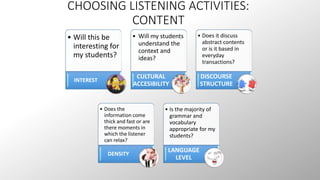
CHOOSING LISTENING ACTIVITIES: 
CONTENT 
• Will this be 
interesting for 
my students? 
INTEREST 
• Will my students 
understand the 
context and 
ideas? 
CULTURAL 
ACCESIBILITY 
• Does it discuss 
abstract contents 
or is it based in 
everyday 
transactions? 
DISCOURSE 
STRUCTURE 
• Does the 
information come 
thick and fast or are 
there moments in 
which the listener 
can relax? 
DENSITY 
• Is the majority of 
grammar and 
vocabulary 
appropriate for my 
students? 
LANGUAGE 
LEVEL
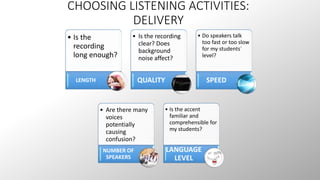
CHOOSING LISTENING ACTIVITIES: 
DELIVERY 
• Is the 
recording 
long enough? 
LENGTH 
• Is the recording 
clear? Does 
background 
noise affect? 
QUALITY 
• Do speakers talk 
too fast or too slow 
for my students´ 
level? 
SPEED 
• Are there many 
voices 
potentially 
causing 
confusion? 
NUMBER OF 
SPEAKERS 
• Is the accent 
familiar and 
comprehensible for 
my students? 
LANGUAGE 
LEVEL
LISTENING SUBSKILLS/PURPOSES 
• Ability to understand the general idea or gist of what is 
said. 
• Ability to understand specific information (words). 
• Ability to understand details (phrases and sentences). 
• Ability to understand speakers´ intention (Why 
something is said). 
• Ability to understand speakers´attitude (How the person 
feels). 
• Ability to understand and confirm predictions. 
• Ability to compare previously known information to what 
is said.
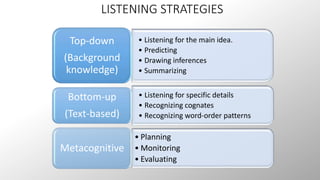
LISTENING STRATEGIES 
• Listening for the main idea. 
• Predicting 
• Drawing inferences 
• Summarizing 
Top-down 
(Background 
knowledge) 
• Listening for specific details 
• Recognizing cognates 
• Recognizing word-order patterns 
Bottom-up 
(Text-based) 
• Planning 
• Monitoring 
• Evaluating 
Metacognitive
SESSION AIM 
•By the end of this session you will… 
• …have gotten familiar with different ways 
to set your students for different types of 
interaction and activities.
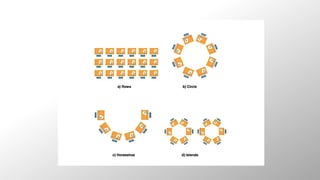
SEATING ARRANGEMENT
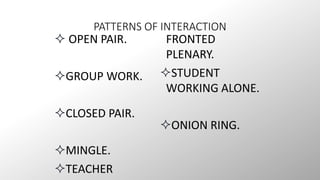
PATTERNS OF INTERACTION 
 OPEN PAIR. 
GROUP WORK. 
CLOSED PAIR. 
MINGLE. 
TEACHER 
FRONTED 
PLENARY. 
STUDENT 
WORKING ALONE. 
ONION RING.
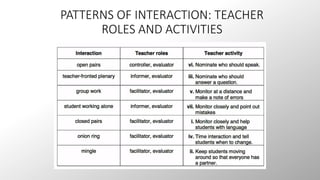
PATTERNS OF INTERACTION: TEACHER 
ROLES AND ACTIVITIES

British council resources iii

  • 1.
    British Council ResourcesIII The following resources are designed by members of the British Council and are meant to be implemented thorughout LINGUAVENTURAS, ESL Project from SED
  • 2.
    AIMS • Bythe end of this session you will • …have had a hands on experience on lesson planning according to one of the techniques or methodologies you just heard a presentation about.
  • 3.
    GUIDELINES TO COMPLETETHE LESSON PLAN TEMPLATE • Decide on a target population and topic. Complete the header accordingly. • Include the class aim (s) in the lines. • Include the period of time you expect students to spend in each activity in the first column (time).
  • 4.
    GUIDELINES TO COMPLETETHE LESSON PLAN TEMPLATE • The name of each stage must be according to the technique or methodology you were assigned. • The column aim is meant to be completed with the specific aim of each stage, one that will be related and point at the general aim (s) of the class. • The procedure refers to the step to step that will be followed to develop each of the activities.
  • 5.
    GUIDELINES TO COMPLETETHE LESSON PLAN TEMPLATE • The interaction column corresponds to the type of interaction (T-SS, S-S, etc.) and the size of the groups if any. • In the comments column you may include things to keep in mind or things you notice you could improve as you execute the lesson plan.
  • 6.
    LESSON PLAN ASSESSMENT 20% 20% 20% 20% 20% USE OF THE FORMAT AIMS APPROACH USE ACTIVITIES COHERENCE
  • 7.
    AIMS • Bythe end of this session you will… • … have recognized what planning and carrying out communicative activities and games involves.
  • 8.
    GUIDELINES TO PLANYOUR COMMUNICATIVE ACTIVITIES  Define the type of population you will address this activity to.  Plan the way you will display instructions.  Remember you must include lots of student-student interaction during the development of the activity.  Keep in mind the recommendations given in the “Ingredients” and “Creative games for the language class” texts.  Demonstrations must last 7 minutes only.
  • 9.
    SESSION AIM •By the end of the session you will have practised identifying types of errors students could make during spoken interaction, and suitable responses to them.
  • 10.
    WHAT IS INVOLVEDIN EFFECTIVE COMMUNICATION? 1. Phonological features of speech. 2. Following rules of language. 3. Communicative functions of the language. 4. Social meaning. 5. Paralinguistic devices.
  • 11.
    ERROR CORRECTION TECHNIQUES Peer correction: Correction is done by other members of the class. Gestures and mime: A gesture (for example a wobbling hand), may be enough to indicate that something does not quite work. Facial expression: The teacher’s facial expression shows that something is wrong. Non-verbal sounds: a simple Humm… or any other noises to point the error. Simple phrases: We simply say That’s not quite right, Almost, Nearly. Finger correction: Fingers are used to represent words or syllables to help students’ keep track of their error. Echoing: We repeat what the student has said emphasising the part of the utterance that was wrong. Ex: *Flight 309 GO to Paris? (said with a questioning intonation). Reformulation: the teacher to repeat what the student has said correctly, reformulating the sentence, but without making a big issue of it. Post activity correction: Correction is given after the activity. Hinting: a quick way of helping students to activate rules they already know (but which they have temporarily ‘disobeyed’) is to give a quiet hint. We might just say the word ‘tense’ to make them think that perhaps they should have used the past simple rather than the present perfect.
  • 12.
    SESSION AIM • • By the end of this session you will be clear about the guidelines you will follow to plan your micro teaching assignment.
  • 13.
    STEPS TO PLANYOUR MICRO TEACHING Before you Begin 1. Determine your target population (age, gender, background knowledge they may have, etc.) 2. Identify the topic and skills you will include. 3. Determine which approach (out of the ones studied during the first day) you will use. 4. Define the session aim(s).
  • 14.
    STEPS TO PLANYOUR MICRO TEACHING As you Write your Lesson Plan • 4. Plan activities: • State an aim for each activity. • Determine timing for each stage in your class or activity. • Make a list of materials you will need. • Consider what you will say and how you will convey instructions. • 5. Reread your session plan and check for coherence and cohesion!
  • 15.
    STEPS TO PLANYOUR MICRO TEACHING ELEMENTS YOUR MICROTEACHING SHOULD INCLUDE • A WARM UP to allow your students switch from a Spanish speaking environment to an English class. • AIMS to guide the activities and to let students know what they are expected to do and achieve by the end of the lesson. • One of THE APPROACHES studied last week during the second session.
  • 16.
    AIM • Bythe end of this session you will… • • …be ready to plan listening activities considering your students´ skills and needs. • •
  • 17.
    THE IMPORTANCE OFLISTENING ACTIVITIES • It is an ESSENTIAL SKILL to develop for effective COMMUNICATION. • It is a way for students to become FAMILIAR with AUTHENTIC LANGUAGE USE without being immersed in a context where the target language is spoken.
  • 18.
    CHOOSING LISTENING ACTIVITIES: CONTENT • Will this be interesting for my students? INTEREST • Will my students understand the context and ideas? CULTURAL ACCESIBILITY • Does it discuss abstract contents or is it based in everyday transactions? DISCOURSE STRUCTURE • Does the information come thick and fast or are there moments in which the listener can relax? DENSITY • Is the majority of grammar and vocabulary appropriate for my students? LANGUAGE LEVEL
  • 19.
    CHOOSING LISTENING ACTIVITIES: DELIVERY • Is the recording long enough? LENGTH • Is the recording clear? Does background noise affect? QUALITY • Do speakers talk too fast or too slow for my students´ level? SPEED • Are there many voices potentially causing confusion? NUMBER OF SPEAKERS • Is the accent familiar and comprehensible for my students? LANGUAGE LEVEL
  • 20.
    LISTENING SUBSKILLS/PURPOSES •Ability to understand the general idea or gist of what is said. • Ability to understand specific information (words). • Ability to understand details (phrases and sentences). • Ability to understand speakers´ intention (Why something is said). • Ability to understand speakers´attitude (How the person feels). • Ability to understand and confirm predictions. • Ability to compare previously known information to what is said.
  • 21.
    LISTENING STRATEGIES •Listening for the main idea. • Predicting • Drawing inferences • Summarizing Top-down (Background knowledge) • Listening for specific details • Recognizing cognates • Recognizing word-order patterns Bottom-up (Text-based) • Planning • Monitoring • Evaluating Metacognitive
  • 22.
    SESSION AIM •Bythe end of this session you will… • …have gotten familiar with different ways to set your students for different types of interaction and activities.
  • 23.
  • 24.
    PATTERNS OF INTERACTION  OPEN PAIR. GROUP WORK. CLOSED PAIR. MINGLE. TEACHER FRONTED PLENARY. STUDENT WORKING ALONE. ONION RING.
  • 25.
    PATTERNS OF INTERACTION:TEACHER ROLES AND ACTIVITIES

Editor's Notes

  • #4 This lesson plan must be intended for a 90 minute session.
  • #7 Feedback will last 20 minutes, 10 per pair. Encourage them not to limit this exercise to assigning a completion percentage, they should givecomments and suggestions about their peer´s work.
  • #11 Phonological features of speech Speakers need to be able to produce the phonological features of speech well enough to be understood, and understand them when they hear them. These features include: (Individual sounds: consonants, vowels, diphthongs such as in day and triphthongs such as in here, The stressed and weak sounds in words; for example, the second syllable of 'banana' is stressed and the first and third are weak, The stressed and weak words in speech; for example, in the order "Go to bed!" 'Go' and 'bed' are stressed and 'to' is not., The rhythm of speech in general, The intonation patterns in speech, falling, rising, flat, etcetera, The features of connected speech, for example, connected speech produces contractions such as doesn’t, linking sounds such as the /j/ in 'I am', lost sounds such as the /t/ in 'I don’t know', and changed sounds such as the /t/ in 'white bag' changing to a /p/.) Following the rules of language Speakers need to be able to understand and follow the rules of language at a word, sentence and text level. This includes: Choosing the right vocabulary: the meaning of a word, its connotations, the level of formality, the type of register and genre, and the words it normally goes with (collocations), Using grammar structures to put clauses and sentences together, Using features of discourse to give long and short turns cohesion and coherence. For example, speakers need to use referencing "This is the problem" and connectors "so...". Communicative functions Speakers need to be able to recognise, understand and use the communicative functions of speech. This includes: Understanding the communicative functions of vocabulary and grammar. For example, why this is a normal exchange: A: "Did you walk the dog today?" B: "I’ve been in bed all day with a cold."   Or what a speaker means when he says: "Do you know who I am?" Understanding the functions of intonation and moving stress. For example, intonation and stress can show attitude: "Oh, really?" Emphasis: "I said three bananas", and structure, e.g. a falling intonation at the end of a list of items. Recognising features such as repetitions, re-phrasing, pauses, and noises and understanding their function. Recognising non-linguistic features such as changes in volume and tone.
  • #18 . 1. It is necessary to UNDERSTAND what we hear in order to RESPOND and keep a CONVERSATION going. 2. Since students are learning English as a Foreign language, not as a second language because they are not living in a place where it is the official language.