Chapter 7: 
Constructed Response Tests 
Popham, W. J (2007). Classroom assessment: What teachers 
need to know. Pearson/Allyn and Bacon. 
Presentation by Jeanne Sinclair / UTSA 
October 22, 2014
Constructed 
Response 
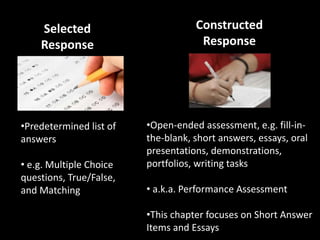
Selected 
Response 
•Predetermined list of 
answers 
• e.g. Multiple Choice 
questions, True/False, 
and Matching 
•Open-ended assessment, e.g. fill-in-the- 
blank, short answers, essays, oral 
presentations, demonstrations, 
portfolios, writing tasks 
• a.k.a. Performance Assessment 
•This chapter focuses on Short Answer 
Items and Essays
It is said that constructed 
response questions (like 
essays) are more difficult 
for students than 
selected response 
questions. 
Do you agree or 
disagree? Why?
Popham says… 
Partial knowledge is not enough to 
produce the correct answer in 
constructed response questions.
Part 1: Short-Answer Items
Short Answer Items 
• Student supplies a word, phrase, or sentence to 
answer a question or complete a statement. 
• These items usually show acquisition of 
knowledge. However, they can be constructed 
to demonstrate higher levels of thinking. 
Examples: 
Who was the first Prime Minister of Canada? 
Columbus landed in this country in the year __________. 
In 100 words or less, describe the water cycle.
Popham’s Guidelines for Short Answer Items 
• Use direct questions, not incomplete 
statements (especially for young students). 
• If you use incomplete statements, construct 
them so there is only one unique answer. 
• The item should require a very concise 
response. 
• Use no more than one or two blanks in each. 
• Make all blanks equal in length 
• Use blanks at the end, not in the middle.
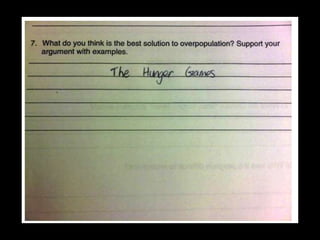
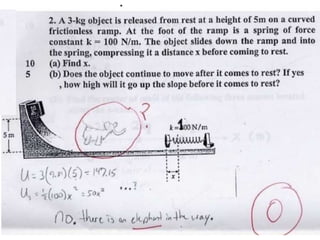
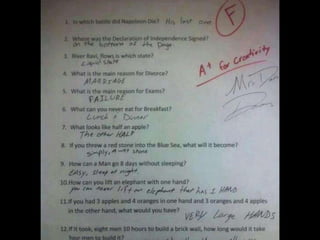
Let’s Grade the Test!
Let’s Grade the Test 
Short Answer Item – 
1. Ms. Joyce has dinner with three of her 
friends. The four friends decide to split the 
cost equally. The bill comes to $31.00, and 
the women plan to leave a small tip. How 
much should Ms. Joyce pay for her share of 
the dinner? ____________________
Let’s Grade the Test 
Short Answer Item – 
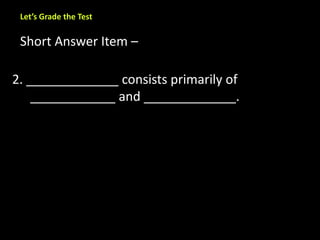
2. _____________ consists primarily of 
____________ and _____________.
Let’s Grade the Test 
Short Answer Item – 
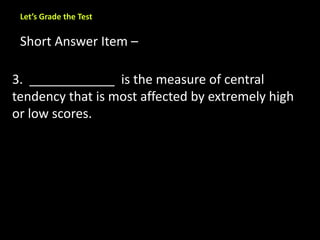
3. ____________ is the measure of central 
tendency that is most affected by extremely high 
or low scores.
Let’s Grade the Test 
Short Answer Item – 
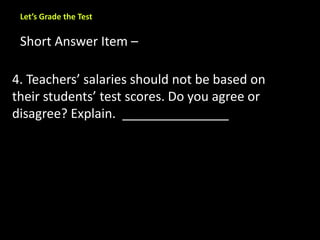
4. Teachers’ salaries should not be based on 
their students’ test scores. Do you agree or 
disagree? Explain. _______________
Part 2: Writing essay prompts
Essay Items… 
• Are longer than short answer 
• Are useful to gauge a student's ability to 
synthesize, evaluate, and compose. 
• Can be a “performance test” if it is a writing 
sample. 
• take time to create (prompts). 
• sometimes have unreliable scoring.
Popham’s Guidelines for Essay Items 
• Be clear about: 
• how long response should be (preferably in 
words) 
• explicit description of task: as detailed as 
possible 
• time to be spent on each item and its value 
so students know where their energy should 
be spent 
• no optional items 
• imagine a quality response to see if the 
essay prompt is reasonable
Let’s Grade the Test!
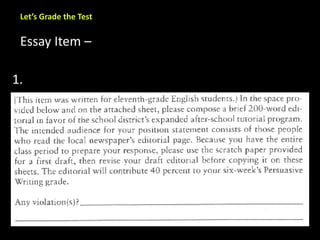
Let’s Grade the Test 
Essay Item – 
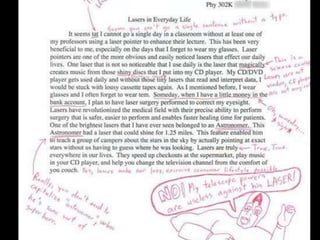
1.
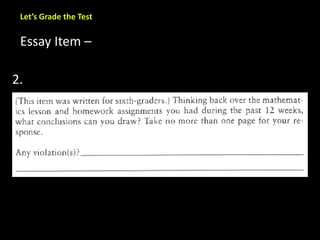
Let’s Grade the Test 
Essay Item – 
2.
Let’s Grade the Test 
Essay Item – 
3. Using details and information from the article 
(America’s Saltiest Sea: Great Salt Lake), 
summarize the main points of the article.
Let’s Grade the Test 
Essay Item 
4. Scientists have found that oceans can 
influence the temperature of nearby 
landmasses. Coastal landmasses tend to have 
more moderate temperatures in summer and 
winter than inland landmasses at the same 
latitude. List three coastal landmasses.
Let’s Grade the Test 
Essay item– 
5. Sample Question (10th Grade Social Studies) 
Consider the time period during the Vietnam War and the 
reasons there were riots in cities and at university campuses. 
Write an essay explaining three of those reasons. Include 
information on the impact (if any) of the riots. The essay 
should be approximately one page in length. Your score will 
depend on the accuracy of your reasons, the organization of 
your essay, and brevity. Although spelling, punctuation, and 
grammar will not be considered in grading, please do your 
best to consider them in your writing. (10 points possible)
Part 3: Essay scoring
Popham’s Guidelines for Scoring Essays 
• Holistic scoring vs. analytical scoring 
• Holistic can include evaluative criteria, but 
does not give points for each criterion 
• Analytical: gives points for each category 
• Hybrid: holistic for high achievers, 
analytical for low achievers 
• Make a key before you grade 
• Decide if mechanics are important 
• score all of the same item at one time 
• Try to keep it anonymous
Let’s Grade the Test!
Let’s Grade the Test 
Scoring – 
1. 
A high school class called U.S. Government Service. 
"l was using a four-item essay examination. I worked up a 
tentative analytic scoring guide for each item. My scoring 
keys placed no emphasis on a student's use of mechanics. 
l scored each student's response to all four items at a 
single sitting, and I found I could usually interpret 
students' responses more sensibly because, from the 
student's name on the first page of the response booklet, 
I could tell whose responses I was grading.”
Let’s Grade the Test 
Scoring – 
2. (From earlier example about Vietnam War) 
Content Accuracy -- up to 2 points for each accurate reason 
the riots ensued (6 points total) 
Organization -- up to 3 points for essay organization (e.g., 
introduction, well expressed points, conclusion) 
Brevity -- up to 1 point for appropriate brevity (i.e., no 
extraneous or "filler" information) 
No penalty for spelling, punctuation, or grammatical errors.
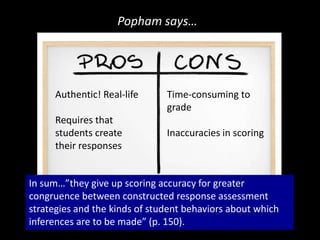
Constructed Response Pros and Cons
Popham says… 
Authentic! Real-life 
Requires that 
students create 
their responses 
Time-consuming to 
grade 
Inaccuracies in scoring 
In sum…”they give up scoring accuracy for greater 
congruence between constructed response assessment 
strategies and the kinds of student behaviors about which 
inferences are to be made” (p. 150).
References 
http://home.messiah.edu/~ab1418/cartoon.png 
http://wamu.org/sites/wamu.org/files/styles/headline_landscape/public/ 
images/attach/08.15.12news-flickr-multiple-choice-test-pencil-edit_ 
0.jpg?itok=jErIcnEK 
http://cache.boston.com/bonzai-fba/ 
Globe_Photo/2007/09/20/1190276115_1963.jpg 
http://4.bp.blogspot.com/- 
zBRZTIY_MxE/Ui9i7ONkfnI/AAAAAAAAAFI/d4iY3Jp5ZX4/s1600/agree-to-disagree. 
jpg 
http://lunar.thegamez.net/greenenergyimage/pros-and-cons-of-alternative- 
energy-sources/people-often-make-lists-of-pros-and-cons-when- 
making-a-decision-1000x709.jpg 
http://fcit.usf.edu/assessment/constructed/constructa.html

Constructed reponse tests popham 2007

  • 1.
    Chapter 7: ConstructedResponse Tests Popham, W. J (2007). Classroom assessment: What teachers need to know. Pearson/Allyn and Bacon. Presentation by Jeanne Sinclair / UTSA October 22, 2014
  • 2.
    Constructed Response Selected Response •Predetermined list of answers • e.g. Multiple Choice questions, True/False, and Matching •Open-ended assessment, e.g. fill-in-the- blank, short answers, essays, oral presentations, demonstrations, portfolios, writing tasks • a.k.a. Performance Assessment •This chapter focuses on Short Answer Items and Essays
  • 3.
    It is saidthat constructed response questions (like essays) are more difficult for students than selected response questions. Do you agree or disagree? Why?
  • 4.
    Popham says… Partialknowledge is not enough to produce the correct answer in constructed response questions.
  • 5.
  • 9.
    Short Answer Items • Student supplies a word, phrase, or sentence to answer a question or complete a statement. • These items usually show acquisition of knowledge. However, they can be constructed to demonstrate higher levels of thinking. Examples: Who was the first Prime Minister of Canada? Columbus landed in this country in the year __________. In 100 words or less, describe the water cycle.
  • 10.
    Popham’s Guidelines forShort Answer Items • Use direct questions, not incomplete statements (especially for young students). • If you use incomplete statements, construct them so there is only one unique answer. • The item should require a very concise response. • Use no more than one or two blanks in each. • Make all blanks equal in length • Use blanks at the end, not in the middle.
  • 11.
  • 12.
    Let’s Grade theTest Short Answer Item – 1. Ms. Joyce has dinner with three of her friends. The four friends decide to split the cost equally. The bill comes to $31.00, and the women plan to leave a small tip. How much should Ms. Joyce pay for her share of the dinner? ____________________
  • 13.
    Let’s Grade theTest Short Answer Item – 2. _____________ consists primarily of ____________ and _____________.
  • 14.
    Let’s Grade theTest Short Answer Item – 3. ____________ is the measure of central tendency that is most affected by extremely high or low scores.
  • 15.
    Let’s Grade theTest Short Answer Item – 4. Teachers’ salaries should not be based on their students’ test scores. Do you agree or disagree? Explain. _______________
  • 16.
    Part 2: Writingessay prompts
  • 19.
    Essay Items… •Are longer than short answer • Are useful to gauge a student's ability to synthesize, evaluate, and compose. • Can be a “performance test” if it is a writing sample. • take time to create (prompts). • sometimes have unreliable scoring.
  • 20.
    Popham’s Guidelines forEssay Items • Be clear about: • how long response should be (preferably in words) • explicit description of task: as detailed as possible • time to be spent on each item and its value so students know where their energy should be spent • no optional items • imagine a quality response to see if the essay prompt is reasonable
  • 21.
  • 22.
    Let’s Grade theTest Essay Item – 1.
  • 23.
    Let’s Grade theTest Essay Item – 2.
  • 24.
    Let’s Grade theTest Essay Item – 3. Using details and information from the article (America’s Saltiest Sea: Great Salt Lake), summarize the main points of the article.
  • 25.
    Let’s Grade theTest Essay Item 4. Scientists have found that oceans can influence the temperature of nearby landmasses. Coastal landmasses tend to have more moderate temperatures in summer and winter than inland landmasses at the same latitude. List three coastal landmasses.
  • 26.
    Let’s Grade theTest Essay item– 5. Sample Question (10th Grade Social Studies) Consider the time period during the Vietnam War and the reasons there were riots in cities and at university campuses. Write an essay explaining three of those reasons. Include information on the impact (if any) of the riots. The essay should be approximately one page in length. Your score will depend on the accuracy of your reasons, the organization of your essay, and brevity. Although spelling, punctuation, and grammar will not be considered in grading, please do your best to consider them in your writing. (10 points possible)
  • 27.
  • 28.
    Popham’s Guidelines forScoring Essays • Holistic scoring vs. analytical scoring • Holistic can include evaluative criteria, but does not give points for each criterion • Analytical: gives points for each category • Hybrid: holistic for high achievers, analytical for low achievers • Make a key before you grade • Decide if mechanics are important • score all of the same item at one time • Try to keep it anonymous
  • 29.
  • 30.
    Let’s Grade theTest Scoring – 1. A high school class called U.S. Government Service. "l was using a four-item essay examination. I worked up a tentative analytic scoring guide for each item. My scoring keys placed no emphasis on a student's use of mechanics. l scored each student's response to all four items at a single sitting, and I found I could usually interpret students' responses more sensibly because, from the student's name on the first page of the response booklet, I could tell whose responses I was grading.”
  • 31.
    Let’s Grade theTest Scoring – 2. (From earlier example about Vietnam War) Content Accuracy -- up to 2 points for each accurate reason the riots ensued (6 points total) Organization -- up to 3 points for essay organization (e.g., introduction, well expressed points, conclusion) Brevity -- up to 1 point for appropriate brevity (i.e., no extraneous or "filler" information) No penalty for spelling, punctuation, or grammatical errors.
  • 32.
  • 33.
    Popham says… Authentic!Real-life Requires that students create their responses Time-consuming to grade Inaccuracies in scoring In sum…”they give up scoring accuracy for greater congruence between constructed response assessment strategies and the kinds of student behaviors about which inferences are to be made” (p. 150).
  • 34.
    References http://home.messiah.edu/~ab1418/cartoon.png http://wamu.org/sites/wamu.org/files/styles/headline_landscape/public/ images/attach/08.15.12news-flickr-multiple-choice-test-pencil-edit_ 0.jpg?itok=jErIcnEK http://cache.boston.com/bonzai-fba/ Globe_Photo/2007/09/20/1190276115_1963.jpg http://4.bp.blogspot.com/- zBRZTIY_MxE/Ui9i7ONkfnI/AAAAAAAAAFI/d4iY3Jp5ZX4/s1600/agree-to-disagree. jpg http://lunar.thegamez.net/greenenergyimage/pros-and-cons-of-alternative- energy-sources/people-often-make-lists-of-pros-and-cons-when- making-a-decision-1000x709.jpg http://fcit.usf.edu/assessment/constructed/constructa.html