Finalizing EUs & EOs 
October 14, 2014
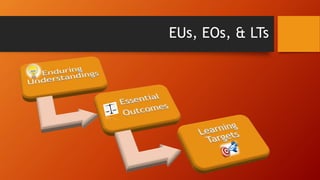
EUs, EOs, & LTs
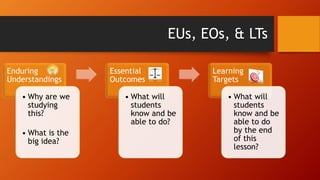
EUs, EOs, & LTs 
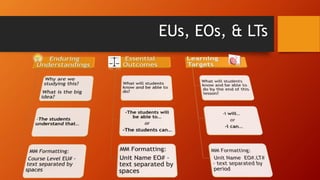
Enduring 
Understandings 
• Why are we 
studying 
this? 
• What is the 
big idea? 
Essential 
Outcomes 
• What will 
students 
know and be 
able to do? 
Learning 
Targets 
• What will 
students 
know and be 
able to do 
by the end 
of this 
lesson?
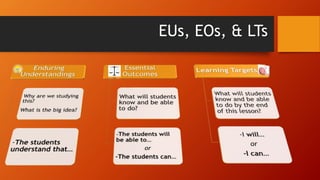
EUs, EOs, & LTs
UNDERSTANDING 
• “To understand a topic or subject is to be able to use 
knowledge and skill wisely and effectively.” 
• “An understanding is the successful result of trying to 
understand- the resultant grasp of an unobvious idea, an 
inference that makes meaning of many discrete (and 
perhaps seemingly insignificant) elements of knowledge.” 
McTighe and Wiggins, 2005, 43.
What is an EU (Enduring Understanding)? 
An Enduring Understanding is a full sentence 
generalization based on “transferable, big 
ideas at the heart of the discipline and in 
need of uncoverage” (McTighe and Wiggins, 2004, 24).
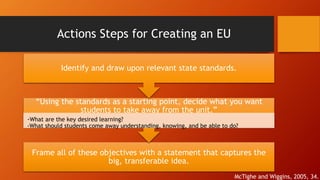
Actions Steps for Creating an EU 
Identify and draw upon relevant state standards. 
“Using the standards as a starting point, decide what you want 
students to take away from the unit.” 
-What are the key desired learning? 
-What should students come away understanding, knowing, and be able to do? 
Frame all of these objectives with a statement that captures the 
big, transferable idea. 
McTighe and Wiggins, 2005, 34.
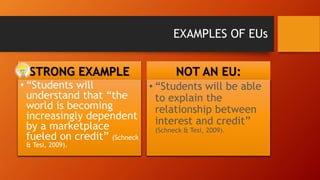
EXAMPLES OF EUs 
STRONG EXAMPLE 
• “Students will 
that 
mathematical models 
must be viewed 
critically so they do 
not mislead us.” 
(McTighe & Wiggins, 2005, 64). 
NOT AN EU: 
• “Students will understand 
how to review a 
mathematical model for 
its appropriateness to 
real-life situations” 
(McTighe & Wiggins, 2005, 64). 
will 
understand that 
novelists often provide 
insights about human 
experience and inner 
life through fictional 
means”(McTighe & Wiggins, 2004, 
64). 
Students explain 
how a work of fiction 
is reflective of the 
human experience. 
“the 
world is becoming 
increasingly dependent 
by a marketplace 
fueled on credit” (Schneck 
& Tesi, 2009). 
will be able 
to explain the 
relationship between 
interest and credit” 
(Schneck & Tesi, 2009).
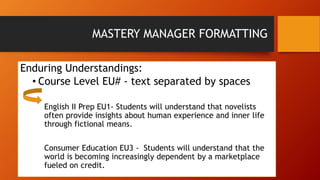
MASTERY MANAGER FORMATTING 
Enduring Understandings: 
• Course Level EU# - text separated by spaces 
English II Prep EU1- Students will understand that novelists 
often provide insights about human experience and inner life 
through fictional means. 
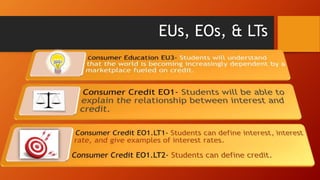
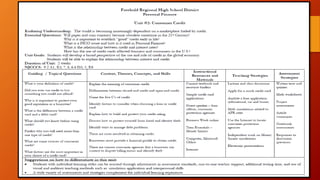
Consumer Education EU3 - Students will understand that the 
world is becoming increasingly dependent by a marketplace 
fueled on credit.
What is an Essential Outcome? 
An Essential Outcome includes the 
information needed to achieve the big idea, 
including: 
• Building blocks for the desired understandings 
• Knowledge acquired from the facts & concepts 
in instructional activities 
• Skills (both simple techniques & complex 
procedures 
LTHS PLC Glossary, 2012, 4.
Actions Steps for Creating an E0 
Identify and draw upon relevant state standards. 
“Using the standards as a starting point, decide what you want 
students to take away from the unit.” 
-What are the key desired learning? 
-What should students come away understanding, knowing, and be able to do? 
McTighe and Wiggins, 2005, 34.
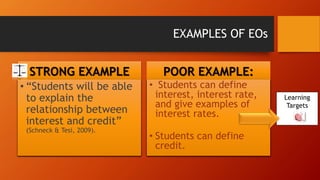
EXAMPLES OF EOs 
STRONG EXAMPLE 
• “Students will 
understand how to 
evaluate a 
mathematical model 
for its appropriateness 
to real-life situations” 
(McTighe & Wiggins, 2005, 64). 
POOR EXAMPLE: 
“Students define 
mathematical modeling.” 
• “Students can give an 
example of a 
mathematical model.” 
(McTighe & Wiggins, 2005, 64). 
• Students will explain 
how a work of fiction 
is reflective of the 
human experience. 
• Students can identify a 
work of fiction. 
“Students will be able 
to explain the 
relationship between 
interest and credit” 
(Schneck & Tesi, 2009). 
• Students can define 
interest, interest rate, 
and give examples of 
interest rates. 
• Students can define 
credit. 
Learning 
Targets
MASTERY MANAGER FORMATTING 
Essential Outcomes: 
• Unit Name EO# - text separated by spaces 
Fiction EO3- Students will be able to explain how a work of 
fiction is reflective of the human experience. 
Consumer Credit EO1- Students will be able to explain the 
relationship between interest and credit.
EUs, EOs, & LTs
EUs, EOs, & LTs
REFERENCES 
McTighe, J. & Wiggins, G. (2004). Understanding by design: 
Professional development workbook. Alexandria, Virginia: ASCD. 
McTighe, J. & Wiggins, G. (2nd ed) (2005). Understanding by design. 
Columbus, Ohio: Pearson Merrill Prentice Hall. 
Schneck, S. & Tesi, V. (2009). Financial literacy. Englishtown, New 
Jersey: Freehold Regional High School District.

Finalizing e us & eos

  • 1.
    Finalizing EUs &EOs October 14, 2014
  • 2.
  • 3.
    EUs, EOs, &LTs Enduring Understandings • Why are we studying this? • What is the big idea? Essential Outcomes • What will students know and be able to do? Learning Targets • What will students know and be able to do by the end of this lesson?
  • 4.
  • 5.
    UNDERSTANDING • “Tounderstand a topic or subject is to be able to use knowledge and skill wisely and effectively.” • “An understanding is the successful result of trying to understand- the resultant grasp of an unobvious idea, an inference that makes meaning of many discrete (and perhaps seemingly insignificant) elements of knowledge.” McTighe and Wiggins, 2005, 43.
  • 6.
    What is anEU (Enduring Understanding)? An Enduring Understanding is a full sentence generalization based on “transferable, big ideas at the heart of the discipline and in need of uncoverage” (McTighe and Wiggins, 2004, 24).
  • 7.
    Actions Steps forCreating an EU Identify and draw upon relevant state standards. “Using the standards as a starting point, decide what you want students to take away from the unit.” -What are the key desired learning? -What should students come away understanding, knowing, and be able to do? Frame all of these objectives with a statement that captures the big, transferable idea. McTighe and Wiggins, 2005, 34.
  • 8.
    EXAMPLES OF EUs STRONG EXAMPLE • “Students will that mathematical models must be viewed critically so they do not mislead us.” (McTighe & Wiggins, 2005, 64). NOT AN EU: • “Students will understand how to review a mathematical model for its appropriateness to real-life situations” (McTighe & Wiggins, 2005, 64). will understand that novelists often provide insights about human experience and inner life through fictional means”(McTighe & Wiggins, 2004, 64). Students explain how a work of fiction is reflective of the human experience. “the world is becoming increasingly dependent by a marketplace fueled on credit” (Schneck & Tesi, 2009). will be able to explain the relationship between interest and credit” (Schneck & Tesi, 2009).
  • 9.
    MASTERY MANAGER FORMATTING Enduring Understandings: • Course Level EU# - text separated by spaces English II Prep EU1- Students will understand that novelists often provide insights about human experience and inner life through fictional means. Consumer Education EU3 - Students will understand that the world is becoming increasingly dependent by a marketplace fueled on credit.
  • 10.
    What is anEssential Outcome? An Essential Outcome includes the information needed to achieve the big idea, including: • Building blocks for the desired understandings • Knowledge acquired from the facts & concepts in instructional activities • Skills (both simple techniques & complex procedures LTHS PLC Glossary, 2012, 4.
  • 11.
    Actions Steps forCreating an E0 Identify and draw upon relevant state standards. “Using the standards as a starting point, decide what you want students to take away from the unit.” -What are the key desired learning? -What should students come away understanding, knowing, and be able to do? McTighe and Wiggins, 2005, 34.
  • 12.
    EXAMPLES OF EOs STRONG EXAMPLE • “Students will understand how to evaluate a mathematical model for its appropriateness to real-life situations” (McTighe & Wiggins, 2005, 64). POOR EXAMPLE: “Students define mathematical modeling.” • “Students can give an example of a mathematical model.” (McTighe & Wiggins, 2005, 64). • Students will explain how a work of fiction is reflective of the human experience. • Students can identify a work of fiction. “Students will be able to explain the relationship between interest and credit” (Schneck & Tesi, 2009). • Students can define interest, interest rate, and give examples of interest rates. • Students can define credit. Learning Targets
  • 13.
    MASTERY MANAGER FORMATTING Essential Outcomes: • Unit Name EO# - text separated by spaces Fiction EO3- Students will be able to explain how a work of fiction is reflective of the human experience. Consumer Credit EO1- Students will be able to explain the relationship between interest and credit.
  • 14.
  • 15.
  • 17.
    REFERENCES McTighe, J.& Wiggins, G. (2004). Understanding by design: Professional development workbook. Alexandria, Virginia: ASCD. McTighe, J. & Wiggins, G. (2nd ed) (2005). Understanding by design. Columbus, Ohio: Pearson Merrill Prentice Hall. Schneck, S. & Tesi, V. (2009). Financial literacy. Englishtown, New Jersey: Freehold Regional High School District.

Editor's Notes

  • #6 McTighe & Wiggins, pg. 43: “A genuine understanding involves another kind of transfer. We go beyond what we see, using big ideas, to make meaning of it…” Ex: “’Oh, that’s just like what we saw when the pioneers headed west’”, a student excitedly realizes when considering 20th century immigration.” “That’s the kind of transfer we seek.! :The challenge is to make it more likely by design rather than by luck or natural disposition.” THINGS McTighe & Wiggins Point Out: “Because big ideas are inherently transferable, they help us connect discrete topic and skills.” -”A key finding in the learning and transfer literature (which comes from research on cognitive psychology) is that organizing into a conceptual framework allows for greater transfer.” -”Learning with understanding is more likely to promote transfer than simply memorizing information from a text or a lecture.”
  • #9 All 3 POOR examples are actually EOs because that is the most common error when writing them…that we look at things students should actually know or be able to do and we do not think of knowledge that is transferable in the course and beyond.
  • #13 All 3 POOR examples are more likely to be daily learning targets than unit Essential Outcomes. The EOs are measured through a summative assessment/ experience. The LTs are assessed, and are generally done so through formative means. In order to demonstrate mastery of the EO, it is often imperative that you know the daily LT.