Subjective Test
By
Ni Kadek Widiantari
Ni Made Lia Indra Dewi
Putu Melyawati
PURPOSES
There three purposes of this paper.
The first, it was aimed to know the
definition of subjective test. The
second, it was aimed to know
strengths and limitations of Subjective
test. The last, it was aimed to find out
the way to score Subjective test in the
school.
THEORY


Assessment
Assessment is the process of
obtaining or collecting data that is
used for making decision about
students.
It can include the test or non-test
SUBJECTIVE TEST


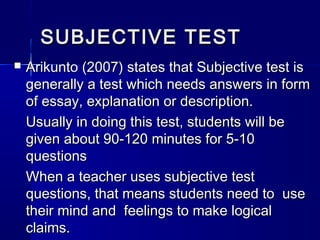
Arikunto (2007) states that Subjective test is
generally a test which needs answers in form
of essay, explanation or description.
Usually in doing this test, students will be
given about 90-120 minutes for 5-10
questions
When a teacher uses subjective test
questions, that means students need to use
their mind and feelings to make logical
claims.
Classification of Essay
Test




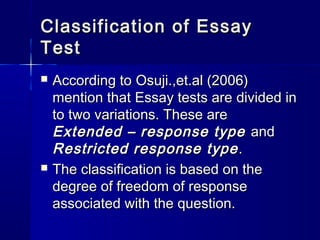
According to Osuji.,et.al (2006)
mention that Essay tests are divided in
to two variations. These are
Extended – response type and
Restricted response type .
The classification is based on the
degree of freedom of response
associated with the question.
Extended Response
Essays
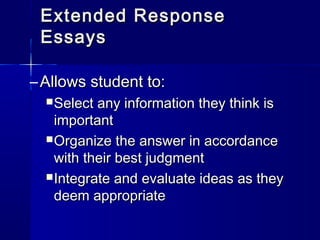
– Allows student to:
 Select

any information they think is
important
 Organize the answer in accordance
with their best judgment
 Integrate and evaluate ideas as they
deem appropriate
Example :


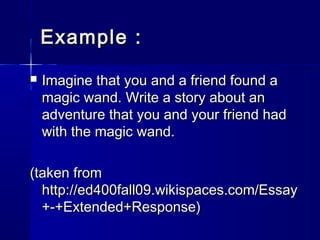
Imagine that you and a friend found a
magic wand. Write a story about an
adventure that you and your friend had
with the magic wand.

(taken from
http://ed400fall09.wikispaces.com/Essay
+-+Extended+Response)
Restricted Response


The nature of Restricted response
type are:
–
–
–
–

Limits both content and response.
Content is limited by scope of topic.
Response is limited in the directions.
Most appropriate for learning objectives
that require the interpretation or
application of data in a specific area.
Example :


Why is the barometer one of the most
useful instruments for forecasting
weather? Answer in a brief paragraph
(taken from
http://ed400fall09.wikispaces.com/Ess
ay+-+Restricted+Response)
The Strengths









It is easy to be prepared and organized
It does not give any opportunities to speculate
or cheat
It encourages students to dare in expressing
opinions and arranging good sentences.
It provides opportunities for students to
express their opinion by using their own style.
It can identify the students’ understanding
about the problem that being tested.
The limitations










It’s validity and reliability are low due to it’s difficult to be
known in which aspects the students have understood the
material.
Limited material can be tested. This means less
representative in terms of representing the entire material.
The ways to score and evaluate are often influenced by
subjective aspect.
It requires more individualized consideration of the teacher
(assessor).
It takes much times to evaluate it and the assessor can not
be replaced by other.
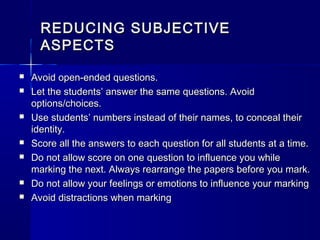
REDUCING SUBJECTIVE
ASPECTS











Avoid open-ended questions.
Let the students’ answer the same questions. Avoid
options/choices.
Use students’ numbers instead of their names, to conceal their
identity.
Score all the answers to each question for all students at a time.
Do not allow score on one question to influence you while
marking the next. Always rearrange the papers before you mark.
Do not allow your feelings or emotions to influence your marking
Avoid distractions when marking
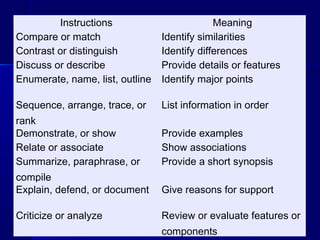
Instructions
Compare or match
Contrast or distinguish
Discuss or describe
Enumerate, name, list, outline

Meaning
Identify similarities
Identify differences
Provide details or features
Identify major points

Sequence, arrange, trace, or

List information in order

rank
Demonstrate, or show
Relate or associate
Summarize, paraphrase, or

Provide examples
Show associations
Provide a short synopsis

compile
Explain, defend, or document

Give reasons for support

Criticize or analyze

Review or evaluate features or
components
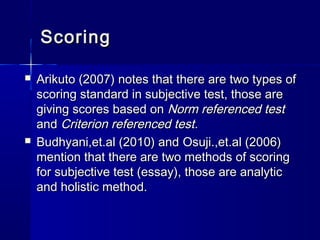
Scoring




Arikuto (2007) notes that there are two types of
scoring standard in subjective test, those are
giving scores based on Norm referenced test
and Criterion referenced test.
Budhyani,et.al (2010) and Osuji.,et.al (2006)
mention that there are two methods of scoring
for subjective test (essay), those are analytic
and holistic method.
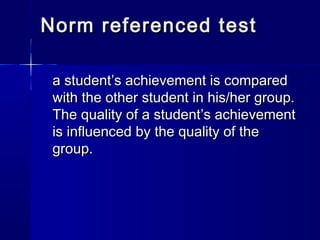
Norm referenced test
a student’s achievement is compared
with the other student in his/her group.
The quality of a student’s achievement
is influenced by the quality of the
group.
Criterion referenced test
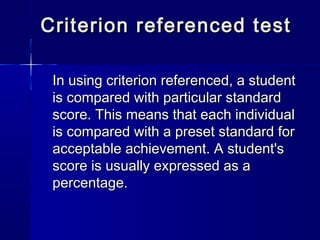
In using criterion referenced, a student
is compared with particular standard
score. This means that each individual
is compared with a preset standard for
acceptable achievement. A student's
score is usually expressed as a
percentage.
The Point or Analytic Method


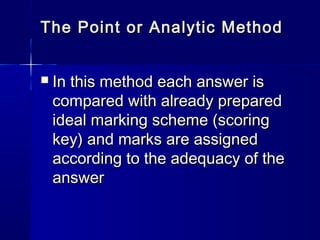
In this method each answer is
compared with already prepared
ideal marking scheme (scoring
key) and marks are assigned
according to the adequacy of the
answer
The Global/Holistic of Rating
Method


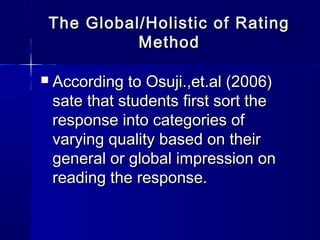
According to Osuji.,et.al (2006)
sate that students first sort the
response into categories of
varying quality based on their
general or global impression on
reading the response.


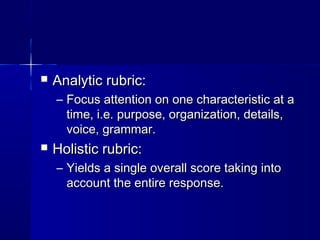
Analytic rubric:
– Focus attention on one characteristic at a
time, i.e. purpose, organization, details,
voice, grammar.



Holistic rubric:
– Yields a single overall score taking into
account the entire response.
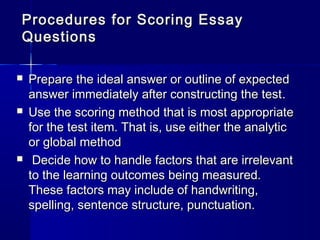
Procedures f or Scoring Essay
Questions






Prepare the ideal answer or outline of expected
answer immediately after constructing the test .
Use the scoring method that is most appropriate
for the test item. That is, use either the analytic
or global method
Decide how to handle factors that are irrelevant
to the learning outcomes being measured.
These factors may include of handwriting,
spelling, sentence structure, punctuation.




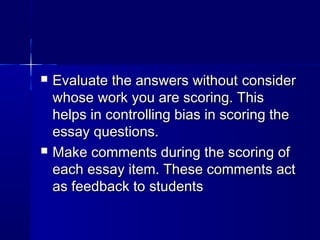
Evaluate the answers without consider
whose work you are scoring. This
helps in controlling bias in scoring the
essay questions.
Make comments during the scoring of
each essay item. These comments act
as feedback to students
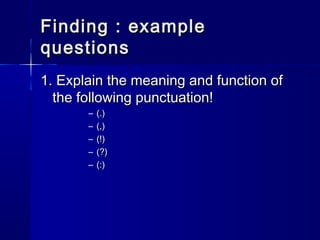
Finding : example
questions
1. Explain the meaning and function of
the following punctuation!
–
–
–
–
–

(.)
(,)
(!)
(?)
(:)
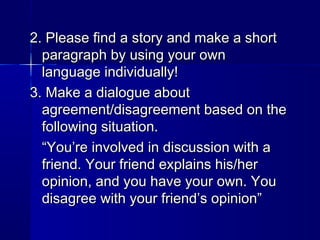
2. Please find a story and make a short
paragraph by using your own
language individually!
3. Make a dialogue about
agreement/disagreement based on the
following situation.
“You’re involved in discussion with a
friend. Your friend explains his/her
opinion, and you have your own. You
disagree with your friend’s opinion”
Example of rubric







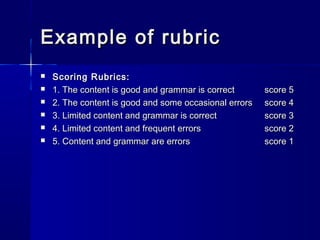
Scoring Rubrics:
1. The content is good and grammar is correct
2. The content is good and some occasional errors
3. Limited content and grammar is correct
4. Limited content and frequent errors
5. Content and grammar are errors

score 5
score 4
score 3
score 2
score 1
Discussion


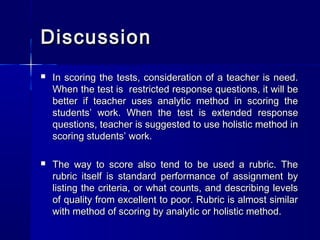
In scoring the tests, consideration of a teacher is need.
When the test is restricted response questions, it will be
better if teacher uses analytic method in scoring the
students’ work. When the test is extended response
questions, teacher is suggested to use holistic method in
scoring students’ work.



The way to score also tend to be used a rubric. The
rubric itself is standard performance of assignment by
listing the criteria, or what counts, and describing levels
of quality from excellent to poor. Rubric is almost similar
with method of scoring by analytic or holistic method.
CONCLUSION

Subjective test (Essay)

  • 1.
    Subjective Test By Ni KadekWidiantari Ni Made Lia Indra Dewi Putu Melyawati
  • 2.
    PURPOSES There three purposesof this paper. The first, it was aimed to know the definition of subjective test. The second, it was aimed to know strengths and limitations of Subjective test. The last, it was aimed to find out the way to score Subjective test in the school.
  • 3.
    THEORY  Assessment Assessment is theprocess of obtaining or collecting data that is used for making decision about students. It can include the test or non-test
  • 4.
    SUBJECTIVE TEST  Arikunto (2007)states that Subjective test is generally a test which needs answers in form of essay, explanation or description. Usually in doing this test, students will be given about 90-120 minutes for 5-10 questions When a teacher uses subjective test questions, that means students need to use their mind and feelings to make logical claims.
  • 5.
    Classification of Essay Test   Accordingto Osuji.,et.al (2006) mention that Essay tests are divided in to two variations. These are Extended – response type and Restricted response type . The classification is based on the degree of freedom of response associated with the question.
  • 6.
    Extended Response Essays – Allowsstudent to:  Select any information they think is important  Organize the answer in accordance with their best judgment  Integrate and evaluate ideas as they deem appropriate
  • 7.
    Example :  Imagine thatyou and a friend found a magic wand. Write a story about an adventure that you and your friend had with the magic wand. (taken from http://ed400fall09.wikispaces.com/Essay +-+Extended+Response)
  • 8.
    Restricted Response  The natureof Restricted response type are: – – – – Limits both content and response. Content is limited by scope of topic. Response is limited in the directions. Most appropriate for learning objectives that require the interpretation or application of data in a specific area.
  • 9.
    Example :  Why isthe barometer one of the most useful instruments for forecasting weather? Answer in a brief paragraph (taken from http://ed400fall09.wikispaces.com/Ess ay+-+Restricted+Response)
  • 10.
    The Strengths      It iseasy to be prepared and organized It does not give any opportunities to speculate or cheat It encourages students to dare in expressing opinions and arranging good sentences. It provides opportunities for students to express their opinion by using their own style. It can identify the students’ understanding about the problem that being tested.
  • 11.
    The limitations      It’s validityand reliability are low due to it’s difficult to be known in which aspects the students have understood the material. Limited material can be tested. This means less representative in terms of representing the entire material. The ways to score and evaluate are often influenced by subjective aspect. It requires more individualized consideration of the teacher (assessor). It takes much times to evaluate it and the assessor can not be replaced by other.
  • 12.
    REDUCING SUBJECTIVE ASPECTS        Avoid open-endedquestions. Let the students’ answer the same questions. Avoid options/choices. Use students’ numbers instead of their names, to conceal their identity. Score all the answers to each question for all students at a time. Do not allow score on one question to influence you while marking the next. Always rearrange the papers before you mark. Do not allow your feelings or emotions to influence your marking Avoid distractions when marking
  • 13.
    Instructions Compare or match Contrastor distinguish Discuss or describe Enumerate, name, list, outline Meaning Identify similarities Identify differences Provide details or features Identify major points Sequence, arrange, trace, or List information in order rank Demonstrate, or show Relate or associate Summarize, paraphrase, or Provide examples Show associations Provide a short synopsis compile Explain, defend, or document Give reasons for support Criticize or analyze Review or evaluate features or components
  • 14.
    Scoring   Arikuto (2007) notesthat there are two types of scoring standard in subjective test, those are giving scores based on Norm referenced test and Criterion referenced test. Budhyani,et.al (2010) and Osuji.,et.al (2006) mention that there are two methods of scoring for subjective test (essay), those are analytic and holistic method.
  • 15.
    Norm referenced test astudent’s achievement is compared with the other student in his/her group. The quality of a student’s achievement is influenced by the quality of the group.
  • 16.
    Criterion referenced test Inusing criterion referenced, a student is compared with particular standard score. This means that each individual is compared with a preset standard for acceptable achievement. A student's score is usually expressed as a percentage.
  • 17.
    The Point orAnalytic Method  In this method each answer is compared with already prepared ideal marking scheme (scoring key) and marks are assigned according to the adequacy of the answer
  • 18.
    The Global/Holistic ofRating Method  According to Osuji.,et.al (2006) sate that students first sort the response into categories of varying quality based on their general or global impression on reading the response.
  • 19.
     Analytic rubric: – Focusattention on one characteristic at a time, i.e. purpose, organization, details, voice, grammar.  Holistic rubric: – Yields a single overall score taking into account the entire response.
  • 20.
    Procedures f orScoring Essay Questions    Prepare the ideal answer or outline of expected answer immediately after constructing the test . Use the scoring method that is most appropriate for the test item. That is, use either the analytic or global method Decide how to handle factors that are irrelevant to the learning outcomes being measured. These factors may include of handwriting, spelling, sentence structure, punctuation.
  • 21.
      Evaluate the answerswithout consider whose work you are scoring. This helps in controlling bias in scoring the essay questions. Make comments during the scoring of each essay item. These comments act as feedback to students
  • 22.
    Finding : example questions 1.Explain the meaning and function of the following punctuation! – – – – – (.) (,) (!) (?) (:)
  • 23.
    2. Please finda story and make a short paragraph by using your own language individually! 3. Make a dialogue about agreement/disagreement based on the following situation. “You’re involved in discussion with a friend. Your friend explains his/her opinion, and you have your own. You disagree with your friend’s opinion”
  • 24.
    Example of rubric       ScoringRubrics: 1. The content is good and grammar is correct 2. The content is good and some occasional errors 3. Limited content and grammar is correct 4. Limited content and frequent errors 5. Content and grammar are errors score 5 score 4 score 3 score 2 score 1
  • 25.
    Discussion  In scoring thetests, consideration of a teacher is need. When the test is restricted response questions, it will be better if teacher uses analytic method in scoring the students’ work. When the test is extended response questions, teacher is suggested to use holistic method in scoring students’ work.  The way to score also tend to be used a rubric. The rubric itself is standard performance of assignment by listing the criteria, or what counts, and describing levels of quality from excellent to poor. Rubric is almost similar with method of scoring by analytic or holistic method.
  • 26.