Differentiated Instruction
Objectives
Compare/Contrast Fixed and Growth Mindsets
Define Differentiated Instruction (DI)
Explain the Principles of Differentiation
Identify theType of Differentiation
Two ideas to keep in mind today:
EffectiveTeaching is harder than
ineffective teaching.
Small changes can make a big
difference.
Pat Quin, “The RTI Guy”
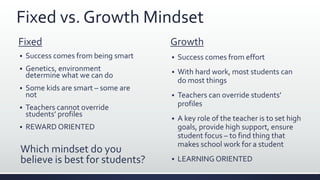
Fixed vs. Growth Mindset
Growth
 Success comes from effort
 With hard work, most students can
do most things
 Teachers can override students’
profiles
 A key role of the teacher is to set high
goals, provide high support, ensure
student focus – to find thing that
makes school work for a student
 LEARNING ORIENTED
Fixed
 Success comes from being smart
 Genetics, environment
determine what we can do
 Some kids are smart – some are
not
 Teachers cannot override
students’ profiles
 REWARD ORIENTED
Which mindset do you
believe is best for students?
What is Differentiation?
 “A systematic approach to planning curriculum
and instruction for academically diverse
learners” that provides students of different
abilities, interests, or learning needs equally
appropriate ways to learn. (Tomlinson & Strickland, p.7)
It is not what we teach, it is HOW WETEACH
Differentiation is . . .
 Responsive teaching rather than one-size-fits-
all teaching.
 Planning for the unpredictability of a classroom.
 Respectful teaching.
 A sequence of common sense decisions made
by teachers with a student-first orientation.
Differentiation is NOT . . .
 New.
 Tracking or an IEP for every child .
 Constant group work.
 Occasional variation of teaching styles.
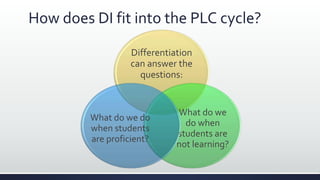
How does DI fit into the PLC cycle?
Differentiation
can answer the
questions:
What do we
do when
students are
not learning?
What do we do
when students
are proficient?
Common Sense of DI
 Ensuring an environment that actively supports students in the work
of learning (mindset, connections, community)
 Absolute clarity about a powerful learning destination (Enduring
Understandings, Essential Outcomes, LearningTargets (KUD))
 Persistently knowing where students are in relation to the
destination along the way (assessment)
 Adjusting teaching to make sure each student arrives at the
destination and, when possible, moves beyond it (readiness,
interest, learning profile)
 Effective leadership and management of flexible classroom routines
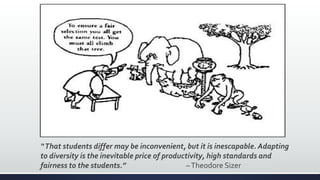
“That students differ may be inconvenient, but it is inescapable. Adapting
to diversity is the inevitable price of productivity, high standards and
fairness to the students.” –Theodore Sizer
5 Principles of DI
 A supportive learning environment
 Quality curriculum
 Assessment that informs teaching and learning
 Instruction that responds to student variance
 Leading and managing the classroom
Tomlinson (2013)
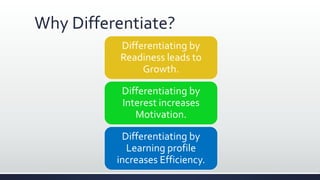
Why Differentiate?
Differentiating by
Readiness leads to
Growth.
Differentiating by
Interest increases
Motivation.
Differentiating by
Learning profile
increases Efficiency.
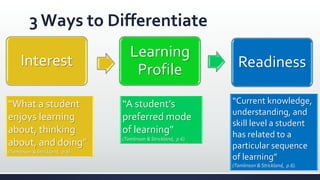
3 Ways to Differentiate
Interest
Learning
Profile Readiness
“What a student
enjoys learning
about, thinking
about, and doing”
(Tomlinson & Strickland, p.6)
“Current knowledge,
understanding, and
skill level a student
has related to a
particular sequence
of learning”
(Tomlinson & Strickland, p.6).
“A student’s
preferred mode
of learning”
(Tomlinson & Strickland, p.6).
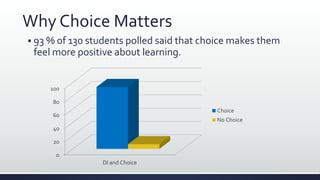
Why Choice Matters
0
20
40
60
80
100
DI and Choice
Choice
No Choice
 93 % of 130 students polled said that choice makes them
feel more positive about learning.
TeacherTestimonials
“Being a special education teacher, I assumed what I was doing
every day was considered DI. It wasn’t until our professional
development that I truly understood that I was merely modifying
existing instruction for a few select students who were struggling
in my class. After using DI in my room for about a year, the entire
class has benefitted from these changes, instead of a select few at-
risk students. Using formative assessments has also been a great
way to monitor student progress and collect data on their
performance. This information comes in handy when speaking to
students and parents about their progress in my class, and allows
me to focus on specific areas of difficulty.”
- A SPECIAL EDUCATION TEACHER
TeacherTestimonials
“By differentiating instruction, I have been able to
challenge my high-achieving students, make language
learning easier for struggling students, motivate my
reluctant learners and provide exciting and meaningful
learning experiences for everyone. It has definitely made
me a better teacher and I have seen more students have
greater success!”
- A WORLD LANGUAGE TEACHER
StudentTestimonials
“I feel a lot more pressure when you give us a specific
assignment. If I get to choose, I feel less pressured.”
“I think it is helpful when you differentiate because we
have the chance to be creative. I’d be bored if we all did
the same things all the time.”
StudentTestimonials
“I can take charge of my own learning.”
“It’s helpful because I get to pick how I understand the
information. I know how I learn best. I do not like being
forced to learn things in a way that doesn’t help me.”
StudentTestimonials
“You get to work with people who are at your same skill
level sometimes, so you don’t have to feel overwhelmed
when everyone else is ready to move on and you aren’t.”
“When we receive extra support or enrichment, I think it
pushes us to understand more content rather than
assuming everyone is at the same point.”
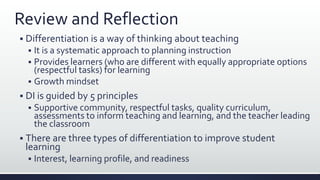
Review and Reflection
 Differentiation is a way of thinking about teaching
 It is a systematic approach to planning instruction
 Provides learners (who are different with equally appropriate options
(respectful tasks) for learning
 Growth mindset
 DI is guided by 5 principles
 Supportive community, respectful tasks, quality curriculum,
assessments to inform teaching and learning, and the teacher leading
the classroom
 There are three types of differentiation to improve student
learning
 Interest, learning profile, and readiness
Review and Reflection
 How can you apply today’s information to your
classroom?
 How can you incorporate DI with assessment and
literacy?
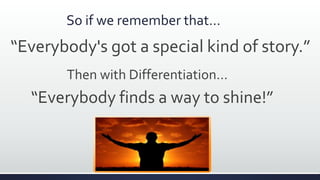
So if we remember that…
“Everybody's got a special kind of story.”
Then with Differentiation…
“Everybody finds a way to shine!”

Differentiated instruction.summer workshop.2015

  • 1.
  • 2.
    Objectives Compare/Contrast Fixed andGrowth Mindsets Define Differentiated Instruction (DI) Explain the Principles of Differentiation Identify theType of Differentiation
  • 3.
    Two ideas tokeep in mind today: EffectiveTeaching is harder than ineffective teaching. Small changes can make a big difference. Pat Quin, “The RTI Guy”
  • 4.
    Fixed vs. GrowthMindset Growth  Success comes from effort  With hard work, most students can do most things  Teachers can override students’ profiles  A key role of the teacher is to set high goals, provide high support, ensure student focus – to find thing that makes school work for a student  LEARNING ORIENTED Fixed  Success comes from being smart  Genetics, environment determine what we can do  Some kids are smart – some are not  Teachers cannot override students’ profiles  REWARD ORIENTED Which mindset do you believe is best for students?
  • 5.
    What is Differentiation? “A systematic approach to planning curriculum and instruction for academically diverse learners” that provides students of different abilities, interests, or learning needs equally appropriate ways to learn. (Tomlinson & Strickland, p.7) It is not what we teach, it is HOW WETEACH
  • 6.
    Differentiation is .. .  Responsive teaching rather than one-size-fits- all teaching.  Planning for the unpredictability of a classroom.  Respectful teaching.  A sequence of common sense decisions made by teachers with a student-first orientation.
  • 7.
    Differentiation is NOT. . .  New.  Tracking or an IEP for every child .  Constant group work.  Occasional variation of teaching styles.
  • 8.
    How does DIfit into the PLC cycle? Differentiation can answer the questions: What do we do when students are not learning? What do we do when students are proficient?
  • 9.
    Common Sense ofDI  Ensuring an environment that actively supports students in the work of learning (mindset, connections, community)  Absolute clarity about a powerful learning destination (Enduring Understandings, Essential Outcomes, LearningTargets (KUD))  Persistently knowing where students are in relation to the destination along the way (assessment)  Adjusting teaching to make sure each student arrives at the destination and, when possible, moves beyond it (readiness, interest, learning profile)  Effective leadership and management of flexible classroom routines
  • 10.
    “That students differmay be inconvenient, but it is inescapable. Adapting to diversity is the inevitable price of productivity, high standards and fairness to the students.” –Theodore Sizer
  • 11.
    5 Principles ofDI  A supportive learning environment  Quality curriculum  Assessment that informs teaching and learning  Instruction that responds to student variance  Leading and managing the classroom Tomlinson (2013)
  • 12.
    Why Differentiate? Differentiating by Readinessleads to Growth. Differentiating by Interest increases Motivation. Differentiating by Learning profile increases Efficiency.
  • 13.
    3 Ways toDifferentiate Interest Learning Profile Readiness “What a student enjoys learning about, thinking about, and doing” (Tomlinson & Strickland, p.6) “Current knowledge, understanding, and skill level a student has related to a particular sequence of learning” (Tomlinson & Strickland, p.6). “A student’s preferred mode of learning” (Tomlinson & Strickland, p.6).
  • 14.
    Why Choice Matters 0 20 40 60 80 100 DIand Choice Choice No Choice  93 % of 130 students polled said that choice makes them feel more positive about learning.
  • 15.
    TeacherTestimonials “Being a specialeducation teacher, I assumed what I was doing every day was considered DI. It wasn’t until our professional development that I truly understood that I was merely modifying existing instruction for a few select students who were struggling in my class. After using DI in my room for about a year, the entire class has benefitted from these changes, instead of a select few at- risk students. Using formative assessments has also been a great way to monitor student progress and collect data on their performance. This information comes in handy when speaking to students and parents about their progress in my class, and allows me to focus on specific areas of difficulty.” - A SPECIAL EDUCATION TEACHER
  • 16.
    TeacherTestimonials “By differentiating instruction,I have been able to challenge my high-achieving students, make language learning easier for struggling students, motivate my reluctant learners and provide exciting and meaningful learning experiences for everyone. It has definitely made me a better teacher and I have seen more students have greater success!” - A WORLD LANGUAGE TEACHER
  • 17.
    StudentTestimonials “I feel alot more pressure when you give us a specific assignment. If I get to choose, I feel less pressured.” “I think it is helpful when you differentiate because we have the chance to be creative. I’d be bored if we all did the same things all the time.”
  • 18.
    StudentTestimonials “I can takecharge of my own learning.” “It’s helpful because I get to pick how I understand the information. I know how I learn best. I do not like being forced to learn things in a way that doesn’t help me.”
  • 19.
    StudentTestimonials “You get towork with people who are at your same skill level sometimes, so you don’t have to feel overwhelmed when everyone else is ready to move on and you aren’t.” “When we receive extra support or enrichment, I think it pushes us to understand more content rather than assuming everyone is at the same point.”
  • 20.
    Review and Reflection Differentiation is a way of thinking about teaching  It is a systematic approach to planning instruction  Provides learners (who are different with equally appropriate options (respectful tasks) for learning  Growth mindset  DI is guided by 5 principles  Supportive community, respectful tasks, quality curriculum, assessments to inform teaching and learning, and the teacher leading the classroom  There are three types of differentiation to improve student learning  Interest, learning profile, and readiness
  • 21.
    Review and Reflection How can you apply today’s information to your classroom?  How can you incorporate DI with assessment and literacy?
  • 22.
    So if weremember that… “Everybody's got a special kind of story.” Then with Differentiation… “Everybody finds a way to shine!”

Editor's Notes

  • #3 May require more than one slide
  • #4 May require more than one slide
  • #15 May require more than one slide