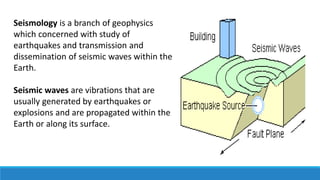
Seismology is a branch of geophysics
which concerned with study of
earthquakes and transmission and
dissemination of seismic waves within the
Earth.
Seismic waves are vibrations that are
usually generated by earthquakes or
explosions and are propagated within the
Earth or along its surface.
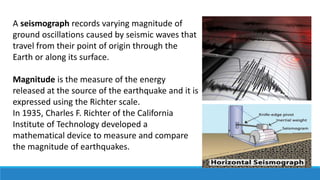
A seismograph records varying magnitude of
ground oscillations caused by seismic waves that
travel from their point of origin through the
Earth or along its surface.
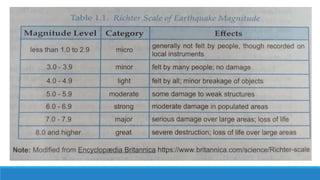
Magnitude is the measure of the energy
released at the source of the earthquake and it is
expressed using the Richter scale.
In 1935, Charles F. Richter of the California
Institute of Technology developed a
mathematical device to measure and compare
the magnitude of earthquakes.
Types of Seismic Waves
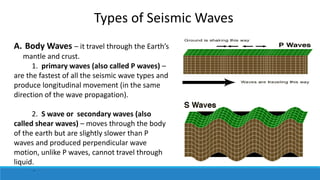
A. Body Waves – it travel through the Earth’s
mantle and crust.
1. primary waves (also called P waves) –
are the fastest of all the seismic wave types and
produce longitudinal movement (in the same
direction of the wave propagation).
2. S wave or secondary waves (also
called shear waves) – moves through the body
of the earth but are slightly slower than P
waves and produced perpendicular wave
motion, unlike P waves, cannot travel through
liquid.
-
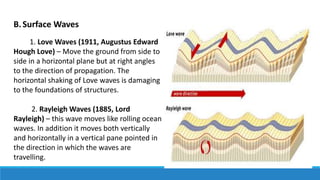
B.Surface Waves
1. Love Waves (1911, Augustus Edward
Hough Love) – Move the ground from side to
side in a horizontal plane but at right angles
to the direction of propagation. The
horizontal shaking of Love waves is damaging
to the foundations of structures.
2. Rayleigh Waves (1885, Lord
Rayleigh) – this wave moves like rolling ocean
waves. In addition it moves both vertically
and horizontally in a vertical pane pointed in
the direction in which the waves are
travelling.

Seismic waves

  • 2.
    Seismology is abranch of geophysics which concerned with study of earthquakes and transmission and dissemination of seismic waves within the Earth. Seismic waves are vibrations that are usually generated by earthquakes or explosions and are propagated within the Earth or along its surface.
  • 3.
    A seismograph recordsvarying magnitude of ground oscillations caused by seismic waves that travel from their point of origin through the Earth or along its surface. Magnitude is the measure of the energy released at the source of the earthquake and it is expressed using the Richter scale. In 1935, Charles F. Richter of the California Institute of Technology developed a mathematical device to measure and compare the magnitude of earthquakes.
  • 5.
    Types of SeismicWaves A. Body Waves – it travel through the Earth’s mantle and crust. 1. primary waves (also called P waves) – are the fastest of all the seismic wave types and produce longitudinal movement (in the same direction of the wave propagation). 2. S wave or secondary waves (also called shear waves) – moves through the body of the earth but are slightly slower than P waves and produced perpendicular wave motion, unlike P waves, cannot travel through liquid. -
  • 6.
    B.Surface Waves 1. LoveWaves (1911, Augustus Edward Hough Love) – Move the ground from side to side in a horizontal plane but at right angles to the direction of propagation. The horizontal shaking of Love waves is damaging to the foundations of structures. 2. Rayleigh Waves (1885, Lord Rayleigh) – this wave moves like rolling ocean waves. In addition it moves both vertically and horizontally in a vertical pane pointed in the direction in which the waves are travelling.