FABRIKAM
FABRIKAM 2
GETTING STARTED
Respiration is the process by which we draw air into our lungs so that our bodies
can take up oxygen from the air. Let us examine the situation below. As we inhale, the
diaphragm moves down to reduce pressure in the lungs, causing external air to rush in
to fill the lower pressure volume.
As we exhale, the diaphragm is pushing against the lungs, increasing pressure
inside the lungs and forcing the high-pressure air out.
Breathing involves pressure differences between the inside of the lungs and the
air outside. The pressure differences are only a few torr. Figure 28.1. Respiration A
normal breath contain 0.21 mol of air per breath-- not much but enough to keep us
alive.
FABRIKAM 3
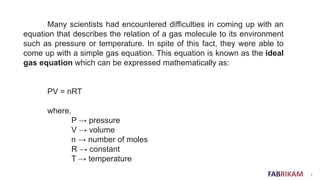
Many scientists had encountered difficulties in coming up with an
equation that describes the relation of a gas molecule to its environment
such as pressure or temperature. In spite of this fact, they were able to
come up with a simple gas equation. This equation is known as the ideal
gas equation which can be expressed mathematically as:
PV = nRT
where,
P → pressure
V → volume
n → number of moles
R → constant
T → temperature
FABRIKAM 4
Before applying the concept, it is important that we understand
the concept first. Boyle's Law, Charles' Law and Avogadro's Law assume
that the gases are in an ideal state where it is unaffected by real world
conditions. Thus, an ideal gas follows the Kinetic-Molecular Theory which
differentiate them from non ideal gas because they deviate from this
theory due to real world conditions.
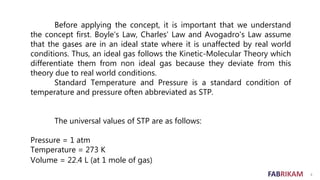
Standard Temperature and Pressure is a standard condition of
temperature and pressure often abbreviated as STP.
The universal values of STP are as follows:
Pressure = 1 atm
Temperature = 273 K
Volume = 22.4 L (at 1 mole of gas)
FABRIKAM 5
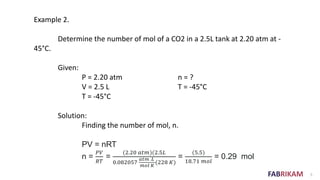
Example 2.
Determine the number of mol of a CO2 in a 2.5L tank at 2.20 atm at -
45°C.
Given:
P = 2.20 atm n = ?
V = 2.5 L T = -45°C
T = -45°C
Solution:
Finding the number of mol, n.
PV = nRT
n =
𝑃𝑉
𝑅𝑇
=
(2.20 𝑎𝑡𝑚)(2.5𝐿
0.082057
𝑎𝑡𝑚 .𝐿
𝑚𝑜𝑙 𝐾
(228 𝐾)
=
(5.5)
18.71 𝑚𝑜𝑙
= 0.29 mol
FABRIKAM 6
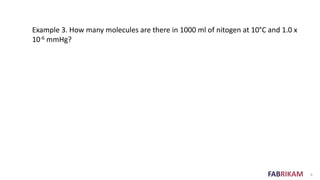
Example 3. How many molecules are there in 1000 ml of nitogen at 10°C and 1.0 x
10-6 mmHg?

Ideal Gas Law.pptx

  • 1.
  • 2.
    FABRIKAM 2 GETTING STARTED Respirationis the process by which we draw air into our lungs so that our bodies can take up oxygen from the air. Let us examine the situation below. As we inhale, the diaphragm moves down to reduce pressure in the lungs, causing external air to rush in to fill the lower pressure volume. As we exhale, the diaphragm is pushing against the lungs, increasing pressure inside the lungs and forcing the high-pressure air out. Breathing involves pressure differences between the inside of the lungs and the air outside. The pressure differences are only a few torr. Figure 28.1. Respiration A normal breath contain 0.21 mol of air per breath-- not much but enough to keep us alive.
  • 3.
    FABRIKAM 3 Many scientistshad encountered difficulties in coming up with an equation that describes the relation of a gas molecule to its environment such as pressure or temperature. In spite of this fact, they were able to come up with a simple gas equation. This equation is known as the ideal gas equation which can be expressed mathematically as: PV = nRT where, P → pressure V → volume n → number of moles R → constant T → temperature
  • 4.
    FABRIKAM 4 Before applyingthe concept, it is important that we understand the concept first. Boyle's Law, Charles' Law and Avogadro's Law assume that the gases are in an ideal state where it is unaffected by real world conditions. Thus, an ideal gas follows the Kinetic-Molecular Theory which differentiate them from non ideal gas because they deviate from this theory due to real world conditions. Standard Temperature and Pressure is a standard condition of temperature and pressure often abbreviated as STP. The universal values of STP are as follows: Pressure = 1 atm Temperature = 273 K Volume = 22.4 L (at 1 mole of gas)
  • 5.
    FABRIKAM 5 Example 2. Determinethe number of mol of a CO2 in a 2.5L tank at 2.20 atm at - 45°C. Given: P = 2.20 atm n = ? V = 2.5 L T = -45°C T = -45°C Solution: Finding the number of mol, n. PV = nRT n = 𝑃𝑉 𝑅𝑇 = (2.20 𝑎𝑡𝑚)(2.5𝐿 0.082057 𝑎𝑡𝑚 .𝐿 𝑚𝑜𝑙 𝐾 (228 𝐾) = (5.5) 18.71 𝑚𝑜𝑙 = 0.29 mol
  • 6.
    FABRIKAM 6 Example 3.How many molecules are there in 1000 ml of nitogen at 10°C and 1.0 x 10⁻⁶ mmHg?