SEISMOLOGY : THE STUDY
OF SEISMIC WAVES
What is Seismic Waves?
• are the scientific study of earthquakes
• encompasses the investigation of seismic waves and their
behavior.
• are the waves of energy that travel through the Earth’s layers
following an earthquake or other seismic event.
• it provide valuable information about the Earth’s interior
structure and composition.
TWO (2) MAJOR TYPES OF
SEISMIC WAVES
BODY WAVES
Body waves provide valuable information about the
Earth’s interior structure and composition. By studying the
characteristics and behavior of P-waves and S-waves,
seismologists can infer the properties of the Earth’s layers
and gain insights into the nature of seismic events such as
earthquakes.
Primary Waves
• Primary Waves (P-waves): P-waves are
the fastest seismic waves and are the first to
arrive at seismometers after an earthquake.
They are compressional waves that can
travel through solids, liquids, and gases.
Secondary Waves
• Secondary Waves (S-waves): S-
waves are slower than P-waves and
arrive after P-waves. They are shear
waves that can only travel through
solids, not through liquids or gases.
SURFACE WAVES
Are a type of seismic wave that propagates along the
Earth’s surface, causing the ground to move in a rolling or
swaying motion. These waves are generated by the
interaction of body waves with the Earth’s surface and are
responsible for the most significant ground shaking and
damage during an earthquake.
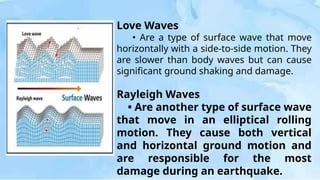
Love Waves
• Are a type of surface wave that move
horizontally with a side-to-side motion. They
are slower than body waves but can cause
significant ground shaking and damage.
Rayleigh Waves
• Are another type of surface wave
that move in an elliptical rolling
motion. They cause both vertical
and horizontal ground motion and
are responsible for the most
damage during an earthquake.
THANK YOU!

Seismology: The Study pf Seismic Waves.pptx

  • 1.
    SEISMOLOGY : THESTUDY OF SEISMIC WAVES
  • 2.
    What is SeismicWaves? • are the scientific study of earthquakes • encompasses the investigation of seismic waves and their behavior. • are the waves of energy that travel through the Earth’s layers following an earthquake or other seismic event. • it provide valuable information about the Earth’s interior structure and composition.
  • 3.
    TWO (2) MAJORTYPES OF SEISMIC WAVES
  • 4.
    BODY WAVES Body wavesprovide valuable information about the Earth’s interior structure and composition. By studying the characteristics and behavior of P-waves and S-waves, seismologists can infer the properties of the Earth’s layers and gain insights into the nature of seismic events such as earthquakes.
  • 5.
    Primary Waves • PrimaryWaves (P-waves): P-waves are the fastest seismic waves and are the first to arrive at seismometers after an earthquake. They are compressional waves that can travel through solids, liquids, and gases. Secondary Waves • Secondary Waves (S-waves): S- waves are slower than P-waves and arrive after P-waves. They are shear waves that can only travel through solids, not through liquids or gases.
  • 6.
    SURFACE WAVES Are atype of seismic wave that propagates along the Earth’s surface, causing the ground to move in a rolling or swaying motion. These waves are generated by the interaction of body waves with the Earth’s surface and are responsible for the most significant ground shaking and damage during an earthquake.
  • 7.
    Love Waves • Area type of surface wave that move horizontally with a side-to-side motion. They are slower than body waves but can cause significant ground shaking and damage. Rayleigh Waves • Are another type of surface wave that move in an elliptical rolling motion. They cause both vertical and horizontal ground motion and are responsible for the most damage during an earthquake.
  • 8.