Introduction to Seismology Seismic Hazard Analysis 2 Department of Earth Sciences KFUPM Ali Oncel [email_address] Introduction to Seismology-KFUPM
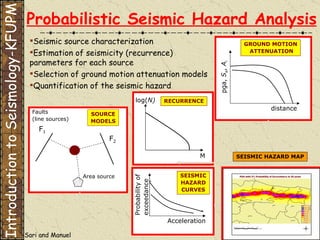
Seismic source characterization Estimation of seismicity (recurrence) parameters for each source Selection of ground motion attenuation models Quantification of the seismic hazard Sari and Manuel Probabilistic Seismic Hazard Analysis Introduction to Seismology-KFUPM log( N) M RECURRENCE Probability of exceedance Acceleration SEISMIC HAZARD CURVES F 2 F 1 Faults (line sources) Area source SOURCE MODELS pga,  S a ,  A i GROUND MOTION ATTENUATION distance SEISMIC HAZARD MAP
PART 1: SOURCE CHARACTERIZATION Introduction to Seismology-KFUPM
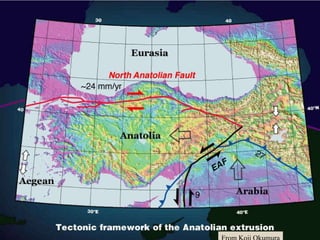
From Koji Okumura
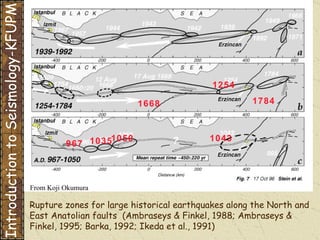
Rupture zones for large historical earthquakes along the North and East Anatolian faults  (Ambraseys & Finkel, 1988; Ambraseys & Finkel, 1995; Barka, 1992; Ikeda et al., 1991)   from Introduction to Seismology-KFUPM 1254 967 1784 1668 1035 1050 1043 From Koji Okumura
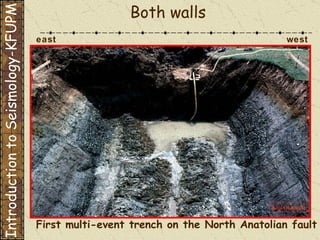
Both walls Introduction to Seismology-KFUPM east west First multi-event trench on the North Anatolian fault Koji Okumura
 
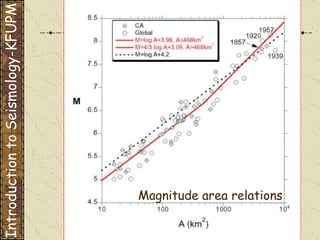
Magnitude area relations Introduction to Seismology-KFUPM
Magnitude scales: Body wave magnitude (Mb) Richter magnitude (ML) Surface wave magnitude (Ms) Moment magnitude (Mw) Catalogs: Preliminary Determination of Earthquakes (PDE) International Seismic Centre (ISC) Local catalogs (Ambraseys) EARTHQUAKE CATALOGS Introduction to Seismology-KFUPM
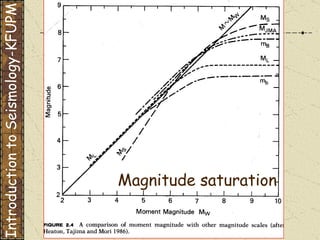
Magnitude saturation Introduction to Seismology-KFUPM
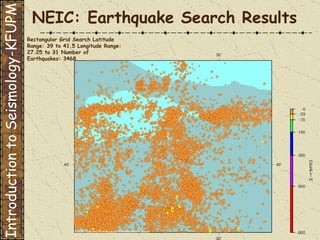
NEIC: Earthquake Search Results                                                                                                           Rectangular Grid Search Latitude Range: 39 to 41.5 Longitude Range: 27.25 to 31 Number of Earthquakes: 3468    Introduction to Seismology-KFUPM
Development of one catalog from several catalogs Declustering Use of Catalog Calculation of Gutenberg-Richter a and b-values Smooth seismicity model (background) Comparison with model rates of seismicity Developing uniform catalog: Introduction to Seismology-KFUPM
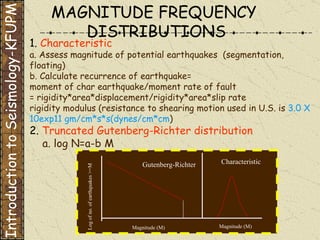
1.   Characteristic  a. Assess magnitude of potential earthquakes  (segmentation, floating) b. Calculate recurrence of earthquake=  moment of char earthquake/moment rate of fault = rigidity*area*displacement/rigidity*area*slip rate rigidity modulus (resistance to shearing motion used in U.S. is  3.0 X 10exp11 gm/cm*s*s(dynes/cm*cm ) 2.   Truncated Gutenberg-Richter distribution a. log N=a-b M MAGNITUDE FREQUENCY  DISTRIBUTIONS Introduction to Seismology-KFUPM Log of no. of earthquakes >=M Magnitude (M) Magnitude (M) Characteristic Gutenberg-Richter
Assumes that where smaller magnitude earthquakes have occurred in the past is where larger earthquakes  will occur in the future. Smoothed Seismicity Introduction to Seismology-KFUPM
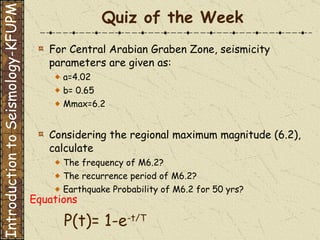
Quiz of the Week For Central Arabian Graben Zone, seismicity parameters are given as: a=4.02 b= 0.65 Mmax=6.2 Considering the regional maximum magnitude (6.2), calculate  The frequency of M6.2?  The recurrence period of M6.2? Earthquake Probability of M6.2 for 50 yrs? P(t)= 1-e -t/T Equations Introduction to Seismology-KFUPM

ÖNCEL AKADEMİ: INTRODUCTION TO SEISMOLOGY

  • 1.
    Introduction to SeismologySeismic Hazard Analysis 2 Department of Earth Sciences KFUPM Ali Oncel [email_address] Introduction to Seismology-KFUPM
  • 2.
    Seismic source characterizationEstimation of seismicity (recurrence) parameters for each source Selection of ground motion attenuation models Quantification of the seismic hazard Sari and Manuel Probabilistic Seismic Hazard Analysis Introduction to Seismology-KFUPM log( N) M RECURRENCE Probability of exceedance Acceleration SEISMIC HAZARD CURVES F 2 F 1 Faults (line sources) Area source SOURCE MODELS pga, S a , A i GROUND MOTION ATTENUATION distance SEISMIC HAZARD MAP
  • 3.
    PART 1: SOURCECHARACTERIZATION Introduction to Seismology-KFUPM
  • 4.
  • 5.
    Rupture zones forlarge historical earthquakes along the North and East Anatolian faults (Ambraseys & Finkel, 1988; Ambraseys & Finkel, 1995; Barka, 1992; Ikeda et al., 1991) from Introduction to Seismology-KFUPM 1254 967 1784 1668 1035 1050 1043 From Koji Okumura
  • 6.
    Both walls Introductionto Seismology-KFUPM east west First multi-event trench on the North Anatolian fault Koji Okumura
  • 7.
  • 8.
    Magnitude area relationsIntroduction to Seismology-KFUPM
  • 9.
    Magnitude scales: Bodywave magnitude (Mb) Richter magnitude (ML) Surface wave magnitude (Ms) Moment magnitude (Mw) Catalogs: Preliminary Determination of Earthquakes (PDE) International Seismic Centre (ISC) Local catalogs (Ambraseys) EARTHQUAKE CATALOGS Introduction to Seismology-KFUPM
  • 10.
  • 11.
    NEIC: Earthquake SearchResults                                                                                                          Rectangular Grid Search Latitude Range: 39 to 41.5 Longitude Range: 27.25 to 31 Number of Earthquakes: 3468   Introduction to Seismology-KFUPM
  • 12.
    Development of onecatalog from several catalogs Declustering Use of Catalog Calculation of Gutenberg-Richter a and b-values Smooth seismicity model (background) Comparison with model rates of seismicity Developing uniform catalog: Introduction to Seismology-KFUPM
  • 13.
    1. Characteristic a. Assess magnitude of potential earthquakes (segmentation, floating) b. Calculate recurrence of earthquake= moment of char earthquake/moment rate of fault = rigidity*area*displacement/rigidity*area*slip rate rigidity modulus (resistance to shearing motion used in U.S. is 3.0 X 10exp11 gm/cm*s*s(dynes/cm*cm ) 2. Truncated Gutenberg-Richter distribution a. log N=a-b M MAGNITUDE FREQUENCY DISTRIBUTIONS Introduction to Seismology-KFUPM Log of no. of earthquakes >=M Magnitude (M) Magnitude (M) Characteristic Gutenberg-Richter
  • 14.
    Assumes that wheresmaller magnitude earthquakes have occurred in the past is where larger earthquakes will occur in the future. Smoothed Seismicity Introduction to Seismology-KFUPM
  • 15.
    Quiz of theWeek For Central Arabian Graben Zone, seismicity parameters are given as: a=4.02 b= 0.65 Mmax=6.2 Considering the regional maximum magnitude (6.2), calculate The frequency of M6.2? The recurrence period of M6.2? Earthquake Probability of M6.2 for 50 yrs? P(t)= 1-e -t/T Equations Introduction to Seismology-KFUPM