Ali Oncel [email_address] Department of Earth Sciences KFUPM Gravity Modeling 2 Introduction to Geophysics Introduction to Geophysics-KFUPM Highest peaks on the planet
Previous Lecture Local Isostasy & Flexure  Regional Isostasy & Flexure  Flexural Rigidity (D)  Flexural Modeling  Examples of Lithospheric Flexure Example from the West Africa (Watts and Stewart, 1998).   Introduction to Geophysics-KFUPM
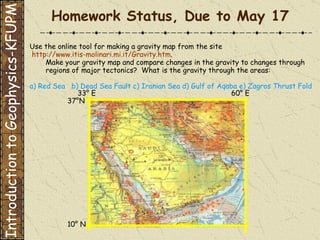
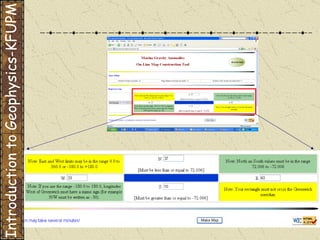
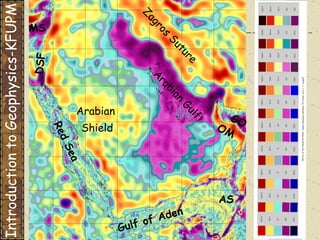
Homework Status, Due to May 17 Use the online tool for making a gravity map from the site http://www.itis-molinari.mi.it/Gravity.htm . Make your gravity map and compare changes in the gravity to changes through regions of major tectonics?  What is the gravity through the areas:  a) Red Sea  b) Dead Sea Fault c) Iranian Sea d) Gulf of Aqaba e) Zagros Thrust Fold Introduction to Geophysics-KFUPM
Introduction to Geophysics-KFUPM
Red Sea Arabian Gulf DSF Arabian  Shield Gulf of Aden Zagros Suture GO AS MS OM Introduction to Geophysics-KFUPM
Homework Status, Due to May 20 Given the following exercises of your handout: 8.2 8.3 8.8 Try to use one of those provided Excel Programs if possible in solving your problems from the link: http://www.mtech.edu/clink/Home/Classes/Geop3020/chapter6.htm Then, e-mail your homework which is solved under Excel to me :  [email_address] .  Introduction to Geophysics-KFUPM
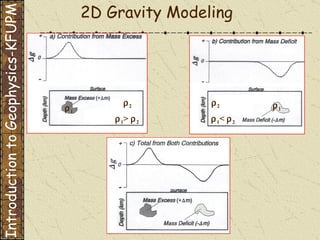
2D Gravity Modeling  1 >    2  1  2  1 <    2  1  2 Introduction to Geophysics-KFUPM
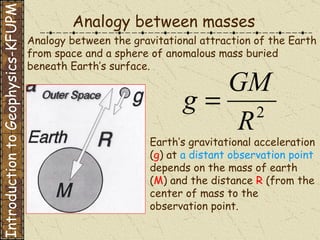
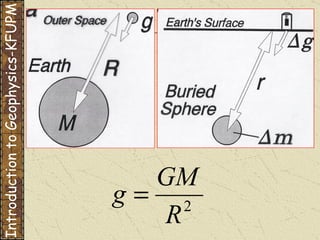
Analogy between the gravitational attraction of the Earth from space and a sphere of anomalous mass buried beneath Earth’s surface. Earth’s gravitational acceleration ( g ) at  a distant observation point  depends on the mass of earth ( M ) and the distance  R  (from the center of mass to the observation point. Analogy between masses Introduction to Geophysics-KFUPM
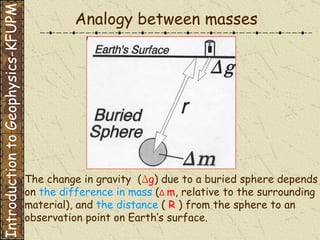
The change in gravity  ( Δ g ) due to a buried sphere depends on  the difference in mass  ( Δ   m , relative to the surrounding material), and  the distance  (  R  ) from the sphere to an observation point on Earth’s surface. Analogy between masses Introduction to Geophysics-KFUPM
Introduction to Geophysics-KFUPM
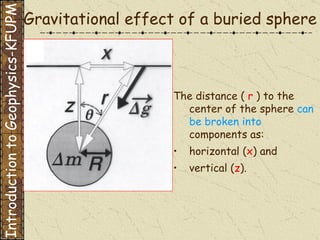
Gravitational effect of a buried sphere The distance (  r  ) to the center of the sphere  can be broken into  components as: horizontal ( x ) and  vertical ( z ). Introduction to Geophysics-KFUPM
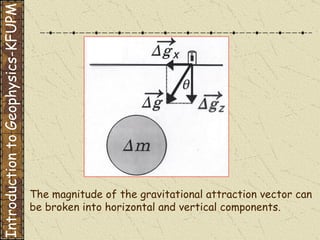
The magnitude of the gravitational attraction vector can be broken into horizontal and vertical components. Introduction to Geophysics-KFUPM
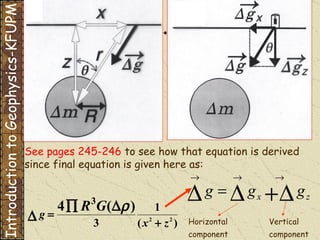
Introduction to Geophysics-KFUPM See pages 245-246  to see how that equation is derived since final equation is given here as: Horizontal  component Vertical  component
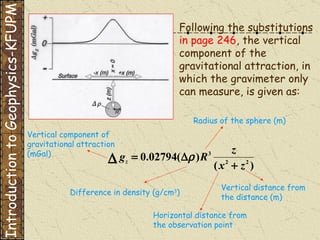
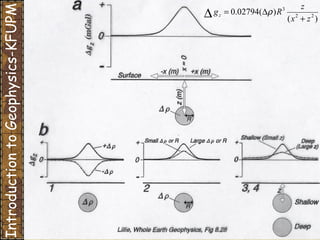
Following the substitutions  in page 246 , the vertical component of the gravitational attraction, in which the gravimeter only can measure, is given as: Vertical component of gravitational attraction (mGal) Difference in density (g/cm 3 ) Radius of the sphere (m) Horizontal distance from the observation point Vertical distance from the distance (m) Introduction to Geophysics-KFUPM
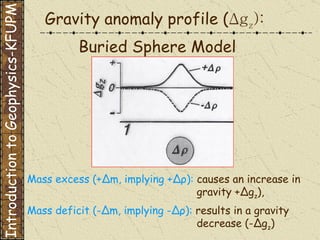
Gravity anomaly profile ( Δ g z ):  Buried Sphere Model Mass excess   (+ Δ m, implying  + Δ ρ ):  causes an increase in    gravity  + Δ g z ),  Mass deficit  (- Δ m, implying  - Δ ρ ):  results in a gravity    decrease ( - Δ g z ) Introduction to Geophysics-KFUPM
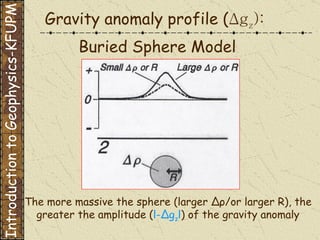
The more massive the sphere (larger  Δ ρ /or larger R), the greater the amplitude ( l - Δ g z l ) of the gravity anomaly Gravity anomaly profile ( Δ g z ):  Buried Sphere Model Introduction to Geophysics-KFUPM
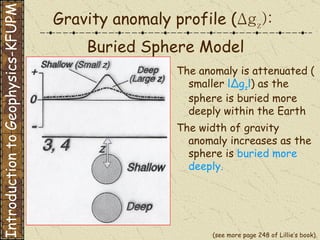
The anomaly is attenuated ( smaller  l Δ g z l ) as the sphere is buried more deeply within the Earth The width of gravity anomaly increases as the sphere is  buried more deeply. Gravity anomaly profile ( Δ g z ):  Buried Sphere Model Introduction to Geophysics-KFUPM (see more page 248 of Lillie’s book).
Introduction to Geophysics-KFUPM

ÖNCEL AKADEMİ: INTRODUCTION TO GEOPHYSICS

  • 1.
    Ali Oncel [email_address]Department of Earth Sciences KFUPM Gravity Modeling 2 Introduction to Geophysics Introduction to Geophysics-KFUPM Highest peaks on the planet
  • 2.
    Previous Lecture LocalIsostasy & Flexure Regional Isostasy & Flexure Flexural Rigidity (D) Flexural Modeling Examples of Lithospheric Flexure Example from the West Africa (Watts and Stewart, 1998). Introduction to Geophysics-KFUPM
  • 3.
    Homework Status, Dueto May 17 Use the online tool for making a gravity map from the site http://www.itis-molinari.mi.it/Gravity.htm . Make your gravity map and compare changes in the gravity to changes through regions of major tectonics? What is the gravity through the areas: a) Red Sea b) Dead Sea Fault c) Iranian Sea d) Gulf of Aqaba e) Zagros Thrust Fold Introduction to Geophysics-KFUPM
  • 4.
  • 5.
    Red Sea ArabianGulf DSF Arabian Shield Gulf of Aden Zagros Suture GO AS MS OM Introduction to Geophysics-KFUPM
  • 6.
    Homework Status, Dueto May 20 Given the following exercises of your handout: 8.2 8.3 8.8 Try to use one of those provided Excel Programs if possible in solving your problems from the link: http://www.mtech.edu/clink/Home/Classes/Geop3020/chapter6.htm Then, e-mail your homework which is solved under Excel to me : [email_address] . Introduction to Geophysics-KFUPM
  • 7.
    2D Gravity Modeling 1 >  2  1  2  1 <  2  1  2 Introduction to Geophysics-KFUPM
  • 8.
    Analogy between thegravitational attraction of the Earth from space and a sphere of anomalous mass buried beneath Earth’s surface. Earth’s gravitational acceleration ( g ) at a distant observation point depends on the mass of earth ( M ) and the distance R (from the center of mass to the observation point. Analogy between masses Introduction to Geophysics-KFUPM
  • 9.
    The change ingravity ( Δ g ) due to a buried sphere depends on the difference in mass ( Δ m , relative to the surrounding material), and the distance ( R ) from the sphere to an observation point on Earth’s surface. Analogy between masses Introduction to Geophysics-KFUPM
  • 10.
  • 11.
    Gravitational effect ofa buried sphere The distance ( r ) to the center of the sphere can be broken into components as: horizontal ( x ) and vertical ( z ). Introduction to Geophysics-KFUPM
  • 12.
    The magnitude ofthe gravitational attraction vector can be broken into horizontal and vertical components. Introduction to Geophysics-KFUPM
  • 13.
    Introduction to Geophysics-KFUPMSee pages 245-246 to see how that equation is derived since final equation is given here as: Horizontal component Vertical component
  • 14.
    Following the substitutions in page 246 , the vertical component of the gravitational attraction, in which the gravimeter only can measure, is given as: Vertical component of gravitational attraction (mGal) Difference in density (g/cm 3 ) Radius of the sphere (m) Horizontal distance from the observation point Vertical distance from the distance (m) Introduction to Geophysics-KFUPM
  • 15.
    Gravity anomaly profile( Δ g z ): Buried Sphere Model Mass excess (+ Δ m, implying + Δ ρ ): causes an increase in gravity + Δ g z ), Mass deficit (- Δ m, implying - Δ ρ ): results in a gravity decrease ( - Δ g z ) Introduction to Geophysics-KFUPM
  • 16.
    The more massivethe sphere (larger Δ ρ /or larger R), the greater the amplitude ( l - Δ g z l ) of the gravity anomaly Gravity anomaly profile ( Δ g z ): Buried Sphere Model Introduction to Geophysics-KFUPM
  • 17.
    The anomaly isattenuated ( smaller l Δ g z l ) as the sphere is buried more deeply within the Earth The width of gravity anomaly increases as the sphere is buried more deeply. Gravity anomaly profile ( Δ g z ): Buried Sphere Model Introduction to Geophysics-KFUPM (see more page 248 of Lillie’s book).
  • 18.