Ali Oncel [email_address] Department of Earth Sciences KFUPM Gravity Modeling Introduction to Geophysics Introduction to Geophysics-KFUPM Highest peaks on the planet
Previous Lecture Models of Isostasy Airy Model  Pratt Model Local Isostasy  Lithostatic Pressure   Mathematical Background of Airy Model Mathematical Background of Pratt Model Introduction to Geophysics-KFUPM
Recall: Elasticity Elasticity:  ability of materials to return to original shape, size and position after removal of stress The lithosphere behaves  elastically , therefore it bends when forces (loads) are applied to it. This behavior is called  flexure , which is a means of distributing a mass excess ( a load ) over a large area in order to achieve isostatic equilibrium. Introduction to Geophysics-KFUPM
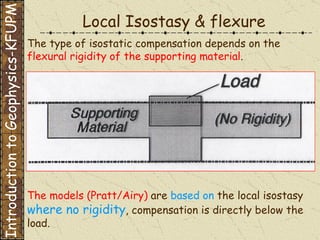
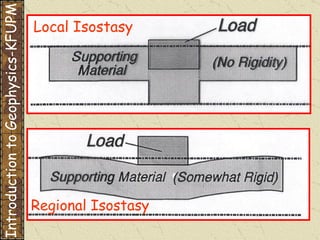
The type of isostatic compensation depends on the  flexural rigidity of the supporting material . The models (Pratt/Airy)  are  based on  the local isostasy  where no rigidity , compensation is directly below the load. Local Isostasy & flexure Introduction to Geophysics-KFUPM
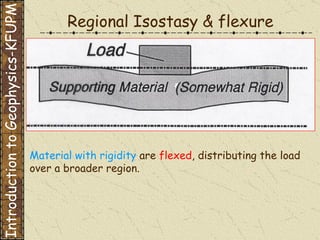
Regional Isostasy & flexure Material with rigidity  are  flexed , distributing the load over a broader region. Introduction to Geophysics-KFUPM
Introduction to Geophysics-KFUPM
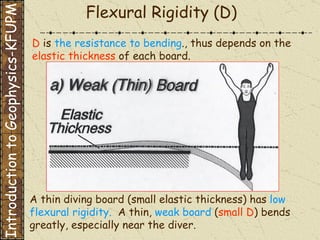
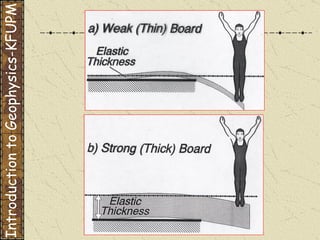
Flexural Rigidity (D) A thin diving board (small elastic thickness) has  low flexural rigidity.   A thin,  weak board  ( small D ) bends greatly, especially near the diver. D   is  the resistance to bending ., thus depends on the   elastic thickness   of each board. Introduction to Geophysics-KFUPM
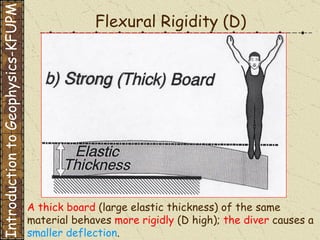
Flexural Rigidity (D) A thick board  (large elastic thickness) of the same material behaves  more rigidly  (D high);  the diver  causes a  smaller deflection . Introduction to Geophysics-KFUPM
Introduction to Geophysics-KFUPM
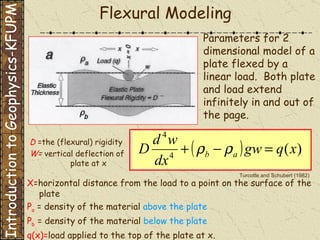
Flexural Modeling X =horizontal distance from the load to a point on the surface of the plate Ρ a  = density of the material  above the plate Ρ b  = density of the material  below the plate q(x)= load applied to the top of the plate at x. Parameters for 2 dimensional model of a plate flexed by a linear load.  Both plate and load extend infinitely in and out of the page. Introduction to Geophysics-KFUPM D  =the (flexural) rigidity W =  vertical deflection of  plate at x Turcotte and Schubert (1982)
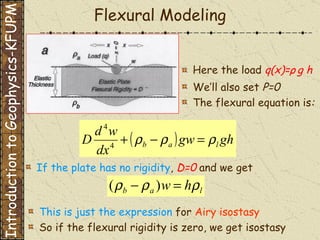
Flexural Modeling If the plate has no rigidity ,  D=0   and we get Here the load  q(x)= ρ   g h We’ll also set  P=0 The flexural equation is : This is just the expression  for   Airy isostasy So if the flexural rigidity is zero, we get isostasy Introduction to Geophysics-KFUPM
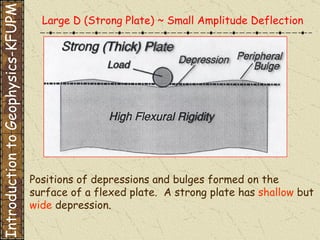
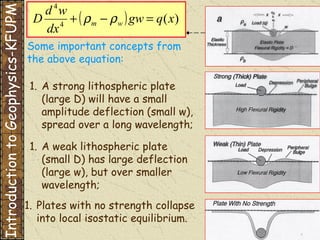
Positions of depressions and bulges formed on the surface of a flexed plate.  A strong plate has   shallow   but   wide   depression. Introduction to Geophysics-KFUPM Large D (Strong Plate) ~ Small Amplitude Deflection
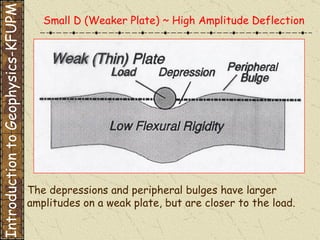
The depressions and peripheral bulges have larger amplitudes on a weak plate, but are closer to the load. Small D (Weaker Plate) ~ High Amplitude Deflection Introduction to Geophysics-KFUPM
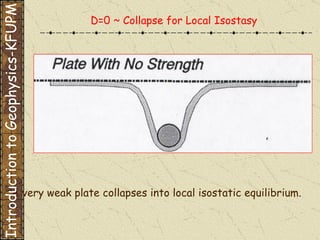
A very weak plate collapses into local isostatic equilibrium. D=0 ~ Collapse for Local Isostasy Introduction to Geophysics-KFUPM
Plates with no strength collapse into local isostatic equilibrium. A strong lithospheric plate (large D) will have a small amplitude deflection (small w), spread over a long wavelength; A weak lithospheric plate (small D) has large deflection (large w), but over smaller wavelength; Some important concepts from the above equation: Introduction to Geophysics-KFUPM
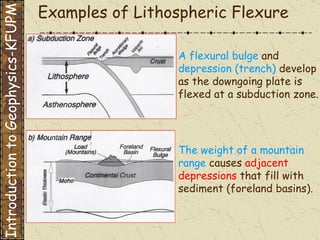
Examples of Lithospheric Flexure A flexural bulge  and  depression (trench)  develop as the downgoing plate is flexed at a subduction zone. The weight of a mountain range  causes  adjacent depressions  that fill with sediment (foreland basins). Introduction to Geophysics-KFUPM
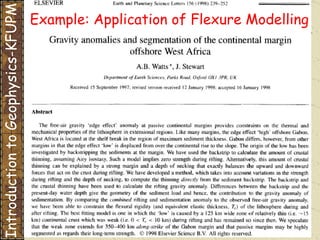
Introduction to Geophysics-KFUPM Example: Application of Flexure Modelling
Homework, Due to May 20 Given the following exercises of your handout: 8.2 8.3 8.8 Try to use one of those provided Excel Programs if possible in solving your problems from the link: http://www.mtech.edu/clink/Home/Classes/Geop3020/chapter6.htm Then, e-mail your homework which is solved under Excel to me :  [email_address] .  Introduction to Geophysics-KFUPM

ÖNCEL AKADEMİ: INTRODUCTION TO GEOPHYSICS

  • 1.
    Ali Oncel [email_address]Department of Earth Sciences KFUPM Gravity Modeling Introduction to Geophysics Introduction to Geophysics-KFUPM Highest peaks on the planet
  • 2.
    Previous Lecture Modelsof Isostasy Airy Model Pratt Model Local Isostasy Lithostatic Pressure Mathematical Background of Airy Model Mathematical Background of Pratt Model Introduction to Geophysics-KFUPM
  • 3.
    Recall: Elasticity Elasticity: ability of materials to return to original shape, size and position after removal of stress The lithosphere behaves elastically , therefore it bends when forces (loads) are applied to it. This behavior is called flexure , which is a means of distributing a mass excess ( a load ) over a large area in order to achieve isostatic equilibrium. Introduction to Geophysics-KFUPM
  • 4.
    The type ofisostatic compensation depends on the flexural rigidity of the supporting material . The models (Pratt/Airy) are based on the local isostasy where no rigidity , compensation is directly below the load. Local Isostasy & flexure Introduction to Geophysics-KFUPM
  • 5.
    Regional Isostasy &flexure Material with rigidity are flexed , distributing the load over a broader region. Introduction to Geophysics-KFUPM
  • 6.
  • 7.
    Flexural Rigidity (D)A thin diving board (small elastic thickness) has low flexural rigidity. A thin, weak board ( small D ) bends greatly, especially near the diver. D is the resistance to bending ., thus depends on the elastic thickness of each board. Introduction to Geophysics-KFUPM
  • 8.
    Flexural Rigidity (D)A thick board (large elastic thickness) of the same material behaves more rigidly (D high); the diver causes a smaller deflection . Introduction to Geophysics-KFUPM
  • 9.
  • 10.
    Flexural Modeling X=horizontal distance from the load to a point on the surface of the plate Ρ a = density of the material above the plate Ρ b = density of the material below the plate q(x)= load applied to the top of the plate at x. Parameters for 2 dimensional model of a plate flexed by a linear load. Both plate and load extend infinitely in and out of the page. Introduction to Geophysics-KFUPM D =the (flexural) rigidity W = vertical deflection of plate at x Turcotte and Schubert (1982)
  • 11.
    Flexural Modeling Ifthe plate has no rigidity , D=0 and we get Here the load q(x)= ρ g h We’ll also set P=0 The flexural equation is : This is just the expression for Airy isostasy So if the flexural rigidity is zero, we get isostasy Introduction to Geophysics-KFUPM
  • 12.
    Positions of depressionsand bulges formed on the surface of a flexed plate. A strong plate has shallow but wide depression. Introduction to Geophysics-KFUPM Large D (Strong Plate) ~ Small Amplitude Deflection
  • 13.
    The depressions andperipheral bulges have larger amplitudes on a weak plate, but are closer to the load. Small D (Weaker Plate) ~ High Amplitude Deflection Introduction to Geophysics-KFUPM
  • 14.
    A very weakplate collapses into local isostatic equilibrium. D=0 ~ Collapse for Local Isostasy Introduction to Geophysics-KFUPM
  • 15.
    Plates with nostrength collapse into local isostatic equilibrium. A strong lithospheric plate (large D) will have a small amplitude deflection (small w), spread over a long wavelength; A weak lithospheric plate (small D) has large deflection (large w), but over smaller wavelength; Some important concepts from the above equation: Introduction to Geophysics-KFUPM
  • 16.
    Examples of LithosphericFlexure A flexural bulge and depression (trench) develop as the downgoing plate is flexed at a subduction zone. The weight of a mountain range causes adjacent depressions that fill with sediment (foreland basins). Introduction to Geophysics-KFUPM
  • 17.
    Introduction to Geophysics-KFUPMExample: Application of Flexure Modelling
  • 18.
    Homework, Due toMay 20 Given the following exercises of your handout: 8.2 8.3 8.8 Try to use one of those provided Excel Programs if possible in solving your problems from the link: http://www.mtech.edu/clink/Home/Classes/Geop3020/chapter6.htm Then, e-mail your homework which is solved under Excel to me : [email_address] . Introduction to Geophysics-KFUPM

Editor's Notes

  • #6 Flex:Bukmek
  • #8 Diving Board: Atlama Tahtasi