Solid Earth Geophysics  Ali Oncel [email_address] Department of Earth Sciences KFUPM Today’s class:  Seismology Measuring the Interior Reading: Fowler Chapter 4
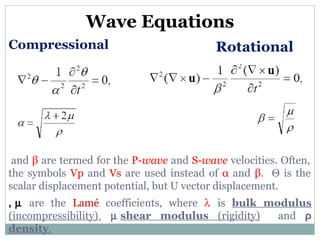
Compressional α   and  β  are termed for the  P- wave  and  S- wave  velocities. Often, the symbols  Vp  and  Vs  are used instead of  α   and  β .   Θ  is the scalar displacement potential, but U vector displacement.  ,    are the  Lamé  coefficients,  where     is  bulk modulus  (incompressibility) ,    shear modulus  (rigidity)   and  ρ   density . Wave Equations Rotational
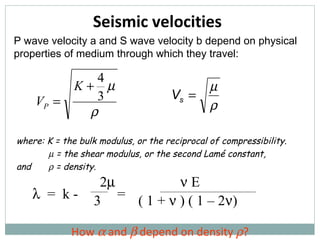
Seismic velocities How    and    depend on density   ? P wave velocity a and S wave velocity b depend on physical properties of medium through which they travel: where: K = the bulk modulus, or the reciprocal of compressibility.    = the shear modulus, or the second Lam é  constant, and    = density.    =  k -  = 2     E 3   ( 1 +    ) ( 1 – 2  )
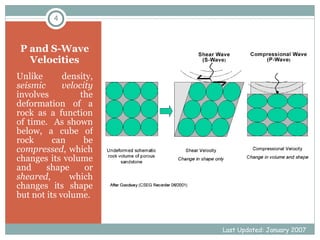
P and S-Wave Velocities Unlike density,  seismic   velocity  involves the deformation of a rock as a function of time.  As shown below, a cube of rock can be  compressed , which changes its volume and shape or  sheared , which changes its shape but not its volume. Last Updated: January 2007
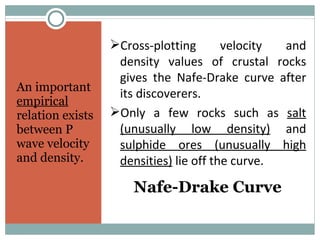
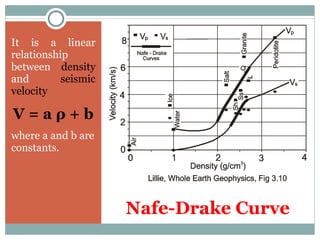
Nafe-Drake Curve An important  empirical  relation exists between P wave velocity and density. Cross-plotting velocity and density values of crustal rocks gives the Nafe-Drake curve after its discoverers. Only a few rocks such as  salt (unusually low density)  and  sulphide ores (unusually high densities)  lie off the curve.
Nafe-Drake Curve It is a linear relationship between  density  and  seismic velocity V = a  ρ  + b where a and b are constants.
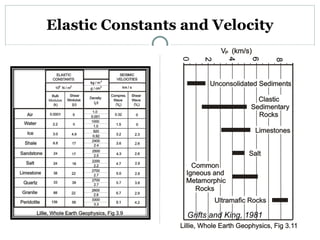
Elastic Constants and Velocity Grifts and King, 1981
 
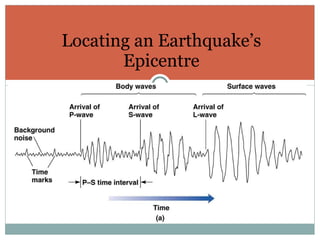
Locating an Earthquake’s Epicentre
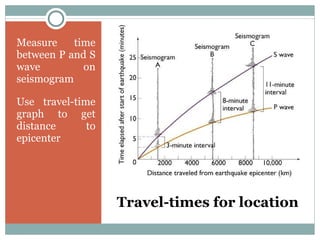
Travel-times for location Measure time between P and S wave on seismogram Use travel-time graph to get distance to epicenter
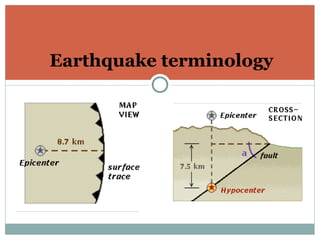
Earthquake terminology
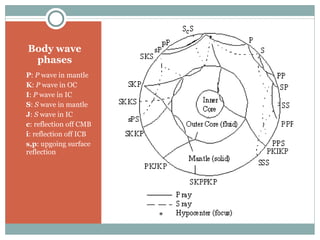
Body wave phases P :  P  wave in mantle K :  P  wave in OC I :  P  wave in IC S :  S  wave in mantle J :  S  wave in IC c : reflection off CMB i : reflection off ICB s,p : upgoing surface reflection
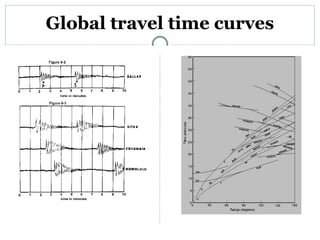
Global travel time curves
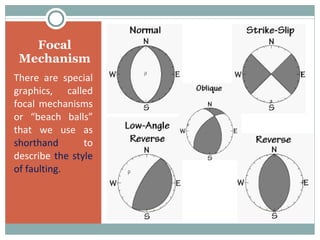
Focal Mechanism There are special graphics, called focal mechanisms or “beach balls” that we use as  shorthand   to describe  the style of faulting.
Seismographs A  seismograph  is an instrument which writes a  permanent continuous record of earth motion.[ 1 ]  Measuring the three orthogonal components of ground motion at a seismic.
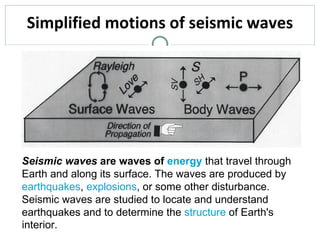
Simplified motions of seismic waves Seismic waves  are waves of  energy  that travel through Earth and along its surface. The waves are produced by  earthquakes ,  explosions , or some other disturbance. Seismic waves are studied to locate and understand earthquakes and to determine the  structure  of Earth's  interior.
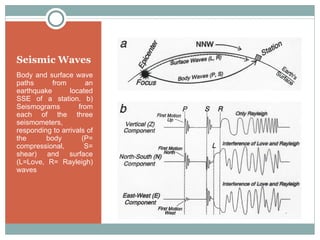
Seismic Waves Body and surface wave paths from an earthquake located SSE of a station. b) Seismograms from each of the three seismometers, responding to arrivals of the body (P= compressional, S= shear) and surface (L=Love, R= Rayleigh) waves
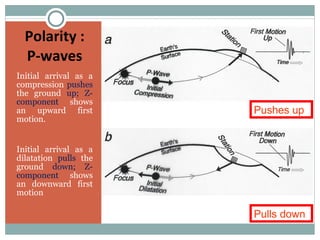
Polarity : P-waves Initial arrival as a compression  pushes   the ground  up; Z-component  shows an upward first motion.  Initial arrival as a dilatation  pulls   the ground  down; Z-component  shows an downward first motion Pushes up Pulls down
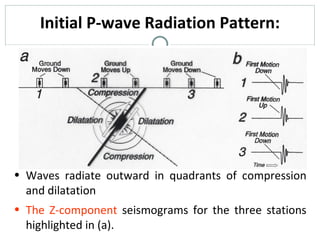
Initial P-wave Radiation Pattern: Waves radiate outward in quadrants of compression and dilatation The Z-component   seismograms for the three stations highlighted in (a).
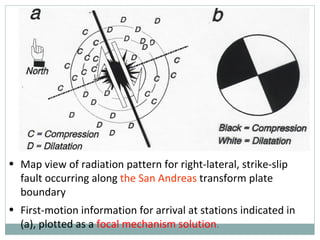
Map view of radiation pattern for right-lateral, strike-slip fault occurring along   the San Andreas   transform plate boundary First-motion information for arrival at stations indicated in (a), plotted as a   focal mechanism solution .
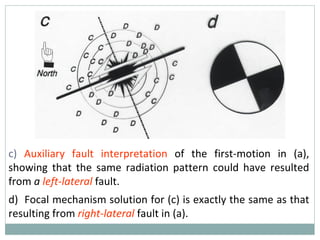
c)   Auxiliary fault interpretation   of the first-motion in (a), showing that the same radiation pattern could have resulted from  a   left-lateral   fault. d)  Focal mechanism solution for (c) is exactly the same as that resulting from   right-lateral  fault in (a).
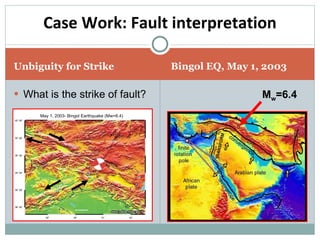
Unbiguity for Strike Bingol EQ, May 1, 2003 What is the strike of fault? Case Work: Fault interpretation M w =6.4
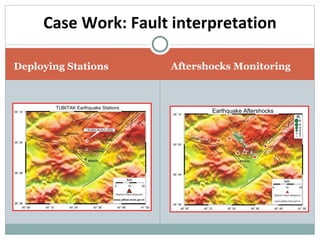
Deploying Stations Aftershocks Monitoring Case Work: Fault interpretation
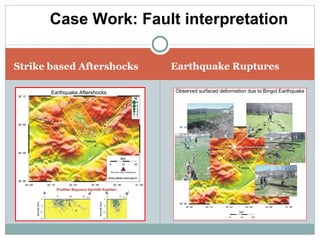
Strike based Aftershocks Earthquake Ruptures Case Work: Fault interpretation

ÖNCEL AKADEMİ: SOLID EARTH GEOPHYSICS

  • 1.
    Solid Earth Geophysics Ali Oncel [email_address] Department of Earth Sciences KFUPM Today’s class: Seismology Measuring the Interior Reading: Fowler Chapter 4
  • 2.
    Compressional α and β are termed for the P- wave and S- wave velocities. Often, the symbols Vp and Vs are used instead of α and β . Θ is the scalar displacement potential, but U vector displacement.  ,  are the Lamé coefficients, where  is bulk modulus (incompressibility) ,   shear modulus (rigidity) and ρ density . Wave Equations Rotational
  • 3.
    Seismic velocities How  and  depend on density  ? P wave velocity a and S wave velocity b depend on physical properties of medium through which they travel: where: K = the bulk modulus, or the reciprocal of compressibility.  = the shear modulus, or the second Lam é constant, and  = density.  = k - = 2   E 3 ( 1 +  ) ( 1 – 2  )
  • 4.
    P and S-WaveVelocities Unlike density, seismic velocity involves the deformation of a rock as a function of time. As shown below, a cube of rock can be compressed , which changes its volume and shape or sheared , which changes its shape but not its volume. Last Updated: January 2007
  • 5.
    Nafe-Drake Curve Animportant empirical relation exists between P wave velocity and density. Cross-plotting velocity and density values of crustal rocks gives the Nafe-Drake curve after its discoverers. Only a few rocks such as salt (unusually low density) and sulphide ores (unusually high densities) lie off the curve.
  • 6.
    Nafe-Drake Curve Itis a linear relationship between density and seismic velocity V = a ρ + b where a and b are constants.
  • 7.
    Elastic Constants andVelocity Grifts and King, 1981
  • 8.
  • 9.
  • 10.
    Travel-times for locationMeasure time between P and S wave on seismogram Use travel-time graph to get distance to epicenter
  • 11.
  • 12.
    Body wave phasesP : P wave in mantle K : P wave in OC I : P wave in IC S : S wave in mantle J : S wave in IC c : reflection off CMB i : reflection off ICB s,p : upgoing surface reflection
  • 13.
  • 14.
    Focal Mechanism Thereare special graphics, called focal mechanisms or “beach balls” that we use as shorthand to describe the style of faulting.
  • 15.
    Seismographs A seismograph is an instrument which writes a permanent continuous record of earth motion.[ 1 ] Measuring the three orthogonal components of ground motion at a seismic.
  • 16.
    Simplified motions ofseismic waves Seismic waves are waves of energy that travel through Earth and along its surface. The waves are produced by earthquakes , explosions , or some other disturbance. Seismic waves are studied to locate and understand earthquakes and to determine the structure of Earth's interior.
  • 17.
    Seismic Waves Bodyand surface wave paths from an earthquake located SSE of a station. b) Seismograms from each of the three seismometers, responding to arrivals of the body (P= compressional, S= shear) and surface (L=Love, R= Rayleigh) waves
  • 18.
    Polarity : P-wavesInitial arrival as a compression pushes the ground up; Z-component shows an upward first motion. Initial arrival as a dilatation pulls the ground down; Z-component shows an downward first motion Pushes up Pulls down
  • 19.
    Initial P-wave RadiationPattern: Waves radiate outward in quadrants of compression and dilatation The Z-component seismograms for the three stations highlighted in (a).
  • 20.
    Map view ofradiation pattern for right-lateral, strike-slip fault occurring along the San Andreas transform plate boundary First-motion information for arrival at stations indicated in (a), plotted as a focal mechanism solution .
  • 21.
    c) Auxiliary fault interpretation of the first-motion in (a), showing that the same radiation pattern could have resulted from a left-lateral fault. d) Focal mechanism solution for (c) is exactly the same as that resulting from right-lateral fault in (a).
  • 22.
    Unbiguity for StrikeBingol EQ, May 1, 2003 What is the strike of fault? Case Work: Fault interpretation M w =6.4
  • 23.
    Deploying Stations AftershocksMonitoring Case Work: Fault interpretation
  • 24.
    Strike based AftershocksEarthquake Ruptures Case Work: Fault interpretation

Editor's Notes

  • #3 PP.29-Stein: What in the physics of the solid earth allows waves to propagate through it? How does the propagation of seismic waves depend on the nature of the material within the earth? Stress Tensor : Describing the forces acting within a deformable solid earth material, and describes deformation.
  • #4 PP. 102, Fowler, 2005. The bulk modules K , which is defined as the ratio of the increase in pressure to the resulting fractional change in volume, is a measure of the force per unit area required to compress material. The shear modulus  is a measure of the force per unit area needed to change the shape of a material. Since P-wave involve change of volume and shape,  is a function of K and  , whereas  is only function of  because S-waves involve no change in volume. Since the bulk modules K must be positive, equations (4.4 and 4.5) show that Vp is always greater than Vp, or, in other words, P-waves always travel faster than S-waves. The rigidity  for liquid is zero, a liquid has no rigidity and can not sustain shear; EQ. (4.5) therefore indicates that S-waves can not be propagated through liquids. Thus, S-waves can not be transmitted through the Earth’s liquid outer core. The dependence of Vp and Vs on density is not immediately obvious, but, in general, denser rocks have higher seismic velocities, contrary to what one would expect from a first glance at Eqs. (4.4) and (4.5). This occurs because the elastic module K and  are also dependent on  and increase rapidly than  .
  • #7 Graph of seismic velocity versus density for materials presented in Fig.3.9. L=limestone; Q=quartz; Sh=shale; Ss=sandstone. Solid rectangles with labels are compressional wave velocities (Vp); corresponding shear wave velocities s) shown directly beneath by plus’s. Emprical (Nafe-Drake”) curves, developed through analysis of numerous rock and sediment samples, are superimposed on the graph (Ludwig, Nafe, and Drake, 1971). Portions of these curves, highlighted by the solid lines, show roughly linear relationship between seismic velocities and densities for crustal rocks. 1g/cm3=103kg/m3.
  • #10 Seismic wave behavior P waves arrive first, then S waves, then L and R After an earthquake, the difference in arrival times at a seismograph station can be used to calculate the distance from the seismograph to the epicenter (D).
  • #20 from an Earthquake occurring on a reverse fault