Introduction to Geophysics Ali Oncel [email_address] Department of Earth Sciences KFUPM Tectonic Interpretation of Seismic Refraction Profiles Introduction to Geophysics-KFUPM
Previous Lecture Hidden Layers   Problem Situations    Low Velocity layer (V 2 <V 1 <V 3 )  Thin layer (V 3 >V 2 >V 1  but h2 very small)  Velocity Inversion-Hidden Layers  Dipping Layer Refractions Single Dipping Refractor Surface   Introduction to Geophysics-KFUPM
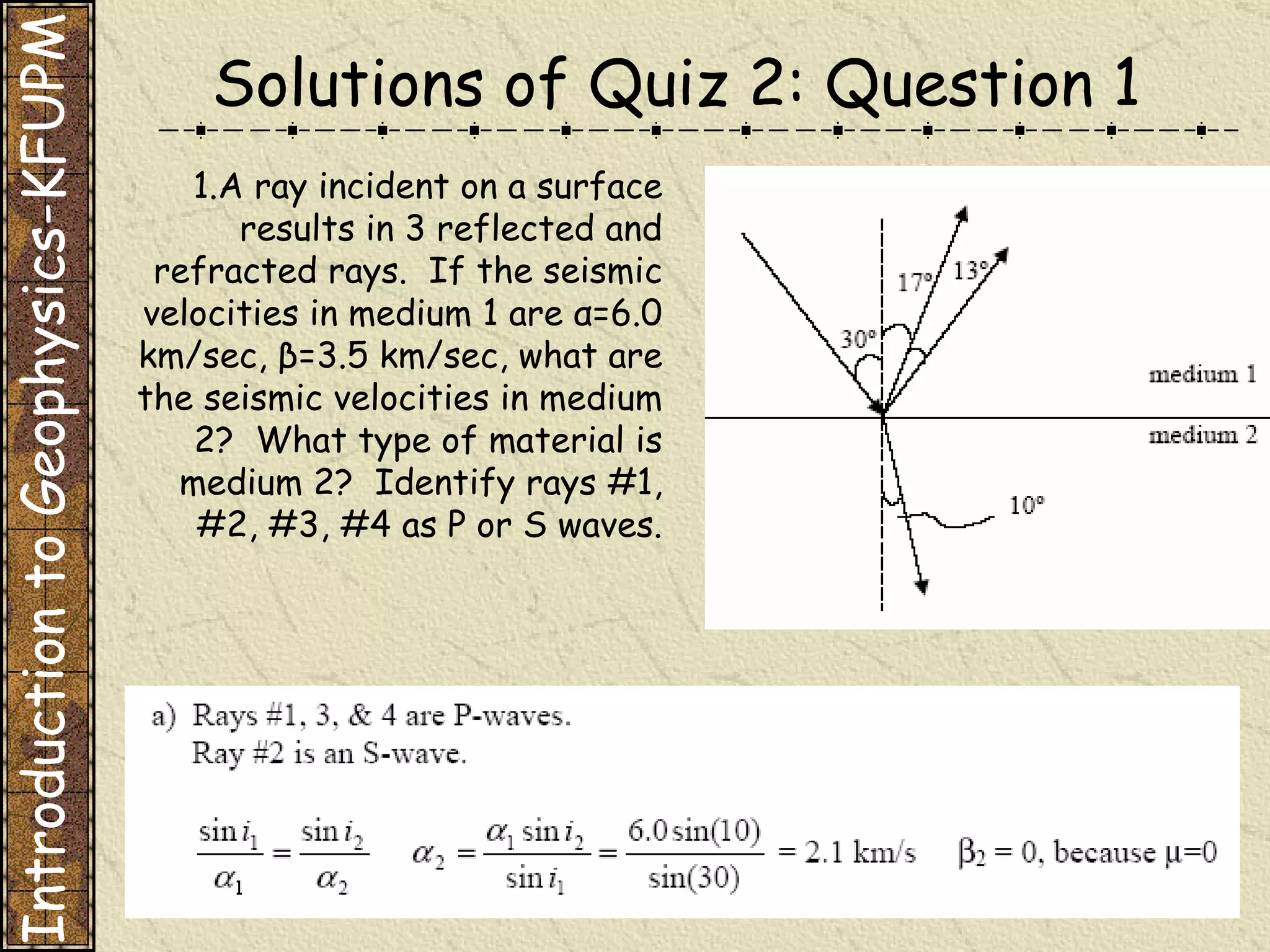
A ray incident on a surface results in 3 reflected and refracted rays.  If the seismic velocities in medium 1 are α=6.0 km/sec, β=3.5 km/sec, what are the seismic velocities in medium 2?  What type of material is medium 2?  Identify rays #1, #2, #3, #4 as P or S waves. Solutions of Quiz 2: Question 1 Introduction to Geophysics-KFUPM
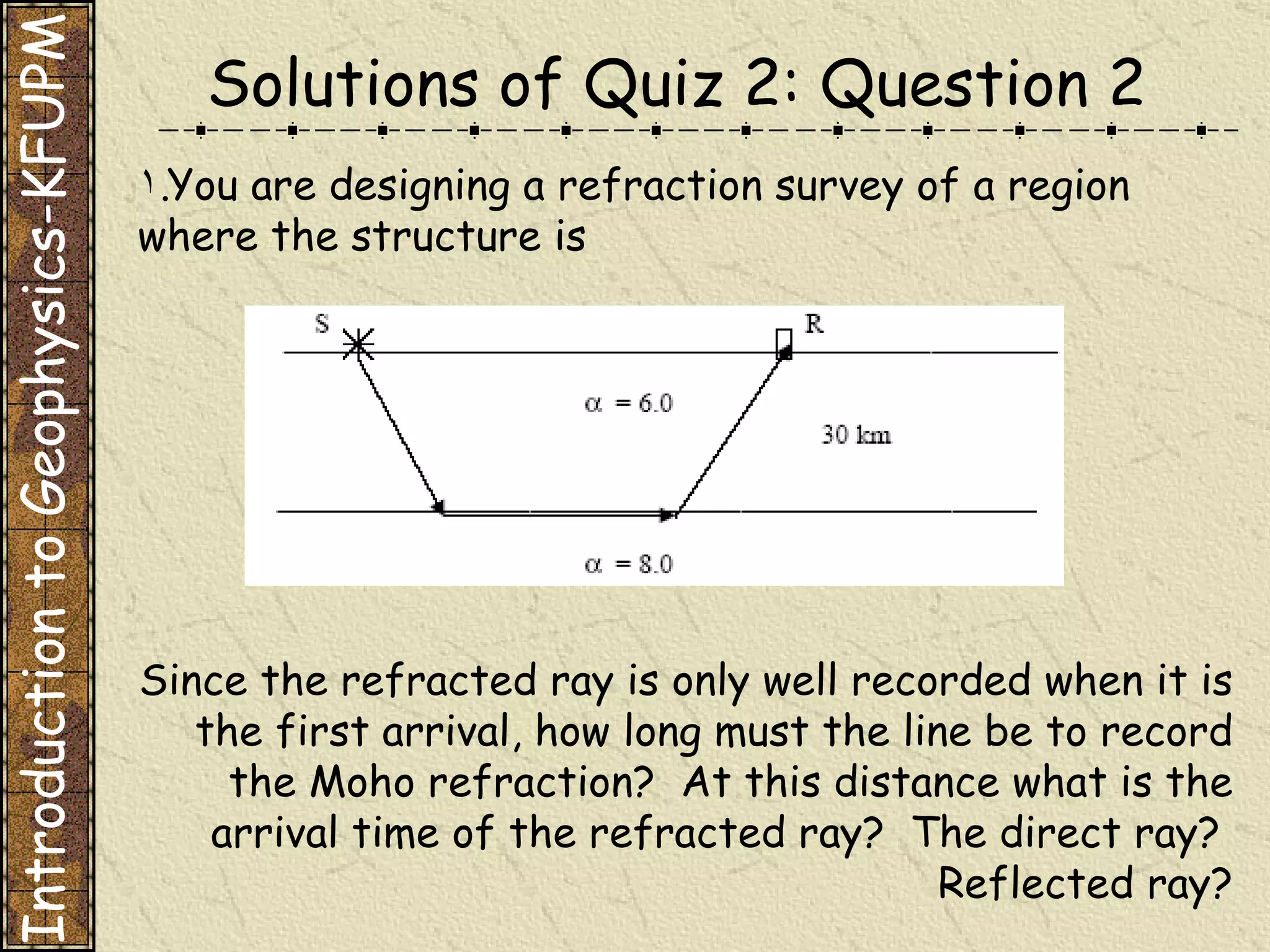
You are designing a refraction survey of a region where the structure is Since the refracted ray is only well recorded when it is the first arrival, how long must the line be to record the Moho refraction?  At this distance what is the arrival time of the refracted ray?  The direct ray?  Reflected ray? Solutions of Quiz 2: Question 2 Introduction to Geophysics-KFUPM
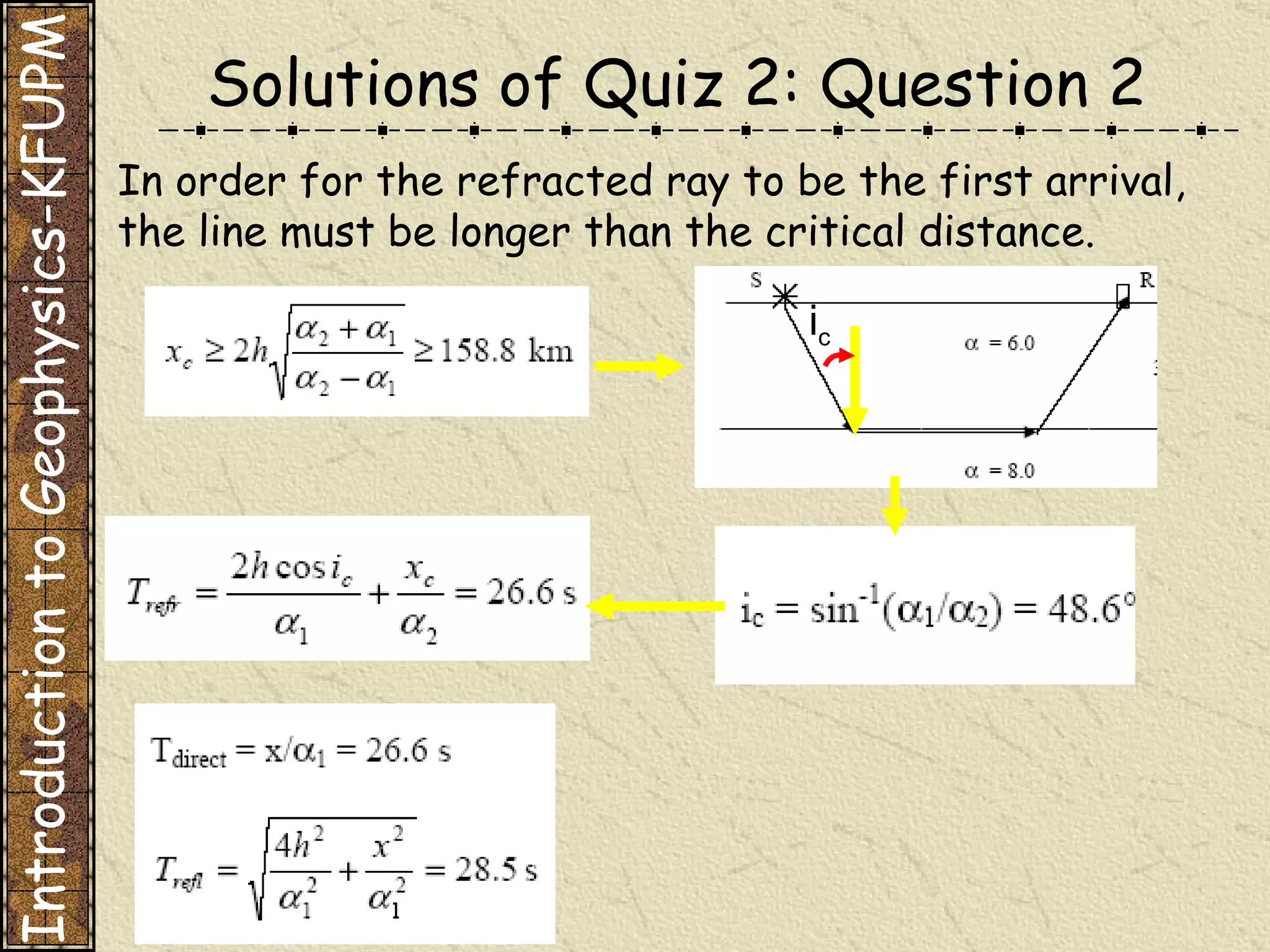
Solutions of Quiz 2: Question 2 Introduction to Geophysics-KFUPM In order for the refracted ray to be the first arrival, the line must be longer than the critical distance. i c
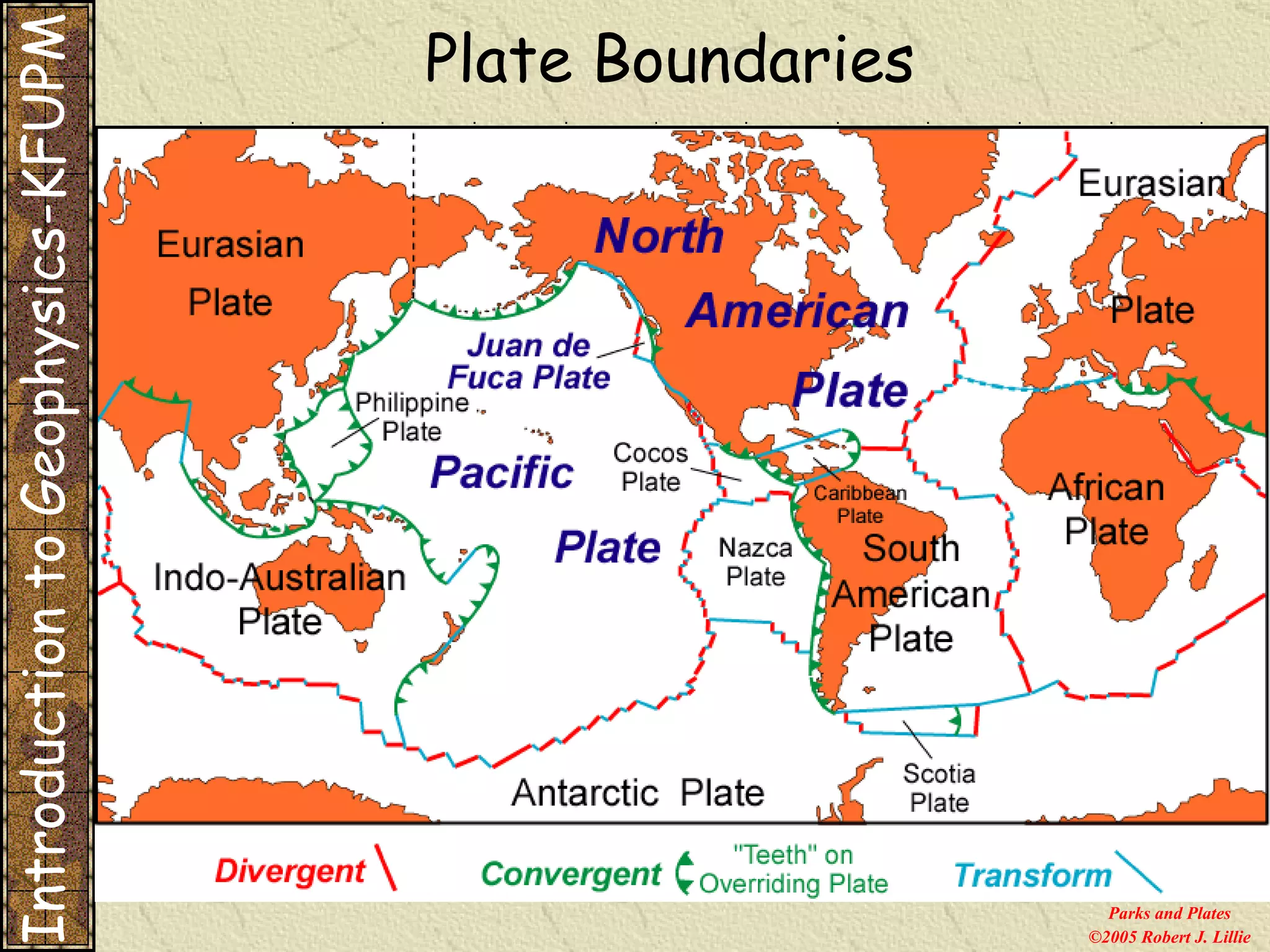
Parks and Plates ©2005 Robert J. Lillie Plate Boundaries Introduction to Geophysics-KFUPM
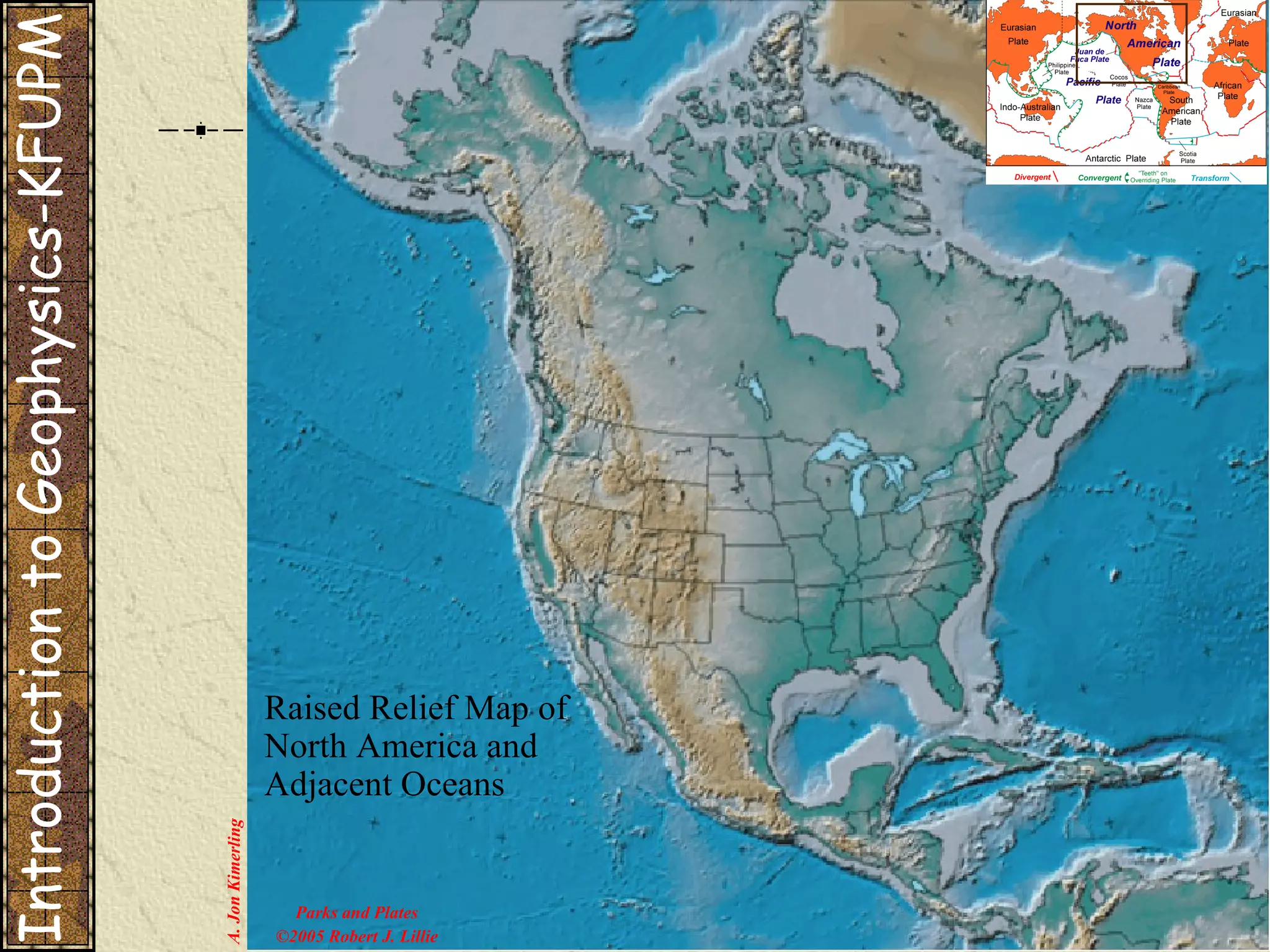
Introduction to Geophysics-KFUPM A. Jon Kimerling Parks and Plates ©2005 Robert J. Lillie Raised Relief Map of North America and Adjacent Oceans
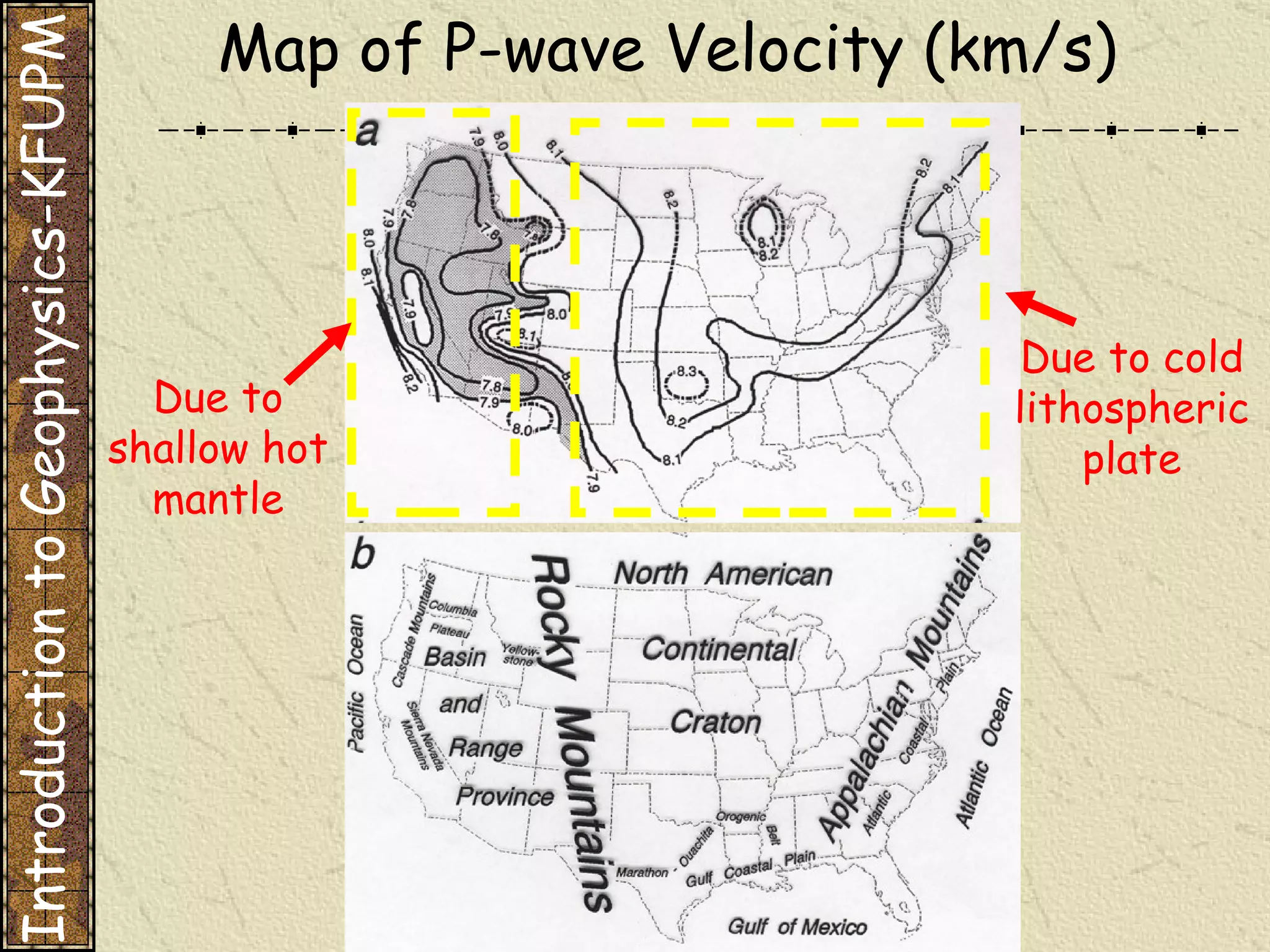
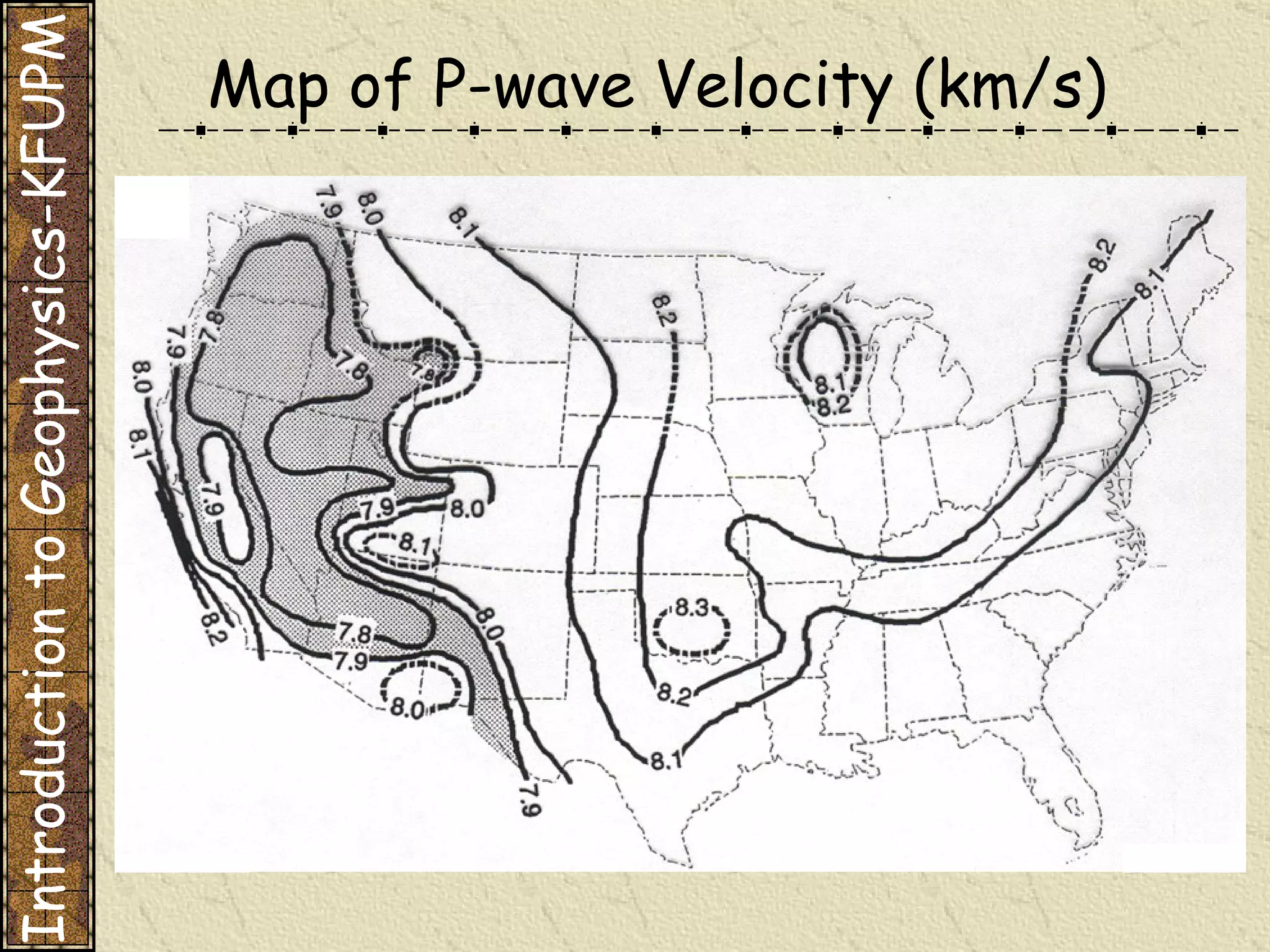
Introduction to Geophysics-KFUPM Due to shallow hot mantle Due to cold lithospheric plate Map of P-wave Velocity (km/s)
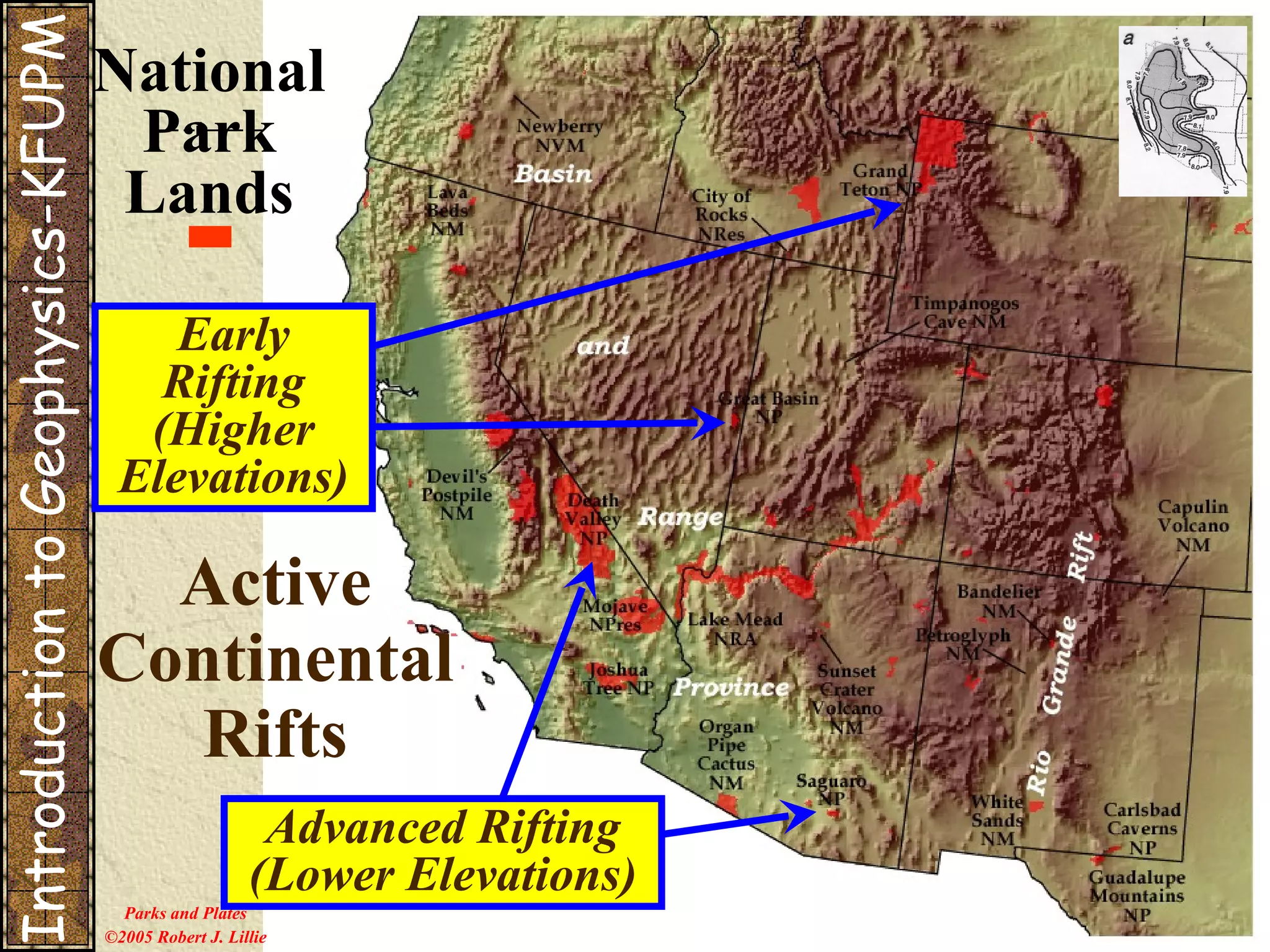
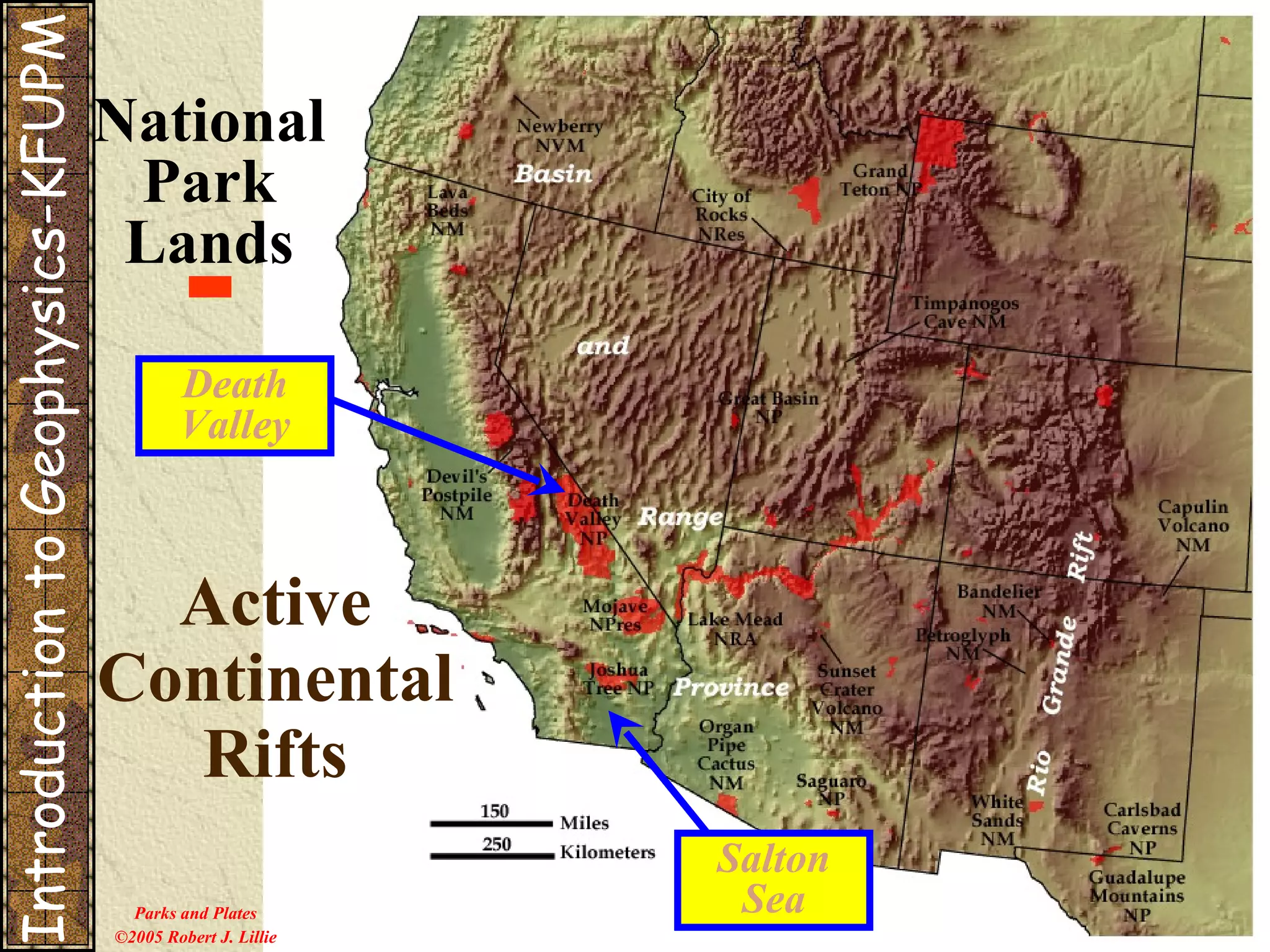
Parks and Plates ©2005 Robert J. Lillie Active Continental Rifts Advanced Rifting (Lower Elevations) Early Rifting (Higher Elevations) Introduction to Geophysics-KFUPM National Park Lands
Introduction to Geophysics-KFUPM Map of P-wave Velocity (km/s)
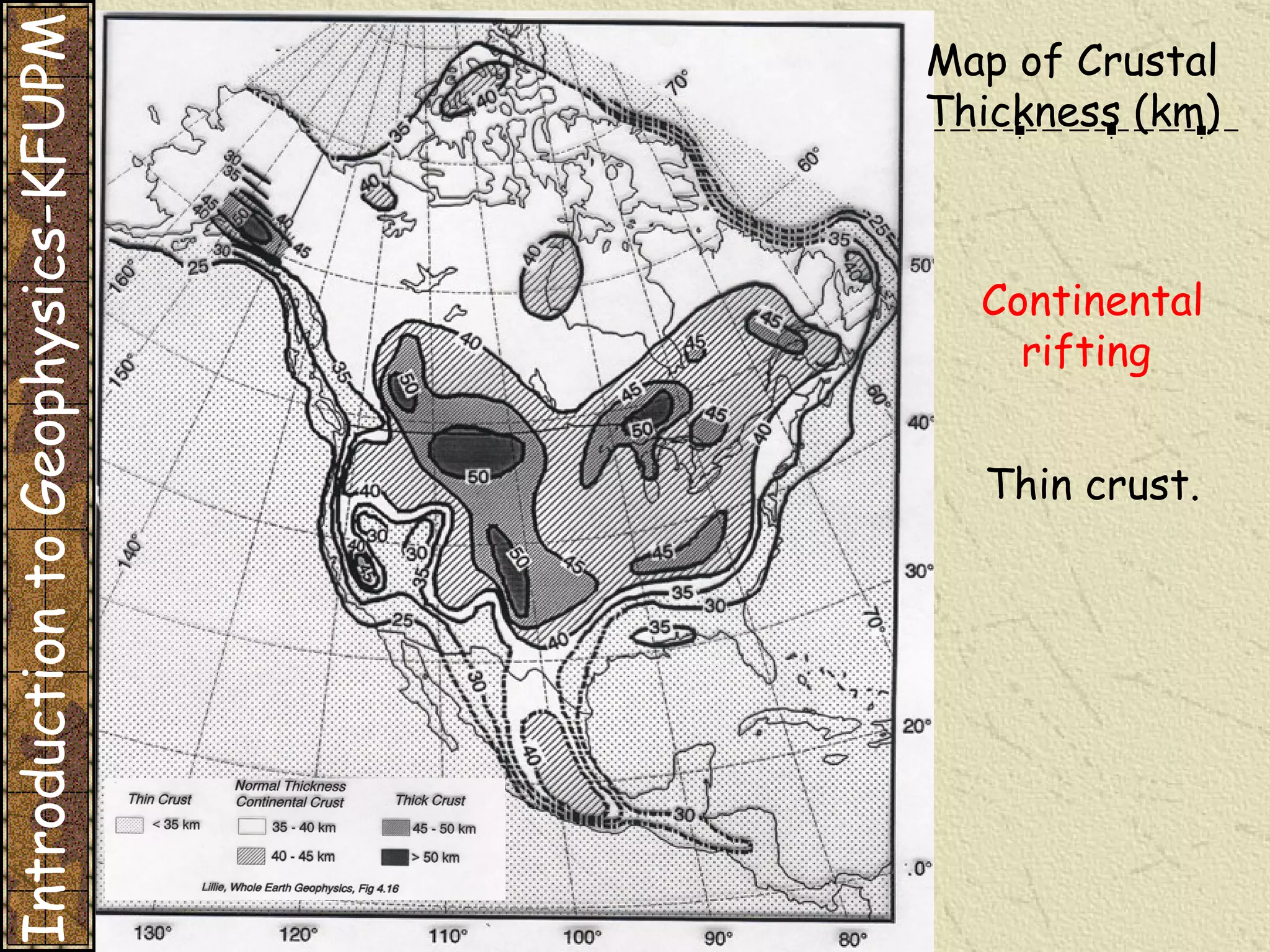
Introduction to Geophysics-KFUPM Continental rifting   Thin crust. Map of Crustal Thickness (km)
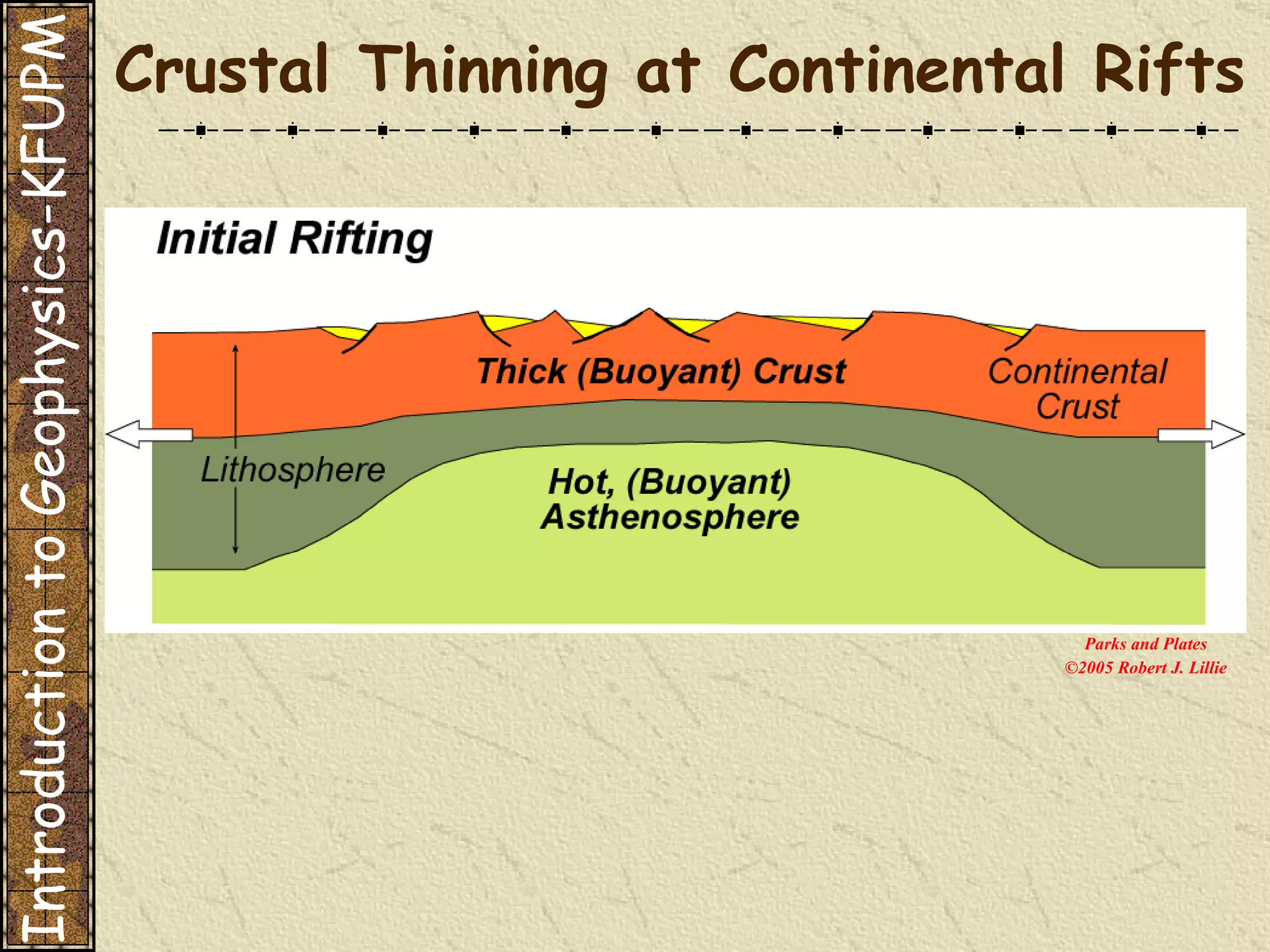
Parks and Plates ©2005 Robert J. Lillie Crustal Thinning at Continental Rifts Introduction to Geophysics-KFUPM
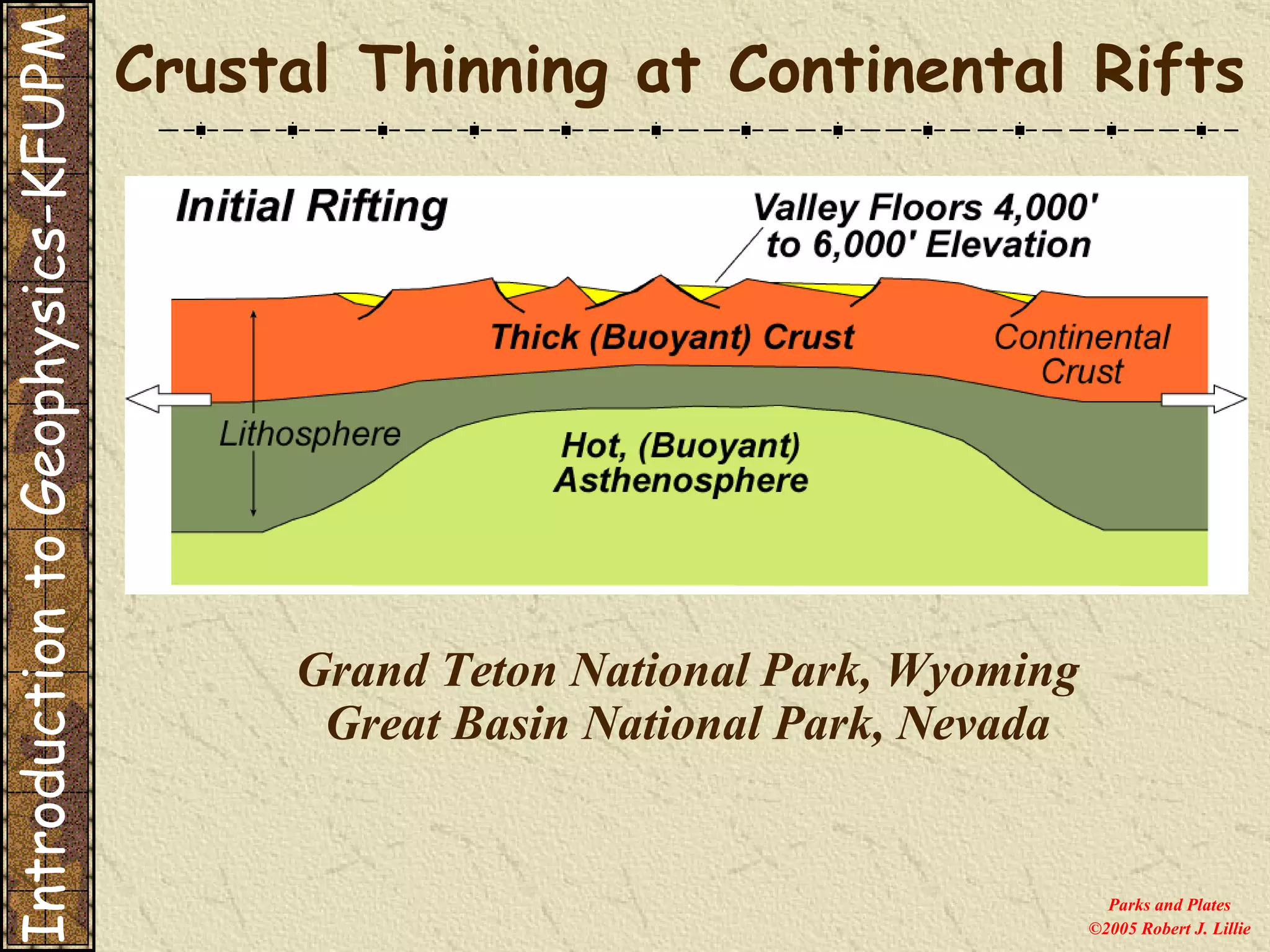
Crustal Thinning at Continental Rifts Parks and Plates ©2005 Robert J. Lillie Grand Teton National Park, Wyoming Great Basin National Park, Nevada Introduction to Geophysics-KFUPM
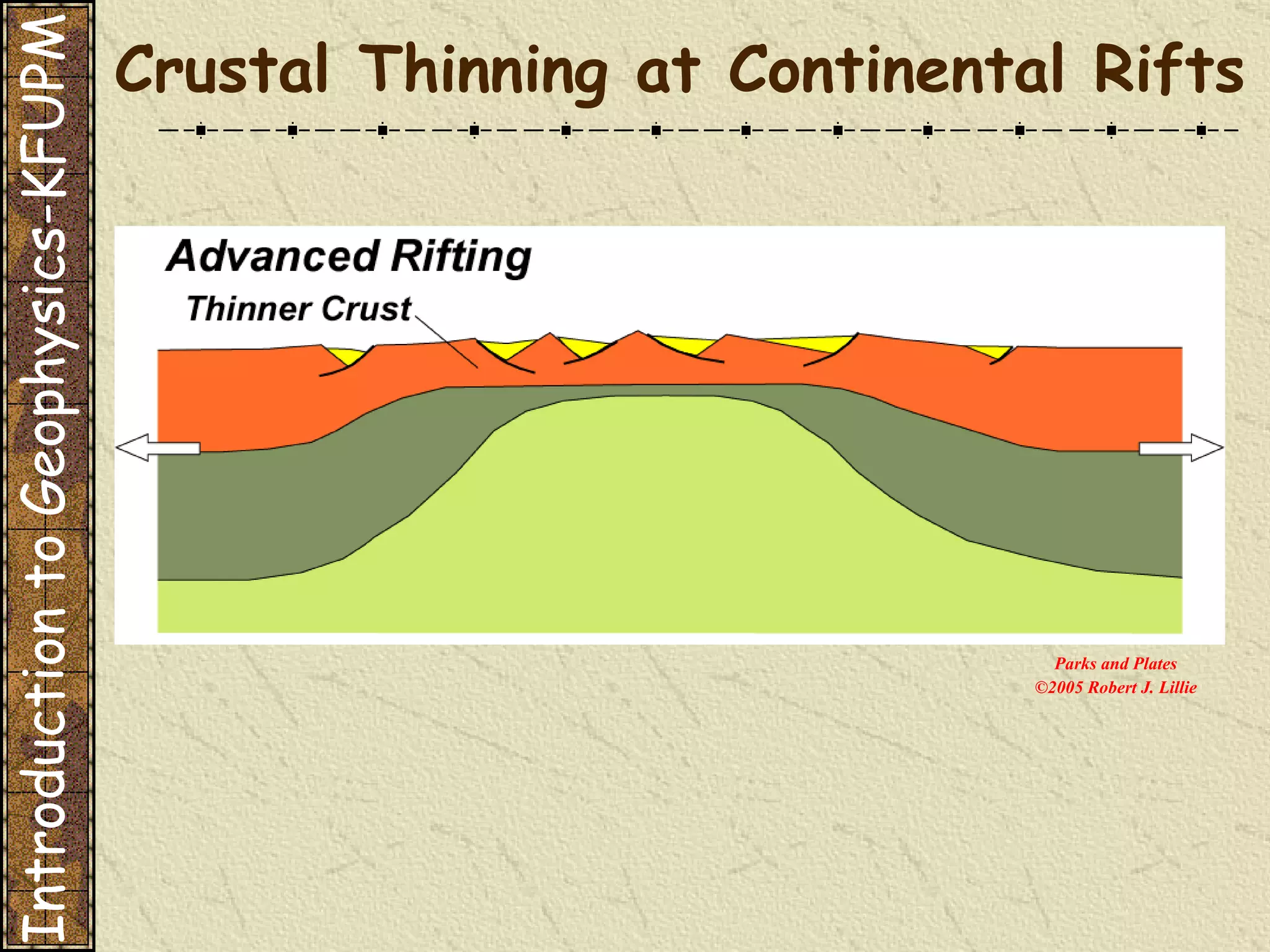
Crustal Thinning at Continental Rifts Parks and Plates ©2005 Robert J. Lillie Introduction to Geophysics-KFUPM
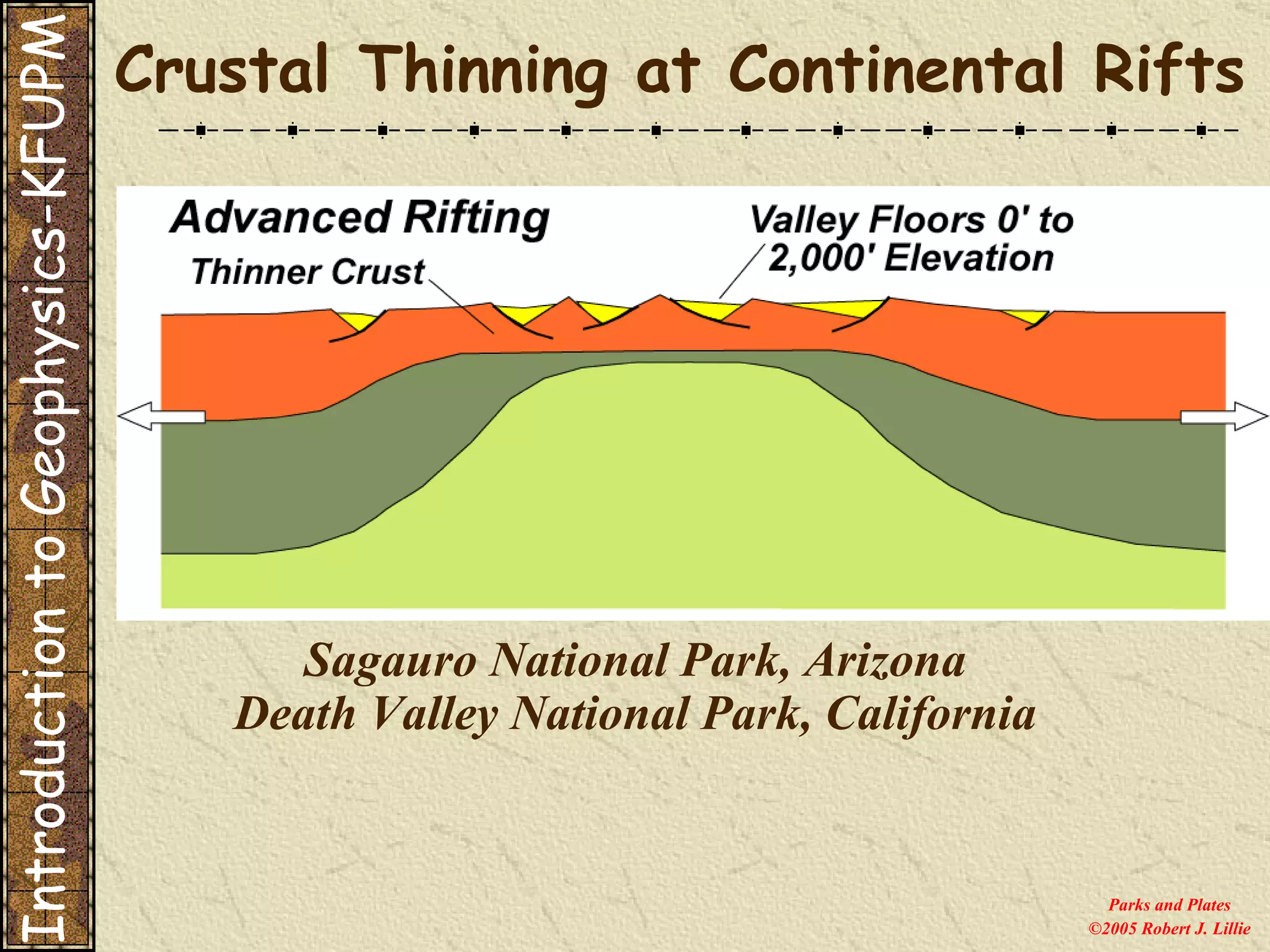
Parks and Plates ©2005 Robert J. Lillie Sagauro National Park, Arizona Death Valley National Park, California Crustal Thinning at Continental Rifts Introduction to Geophysics-KFUPM
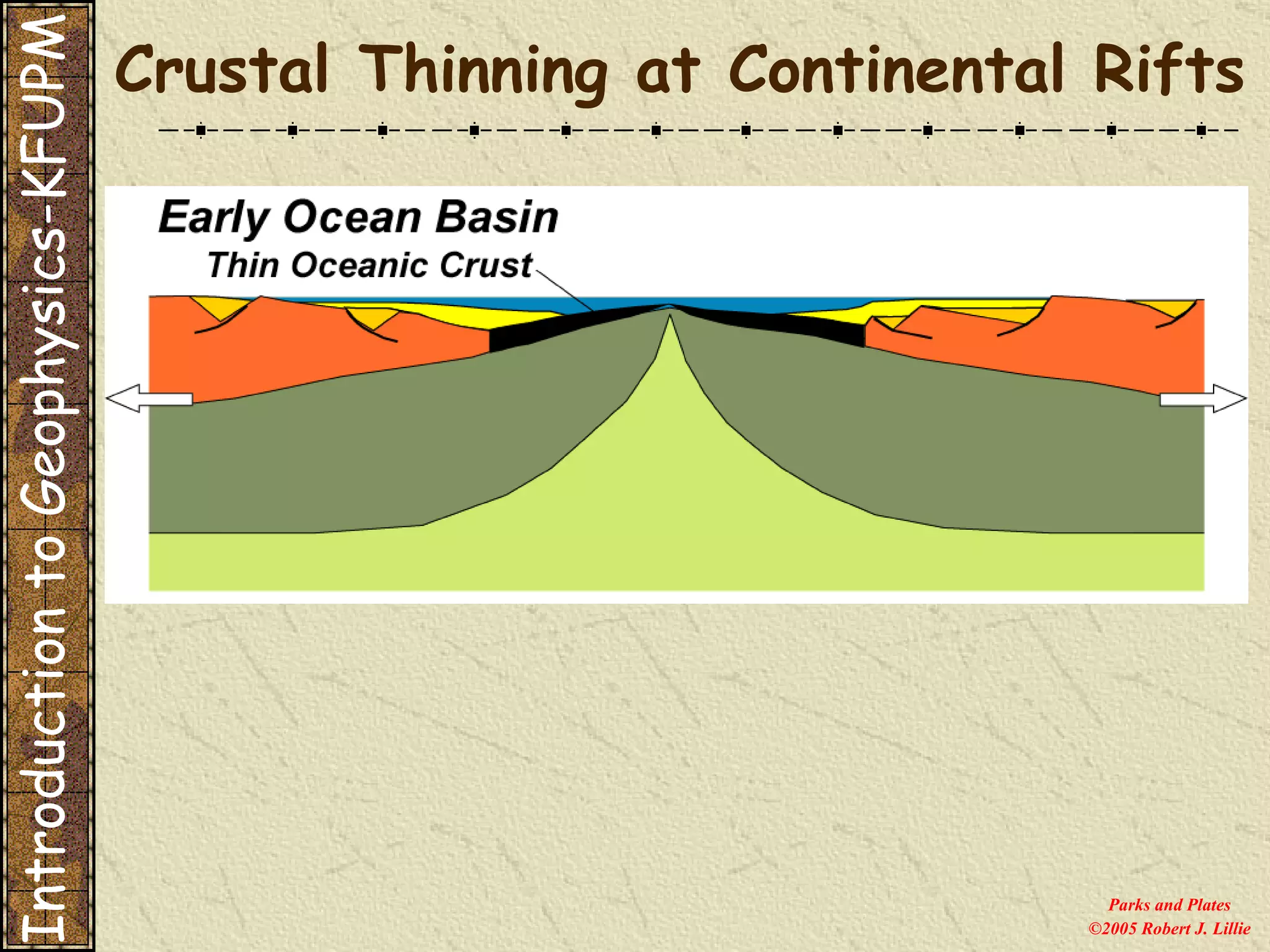
Parks and Plates ©2005 Robert J. Lillie Crustal Thinning at Continental Rifts Introduction to Geophysics-KFUPM
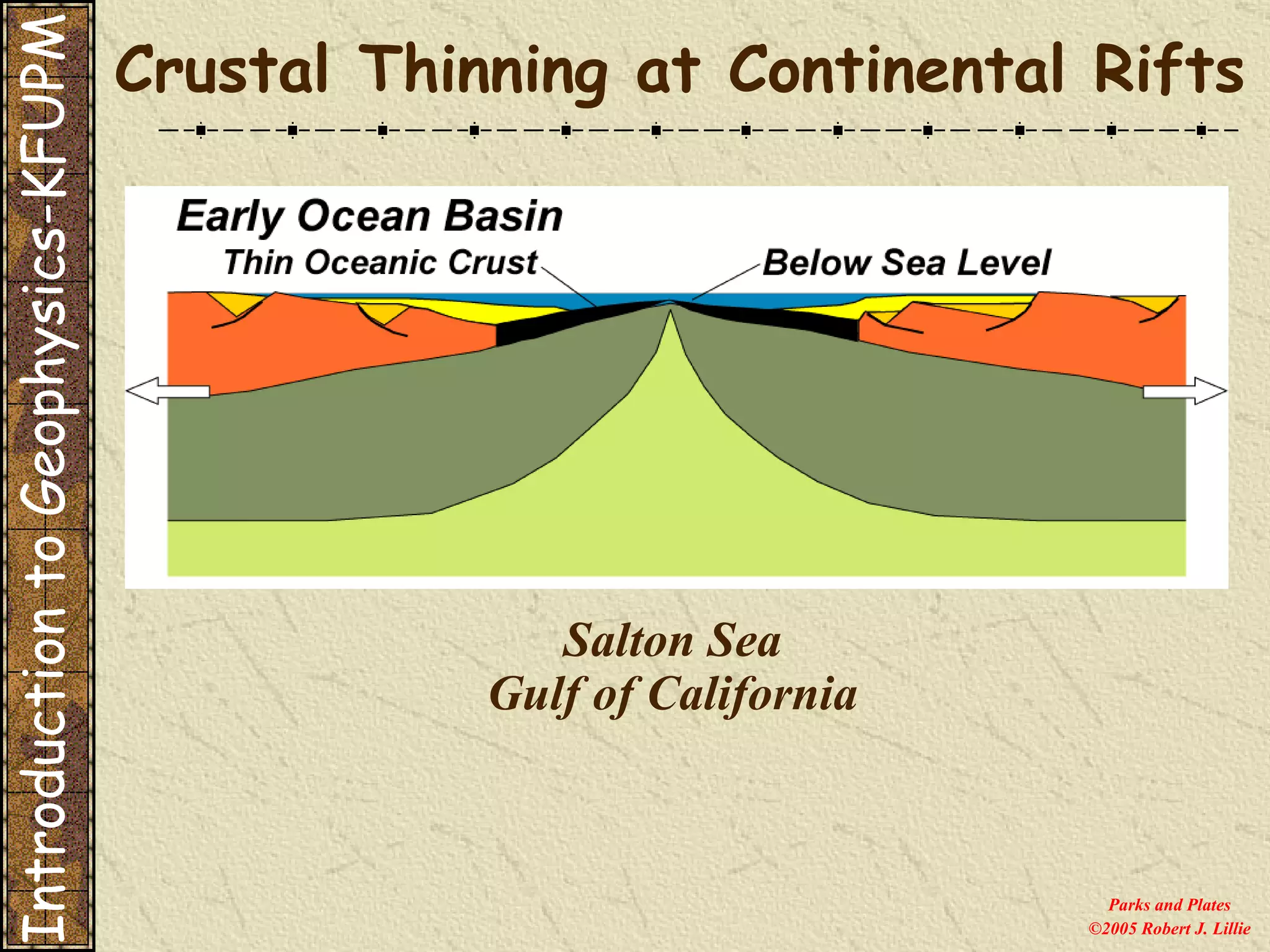
Parks and Plates ©2005 Robert J. Lillie Salton Sea Gulf of California Crustal Thinning at Continental Rifts Introduction to Geophysics-KFUPM
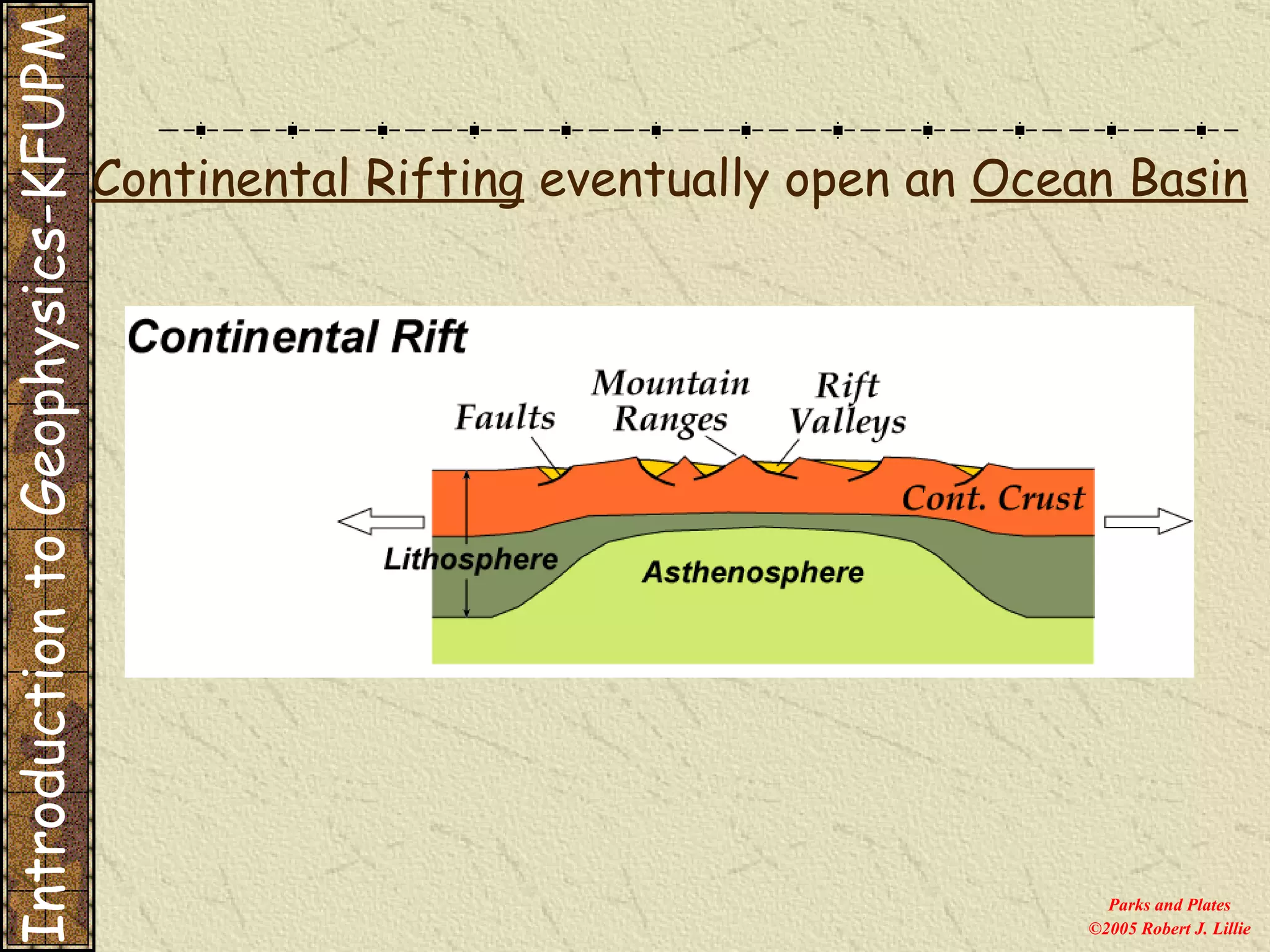
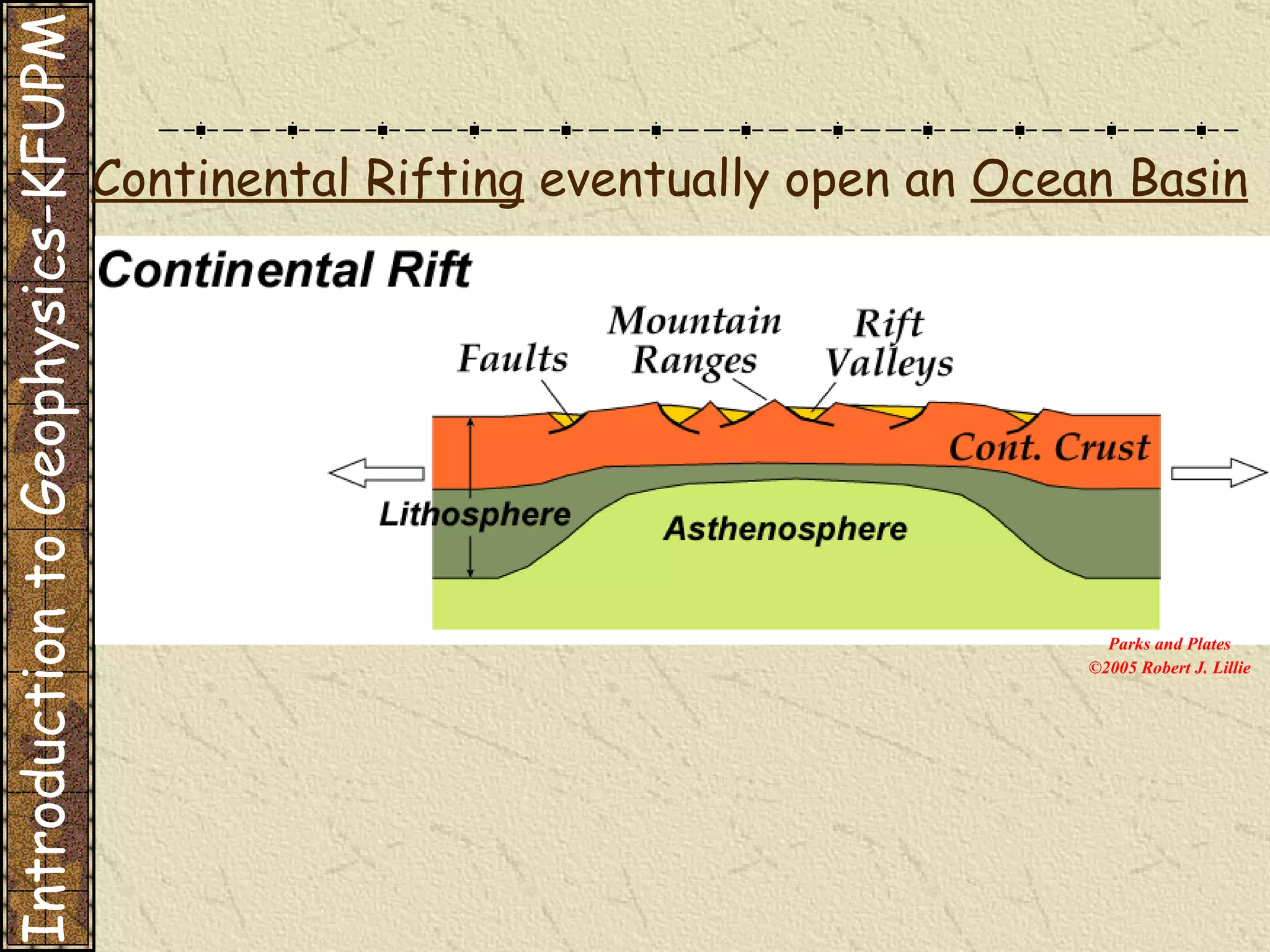
Continental Rifting  eventually open an  Ocean Basin Parks and Plates ©2005 Robert J. Lillie Introduction to Geophysics-KFUPM
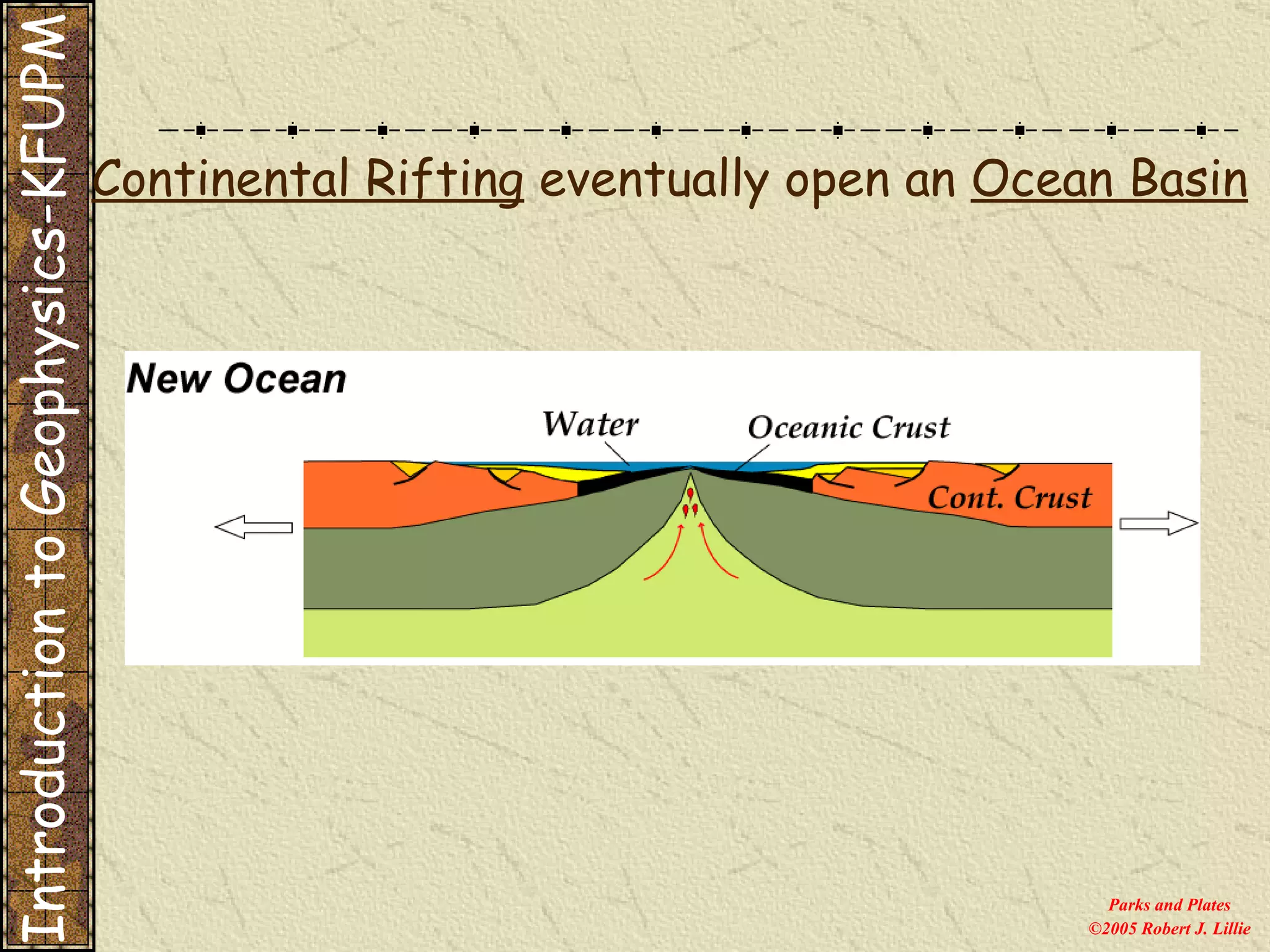
Parks and Plates ©2005 Robert J. Lillie Continental Rifting  eventually open an  Ocean Basin Introduction to Geophysics-KFUPM
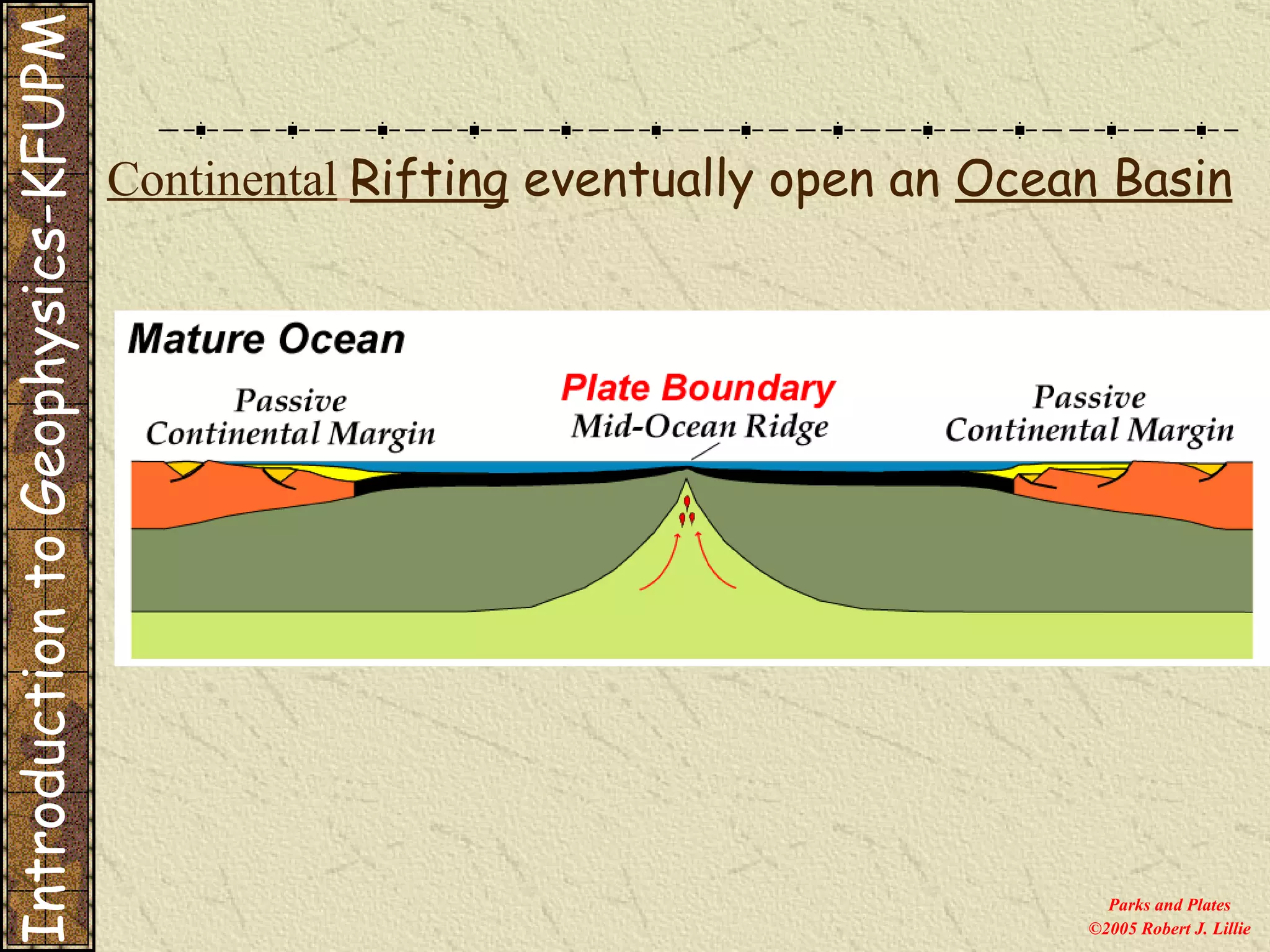
Parks and Plates ©2005 Robert J. Lillie Continental   Rifting  eventually open an  Ocean Basin Introduction to Geophysics-KFUPM
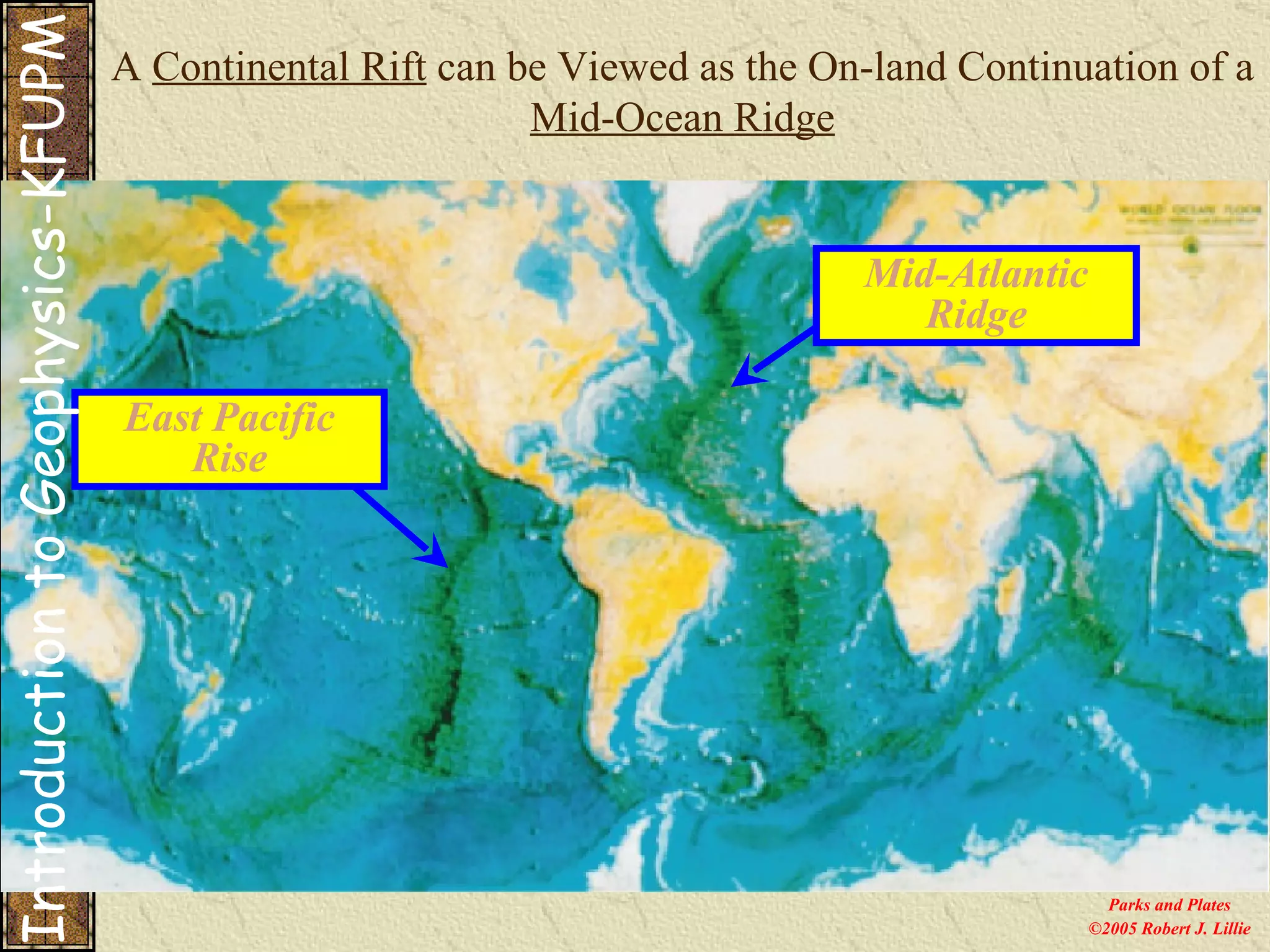
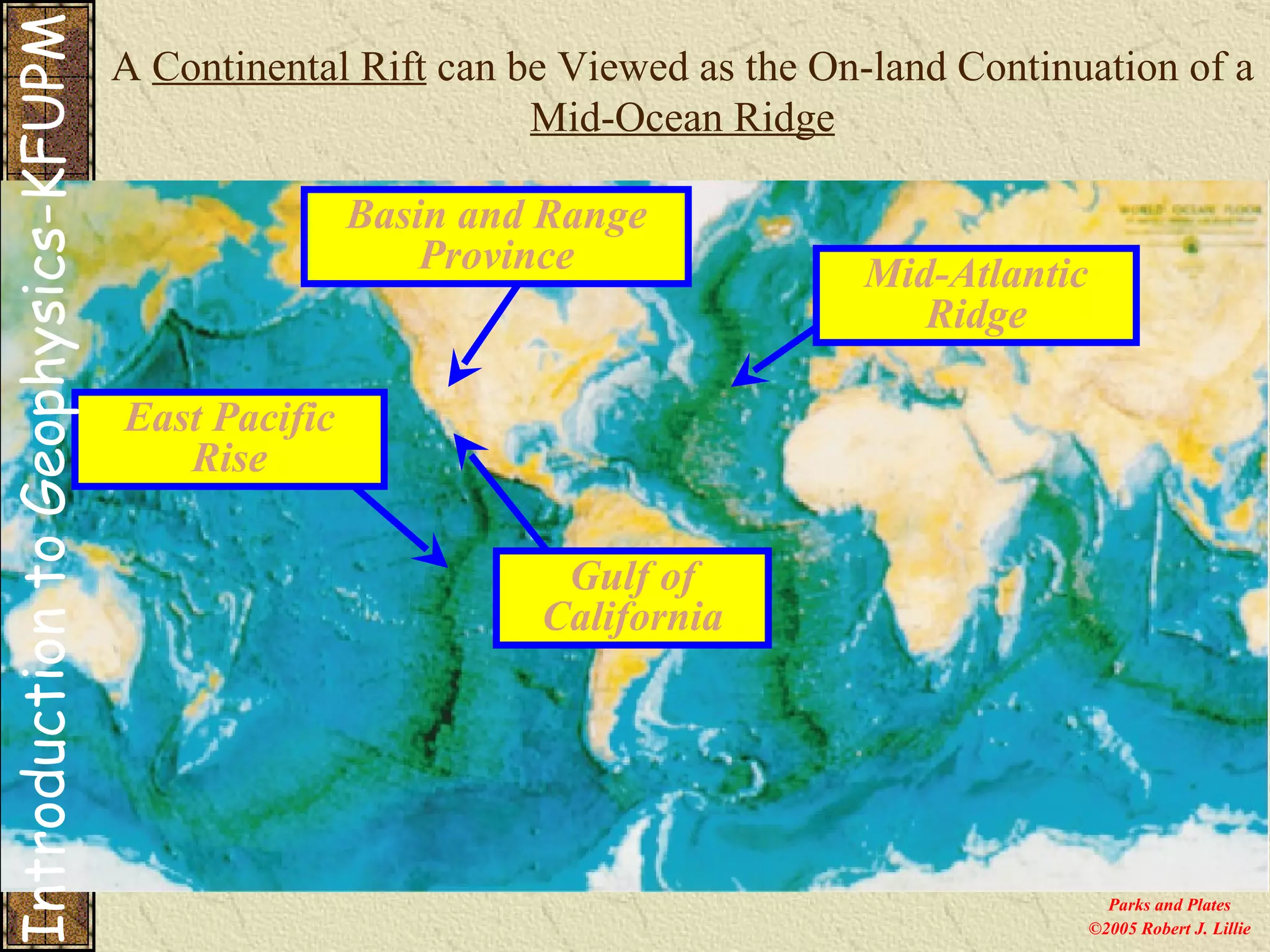
Parks and Plates ©2005 Robert J. Lillie East Pacific Rise Mid-Atlantic Ridge A  Continental Rift  can be Viewed as the On-land Continuation of a  Mid-Ocean Ridge Introduction to Geophysics-KFUPM
Parks and Plates ©2005 Robert J. Lillie Basin and Range Province East Pacific Rise Mid-Atlantic Ridge Gulf of California A  Continental Rift  can be Viewed as the On-land Continuation of a  Mid-Ocean Ridge Introduction to Geophysics-KFUPM
Parks and Plates ©2005 Robert J. Lillie Active Continental Rifts Death Valley Salton Sea Introduction to Geophysics-KFUPM National Park Lands
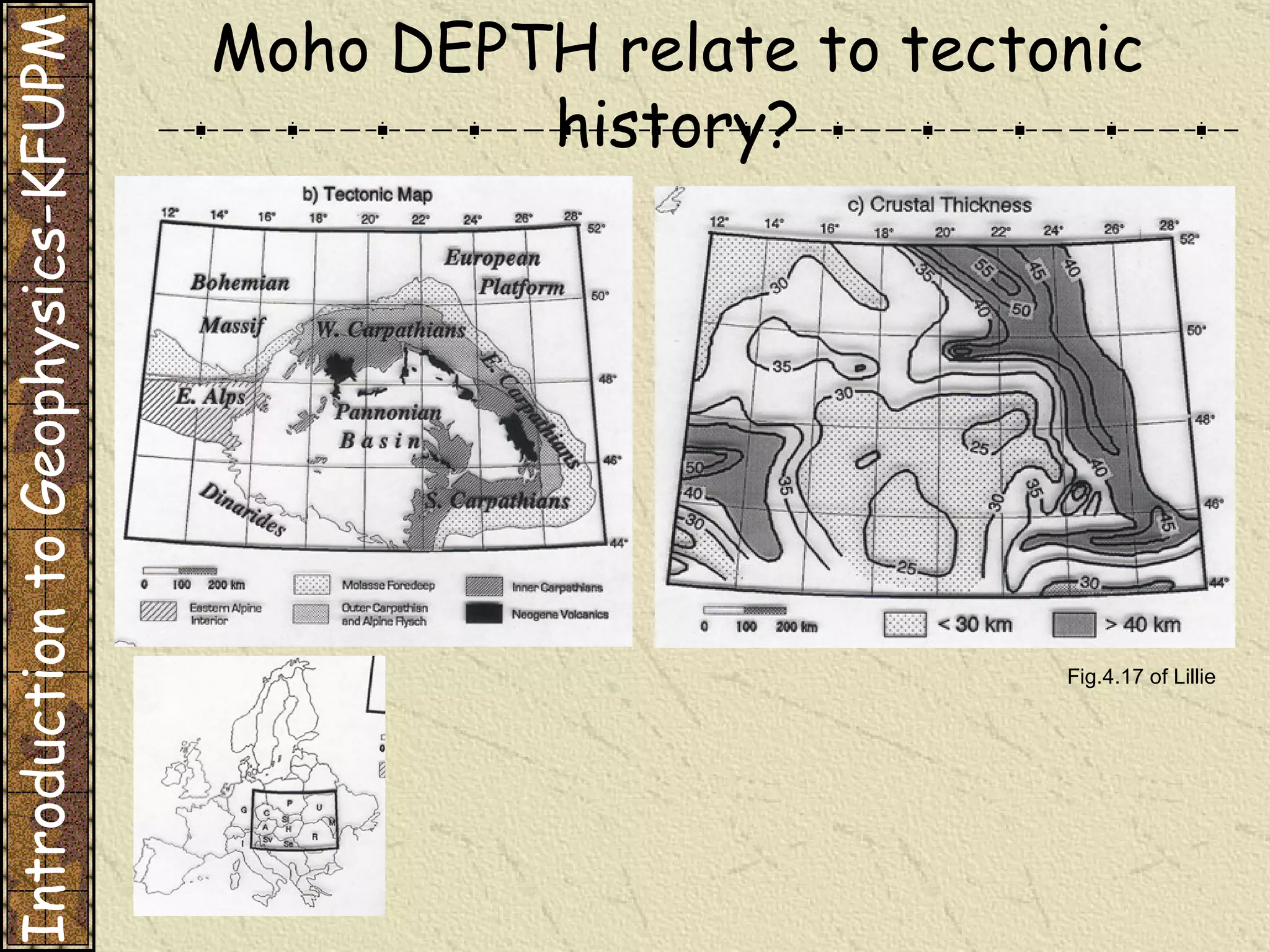
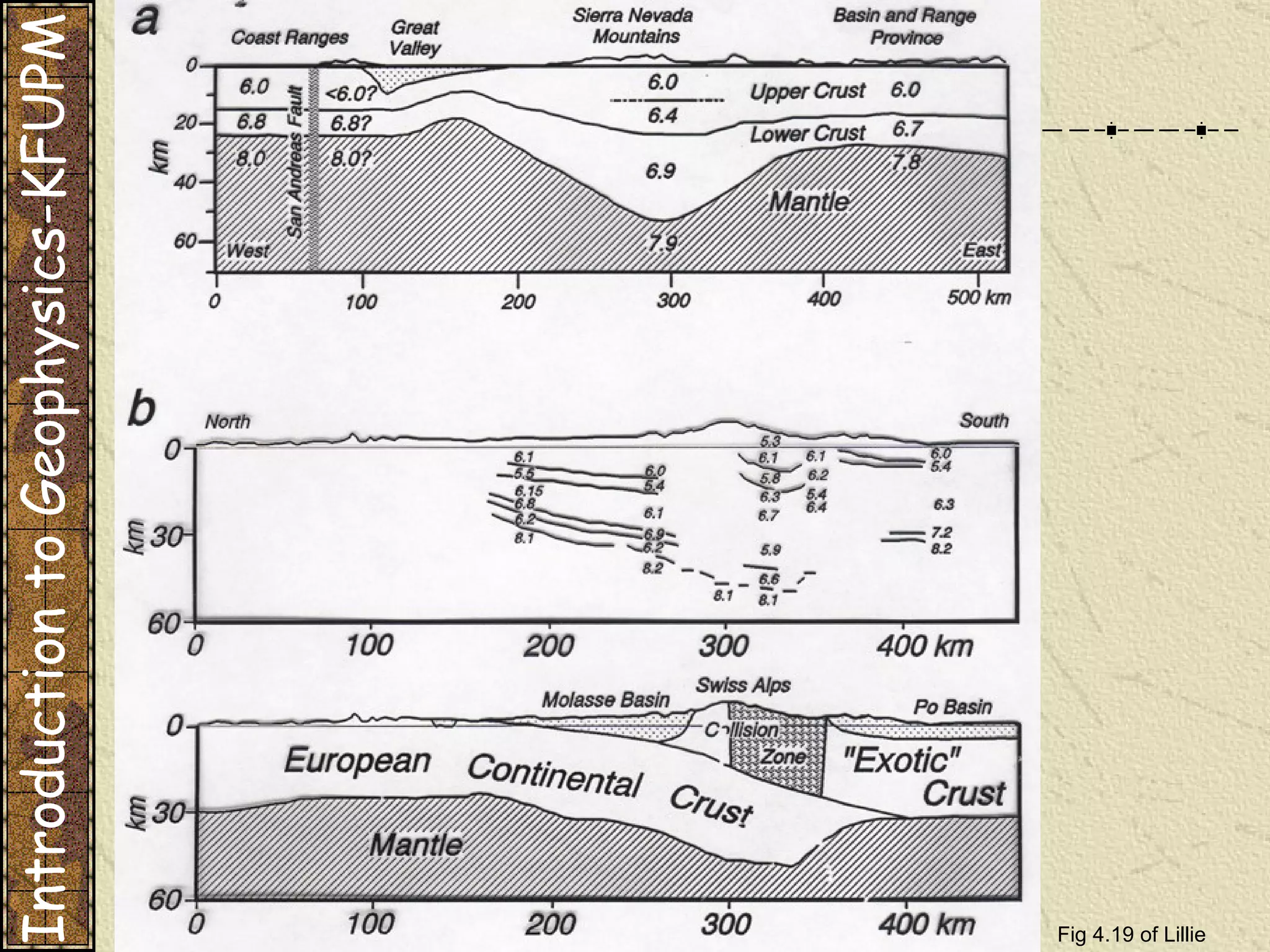
Moho DEPTH relate to tectonic history? Introduction to Geophysics-KFUPM Fig.4.17 of Lillie
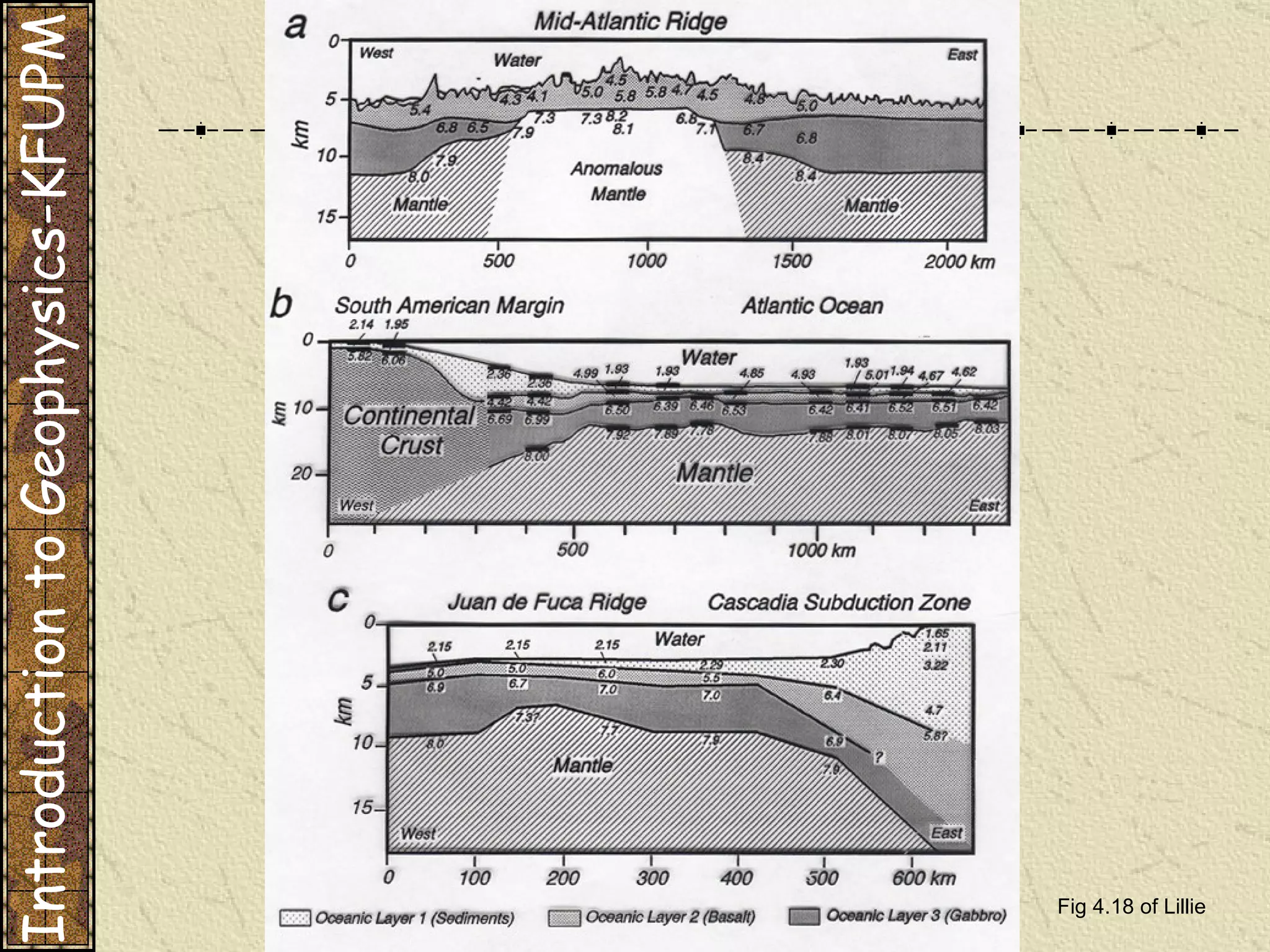
Introduction to Geophysics-KFUPM Fig 4.18 of Lillie
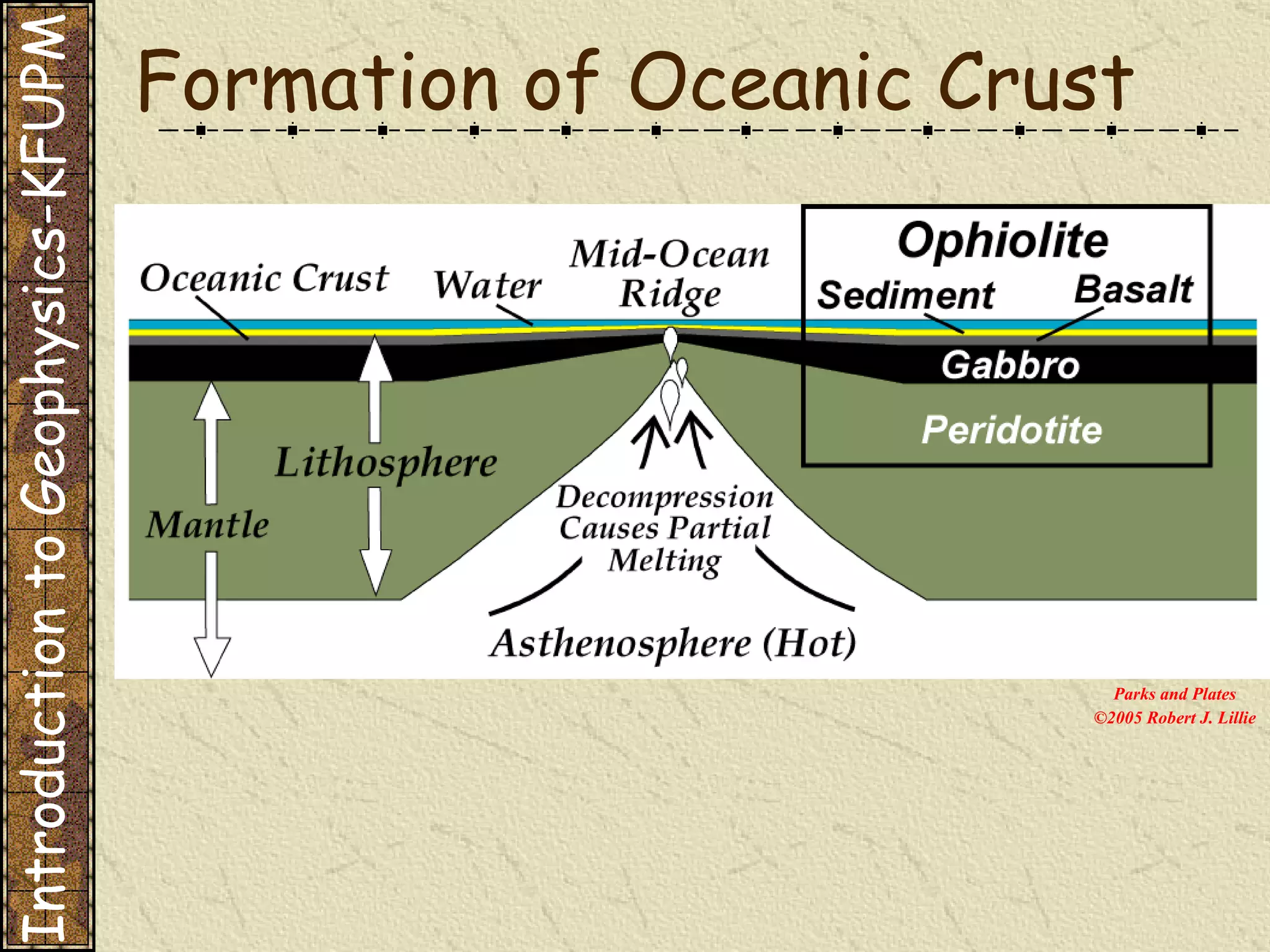
Formation of Oceanic Crust Introduction to Geophysics-KFUPM Parks and Plates ©2005 Robert J. Lillie
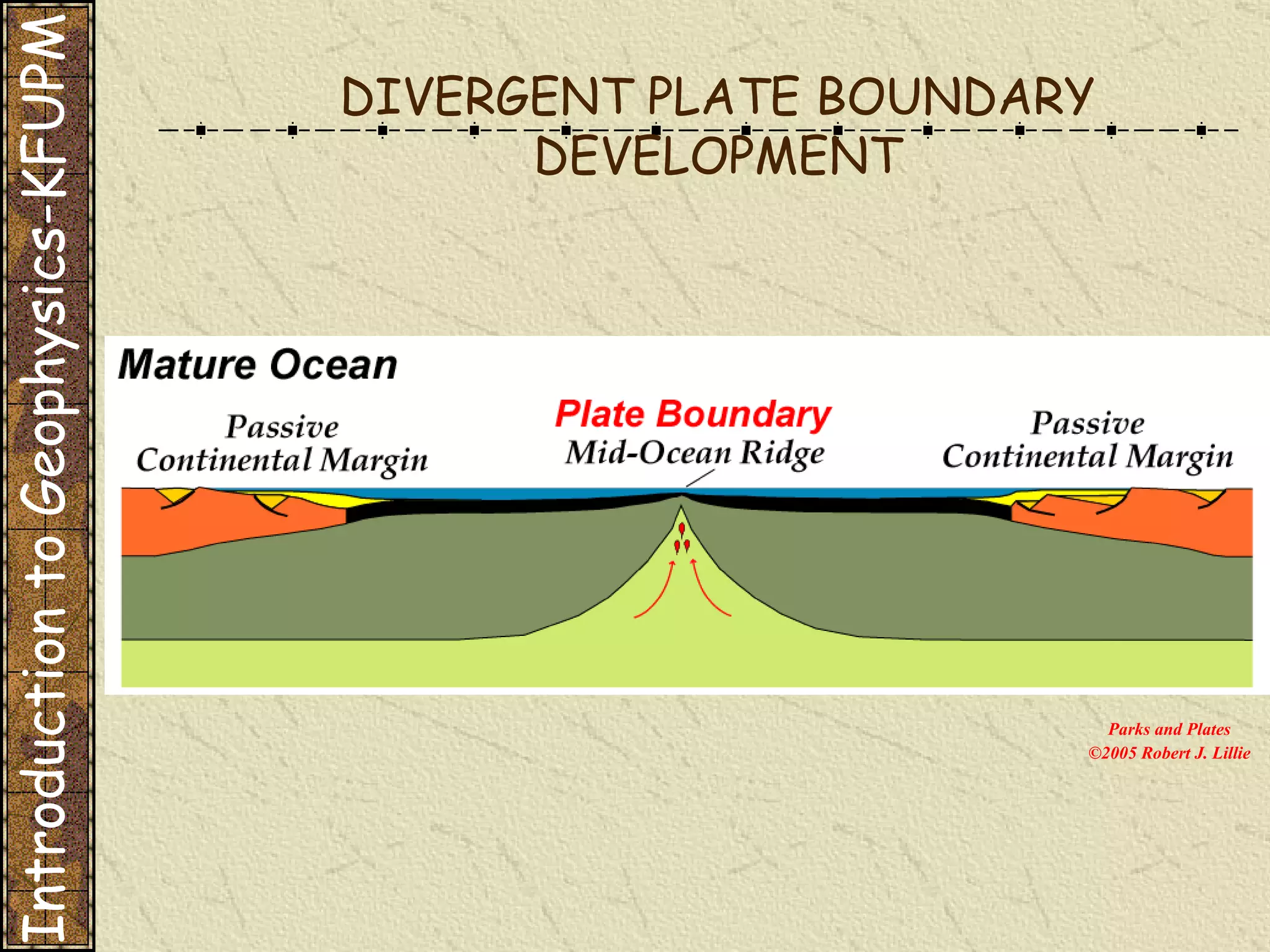
DIVERGENT PLATE BOUNDARY DEVELOPMENT Introduction to Geophysics-KFUPM Parks and Plates ©2005 Robert J. Lillie
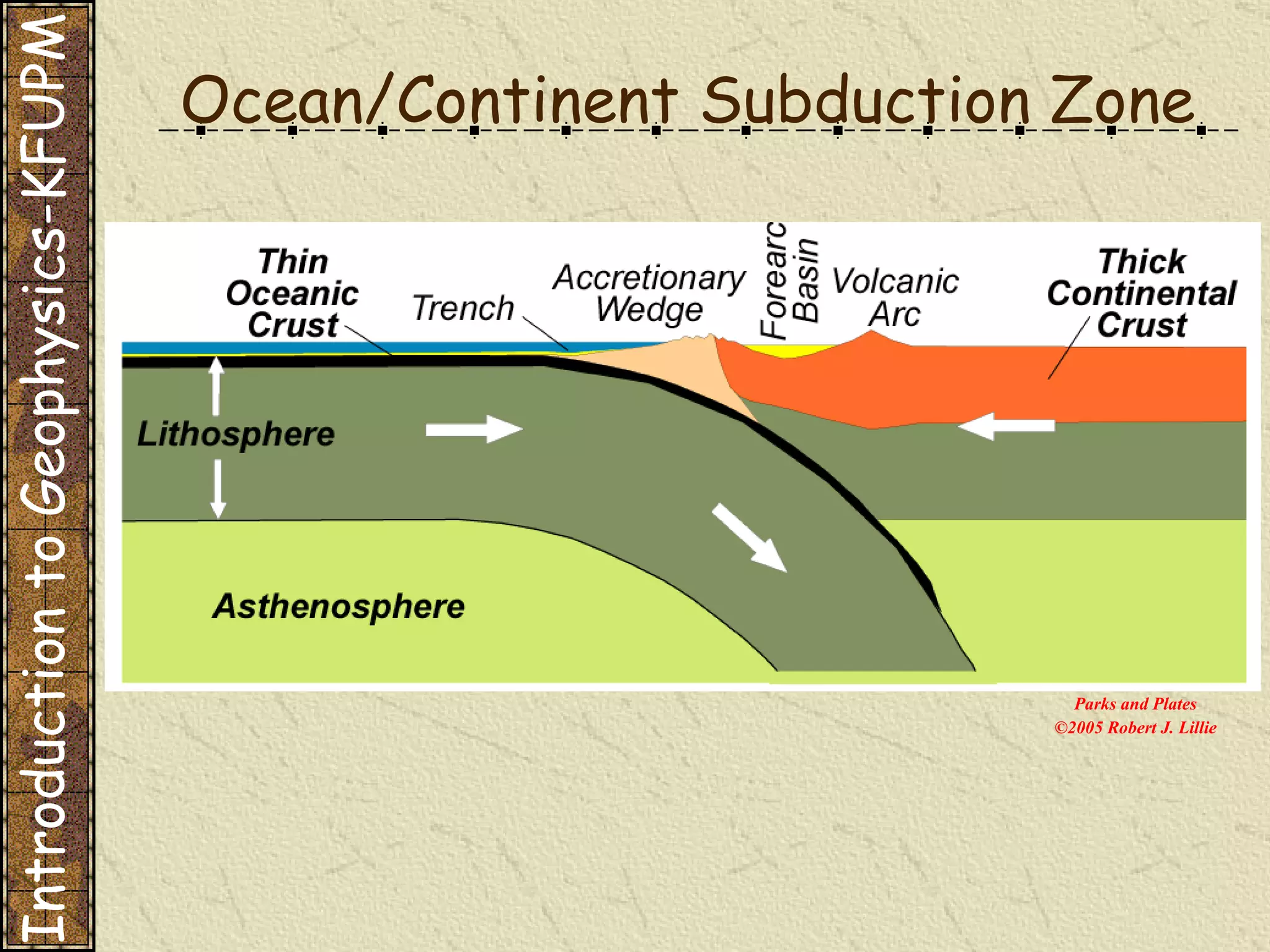
Ocean/Continent Subduction Zone Introduction to Geophysics-KFUPM Parks and Plates ©2005 Robert J. Lillie
Introduction to Geophysics-KFUPM Fig 4.19 of Lillie
Continental Rifting  eventually open an  Ocean Basin Parks and Plates ©2005 Robert J. Lillie Introduction to Geophysics-KFUPM
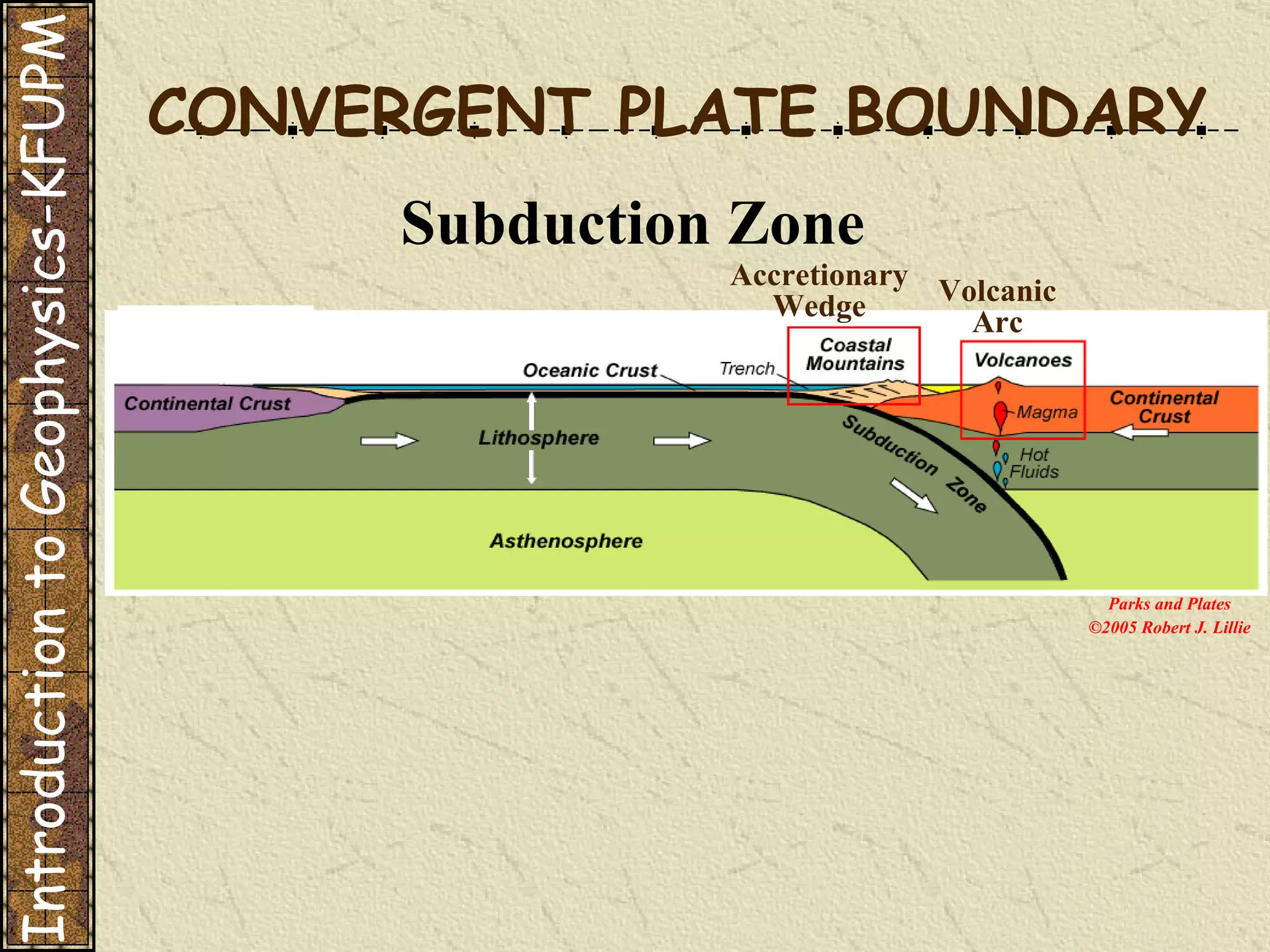
CONVERGENT PLATE BOUNDARY Subduction Zone Introduction to Geophysics-KFUPM Parks and Plates ©2005 Robert J. Lillie Accretionary Wedge Volcanic Arc
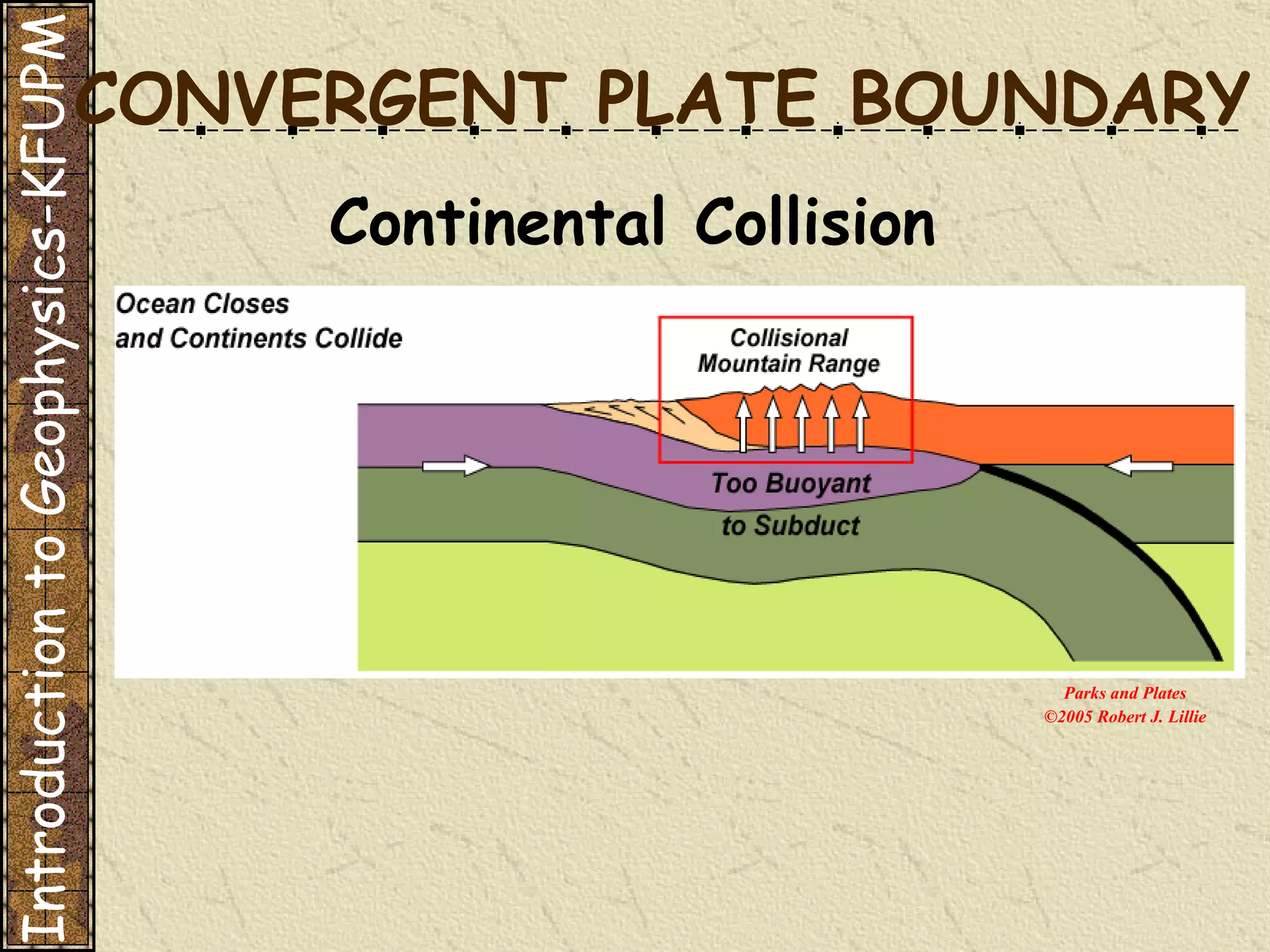
CONVERGENT PLATE BOUNDARY Continental Collision Introduction to Geophysics-KFUPM Parks and Plates ©2005 Robert J. Lillie
Problems 4-3, 4-5, 4-6, 4-7 Homework due to Next Wednesday Introduction to Geophysics-KFUPM

ÖNCEL AKADEMİ: INTRODUCTION TO GEOPHYSICS

  • 1.
    Introduction to GeophysicsAli Oncel [email_address] Department of Earth Sciences KFUPM Tectonic Interpretation of Seismic Refraction Profiles Introduction to Geophysics-KFUPM
  • 2.
    Previous Lecture HiddenLayers Problem Situations   Low Velocity layer (V 2 <V 1 <V 3 ) Thin layer (V 3 >V 2 >V 1 but h2 very small) Velocity Inversion-Hidden Layers Dipping Layer Refractions Single Dipping Refractor Surface Introduction to Geophysics-KFUPM
  • 3.
    A ray incidenton a surface results in 3 reflected and refracted rays. If the seismic velocities in medium 1 are α=6.0 km/sec, β=3.5 km/sec, what are the seismic velocities in medium 2? What type of material is medium 2? Identify rays #1, #2, #3, #4 as P or S waves. Solutions of Quiz 2: Question 1 Introduction to Geophysics-KFUPM
  • 4.
    You are designinga refraction survey of a region where the structure is Since the refracted ray is only well recorded when it is the first arrival, how long must the line be to record the Moho refraction? At this distance what is the arrival time of the refracted ray? The direct ray? Reflected ray? Solutions of Quiz 2: Question 2 Introduction to Geophysics-KFUPM
  • 5.
    Solutions of Quiz2: Question 2 Introduction to Geophysics-KFUPM In order for the refracted ray to be the first arrival, the line must be longer than the critical distance. i c
  • 6.
    Parks and Plates©2005 Robert J. Lillie Plate Boundaries Introduction to Geophysics-KFUPM
  • 7.
    Introduction to Geophysics-KFUPMA. Jon Kimerling Parks and Plates ©2005 Robert J. Lillie Raised Relief Map of North America and Adjacent Oceans
  • 8.
    Introduction to Geophysics-KFUPMDue to shallow hot mantle Due to cold lithospheric plate Map of P-wave Velocity (km/s)
  • 9.
    Parks and Plates©2005 Robert J. Lillie Active Continental Rifts Advanced Rifting (Lower Elevations) Early Rifting (Higher Elevations) Introduction to Geophysics-KFUPM National Park Lands
  • 10.
    Introduction to Geophysics-KFUPMMap of P-wave Velocity (km/s)
  • 11.
    Introduction to Geophysics-KFUPMContinental rifting Thin crust. Map of Crustal Thickness (km)
  • 12.
    Parks and Plates©2005 Robert J. Lillie Crustal Thinning at Continental Rifts Introduction to Geophysics-KFUPM
  • 13.
    Crustal Thinning atContinental Rifts Parks and Plates ©2005 Robert J. Lillie Grand Teton National Park, Wyoming Great Basin National Park, Nevada Introduction to Geophysics-KFUPM
  • 14.
    Crustal Thinning atContinental Rifts Parks and Plates ©2005 Robert J. Lillie Introduction to Geophysics-KFUPM
  • 15.
    Parks and Plates©2005 Robert J. Lillie Sagauro National Park, Arizona Death Valley National Park, California Crustal Thinning at Continental Rifts Introduction to Geophysics-KFUPM
  • 16.
    Parks and Plates©2005 Robert J. Lillie Crustal Thinning at Continental Rifts Introduction to Geophysics-KFUPM
  • 17.
    Parks and Plates©2005 Robert J. Lillie Salton Sea Gulf of California Crustal Thinning at Continental Rifts Introduction to Geophysics-KFUPM
  • 18.
    Continental Rifting eventually open an Ocean Basin Parks and Plates ©2005 Robert J. Lillie Introduction to Geophysics-KFUPM
  • 19.
    Parks and Plates©2005 Robert J. Lillie Continental Rifting eventually open an Ocean Basin Introduction to Geophysics-KFUPM
  • 20.
    Parks and Plates©2005 Robert J. Lillie Continental Rifting eventually open an Ocean Basin Introduction to Geophysics-KFUPM
  • 21.
    Parks and Plates©2005 Robert J. Lillie East Pacific Rise Mid-Atlantic Ridge A Continental Rift can be Viewed as the On-land Continuation of a Mid-Ocean Ridge Introduction to Geophysics-KFUPM
  • 22.
    Parks and Plates©2005 Robert J. Lillie Basin and Range Province East Pacific Rise Mid-Atlantic Ridge Gulf of California A Continental Rift can be Viewed as the On-land Continuation of a Mid-Ocean Ridge Introduction to Geophysics-KFUPM
  • 23.
    Parks and Plates©2005 Robert J. Lillie Active Continental Rifts Death Valley Salton Sea Introduction to Geophysics-KFUPM National Park Lands
  • 24.
    Moho DEPTH relateto tectonic history? Introduction to Geophysics-KFUPM Fig.4.17 of Lillie
  • 25.
  • 26.
    Formation of OceanicCrust Introduction to Geophysics-KFUPM Parks and Plates ©2005 Robert J. Lillie
  • 27.
    DIVERGENT PLATE BOUNDARYDEVELOPMENT Introduction to Geophysics-KFUPM Parks and Plates ©2005 Robert J. Lillie
  • 28.
    Ocean/Continent Subduction ZoneIntroduction to Geophysics-KFUPM Parks and Plates ©2005 Robert J. Lillie
  • 29.
  • 30.
    Continental Rifting eventually open an Ocean Basin Parks and Plates ©2005 Robert J. Lillie Introduction to Geophysics-KFUPM
  • 31.
    CONVERGENT PLATE BOUNDARYSubduction Zone Introduction to Geophysics-KFUPM Parks and Plates ©2005 Robert J. Lillie Accretionary Wedge Volcanic Arc
  • 32.
    CONVERGENT PLATE BOUNDARYContinental Collision Introduction to Geophysics-KFUPM Parks and Plates ©2005 Robert J. Lillie
  • 33.
    Problems 4-3, 4-5,4-6, 4-7 Homework due to Next Wednesday Introduction to Geophysics-KFUPM

Editor's Notes