Solid Earth Geophysics  Ali Oncel [email_address] Department of Earth Sciences KFUPM Today’s class:  Seismology Measuring the Interior Reading: Fowler Chapter 4
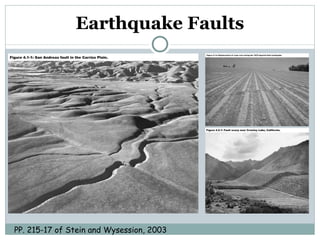
Earthquake Faults PP. 215-17 of Stein and Wysession, 2003
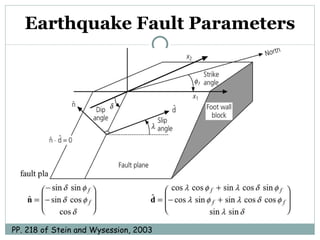
Earthquake Fault Parameters PP. 218 of Stein and Wysession, 2003
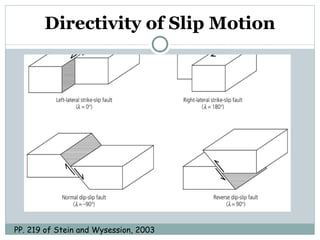
Directivity of Slip Motion PP. 219 of Stein and Wysession, 2003
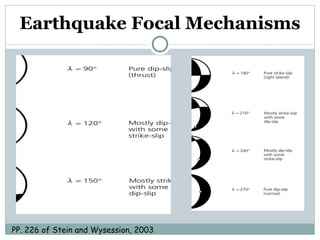
Earthquake Focal Mechanisms PP. 226 of Stein and Wysession, 2003
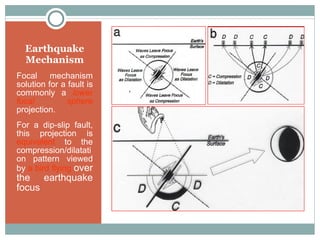
Earthquake Mechanism Focal mechanism solution for a fault is commonly a  lower focal sphere  projection.  For a dip-slip fault, this projection is  equivalent  to the compression/dilatation pattern viewed by  a bird flying   over the earthquake focus .   Black = Compression White = Dilatation
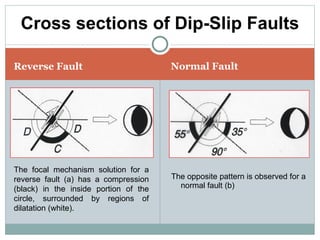
Cross sections of Dip-Slip Faults The opposite pattern is observed for a normal fault (b) Reverse Fault Normal Fault The focal mechanism solution for a reverse fault (a) has a compression (black) in the inside portion of the circle, surrounded by regions of dilatation (white).
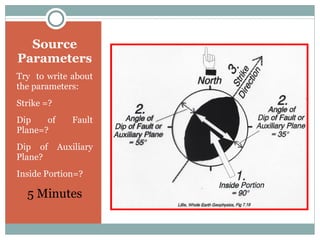
Source Parameters Try  to write about the parameters: Strike =? Dip of Fault Plane=? Dip of Auxiliary Plane? Inside Portion=? 5 Minutes A=? B1=? B2=? C=?
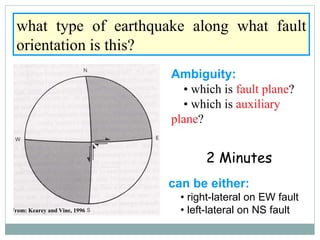
what type of earthquake along what fault orientation is this? Ambiguity: •  which is  fault plane ? •  which is  auxiliary plane ? can be either: •  right-lateral on EW fault •  left-lateral on NS fault 2 Minutes
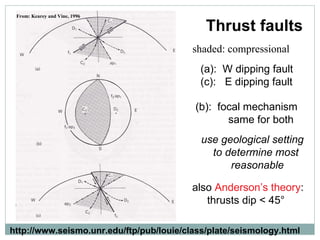
Thrust faults (b):  focal mechanism same for both use geological setting to determine most reasonable shaded: compressional (a):  W dipping fault (c):  E dipping fault also  Anderson’s theory : thrusts dip < 45° http://www.seismo.unr.edu/ftp/pub/louie/class/plate/seismology.html
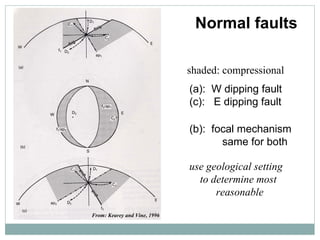
Normal faults shaded: compressional (a):  W dipping fault (c):  E dipping fault (b):  focal mechanism same for both use geological setting to determine most reasonable
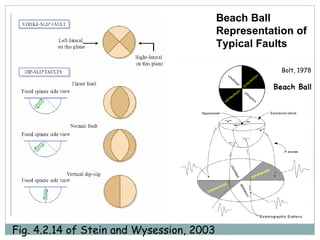
Beach Ball Representation of Typical Faults Fig. 4.2.14 of Stein and Wysession, 2003 Bolt, 1978
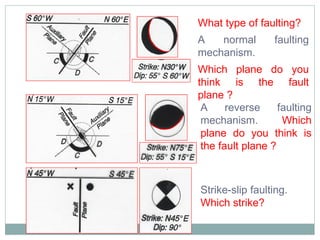
What type of faulting? A normal faulting mechanism.  Which plane do you think is the fault plane ?   A reverse faulting mechanism.  Which plane do you think is the fault plane ? Strike-slip faulting.  Which strike?
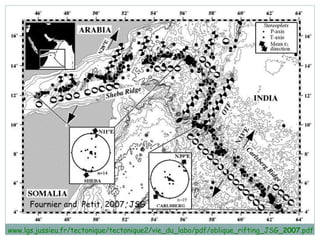
Fournier and  Petit, 2007, JSG www.lgs.jussieu.fr/tectonique/tectonique2/vie_du_labo/pdf/oblique_rifting_JSG_ 2007 .pdf
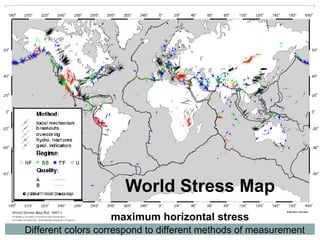
World Stress Map Different colors correspond to different methods of measurement maximum horizontal stress
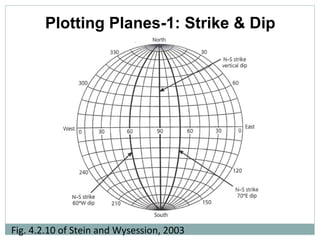
Plotting Planes -1:  Strike & Dip Fig. 4.2.10 of Stein and Wysession, 2003
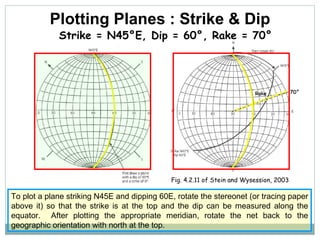
To plot a plane striking N45E and dipping 60E, rotate the stereonet (or tracing paper above it) so that the strike is at the top and the dip can be measured along the equator.  After plotting the appropriate meridian, rotate the net back to the geographic orientation with north at the top. Plotting Planes  :  Strike & Dip Strike = N45°E, Dip = 60°, Rake = 70° Fig. 4.2.11 of Stein and Wysession, 2003
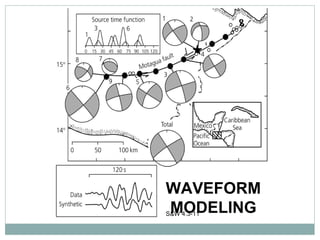
WAVEFORM MODELING S&W 4.3-11
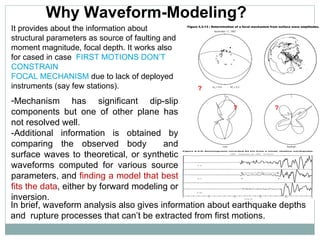
Mechanism has significant dip-slip components but one of other plane has not resolved well . -Additional information is obtained by comparing the observed body  and surface waves to theoretical, or synthetic waveforms computed for various source parameters, and  finding a model that best fits the data , either by forward modeling or inversion .   Why Waveform-Modeling? In brief, waveform analysis also gives information about earthquake depths and  rupture processes that can’t be extracted from first motions. It provides about the information about structural parameters as source of faulting and moment magnitude, focal depth. It works also for cased in case  FIRST MOTIONS DON’T CONSTRAIN  FOCAL MECHANISM  due to lack of deployed instruments (say few stations). ? ? ?
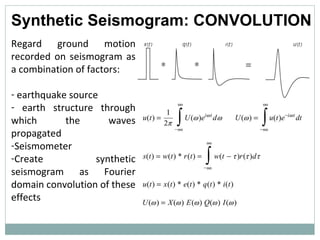
Regard ground motion recorded on seismogram as a combination of factors:  earthquake source earth structure through which the waves propagated Seismometer Create synthetic seismogram as Fourier domain convolution of these effects Synthetic Seismogram: CONVOLUTION

ÖNCEL AKADEMİ: SOLID EARTH GEOPHYSICS

  • 1.
    Solid Earth Geophysics Ali Oncel [email_address] Department of Earth Sciences KFUPM Today’s class: Seismology Measuring the Interior Reading: Fowler Chapter 4
  • 2.
    Earthquake Faults PP.215-17 of Stein and Wysession, 2003
  • 3.
    Earthquake Fault ParametersPP. 218 of Stein and Wysession, 2003
  • 4.
    Directivity of SlipMotion PP. 219 of Stein and Wysession, 2003
  • 5.
    Earthquake Focal MechanismsPP. 226 of Stein and Wysession, 2003
  • 6.
    Earthquake Mechanism Focalmechanism solution for a fault is commonly a lower focal sphere projection. For a dip-slip fault, this projection is equivalent to the compression/dilatation pattern viewed by a bird flying over the earthquake focus . Black = Compression White = Dilatation
  • 7.
    Cross sections ofDip-Slip Faults The opposite pattern is observed for a normal fault (b) Reverse Fault Normal Fault The focal mechanism solution for a reverse fault (a) has a compression (black) in the inside portion of the circle, surrounded by regions of dilatation (white).
  • 8.
    Source Parameters Try to write about the parameters: Strike =? Dip of Fault Plane=? Dip of Auxiliary Plane? Inside Portion=? 5 Minutes A=? B1=? B2=? C=?
  • 9.
    what type ofearthquake along what fault orientation is this? Ambiguity: • which is fault plane ? • which is auxiliary plane ? can be either: • right-lateral on EW fault • left-lateral on NS fault 2 Minutes
  • 10.
    Thrust faults (b): focal mechanism same for both use geological setting to determine most reasonable shaded: compressional (a): W dipping fault (c): E dipping fault also Anderson’s theory : thrusts dip < 45° http://www.seismo.unr.edu/ftp/pub/louie/class/plate/seismology.html
  • 11.
    Normal faults shaded:compressional (a): W dipping fault (c): E dipping fault (b): focal mechanism same for both use geological setting to determine most reasonable
  • 12.
    Beach Ball Representationof Typical Faults Fig. 4.2.14 of Stein and Wysession, 2003 Bolt, 1978
  • 13.
    What type offaulting? A normal faulting mechanism. Which plane do you think is the fault plane ? A reverse faulting mechanism. Which plane do you think is the fault plane ? Strike-slip faulting. Which strike?
  • 14.
    Fournier and Petit, 2007, JSG www.lgs.jussieu.fr/tectonique/tectonique2/vie_du_labo/pdf/oblique_rifting_JSG_ 2007 .pdf
  • 15.
    World Stress MapDifferent colors correspond to different methods of measurement maximum horizontal stress
  • 16.
    Plotting Planes -1: Strike & Dip Fig. 4.2.10 of Stein and Wysession, 2003
  • 17.
    To plot aplane striking N45E and dipping 60E, rotate the stereonet (or tracing paper above it) so that the strike is at the top and the dip can be measured along the equator. After plotting the appropriate meridian, rotate the net back to the geographic orientation with north at the top. Plotting Planes : Strike & Dip Strike = N45°E, Dip = 60°, Rake = 70° Fig. 4.2.11 of Stein and Wysession, 2003
  • 18.
  • 19.
    Mechanism has significantdip-slip components but one of other plane has not resolved well . -Additional information is obtained by comparing the observed body and surface waves to theoretical, or synthetic waveforms computed for various source parameters, and finding a model that best fits the data , either by forward modeling or inversion . Why Waveform-Modeling? In brief, waveform analysis also gives information about earthquake depths and rupture processes that can’t be extracted from first motions. It provides about the information about structural parameters as source of faulting and moment magnitude, focal depth. It works also for cased in case FIRST MOTIONS DON’T CONSTRAIN FOCAL MECHANISM due to lack of deployed instruments (say few stations). ? ? ?
  • 20.
    Regard ground motionrecorded on seismogram as a combination of factors: earthquake source earth structure through which the waves propagated Seismometer Create synthetic seismogram as Fourier domain convolution of these effects Synthetic Seismogram: CONVOLUTION

Editor's Notes

  • #4 PP. 218 of Stein and Wysession, 2003
  • #7 Cross section of reverse fault, earthquake focus and quadrants of compression and dilatation. First motions observed at the surface reveal patterns of compression and dilatation.
  • #15 Fig. 3. Same legend as Fig. 2 for the Sheba and Carlsberg ridges. OTF is Owen transform faults. Bathymetric contour interval is 500 m. Fig. 2. Bathymetric map ( Sandwell and Smith, 1997 ), shallow seismicity between 1964 and 1995 (focal depth &lt;50 km; magnitude &gt;2; Engdahl et al., 1998 ), and all available earthquake focal mechanisms (Harvard CMT for the period 1976–2000; Dziewonski et al., 1981 A.M. Dziewonski, T.A. Chou and J.H. Woodhouse, Determination of earthquake source parameters from waveform data for studies of global and regional seismicity, Journal of Geophysical Research 86 (1981), pp. 2825–2852. Full Text via CrossRef | View Record in Scopus | Cited By in Scopus (411) Dziewonski et al., 1981 ) for the Southwest Indian Ridge (SWIR). Inserted stereoplots are equal-area projections of the P and T axes of the extensional focal mechanisms and the mean direction of extension ( 1 ). The SWIR has been divided into two parts with different trends: the northeastern part between the Rodrigues triple junction and the Prince Edward-Marion-Andrew Bain fracture zone (PEMABFZ; Grindlay et al., 1998 ) trends N054°E ± 2°, and the southwestern part between PEMABFZ and 53°S, 14°E trends N105°E ± 2°. Bathymetric contour interval is 1000 m. Strike-slip focal mechanisms along fracture zones show the consistency between slip vector azimuths and directions of relative motion (solid arrows) calculated from plate motion
  • #17 The planes striking N-S on a stereonet. The meridians (curves going from top to the bottom) represent N-S striking planes with different dips.