Earthquakes
• Causes - tectonics and faults
• Magnitude - energy and intensity
• Earthquake geography
• preparedness
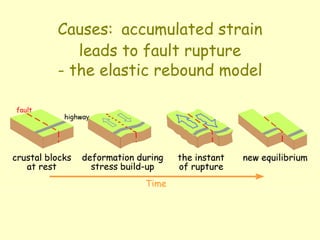
Causes: accumulated strain
leads to fault rupture
- the elastic rebound model
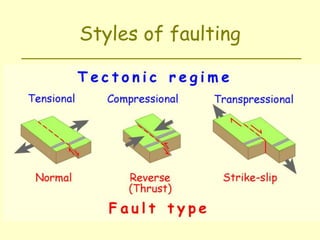
Styles of faulting
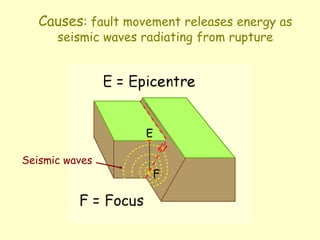
Causes: fault movement releases energy as
seismic waves radiating from rupture
Seismic waves
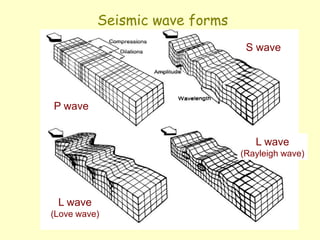
Seismic wave forms
P wave
S wave
L wave
(Rayleigh wave)
L wave
(Love wave)
Earthquake magnitude:
scales based on seismograms
• ML=local (e.g. Richter scale) - based on amplitude
of waves with 1s period within 600 km of
epicentre.
• Mb=body-wave (similar to above)
• Ms=surface wave (wave periods of 20s measured
anywhere on globe
• Mo=seismic moment
• Mw= moment magnitude
The Richter scale
Steps:
1. Measure the interval (in seconds) between
the arrival of the first P and S waves.
2. Measure the amplitude of the largest S
waves.
3. Use nomogram to estimate distance from
earthquake (S-P interval) and magnitude
(join points on S-P interval scale and S
amplitude scale).
4. Use seismograms from at least three
geographic locations to locate epicentre
by triangulation.
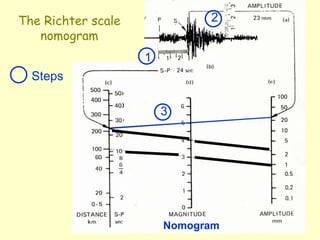
The Richter scale
nomogram
Nomogram
1
2
3
Steps
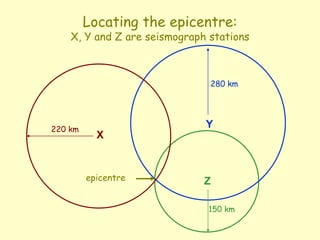
Z
Locating the epicentre:
X, Y and Z are seismograph stations
Y
X
220 km
epicentre
280 km
150 km
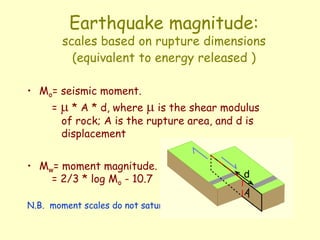
Earthquake magnitude:
scales based on rupture dimensions
(equivalent to energy released )
• Mo= seismic moment.
= m * A * d, where m is the shear modulus
of rock; A is the rupture area, and d is
displacement
• Mw= moment magnitude.
= 2/3 * log Mo - 10.7
N.B. moment scales do not saturate
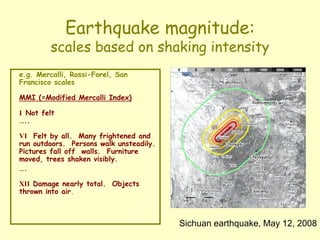
e.g. Mercalli, Rossi-Forel, San
Francisco scales
MMI (=Modified Mercalli Index)
I Not felt
…..
VI Felt by all. Many frightened and
run outdoors. Persons walk unsteadily.
Pictures fall off walls. Furniture
moved, trees shaken visibly.
….
XII Damage nearly total. Objects
thrown into air.
Earthquake magnitude:
scales based on shaking intensity
Sichuan earthquake, May 12, 2008
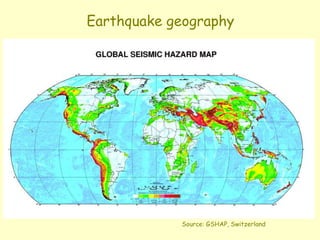
Source: GSHAP, Switzerland
Earthquake geography
Preparedness (examples)
Buildings - site selection, design to code,
retrofit, upgrade codes;
Strengthen bridges, dams, pipelines;
Earthquake drills - houses, schools,
search & rescue;
Emergency planning - survival kits,
evacuation routes, fire prevention, utility
failures, communication alternatives,
education
Seismic hazards
• Locating faults
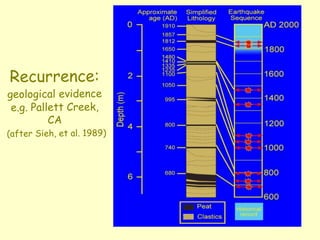
• Estimating recurrence: history and
geology
• Measuring relative motions and
crustal deformation
• Learning from analogies
• Assessing probabilities
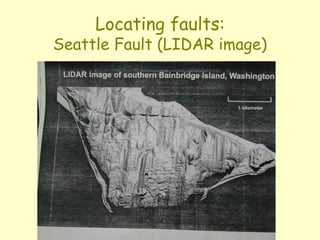
Locating faults:
Seattle Fault (LIDAR image)
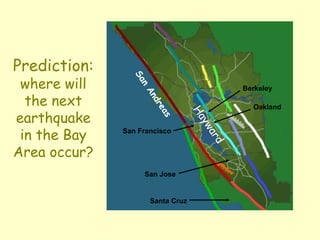
Prediction:
where will
the next
earthquake
in the Bay
Area occur?
San Francisco
San Jose
Santa Cruz
Berkeley
Oakland
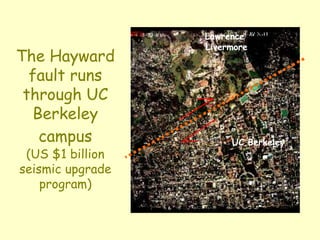
The Hayward
fault runs
through UC
Berkeley
campus
(US $1 billion
seismic upgrade
program)
Lawrence
Livermore
UC Berkeley
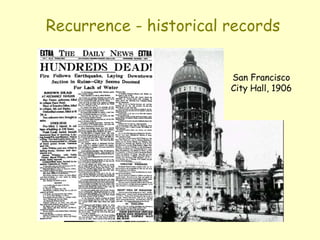
San Francisco
City Hall, 1906
Recurrence - historical records
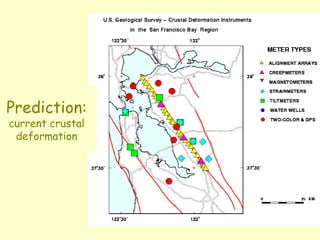
Prediction:
current crustal
deformation
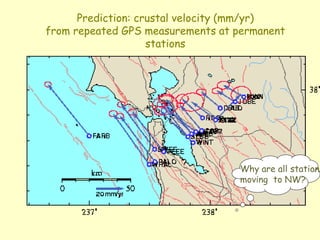
Prediction: crustal velocity (mm/yr)
from repeated GPS measurements at permanent
stations
Why are all stations
moving to NW?
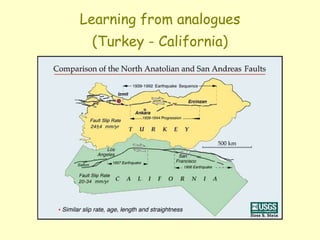
Learning from analogues
(Turkey - California)
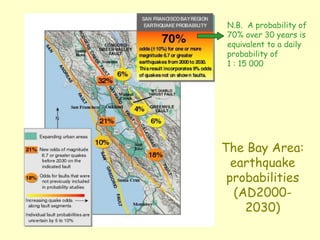
The Bay Area:
earthquake
probabilities
(AD2000-
2030)
N.B. A probability of
70% over 30 years is
equivalent to a daily
probability of
1 : 15 000
Probabilities, yes!
but prediction, no!
• 1996 - Earthquake prediction group of Japanese
Seismological Survey voluntarily disbands (after
Kobe)
• 2000 - British researcher argues that prediction
of main shock impossible at present; immediate
goal should be prediction of aftershock location
and magnitude
Individual seismic hazards
• Shaking = accelerated ground motion
• Liquefaction = failure of waterlogged sandy
substrates
• Landslides, dam failures, etc.
• Tsunamis = seismic sea waves
• Fire, etc.
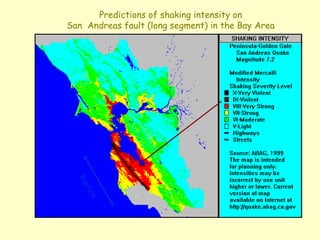
Predictions of shaking intensity on
San Andreas fault (long segment) in the Bay Area
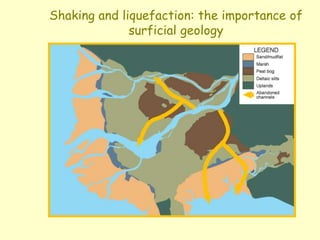
Shaking and liquefaction: the importance of
surficial geology
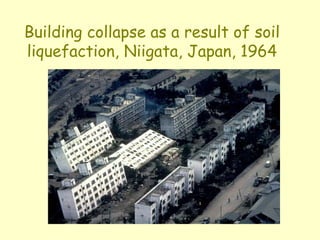
Building collapse as a result of soil
liquefaction, Niigata, Japan, 1964
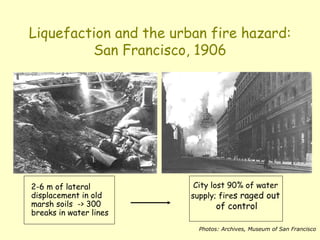
Liquefaction and the urban fire hazard:
San Francisco, 1906
2-6 m of lateral
displacement in old
marsh soils -> 300
breaks in water lines
City lost 90% of water
supply; fires raged out
of control
Photos: Archives, Museum of San Francisco
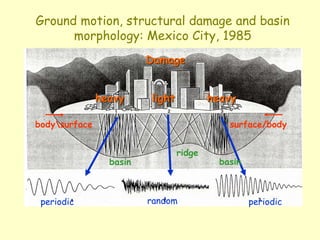
Ground motion, structural damage and basin
morphology: Mexico City, 1985
periodic periodic
random
bodysurface surface/body
Damage
heavy light heavy
ridge
basin basin
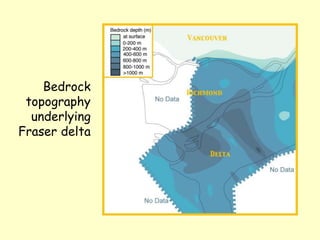
Bedrock
topography
underlying
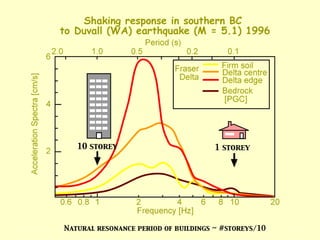
Fraser delta
Earthquakes
don’t kill;
buildings do!
Building harmonics
Buildings at high risk
•URM = unreinforced
masonry;
•open lower storeys;
•poor ties to
foundations
and between storeys;
•lack of cross-bracing;
•poor quality materials.
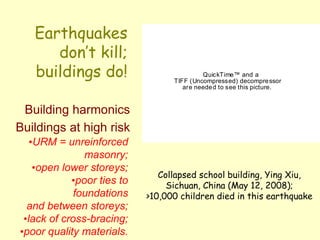
Collapsed school building, Ying Xiu,
Sichuan, China (May 12, 2008);
>10,000 children died in this earthquake
QuickTime™ and a
TIFF (Uncompressed) decompressor
are needed to see this picture.
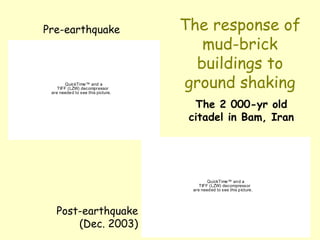
The response of
mud-brick
buildings to
ground shaking
QuickTime™ and a
TIFF (LZW) decompressor
are needed to see this picture.
QuickTime™ and a
TIFF (LZW) decompressor
are needed to see this picture.
The 2 000-yr old
citadel in Bam, Iran
Pre-earthquake
Post-earthquake
(Dec. 2003)
“Much of the building is
done by people putting up
their own houses. But they
cannot afford proper
materials and do not use
skilled labour. There are
many small kilns producing
bricks but because of
demand these are not fired
for the 28 days needed to
make them strong.”
Mohsen Aboutorabi,
Professor of Architecture,
(BBC News, 2003/12/30,
discussing the Bam earthquake in
which ~40,000 died)
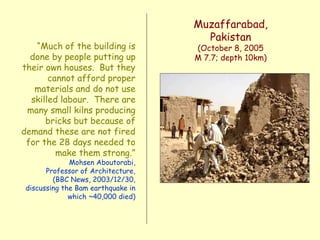
Muzaffarabad,
Pakistan
(October 8, 2005
M 7.7; depth 10km)
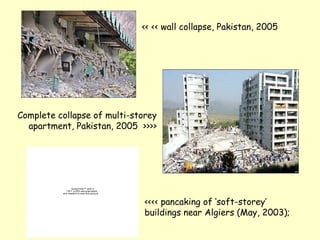
<< << wall collapse, Pakistan, 2005
QuickTime™ and a
TIFF (LZW) decompressor
are needed to see this picture.
<<<< pancaking of ‘soft-storey’
buildings near Algiers (May, 2003);
Complete collapse of multi-storey
apartment, Pakistan, 2005 >>>>
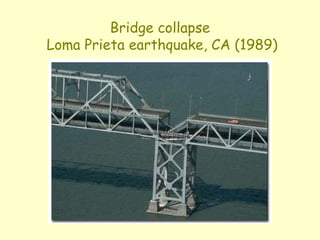
Bridge collapse
Loma Prieta earthquake, CA (1989)
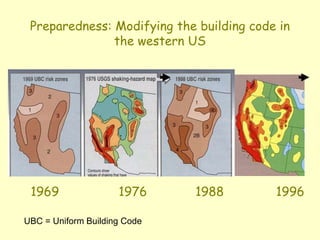
Preparedness: Modifying the building code in
the western US
1969 1976 1988 1996
UBC = Uniform Building Code
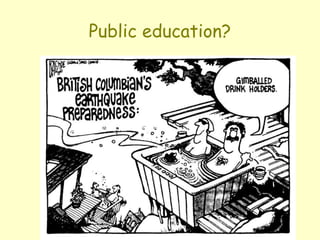
Public education?
Post-earthquake
adjustments
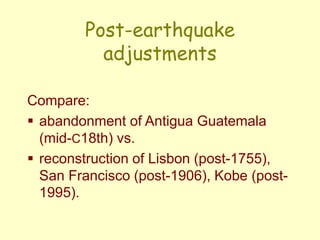
Compare:
 abandonment of Antigua Guatemala
(mid-C18th) vs.
 reconstruction of Lisbon (post-1755),
San Francisco (post-1906), Kobe (post-
1995).
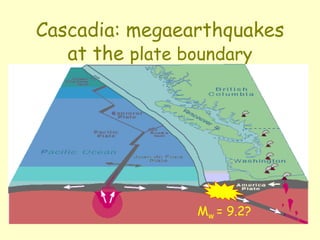
Cascadia: megaearthquakes
at the plate boundary
Mw = 9.2?
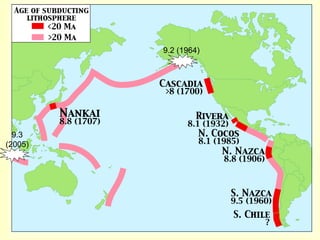
9.2 (1964)
9.3
(2005)
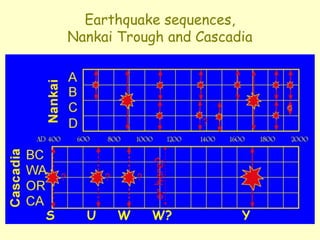
Earthquake sequences,
Nankai Trough and Cascadia
or
here?
S U W W? Y
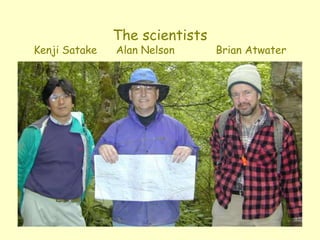
The scientists
Kenji Satake Alan Nelson Brian Atwater
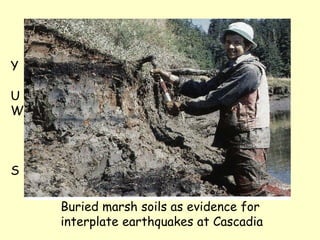
Buried marsh soils as evidence for
interplate earthquakes at Cascadia
Y
U
W
S

Earthquakes.pptx

  • 1.
    Earthquakes • Causes -tectonics and faults • Magnitude - energy and intensity • Earthquake geography • preparedness
  • 2.
    Causes: accumulated strain leadsto fault rupture - the elastic rebound model
  • 3.
  • 4.
    Causes: fault movementreleases energy as seismic waves radiating from rupture Seismic waves
  • 5.
    Seismic wave forms Pwave S wave L wave (Rayleigh wave) L wave (Love wave)
  • 6.
    Earthquake magnitude: scales basedon seismograms • ML=local (e.g. Richter scale) - based on amplitude of waves with 1s period within 600 km of epicentre. • Mb=body-wave (similar to above) • Ms=surface wave (wave periods of 20s measured anywhere on globe • Mo=seismic moment • Mw= moment magnitude
  • 7.
    The Richter scale Steps: 1.Measure the interval (in seconds) between the arrival of the first P and S waves. 2. Measure the amplitude of the largest S waves. 3. Use nomogram to estimate distance from earthquake (S-P interval) and magnitude (join points on S-P interval scale and S amplitude scale). 4. Use seismograms from at least three geographic locations to locate epicentre by triangulation.
  • 8.
  • 9.
    Z Locating the epicentre: X,Y and Z are seismograph stations Y X 220 km epicentre 280 km 150 km
  • 10.
    Earthquake magnitude: scales basedon rupture dimensions (equivalent to energy released ) • Mo= seismic moment. = m * A * d, where m is the shear modulus of rock; A is the rupture area, and d is displacement • Mw= moment magnitude. = 2/3 * log Mo - 10.7 N.B. moment scales do not saturate
  • 11.
    e.g. Mercalli, Rossi-Forel,San Francisco scales MMI (=Modified Mercalli Index) I Not felt ….. VI Felt by all. Many frightened and run outdoors. Persons walk unsteadily. Pictures fall off walls. Furniture moved, trees shaken visibly. …. XII Damage nearly total. Objects thrown into air. Earthquake magnitude: scales based on shaking intensity Sichuan earthquake, May 12, 2008
  • 12.
  • 13.
    Preparedness (examples) Buildings -site selection, design to code, retrofit, upgrade codes; Strengthen bridges, dams, pipelines; Earthquake drills - houses, schools, search & rescue; Emergency planning - survival kits, evacuation routes, fire prevention, utility failures, communication alternatives, education
  • 14.
    Seismic hazards • Locatingfaults • Estimating recurrence: history and geology • Measuring relative motions and crustal deformation • Learning from analogies • Assessing probabilities
  • 15.
  • 16.
    Prediction: where will the next earthquake inthe Bay Area occur? San Francisco San Jose Santa Cruz Berkeley Oakland
  • 17.
    The Hayward fault runs throughUC Berkeley campus (US $1 billion seismic upgrade program) Lawrence Livermore UC Berkeley
  • 18.
    San Francisco City Hall,1906 Recurrence - historical records
  • 20.
  • 21.
    Prediction: crustal velocity(mm/yr) from repeated GPS measurements at permanent stations Why are all stations moving to NW?
  • 22.
  • 23.
    The Bay Area: earthquake probabilities (AD2000- 2030) N.B.A probability of 70% over 30 years is equivalent to a daily probability of 1 : 15 000
  • 24.
    Probabilities, yes! but prediction,no! • 1996 - Earthquake prediction group of Japanese Seismological Survey voluntarily disbands (after Kobe) • 2000 - British researcher argues that prediction of main shock impossible at present; immediate goal should be prediction of aftershock location and magnitude
  • 25.
    Individual seismic hazards •Shaking = accelerated ground motion • Liquefaction = failure of waterlogged sandy substrates • Landslides, dam failures, etc. • Tsunamis = seismic sea waves • Fire, etc.
  • 26.
    Predictions of shakingintensity on San Andreas fault (long segment) in the Bay Area
  • 27.
    Shaking and liquefaction:the importance of surficial geology
  • 28.
    Building collapse asa result of soil liquefaction, Niigata, Japan, 1964
  • 29.
    Liquefaction and theurban fire hazard: San Francisco, 1906 2-6 m of lateral displacement in old marsh soils -> 300 breaks in water lines City lost 90% of water supply; fires raged out of control Photos: Archives, Museum of San Francisco
  • 30.
    Ground motion, structuraldamage and basin morphology: Mexico City, 1985 periodic periodic random bodysurface surface/body Damage heavy light heavy ridge basin basin
  • 31.
  • 32.
    Earthquakes don’t kill; buildings do! Buildingharmonics Buildings at high risk •URM = unreinforced masonry; •open lower storeys; •poor ties to foundations and between storeys; •lack of cross-bracing; •poor quality materials. Collapsed school building, Ying Xiu, Sichuan, China (May 12, 2008); >10,000 children died in this earthquake QuickTime™ and a TIFF (Uncompressed) decompressor are needed to see this picture.
  • 34.
    The response of mud-brick buildingsto ground shaking QuickTime™ and a TIFF (LZW) decompressor are needed to see this picture. QuickTime™ and a TIFF (LZW) decompressor are needed to see this picture. The 2 000-yr old citadel in Bam, Iran Pre-earthquake Post-earthquake (Dec. 2003)
  • 35.
    “Much of thebuilding is done by people putting up their own houses. But they cannot afford proper materials and do not use skilled labour. There are many small kilns producing bricks but because of demand these are not fired for the 28 days needed to make them strong.” Mohsen Aboutorabi, Professor of Architecture, (BBC News, 2003/12/30, discussing the Bam earthquake in which ~40,000 died) Muzaffarabad, Pakistan (October 8, 2005 M 7.7; depth 10km)
  • 36.
    << << wallcollapse, Pakistan, 2005 QuickTime™ and a TIFF (LZW) decompressor are needed to see this picture. <<<< pancaking of ‘soft-storey’ buildings near Algiers (May, 2003); Complete collapse of multi-storey apartment, Pakistan, 2005 >>>>
  • 37.
    Bridge collapse Loma Prietaearthquake, CA (1989)
  • 38.
    Preparedness: Modifying thebuilding code in the western US 1969 1976 1988 1996 UBC = Uniform Building Code
  • 39.
  • 40.
    Post-earthquake adjustments Compare:  abandonment ofAntigua Guatemala (mid-C18th) vs.  reconstruction of Lisbon (post-1755), San Francisco (post-1906), Kobe (post- 1995).
  • 41.
    Cascadia: megaearthquakes at theplate boundary Mw = 9.2?
  • 42.
  • 43.
    Earthquake sequences, Nankai Troughand Cascadia or here? S U W W? Y
  • 44.
    The scientists Kenji SatakeAlan Nelson Brian Atwater
  • 45.
    Buried marsh soilsas evidence for interplate earthquakes at Cascadia Y U W S