SEADTIVE HYPNOTIC DRUGS II
By
Dr. S. Amber Zaidi
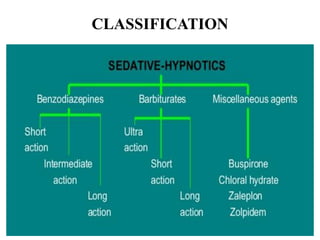
CLASSIFICATION
BARBITURATES
Oldest among sedative and hypnotic class. Due to no. of
disadvantages not used as sedative.
• Low therapeutic index
• Cause dependence
• High abuse potential
• Repeated use leads to the development of tolerance
• Acute barbiturate withdrawal in drug abusers can cause a
fatal withdrawal syndrome
• Drug has been largely replaced by newer drugs
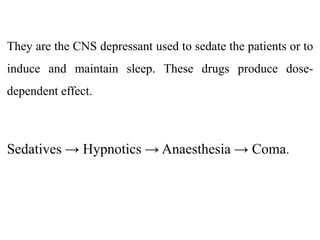
They are the CNS depressant used to sedate the patients or to
induce and maintain sleep. These drugs produce dose-
dependent effect.
Sedatives → Hypnotics → Anaesthesia → Coma.
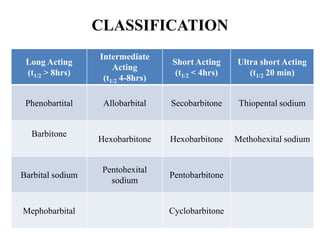
CLASSIFICATION
Long Acting
(t1/2 > 8hrs)
Intermediate
Acting
(t1/2 4-8hrs)
Short Acting
(t1/2 < 4hrs)
Ultra short Acting
(t1/2 20 min)
Phenobartital Allobarbital Secobarbitone Thiopental sodium
Barbitone
Hexobarbitone Hexobarbitone Methohexital sodium
Barbital sodium
Pentohexital
sodium
Pentobarbitone
Mephobarbital Cyclobarbitone
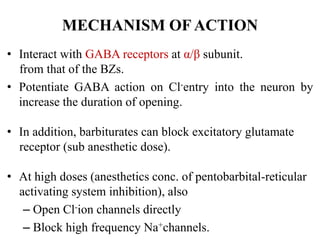
MECHANISM OF ACTION
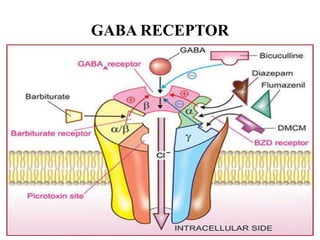
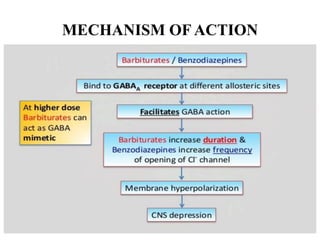
• Interact with GABA receptors at α/β subunit.
from that of the BZs.
• Potentiate GABA action on Cl-entry into the neuron by
increase the duration of opening.
• In addition, barbiturates can block excitatory glutamate
receptor (sub anesthetic dose).
• At high doses (anesthetics conc. of pentobarbital-reticular
activating system inhibition), also
– Open Cl-ion channels directly
– Block high frequency Na+channels.
GABA RECEPTOR
MECHANISM OF ACTION
PHARMACOLOGICAL EFFECTS
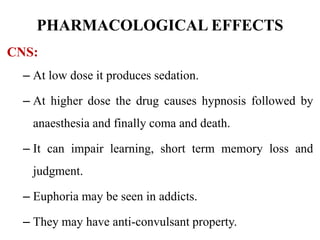
CNS:
– At low dose it produces sedation.
– At higher dose the drug causes hypnosis followed by
anaesthesia and finally coma and death.
– It can impair learning, short term memory loss and
judgment.
– Euphoria may be seen in addicts.
– They may have anti-convulsant property.
PHARMACOLOGICAL EFFECTS
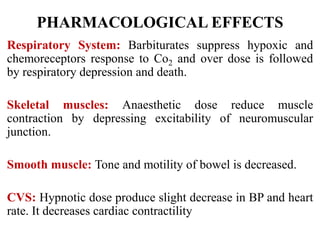
Respiratory System: Barbiturates suppress hypoxic and
chemoreceptors response to Co2 and over dose is followed
by respiratory depression and death.
Skeletal muscles: Anaesthetic dose reduce muscle
contraction by depressing excitability of neuromuscular
junction.
Smooth muscle: Tone and motility of bowel is decreased.
CVS: Hypnotic dose produce slight decrease in BP and heart
rate. It decreases cardiac contractility
PHARMACOLOGICAL EFFECTS
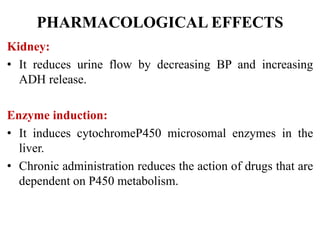
Kidney:
• It reduces urine flow by decreasing BP and increasing
ADH release.
Enzyme induction:
• It induces cytochromeP450 microsomal enzymes in the
liver.
• Chronic administration reduces the action of drugs that are
dependent on P450 metabolism.
KINETICS
• All barbiturates are weak acids, lipid soluble, absorbed
orally. distribute throughout the body
• Thiopentone is highly lipid soluble (high rate of entry into
CNS- quick onset of action)
• Redistribute in the body from the brain to skeletal
muscles- adipose tissues
• Metabolized in the liver to inactive metabolites
• Excreted in the urine. Alkalinization increases excretion
• Cross the placenta
THERAPEUTIC USES
• Now, they are not used as hypnotics and anxiolytics.
• Thiopental is used intravenously to induce anaesthesia.
• Phenobarbitone is used in epilepsy.
• They are used in long term management of tonic-clonic
seizure
• They are sometimes used as adjuvant in psychosomatic
disorder.
ADVERSE EFFECTS
• Drug hangover
– Nausea
– Dizziness
• CNS
– causes drowsiness
– impaired concentration
– mental and physical sluggishness.
• Tolerance
• Dependence (abuse liability)
• Withdrawal symptoms cause tremor, anxiety, weakness,
restlessness, nausea, vomiting and cardiac arrest.
• Neonatal flacidity & respiratory depression
ACUTE BARBITURATE POISONING
Mostly suicidal – excessive CNS depression – flabby and
comatose with shallow and failing respiration, CVS collapse,
renal shut down & pulmonary complications
Treatment:
• Supportive: patent airway, assisted respiration, oxygen, IV
fluid and vasopressors like Dopamine
• Gastric lavage (activated charcoal)
• Alkaline diuresis: Sodium bicarbonate 1 meq/kg IV with
or without mannitol for long acting drugs
• Haemodialysis: highly effective in long as well as short
acting drugs
DRUG INTERACTION
• Induce metabolism of many drugs – warfarin, steroids,
OCP, chloramphenicol, tolbutamide
• Alcohol, antihistamines, opioids – CNS depression
• Sodium valproate – increases plasma conc. of
Phenobarbitone
• Phenobarbitone – competitively induces phenytoin
metabolism
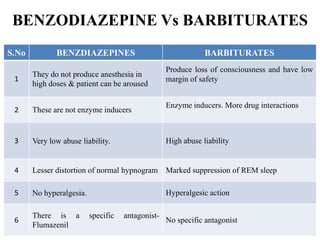
BENZODIAZEPINE Vs BARBITURATES
S.No BENZDIAZEPINES BARBITURATES
1
They do not produce anesthesia in
high doses & patient can be aroused
Produce loss of consciousness and have low
margin of safety
2 These are not enzyme inducers
Enzyme inducers. More drug interactions
3 Very low abuse liability. High abuse liability
4 Lesser distortion of normal hypnogram Marked suppression of REM sleep
5 No hyperalgesia. Hyperalgesic action
6
There is a specific antagonist-
Flumazenil
No specific antagonist
NON-BENZODIAZEPINES
ZOPICLONE
• Cyclopyrrolone derivative: active metabolite – N-
desmethylzopiclone
• MOA: Binds to α subunit of BZ receptor– hypnotic action
• No sleep architecture distortion or withdrawal phenomena
• Uses: to wean off insomniacs on BZ and short term
therapy for insomnia
• ADRs: Metallic taste, impairment of judgment and
alertness, psychological disturbance – addictive property
(rarely)
• Half life: 5 – 6 hours
ZOLPIDEM
• MOA: Acts on α1 subunit of BZ receptor (hypnotic)
• Shortened sleep latency period, prolongs sleep time – but
no anticonvulsant, antianxiety or muscle relaxant effects
• Minimal residual day time sedation or fading of effects on
repeated use
• Little rebound insomnia on discontinuation
• Absence of tolerance and low abuse potential
• Kinetics: Completely metabolized in liver – half life – 2
hrs
• Uses: short term therapy of sleep onset insomnia – day
time sedation less (short half life)
ZALEPLON
• Shortest acting - acts on α1 subunit of BZ receptor
(hypnotic)
• Kinetic: Rapidly absorbed (30% bioavailability) – rapidly
cleared by hepatic metabolism – Half life (1 hr)– no active
metabolite
• Does not prolong total sleep time or reduce the number of
awakenings
• Can be taken late night – no morning sedation, anxiety or
insomnia
• No tolerance or dependence
• Uses: Sleep-onset insomnia (1-2 weeks therapy)
BUSPIRONE
• Totally different anxiolytic from BZs, no effects on GABA
systems, partial agonist at 5-HT1A receptors some affinity
for D2 & 5-HT2A
• Indication: Indicated for generalized anxiety disorders but
takes 1 to 2 weeks to exert anxiolytic effects.
• Buspirone lacks anticonvulsant and Muscle relaxant
property and cause minimal sedation.
• No additive CNS depression with other drugs.
• ADRs: hypothermia, increase prolactin, headache,
dizziness, nervousness
CHLORAL HYDRATE
• Relatively safe hypnotic, inducing sleep in a half hour
and lasting about 6h.
• Used mainly in children and elder, and in patients
who failed to respond other drugs.
THANK YOU

SEADTIVE HYPNOTIC DRUGS PPT 2.pdf hghhhhhh we

  • 1.
    SEADTIVE HYPNOTIC DRUGSII By Dr. S. Amber Zaidi
  • 2.
  • 3.
    BARBITURATES Oldest among sedativeand hypnotic class. Due to no. of disadvantages not used as sedative. • Low therapeutic index • Cause dependence • High abuse potential • Repeated use leads to the development of tolerance • Acute barbiturate withdrawal in drug abusers can cause a fatal withdrawal syndrome • Drug has been largely replaced by newer drugs
  • 4.
    They are theCNS depressant used to sedate the patients or to induce and maintain sleep. These drugs produce dose- dependent effect. Sedatives → Hypnotics → Anaesthesia → Coma.
  • 5.
    CLASSIFICATION Long Acting (t1/2 >8hrs) Intermediate Acting (t1/2 4-8hrs) Short Acting (t1/2 < 4hrs) Ultra short Acting (t1/2 20 min) Phenobartital Allobarbital Secobarbitone Thiopental sodium Barbitone Hexobarbitone Hexobarbitone Methohexital sodium Barbital sodium Pentohexital sodium Pentobarbitone Mephobarbital Cyclobarbitone
  • 6.
    MECHANISM OF ACTION •Interact with GABA receptors at α/β subunit. from that of the BZs. • Potentiate GABA action on Cl-entry into the neuron by increase the duration of opening. • In addition, barbiturates can block excitatory glutamate receptor (sub anesthetic dose). • At high doses (anesthetics conc. of pentobarbital-reticular activating system inhibition), also – Open Cl-ion channels directly – Block high frequency Na+channels.
  • 7.
  • 8.
  • 9.
    PHARMACOLOGICAL EFFECTS CNS: – Atlow dose it produces sedation. – At higher dose the drug causes hypnosis followed by anaesthesia and finally coma and death. – It can impair learning, short term memory loss and judgment. – Euphoria may be seen in addicts. – They may have anti-convulsant property.
  • 10.
    PHARMACOLOGICAL EFFECTS Respiratory System:Barbiturates suppress hypoxic and chemoreceptors response to Co2 and over dose is followed by respiratory depression and death. Skeletal muscles: Anaesthetic dose reduce muscle contraction by depressing excitability of neuromuscular junction. Smooth muscle: Tone and motility of bowel is decreased. CVS: Hypnotic dose produce slight decrease in BP and heart rate. It decreases cardiac contractility
  • 11.
    PHARMACOLOGICAL EFFECTS Kidney: • Itreduces urine flow by decreasing BP and increasing ADH release. Enzyme induction: • It induces cytochromeP450 microsomal enzymes in the liver. • Chronic administration reduces the action of drugs that are dependent on P450 metabolism.
  • 12.
    KINETICS • All barbituratesare weak acids, lipid soluble, absorbed orally. distribute throughout the body • Thiopentone is highly lipid soluble (high rate of entry into CNS- quick onset of action) • Redistribute in the body from the brain to skeletal muscles- adipose tissues • Metabolized in the liver to inactive metabolites • Excreted in the urine. Alkalinization increases excretion • Cross the placenta
  • 13.
    THERAPEUTIC USES • Now,they are not used as hypnotics and anxiolytics. • Thiopental is used intravenously to induce anaesthesia. • Phenobarbitone is used in epilepsy. • They are used in long term management of tonic-clonic seizure • They are sometimes used as adjuvant in psychosomatic disorder.
  • 14.
    ADVERSE EFFECTS • Drughangover – Nausea – Dizziness • CNS – causes drowsiness – impaired concentration – mental and physical sluggishness. • Tolerance • Dependence (abuse liability) • Withdrawal symptoms cause tremor, anxiety, weakness, restlessness, nausea, vomiting and cardiac arrest. • Neonatal flacidity & respiratory depression
  • 15.
    ACUTE BARBITURATE POISONING Mostlysuicidal – excessive CNS depression – flabby and comatose with shallow and failing respiration, CVS collapse, renal shut down & pulmonary complications Treatment: • Supportive: patent airway, assisted respiration, oxygen, IV fluid and vasopressors like Dopamine • Gastric lavage (activated charcoal) • Alkaline diuresis: Sodium bicarbonate 1 meq/kg IV with or without mannitol for long acting drugs • Haemodialysis: highly effective in long as well as short acting drugs
  • 16.
    DRUG INTERACTION • Inducemetabolism of many drugs – warfarin, steroids, OCP, chloramphenicol, tolbutamide • Alcohol, antihistamines, opioids – CNS depression • Sodium valproate – increases plasma conc. of Phenobarbitone • Phenobarbitone – competitively induces phenytoin metabolism
  • 17.
    BENZODIAZEPINE Vs BARBITURATES S.NoBENZDIAZEPINES BARBITURATES 1 They do not produce anesthesia in high doses & patient can be aroused Produce loss of consciousness and have low margin of safety 2 These are not enzyme inducers Enzyme inducers. More drug interactions 3 Very low abuse liability. High abuse liability 4 Lesser distortion of normal hypnogram Marked suppression of REM sleep 5 No hyperalgesia. Hyperalgesic action 6 There is a specific antagonist- Flumazenil No specific antagonist
  • 18.
  • 19.
    ZOPICLONE • Cyclopyrrolone derivative:active metabolite – N- desmethylzopiclone • MOA: Binds to α subunit of BZ receptor– hypnotic action • No sleep architecture distortion or withdrawal phenomena • Uses: to wean off insomniacs on BZ and short term therapy for insomnia • ADRs: Metallic taste, impairment of judgment and alertness, psychological disturbance – addictive property (rarely) • Half life: 5 – 6 hours
  • 20.
    ZOLPIDEM • MOA: Actson α1 subunit of BZ receptor (hypnotic) • Shortened sleep latency period, prolongs sleep time – but no anticonvulsant, antianxiety or muscle relaxant effects • Minimal residual day time sedation or fading of effects on repeated use • Little rebound insomnia on discontinuation • Absence of tolerance and low abuse potential • Kinetics: Completely metabolized in liver – half life – 2 hrs • Uses: short term therapy of sleep onset insomnia – day time sedation less (short half life)
  • 21.
    ZALEPLON • Shortest acting- acts on α1 subunit of BZ receptor (hypnotic) • Kinetic: Rapidly absorbed (30% bioavailability) – rapidly cleared by hepatic metabolism – Half life (1 hr)– no active metabolite • Does not prolong total sleep time or reduce the number of awakenings • Can be taken late night – no morning sedation, anxiety or insomnia • No tolerance or dependence • Uses: Sleep-onset insomnia (1-2 weeks therapy)
  • 22.
    BUSPIRONE • Totally differentanxiolytic from BZs, no effects on GABA systems, partial agonist at 5-HT1A receptors some affinity for D2 & 5-HT2A • Indication: Indicated for generalized anxiety disorders but takes 1 to 2 weeks to exert anxiolytic effects. • Buspirone lacks anticonvulsant and Muscle relaxant property and cause minimal sedation. • No additive CNS depression with other drugs. • ADRs: hypothermia, increase prolactin, headache, dizziness, nervousness
  • 23.
    CHLORAL HYDRATE • Relativelysafe hypnotic, inducing sleep in a half hour and lasting about 6h. • Used mainly in children and elder, and in patients who failed to respond other drugs.
  • 24.