SEDATIVES
&
HYPNOTICS
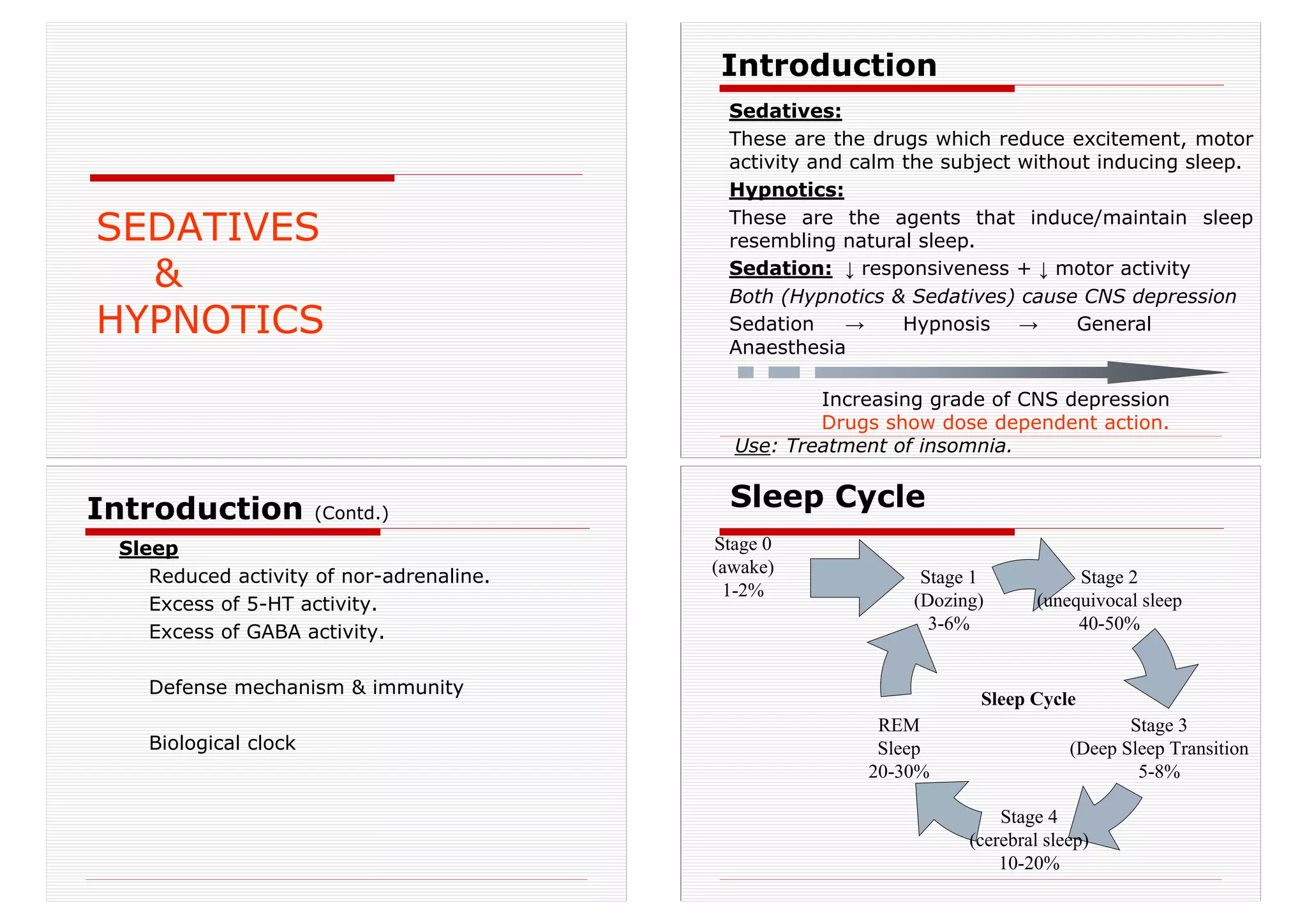
Sedatives:
These are the drugs which reduce excitement, motor
activity and calm the subject without inducing sleep.
Hypnotics:
These are the agents that induce/maintain sleep
resembling natural sleep.
Sedation: ↓ responsiveness + ↓ motor activity
Both (Hypnotics & Sedatives) cause CNS depression
Sedation → Hypnosis → General
Anaesthesia
Increasing grade of CNS depression
Drugs show dose dependent action.
Use: Treatment of insomnia.
Introduction
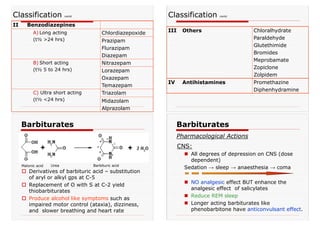
Sleep
Reduced activity of nor-adrenaline.
Excess of 5-HT activity.
Excess of GABA activity.
Defense mechanism & immunity
Biological clock
Introduction (Contd.)
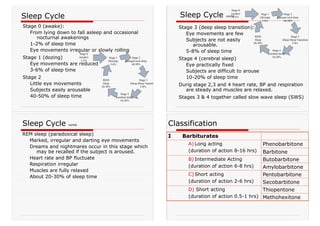
Stage 1
(Dozing)
3-6%
Stage 2
(unequivocal sleep
40-50%
Stage 3
(Deep Sleep Transition
5-8%
Stage 4
(cerebral sleep)
10-20%
REM
Sleep
20-30%
Stage 0
(awake)
1-2%
Sleep Cycle
Sleep Cycle
Sleep Cycle
Stage 0 (awake):
From lying down to fall asleep and occasional
nocturnal awakenings
1-2% of sleep time
Eye movements irregular or slowly rolling
Stage 1 (dozing)
Eye movements are reduced
3-6% of sleep time
Stage 2
Little eye movements
Subjects easily arousable
40-50% of sleep time
Stage 1
(Dozing)
3-6%
Stage 2
(unequivocal sleep
40-50%
Stage 3
(Deep Sleep Transiti
5-8%
Stage 4
(cerebral sleep)
10-20%
REM
Sleep
20-30%
Stage 0
(awake)
1-2%
Sleep Cycle contd.
Stage 3 (deep sleep transition):
Eye movements are few
Subjects are not easily
arousable.
5-8% of sleep time
Stage 4 (cerebral sleep)
Eye practically fixed
Subjects are difficult to arouse
10-20% of sleep time
Durig stage 2,3 and 4 heart rate, BP and respiration
are steady and muscles are relaxed.
Stages 3 & 4 together called slow wave sleep (SWS)
Stage 1
(Dozing)
3-6%
Stage 2
(unequivocal sleep
40-50%
Stage 3
(Deep Sleep Transition
5-8%
Stage 4
(cerebral sleep)
10-20%
REM
Sleep
20-30%
Stage 0
(awake)
1-2%
Sleep Cycle contd.
REM sleep (paradoxical sleep)
Marked, irregular and darting eye movements
Dreams and nightmares occur in this stage which
may be recalled if the subject is aroused.
Heart rate and BP fluctuate
Respiration irregular
Muscles are fully relaxed
About 20-30% of sleep time
Classification
I Barbiturates
A) Long acting
(duration of action 8-16 hrs)
Phenobarbitone
Barbitone
B) Intermediate Acting
(duration of action 6-8 hrs)
Butobarbitone
Amylobarbitone
C) Short acting
(duration of action 2-6 hrs)
Pentobarbitone
Secobarbitone
D) Short acting
(duration of action 0.5-1 hrs)
Thiopentone
Methohexitone
Classification contd
II Benzodiazepines
A) Long acting
(t½ >24 hrs)
Chlordiazepoxide
Prazipam
Flurazipam
Diazepam
B) Short acting
(t½ 5 to 24 hrs)
Nitrazepam
Lorazepam
Oxazepam
Temazepam
C) Ultra short acting
(t½ <24 hrs)
Triazolam
Midazolam
Alprazolam
III Others Chloralhydrate
Paraldehyde
Glutethimide
Bromides
Meprobamate
Zopiclone
Zolpidem
IV Antihistamines Promethazine
Diphenhydramine
Classification contd
Barbiturates
† Derivatives of barbituric acid – substitution
of aryl or alkyl gps at C-5
† Replacement of O with S at C-2 yield
thiobarbiturates
† Produce alcohol like symptoms such as
impaired motor control (ataxia), dizziness,
and slower breathing and heart rate
Malonic acid Urea Barbituric acid
CNS:
„ All degrees of depression on CNS (dose
dependent)
Sedation → sleep → anaesthesia → coma
„ NO analgesic effect BUT enhance the
analgesic effect of salicylates
„ Reduce REM sleep
„ Longer acting barbiturates like
phenobarbitone have anticonvulsant effect.
Barbiturates
Pharmacological Actions
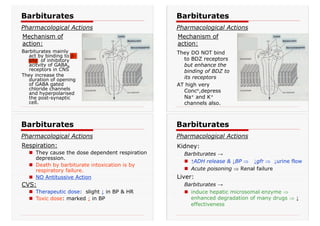
Barbiturates mainly
act by binding to β-
site of inhibitory
acitvity of GABAA
receptors in CNS
They increase the
duration of opening
of GABA gated
chloride channels
and hyperpolarised
the post-synaptic
cell.
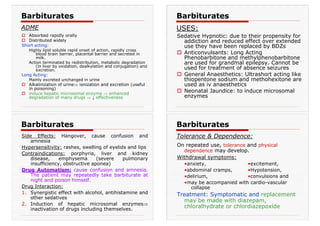
Barbiturates
Pharmacological Actions
Mechanism of
action:
They DO NOT bind
to BDZ receptors
but enhance the
binding of BDZ to
its receptors
AT high very
Concn,depress
Na+ and K+
channels also.
Barbiturates
Pharmacological Actions
Mechanism of
action:
Barbiturates
Pharmacological Actions
Respiration:
„ They cause the dose dependent respiration
depression.
„ Death by barbiturate intoxication is by
respiratory failure.
„ NO Antitussive Action
CVS:
„ Therapeutic dose: slight ↓ in BP & HR
„ Toxic dose: marked ↓ in BP
Kidney:
Barbiturates →
„ ↑ADH release & ↓BP Ÿ ↓gfr Ÿ ↓urine flow
„ Acute poisoning Ÿ Renal failure
Liver:
Barbiturates →
„ induce hepatic microsomal enzyme Ÿ
enhanced degradation of many drugs Ÿ ↓
effectiveness
Barbiturates
Pharmacological Actions
† Absorbed rapidly orally
† Distributed widely
Short acting:
Highly lipid soluble rapid onset of action, rapidly cross
blood brain barrier, placental barrier and secreted in
milk.
Action terminated by redistribution, metabolic degradation
(in liver by oxidation, dealkylation and conjugation) and
excretion.
Long Acting:
Mainly excreted unchanged in urine
† Alkalinization of urineŸ ionization and excretion (useful
in poisoning)
† induce hepatic microsomal enzyme Ÿ enhanced
degradation of many drugs Ÿ ↓ effectiveness
Barbiturates
ADME
Sedative Hypnotic: due to their propensity for
addiction and reduced effect over extended
use they have been replaced by BDZs
† Anticonvulsants: Long Acting
Phenobarbitone and methylphenobarbitone
are used for grandmal epilepsy. Cannot be
used for treatment of absence seizures
† General Anaesthetics: Ultrashort acting like
thiopentone sodium and methohexitone are
used as iv anaesthetics
† Neonatal Jaundice: to induce microsomal
enzymes
Barbiturates
USES:
Side Effects: Hangover, cause confusion and
amnesia
Hypersensitivity: rashes, swelling of eyelids and lips
Contraindications: porphyria, liver and kidney
disease, emphysema (severe pulmonary
insufficiency, obstructive aponea)
Drug Automatism: cause confusion and amnesia.
The patient may repeatedly take barbiturate at
night and poison himself.
Drug Interaction:
1. Synergistic effect with alcohol, antihistamine and
other sedatives
2. Induction of hepatic microsomal enzymesŸ
inactivation of drugs including themselves.
Barbiturates
On repeated use, tolerance and physical
dependence may develop.
Withdrawal symptoms:
•anxiety, •excitement,
•abdominal cramps, •Hypotension,
•delirium, •convulsions and
•may be accompanied with cardio-vascular
collapse
Treatment: Symptomatic and replacement
may be made with diazepam,
chloralhydrate or chlordiazepoxide
Barbiturates
Tolerance & Dependence:
„ Due to overdose accidentally or with suicide
attempt
„ Lethal dose more than 10 times of full
hypnotic.
„ Blood level more than 6 mg/100ml can cause
death.
„ Short acting more toxic than long acting.
„ Alcohol potentiates the effect.
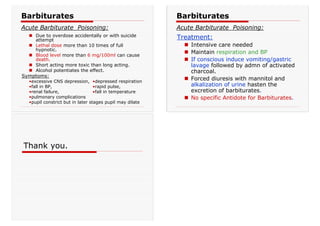
Symptoms:
•excessive CNS depression, •depressed respiration
•fall in BP, •rapid pulse,
•renal failure, •fall in temperature
•pulmonary complications
•pupil constrict but in later stages pupil may dilate
Barbiturates
Acute Barbiturate Poisoning:
Treatment:
„ Intensive care needed
„ Maintain respiration and BP
„ If conscious induce vomiting/gastric
lavage followed by admn of activated
charcoal.
„ Forced diuresis with mannitol and
alkalization of urine hasten the
excretion of barbiturates.
„ No specific Antidote for Barbiturates.
Barbiturates
Acute Barbiturate Poisoning:
CNS:
„ Sedative, Hypnotic, antianxiety, anticonvulsant
and Central Muscle relaxant effects
„ NO analgesic effect
„ Decrease the time of onset of sleep and increase
duration of NREM sleep
CVS & Respiration:
„ Decrease H.R. but lower B.P.
„ Decrease respiration (very less as compared to
barbiturates)
„ BDZs + alcohol Ÿ serious respiratory depression
Benzodiazepines (BDZs)
Pharmacological Actions
Skeletal Muscle:
„ Very good centrally acting muscle
relaxants
In anxiety Ÿ↑ed muscle toneŸ aches and
pains
e.g. Clonazepam (antianxiety & muscle
relaxant)
GIT:
Reduce natural HCl secretion in peptic ulcers
and produce relief in spasmodic colic
Barbiturates
Pharmacological Actions
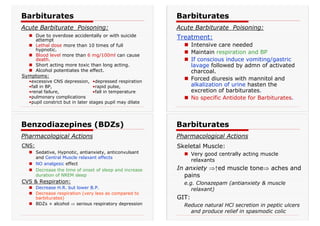
BDZs act by
potentiating the
effect of GABA.
GABA is an
inhibitory
neurotransmitter.
BDZ bind to the α
subunit of the
GABAA receptors
surrounding the
chloride channel in
CNS.
Barbiturates
Pharmacological Actions
Mechanism of
action:
Barbiturates
Pharmacological Actions
Mechanism of
action:
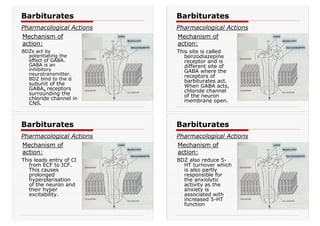
This site is called
benzodiazepine
receptor and is
different site of
GABA where the
receptors of
barbiturates act.
When GABA acts,
chloride channel
of the neuron
membrane open.
This leads entry of Cl
from ECF to ICF.
This causes
prolonged
hyperplarisation
of the neuron and
their hyper
excitability.
Barbiturates
Pharmacological Actions
Mechanism of
action:
BDZ also reduce 5-
HT turnover which
is also partly
responsible for
the anxiolytic
activity as the
anxiety is
associated with
increased 5-HT
function
Barbiturates
Pharmacological Actions
Mechanism of
action:
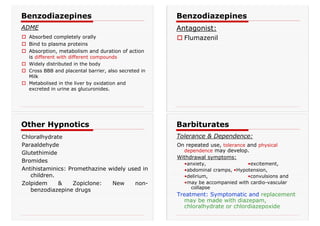
† Absorbed completely orally
† Bind to plasma proteins
† Absorption, metabolism and duration of action
is different with different compounds
† Widely distributed in the body
† Cross BBB and placental barrier, also secreted in
Milk
† Metabolised in the liver by oxidation and
excreted in urine as glucuronides.
Benzodiazepines
ADME
† Flumazenil
Benzodiazepines
Antagonist:
Chloralhydrate
Paraaldehyde
Glutethimide
Bromides
Antihistaminics: Promethazine widely used in
children.
Zolpidem & Zopiclone: New non-
benzodiazepine drugs
Other Hypnotics
On repeated use, tolerance and physical
dependence may develop.
Withdrawal symptoms:
•anxiety, •excitement,
•abdominal cramps, •Hypotension,
•delirium, •convulsions and
•may be accompanied with cardio-vascular
collapse
Treatment: Symptomatic and replacement
may be made with diazepam,
chloralhydrate or chlordiazepoxide
Barbiturates
Tolerance & Dependence:
„ Due to overdose accidentally or with suicide
attempt
„ Lethal dose more than 10 times of full
hypnotic.
„ Blood level more than 6 mg/100ml can cause
death.
„ Short acting more toxic than long acting.
„ Alcohol potentiates the effect.
Symptoms:
•excessive CNS depression, •depressed respiration
•fall in BP, •rapid pulse,
•renal failure, •fall in temperature
•pulmonary complications
•pupil constrict but in later stages pupil may dilate
Barbiturates
Acute Barbiturate Poisoning:
Treatment:
„ Intensive care needed
„ Maintain respiration and BP
„ If conscious induce vomiting/gastric
lavage followed by admn of activated
charcoal.
„ Forced diuresis with mannitol and
alkalization of urine hasten the
excretion of barbiturates.
„ No specific Antidote for Barbiturates.
Barbiturates
Acute Barbiturate Poisoning:
Thank you.

Sedative hypnotic notes

  • 1.
    SEDATIVES & HYPNOTICS Sedatives: These are thedrugs which reduce excitement, motor activity and calm the subject without inducing sleep. Hypnotics: These are the agents that induce/maintain sleep resembling natural sleep. Sedation: ↓ responsiveness + ↓ motor activity Both (Hypnotics & Sedatives) cause CNS depression Sedation → Hypnosis → General Anaesthesia Increasing grade of CNS depression Drugs show dose dependent action. Use: Treatment of insomnia. Introduction Sleep Reduced activity of nor-adrenaline. Excess of 5-HT activity. Excess of GABA activity. Defense mechanism & immunity Biological clock Introduction (Contd.) Stage 1 (Dozing) 3-6% Stage 2 (unequivocal sleep 40-50% Stage 3 (Deep Sleep Transition 5-8% Stage 4 (cerebral sleep) 10-20% REM Sleep 20-30% Stage 0 (awake) 1-2% Sleep Cycle Sleep Cycle
  • 2.
    Sleep Cycle Stage 0(awake): From lying down to fall asleep and occasional nocturnal awakenings 1-2% of sleep time Eye movements irregular or slowly rolling Stage 1 (dozing) Eye movements are reduced 3-6% of sleep time Stage 2 Little eye movements Subjects easily arousable 40-50% of sleep time Stage 1 (Dozing) 3-6% Stage 2 (unequivocal sleep 40-50% Stage 3 (Deep Sleep Transiti 5-8% Stage 4 (cerebral sleep) 10-20% REM Sleep 20-30% Stage 0 (awake) 1-2% Sleep Cycle contd. Stage 3 (deep sleep transition): Eye movements are few Subjects are not easily arousable. 5-8% of sleep time Stage 4 (cerebral sleep) Eye practically fixed Subjects are difficult to arouse 10-20% of sleep time Durig stage 2,3 and 4 heart rate, BP and respiration are steady and muscles are relaxed. Stages 3 & 4 together called slow wave sleep (SWS) Stage 1 (Dozing) 3-6% Stage 2 (unequivocal sleep 40-50% Stage 3 (Deep Sleep Transition 5-8% Stage 4 (cerebral sleep) 10-20% REM Sleep 20-30% Stage 0 (awake) 1-2% Sleep Cycle contd. REM sleep (paradoxical sleep) Marked, irregular and darting eye movements Dreams and nightmares occur in this stage which may be recalled if the subject is aroused. Heart rate and BP fluctuate Respiration irregular Muscles are fully relaxed About 20-30% of sleep time Classification I Barbiturates A) Long acting (duration of action 8-16 hrs) Phenobarbitone Barbitone B) Intermediate Acting (duration of action 6-8 hrs) Butobarbitone Amylobarbitone C) Short acting (duration of action 2-6 hrs) Pentobarbitone Secobarbitone D) Short acting (duration of action 0.5-1 hrs) Thiopentone Methohexitone
  • 3.
    Classification contd II Benzodiazepines A)Long acting (t½ >24 hrs) Chlordiazepoxide Prazipam Flurazipam Diazepam B) Short acting (t½ 5 to 24 hrs) Nitrazepam Lorazepam Oxazepam Temazepam C) Ultra short acting (t½ <24 hrs) Triazolam Midazolam Alprazolam III Others Chloralhydrate Paraldehyde Glutethimide Bromides Meprobamate Zopiclone Zolpidem IV Antihistamines Promethazine Diphenhydramine Classification contd Barbiturates † Derivatives of barbituric acid – substitution of aryl or alkyl gps at C-5 † Replacement of O with S at C-2 yield thiobarbiturates † Produce alcohol like symptoms such as impaired motor control (ataxia), dizziness, and slower breathing and heart rate Malonic acid Urea Barbituric acid CNS: „ All degrees of depression on CNS (dose dependent) Sedation → sleep → anaesthesia → coma „ NO analgesic effect BUT enhance the analgesic effect of salicylates „ Reduce REM sleep „ Longer acting barbiturates like phenobarbitone have anticonvulsant effect. Barbiturates Pharmacological Actions
  • 4.
    Barbiturates mainly act bybinding to β- site of inhibitory acitvity of GABAA receptors in CNS They increase the duration of opening of GABA gated chloride channels and hyperpolarised the post-synaptic cell. Barbiturates Pharmacological Actions Mechanism of action: They DO NOT bind to BDZ receptors but enhance the binding of BDZ to its receptors AT high very Concn,depress Na+ and K+ channels also. Barbiturates Pharmacological Actions Mechanism of action: Barbiturates Pharmacological Actions Respiration: „ They cause the dose dependent respiration depression. „ Death by barbiturate intoxication is by respiratory failure. „ NO Antitussive Action CVS: „ Therapeutic dose: slight ↓ in BP & HR „ Toxic dose: marked ↓ in BP Kidney: Barbiturates → „ ↑ADH release & ↓BP Ÿ ↓gfr Ÿ ↓urine flow „ Acute poisoning Ÿ Renal failure Liver: Barbiturates → „ induce hepatic microsomal enzyme Ÿ enhanced degradation of many drugs Ÿ ↓ effectiveness Barbiturates Pharmacological Actions
  • 5.
    † Absorbed rapidlyorally † Distributed widely Short acting: Highly lipid soluble rapid onset of action, rapidly cross blood brain barrier, placental barrier and secreted in milk. Action terminated by redistribution, metabolic degradation (in liver by oxidation, dealkylation and conjugation) and excretion. Long Acting: Mainly excreted unchanged in urine † Alkalinization of urineŸ ionization and excretion (useful in poisoning) † induce hepatic microsomal enzyme Ÿ enhanced degradation of many drugs Ÿ ↓ effectiveness Barbiturates ADME Sedative Hypnotic: due to their propensity for addiction and reduced effect over extended use they have been replaced by BDZs † Anticonvulsants: Long Acting Phenobarbitone and methylphenobarbitone are used for grandmal epilepsy. Cannot be used for treatment of absence seizures † General Anaesthetics: Ultrashort acting like thiopentone sodium and methohexitone are used as iv anaesthetics † Neonatal Jaundice: to induce microsomal enzymes Barbiturates USES: Side Effects: Hangover, cause confusion and amnesia Hypersensitivity: rashes, swelling of eyelids and lips Contraindications: porphyria, liver and kidney disease, emphysema (severe pulmonary insufficiency, obstructive aponea) Drug Automatism: cause confusion and amnesia. The patient may repeatedly take barbiturate at night and poison himself. Drug Interaction: 1. Synergistic effect with alcohol, antihistamine and other sedatives 2. Induction of hepatic microsomal enzymesŸ inactivation of drugs including themselves. Barbiturates On repeated use, tolerance and physical dependence may develop. Withdrawal symptoms: •anxiety, •excitement, •abdominal cramps, •Hypotension, •delirium, •convulsions and •may be accompanied with cardio-vascular collapse Treatment: Symptomatic and replacement may be made with diazepam, chloralhydrate or chlordiazepoxide Barbiturates Tolerance & Dependence:
  • 6.
    „ Due tooverdose accidentally or with suicide attempt „ Lethal dose more than 10 times of full hypnotic. „ Blood level more than 6 mg/100ml can cause death. „ Short acting more toxic than long acting. „ Alcohol potentiates the effect. Symptoms: •excessive CNS depression, •depressed respiration •fall in BP, •rapid pulse, •renal failure, •fall in temperature •pulmonary complications •pupil constrict but in later stages pupil may dilate Barbiturates Acute Barbiturate Poisoning: Treatment: „ Intensive care needed „ Maintain respiration and BP „ If conscious induce vomiting/gastric lavage followed by admn of activated charcoal. „ Forced diuresis with mannitol and alkalization of urine hasten the excretion of barbiturates. „ No specific Antidote for Barbiturates. Barbiturates Acute Barbiturate Poisoning: CNS: „ Sedative, Hypnotic, antianxiety, anticonvulsant and Central Muscle relaxant effects „ NO analgesic effect „ Decrease the time of onset of sleep and increase duration of NREM sleep CVS & Respiration: „ Decrease H.R. but lower B.P. „ Decrease respiration (very less as compared to barbiturates) „ BDZs + alcohol Ÿ serious respiratory depression Benzodiazepines (BDZs) Pharmacological Actions Skeletal Muscle: „ Very good centrally acting muscle relaxants In anxiety Ÿ↑ed muscle toneŸ aches and pains e.g. Clonazepam (antianxiety & muscle relaxant) GIT: Reduce natural HCl secretion in peptic ulcers and produce relief in spasmodic colic Barbiturates Pharmacological Actions
  • 7.
    BDZs act by potentiatingthe effect of GABA. GABA is an inhibitory neurotransmitter. BDZ bind to the α subunit of the GABAA receptors surrounding the chloride channel in CNS. Barbiturates Pharmacological Actions Mechanism of action: Barbiturates Pharmacological Actions Mechanism of action: This site is called benzodiazepine receptor and is different site of GABA where the receptors of barbiturates act. When GABA acts, chloride channel of the neuron membrane open. This leads entry of Cl from ECF to ICF. This causes prolonged hyperplarisation of the neuron and their hyper excitability. Barbiturates Pharmacological Actions Mechanism of action: BDZ also reduce 5- HT turnover which is also partly responsible for the anxiolytic activity as the anxiety is associated with increased 5-HT function Barbiturates Pharmacological Actions Mechanism of action:
  • 8.
    † Absorbed completelyorally † Bind to plasma proteins † Absorption, metabolism and duration of action is different with different compounds † Widely distributed in the body † Cross BBB and placental barrier, also secreted in Milk † Metabolised in the liver by oxidation and excreted in urine as glucuronides. Benzodiazepines ADME † Flumazenil Benzodiazepines Antagonist: Chloralhydrate Paraaldehyde Glutethimide Bromides Antihistaminics: Promethazine widely used in children. Zolpidem & Zopiclone: New non- benzodiazepine drugs Other Hypnotics On repeated use, tolerance and physical dependence may develop. Withdrawal symptoms: •anxiety, •excitement, •abdominal cramps, •Hypotension, •delirium, •convulsions and •may be accompanied with cardio-vascular collapse Treatment: Symptomatic and replacement may be made with diazepam, chloralhydrate or chlordiazepoxide Barbiturates Tolerance & Dependence:
  • 9.
    „ Due tooverdose accidentally or with suicide attempt „ Lethal dose more than 10 times of full hypnotic. „ Blood level more than 6 mg/100ml can cause death. „ Short acting more toxic than long acting. „ Alcohol potentiates the effect. Symptoms: •excessive CNS depression, •depressed respiration •fall in BP, •rapid pulse, •renal failure, •fall in temperature •pulmonary complications •pupil constrict but in later stages pupil may dilate Barbiturates Acute Barbiturate Poisoning: Treatment: „ Intensive care needed „ Maintain respiration and BP „ If conscious induce vomiting/gastric lavage followed by admn of activated charcoal. „ Forced diuresis with mannitol and alkalization of urine hasten the excretion of barbiturates. „ No specific Antidote for Barbiturates. Barbiturates Acute Barbiturate Poisoning: Thank you.