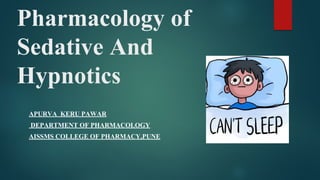
Pharmacology of
Sedative And
Hypnotics
APURVA KERU PAWAR
DEPARTMENT OF PHARMACOLOGY
AISSMS COLLEGE OF PHARMACY,PUNE
Contents
► Introduction
► Classification
► Pharmacological Actions
► Pharmacokinetic
► Uses
► Adverse Effects
► Interactions
► Contraindications
Introduction
What are Sedatives??
“A drug that subdue excitement and calms the patient without inducing sleep. Though the drowsiness may
be produced.”
► It also refers to the decrease in responsiveness to stimulation, along with this ,it also decrease the
alertness,ideation, and motor activities.
What are Hypnotics???
► “ These are the drugs that causes the sleep which resembles with the natural sleep”.
► These are having quicker action,shorter duration and steeper DRC while sedatives having slow on set of
action with flatter DRC
► Hypnotics at lower dose sedative
► There are different grades of CNS depressants
► Sedation Hypnosis General anaesthesia
Difference between Sedative &
Hypnotics
Sedative
► A drug that reduces excitement,calms the
patient without inducing sleep
► Sedative in therapeutic doses are
anxiolytics
► At larger doses causes hypnosis
► Site of action is on limbic system
► Examples- diazepam,lorazepam,etc.
Hypnotics
► Sleep producing drugs
► Used for inititation or maintain the sleep
► At high doses causes general anaesthesia
► Site of action is in midbrain & acending
RAS which maintains wakefullness
► Examples – zopiclone,phenobarbitone
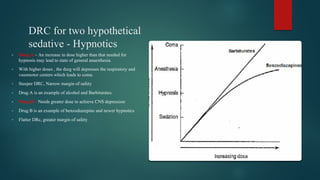
DRC for two hypothetical
sedative - Hypnotics
• Drug A – An increase in dose higher than that needed for
hypnosis may lead to state of general anaesthesia.
• With higher doses , the durg will depresses the respiratory and
vasomotor centers which leads to coma.
• Steeper DRC, Narrow margin of safety
• Drug A is an example of alcohol and Barbiturates.
• Drug B – Needs greater dose to achieve CNS depression
• Drug B is an example of benzodiazepine and newer hypnotics
• Flatter DRc, greater margin of safety
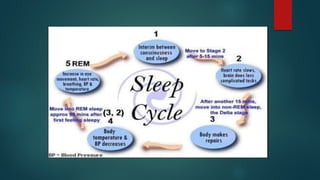
► Sleep
1. NREM – In this there is no fast movement of eyes.It occurres between stage 0 to 4
2. REM – In this eye movements are very fast.
► Stage of NREM-
► Stage 0 [ awake]- It is condition from lying down to falling a sleep(1-2%)
► Stage 1 [dosing]– Eye movement decrease,body muscles relax (5-10%)
► Stage 2 [unequivocal sleep]– more decrease in eye movements, person may arousable.(50%)
► Stage 3 deep sleep transition]– Deeper sleep with minimum eye movements,not easily arousal.
► Stage 4[cerebral sleep] – deepest level of sleep, GH secretion increased, no eye movements, muscles are
fully relaxed, if awakened causes disorientation.(20%)
► REM – dreaming, HR,breathing rate, brain activity increases and relaxation of voluntary muscles.
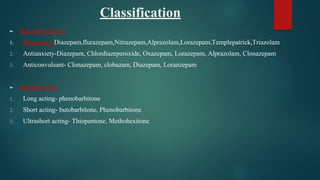
Classification
► Benzodizepines-
1. Hypnotics-Diazepam,flurazepam,Nitrazepam,Alprazolam,Lorazepam,Templepatrick,Triazolam
2. Antianxiety-Diazepam, Chlordiazeperoxide, Oxazepam, Lorazepam, Alprazolam, Clonazepam
3. Anticonvulsant- Clonazepam, clobazam, Diazepam, Loranzepam
► Barbiturates-
1. Long acting- phenobarbitone
2. Short acting- butobarbitone, Phenobarbitone
3. Ultrashort acting- Thiopentone, Methohexitone
► Non- benzodiazepines- Zopiclone, Eszopiclone, Zolpidem, Zaleplon, Etisalat
► Other Hypnotics- Triclofos, Melatonin, Ramelteon, Suvorexant
Barbiturates
► Barbiturates have been popular of last century upto 1960,but are not used now to calm the
patients.
► These are substituted derivatives of barbituric acid,it is not hypnotics but compounds with
alkyl and aryl substitution on c5 have this property.
Pharmacological Actions of
Barbiturates
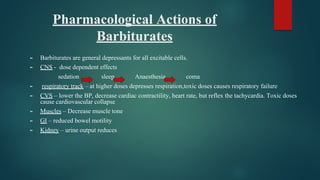
► Barbiturates are general depressants for all excitable cells.
► CNS - dose dependent effects
sedation sleep Anaesthesia coma
► respiratory track – at higher doses depresses respiration,toxic doses causes respiratory failure
► CVS – lower the BP, decrease cardiac contractility, heart rate, but reflex the tachycardia. Toxic doses
cause cardiovascular collapse
► Muscles – Decrease muscle tone
► GI – reduced bowel motility
► Kidney – urine output reduces
Mechanism of Action of barbiturates
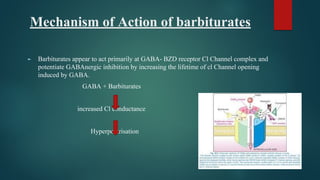
► Barbiturates appear to act primarily at GABA- BZD receptor Cl Channel complex and
potentiate GABAnergic inhibition by increasing the lifetime of cl Channel opening
induced by GABA.
GABA + Barbiturates
increased Cl conductance
Hyperpolarisation
Pharmacokinetics
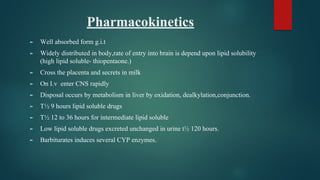
► Well absorbed form g.i.t
► Widely distributed in body,rate of entry into brain is depend upon lipid solubility
(high lipid soluble- thiopentaone.)
► Cross the placenta and secrets in milk
► On I.v enter CNS rapidly
► Disposal occurs by metabolism in liver by oxidation, dealkylation,conjunction.
► T½ 9 hours lipid soluble drugs
► T½ 12 to 36 hours for intermediate lipid soluble
► Low lipid soluble drugs excreted unchanged in urine t½ 120 hours.
► Barbiturates induces several CYP enzymes.
Uses
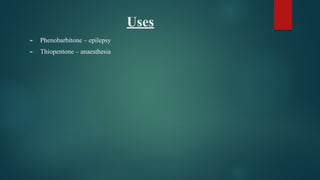
► Phenobarbitone – epilepsy
► Thiopentone – anaesthesia
Acute Barbiturate Poisoning
► At dose of 6-10gm
► Treatment –
► activated charcoal
► gastric lavage
► Artificial ventilation
► Forced alkaline diuresis
► Haemodialysis
Adverse Effects
► Hangover is common,mental confusion, impaired performance, traffic accidents
may occur
► Tolerance and dependence - develops on repeated use,addiction and dependence .
► Withdrawal symptoms- excitement, hallucinations, delirium, convulsions, death
Interactions
► Barbiturates induces several CYP iso- enzymes including glucouronyl transferase
, increase metabolism of drugs like wayfaring,steroids, tolbutamide,
griseofulvin,chloramphenicol,theophylline.
► Additive action with other CNS depressants- alcohol,antihistamines, opioid.
Benzodiazepines
► These are selective CNS depressants .
► It produces the lower ceiling effect, have high therapeutic index, no loss of consciousness,
respiration not depressed.
► Hypnotic doses do not affect respiration or cardiovascular functions.
► Coronary arteries dilate on I.v injection of diazepam.
► Benzodiazepines cause the less distortion of sleep architecture, rebound phenomenon on
discontinue after regular use are less marked.
► BZD do not alter disposition of other drugs by mircosomal enzymes
► Antagonist- flymazenil
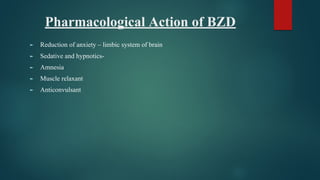
Pharmacological Action of BZD
► Reduction of anxiety – limbic system of brain
► Sedative and hypnotics-
► Amnesia
► Muscle relaxant
► Anticonvulsant
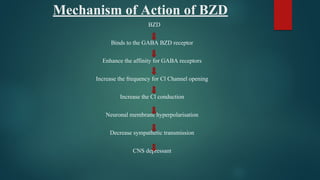
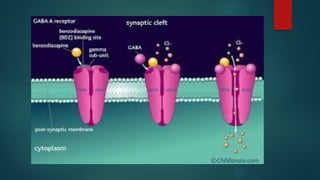
Mechanism of Action of BZD
BZD
Binds to the GABA BZD receptor
Enhance the affinity for GABA receptors
Increase the frequency for Cl Channel opening
Increase the Cl conduction
Neuronal membrane hyperpolarisation
Decrease sympathetic transmission
CNS depressant
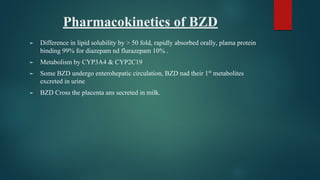
Pharmacokinetics of BZD
► Difference in lipid solubility by > 50 fold, rapidly absorbed orally, plama protein
binding 99% for diazepam nd flurazepam 10% .
► Metabolism by CYP3A4 & CYP2C19
► Some BZD undergo enterohepatic circulation, BZD nad their 1st
metabolites
excreted in urine
► BZD Cross the placenta ans secreted in milk.
Adverse effects of BZDs
► Dizziness, vertigo,ataxia, disorientation , amnesia , prolongation of reaction
time,sleep walking,slept driving, and other abnormal sleep behaviour.
► Less common hangover, weakness,blurring of vision,dry mouth,
► Paradoxical stimulation, irritability, sweating, in occasional patient with
flurazepam.
► Night mares with nitrazepam
► Withdrawal symptoms- Anxiety, restlessness, insomnia, malaise, loss of appetite,
bad dreams
► Contraindicated in pregnancy
Interactions
► Synergistic action with alcohol and other CNS depressants
► CYO 3A4 isoenzymes play role in metabolism of BZDs , action can be prolonged
by CYP 3A4 inhibitors like ketocanazole, erythromycin.
► Cimentidine ,isoniazid ,oral contraceptive retard the BZD metabolism.
Non- BZDs
► These are selective on alpha subunit containing BZD receptor & produce action.
► Lower potential than BZDs
► Shorter duration of action.
► Examples- zopiclone
► Uses- hypnotics , chronic insomnia, day time sedation, anticonvulsant, muscle
relaxant, alcohol withdrawal in dependent subjects, with preanaestic medication
etc.
Benzodiazepine Antagonist
► Flumazenil-
► it is BZD analog, little intrinsic activity ( practically no effect) but competes with
BZD agonist as well as inverse agonist for BZD receptor and reverse their action
► Abolishes hypnotic, psychomotor,congnitive and EEG effects of BZDs.
► Absorbed orally but not used orally. I.v action lasts for 2 hours
► T½1 hour
► Uses- to reverse BZD anaesthesia
BZD overdose
► ADR- safe and well tolerated, agitation, discomfort, fearfullness, anxiety,
coldness, withdrawal seizure
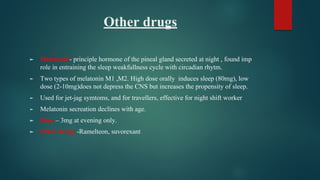
Other drugs
► Melatonin- principle hormone of the pineal gland secreted at night , found imp
role in entraining the sleep weakfullness cycle with circadian rhytm.
► Two types of melatonin M1 ,M2. High dose orally induces sleep (80mg), low
dose (2-10mg)does not depress the CNS but increases the propensity of sleep.
► Used for jet-jag symtoms, and for travellers, effective for night shift worker
► Melatonin secreation declines with age.
► Dose – 3mg at evening only.
► Other drugs -Ramelteon, suvorexant
References
► Essentials of medical pharmacology K.D Tripathi ,8th
Edition
► Google.com
► Slideshare.com
THANK YOU

hypnotics by apurva.pdf

  • 1.
    Pharmacology of Sedative And Hypnotics APURVAKERU PAWAR DEPARTMENT OF PHARMACOLOGY AISSMS COLLEGE OF PHARMACY,PUNE
  • 2.
    Contents ► Introduction ► Classification ►Pharmacological Actions ► Pharmacokinetic ► Uses ► Adverse Effects ► Interactions ► Contraindications
  • 3.
    Introduction What are Sedatives?? “Adrug that subdue excitement and calms the patient without inducing sleep. Though the drowsiness may be produced.” ► It also refers to the decrease in responsiveness to stimulation, along with this ,it also decrease the alertness,ideation, and motor activities. What are Hypnotics??? ► “ These are the drugs that causes the sleep which resembles with the natural sleep”. ► These are having quicker action,shorter duration and steeper DRC while sedatives having slow on set of action with flatter DRC ► Hypnotics at lower dose sedative ► There are different grades of CNS depressants ► Sedation Hypnosis General anaesthesia
  • 4.
    Difference between Sedative& Hypnotics Sedative ► A drug that reduces excitement,calms the patient without inducing sleep ► Sedative in therapeutic doses are anxiolytics ► At larger doses causes hypnosis ► Site of action is on limbic system ► Examples- diazepam,lorazepam,etc. Hypnotics ► Sleep producing drugs ► Used for inititation or maintain the sleep ► At high doses causes general anaesthesia ► Site of action is in midbrain & acending RAS which maintains wakefullness ► Examples – zopiclone,phenobarbitone
  • 5.
    DRC for twohypothetical sedative - Hypnotics • Drug A – An increase in dose higher than that needed for hypnosis may lead to state of general anaesthesia. • With higher doses , the durg will depresses the respiratory and vasomotor centers which leads to coma. • Steeper DRC, Narrow margin of safety • Drug A is an example of alcohol and Barbiturates. • Drug B – Needs greater dose to achieve CNS depression • Drug B is an example of benzodiazepine and newer hypnotics • Flatter DRc, greater margin of safety
  • 6.
    ► Sleep 1. NREM– In this there is no fast movement of eyes.It occurres between stage 0 to 4 2. REM – In this eye movements are very fast. ► Stage of NREM- ► Stage 0 [ awake]- It is condition from lying down to falling a sleep(1-2%) ► Stage 1 [dosing]– Eye movement decrease,body muscles relax (5-10%) ► Stage 2 [unequivocal sleep]– more decrease in eye movements, person may arousable.(50%) ► Stage 3 deep sleep transition]– Deeper sleep with minimum eye movements,not easily arousal. ► Stage 4[cerebral sleep] – deepest level of sleep, GH secretion increased, no eye movements, muscles are fully relaxed, if awakened causes disorientation.(20%) ► REM – dreaming, HR,breathing rate, brain activity increases and relaxation of voluntary muscles.
  • 8.
    Classification ► Benzodizepines- 1. Hypnotics-Diazepam,flurazepam,Nitrazepam,Alprazolam,Lorazepam,Templepatrick,Triazolam 2.Antianxiety-Diazepam, Chlordiazeperoxide, Oxazepam, Lorazepam, Alprazolam, Clonazepam 3. Anticonvulsant- Clonazepam, clobazam, Diazepam, Loranzepam ► Barbiturates- 1. Long acting- phenobarbitone 2. Short acting- butobarbitone, Phenobarbitone 3. Ultrashort acting- Thiopentone, Methohexitone
  • 9.
    ► Non- benzodiazepines-Zopiclone, Eszopiclone, Zolpidem, Zaleplon, Etisalat ► Other Hypnotics- Triclofos, Melatonin, Ramelteon, Suvorexant
  • 10.
    Barbiturates ► Barbiturates havebeen popular of last century upto 1960,but are not used now to calm the patients. ► These are substituted derivatives of barbituric acid,it is not hypnotics but compounds with alkyl and aryl substitution on c5 have this property.
  • 11.
    Pharmacological Actions of Barbiturates ►Barbiturates are general depressants for all excitable cells. ► CNS - dose dependent effects sedation sleep Anaesthesia coma ► respiratory track – at higher doses depresses respiration,toxic doses causes respiratory failure ► CVS – lower the BP, decrease cardiac contractility, heart rate, but reflex the tachycardia. Toxic doses cause cardiovascular collapse ► Muscles – Decrease muscle tone ► GI – reduced bowel motility ► Kidney – urine output reduces
  • 12.
    Mechanism of Actionof barbiturates ► Barbiturates appear to act primarily at GABA- BZD receptor Cl Channel complex and potentiate GABAnergic inhibition by increasing the lifetime of cl Channel opening induced by GABA. GABA + Barbiturates increased Cl conductance Hyperpolarisation
  • 13.
    Pharmacokinetics ► Well absorbedform g.i.t ► Widely distributed in body,rate of entry into brain is depend upon lipid solubility (high lipid soluble- thiopentaone.) ► Cross the placenta and secrets in milk ► On I.v enter CNS rapidly ► Disposal occurs by metabolism in liver by oxidation, dealkylation,conjunction. ► T½ 9 hours lipid soluble drugs ► T½ 12 to 36 hours for intermediate lipid soluble ► Low lipid soluble drugs excreted unchanged in urine t½ 120 hours. ► Barbiturates induces several CYP enzymes.
  • 14.
    Uses ► Phenobarbitone –epilepsy ► Thiopentone – anaesthesia
  • 15.
    Acute Barbiturate Poisoning ►At dose of 6-10gm ► Treatment – ► activated charcoal ► gastric lavage ► Artificial ventilation ► Forced alkaline diuresis ► Haemodialysis
  • 16.
    Adverse Effects ► Hangoveris common,mental confusion, impaired performance, traffic accidents may occur ► Tolerance and dependence - develops on repeated use,addiction and dependence . ► Withdrawal symptoms- excitement, hallucinations, delirium, convulsions, death
  • 17.
    Interactions ► Barbiturates inducesseveral CYP iso- enzymes including glucouronyl transferase , increase metabolism of drugs like wayfaring,steroids, tolbutamide, griseofulvin,chloramphenicol,theophylline. ► Additive action with other CNS depressants- alcohol,antihistamines, opioid.
  • 18.
    Benzodiazepines ► These areselective CNS depressants . ► It produces the lower ceiling effect, have high therapeutic index, no loss of consciousness, respiration not depressed. ► Hypnotic doses do not affect respiration or cardiovascular functions. ► Coronary arteries dilate on I.v injection of diazepam. ► Benzodiazepines cause the less distortion of sleep architecture, rebound phenomenon on discontinue after regular use are less marked. ► BZD do not alter disposition of other drugs by mircosomal enzymes ► Antagonist- flymazenil
  • 19.
    Pharmacological Action ofBZD ► Reduction of anxiety – limbic system of brain ► Sedative and hypnotics- ► Amnesia ► Muscle relaxant ► Anticonvulsant
  • 20.
    Mechanism of Actionof BZD BZD Binds to the GABA BZD receptor Enhance the affinity for GABA receptors Increase the frequency for Cl Channel opening Increase the Cl conduction Neuronal membrane hyperpolarisation Decrease sympathetic transmission CNS depressant
  • 22.
    Pharmacokinetics of BZD ►Difference in lipid solubility by > 50 fold, rapidly absorbed orally, plama protein binding 99% for diazepam nd flurazepam 10% . ► Metabolism by CYP3A4 & CYP2C19 ► Some BZD undergo enterohepatic circulation, BZD nad their 1st metabolites excreted in urine ► BZD Cross the placenta ans secreted in milk.
  • 23.
    Adverse effects ofBZDs ► Dizziness, vertigo,ataxia, disorientation , amnesia , prolongation of reaction time,sleep walking,slept driving, and other abnormal sleep behaviour. ► Less common hangover, weakness,blurring of vision,dry mouth, ► Paradoxical stimulation, irritability, sweating, in occasional patient with flurazepam. ► Night mares with nitrazepam ► Withdrawal symptoms- Anxiety, restlessness, insomnia, malaise, loss of appetite, bad dreams ► Contraindicated in pregnancy
  • 24.
    Interactions ► Synergistic actionwith alcohol and other CNS depressants ► CYO 3A4 isoenzymes play role in metabolism of BZDs , action can be prolonged by CYP 3A4 inhibitors like ketocanazole, erythromycin. ► Cimentidine ,isoniazid ,oral contraceptive retard the BZD metabolism.
  • 25.
    Non- BZDs ► Theseare selective on alpha subunit containing BZD receptor & produce action. ► Lower potential than BZDs ► Shorter duration of action. ► Examples- zopiclone ► Uses- hypnotics , chronic insomnia, day time sedation, anticonvulsant, muscle relaxant, alcohol withdrawal in dependent subjects, with preanaestic medication etc.
  • 26.
    Benzodiazepine Antagonist ► Flumazenil- ►it is BZD analog, little intrinsic activity ( practically no effect) but competes with BZD agonist as well as inverse agonist for BZD receptor and reverse their action ► Abolishes hypnotic, psychomotor,congnitive and EEG effects of BZDs. ► Absorbed orally but not used orally. I.v action lasts for 2 hours ► T½1 hour ► Uses- to reverse BZD anaesthesia BZD overdose ► ADR- safe and well tolerated, agitation, discomfort, fearfullness, anxiety, coldness, withdrawal seizure
  • 27.
    Other drugs ► Melatonin-principle hormone of the pineal gland secreted at night , found imp role in entraining the sleep weakfullness cycle with circadian rhytm. ► Two types of melatonin M1 ,M2. High dose orally induces sleep (80mg), low dose (2-10mg)does not depress the CNS but increases the propensity of sleep. ► Used for jet-jag symtoms, and for travellers, effective for night shift worker ► Melatonin secreation declines with age. ► Dose – 3mg at evening only. ► Other drugs -Ramelteon, suvorexant
  • 28.
    References ► Essentials ofmedical pharmacology K.D Tripathi ,8th Edition ► Google.com ► Slideshare.com
  • 29.