Pavithra
Sachin
Maria
Vidhayaarshini
Philip
INTRODUCTION
 The securities contracts(regulation)Act ,1956,is an
Act to present undesirable in securities by
regulating the business of dealing therein by
providing for certain other matters connected
therewith.
 It was enacted by parliament in the seventh year of
the Republic of India(1956) & extends to the whole
of India .
DEFINITIONS OF CERTAIN
IMPORTANT TERMS
In this act,
 Contract
 Derivative
 Government security
 Member
 Prescribed
 Recognized stock exchange
 Rules
 Securities appellate tribunal
 Securities
 Stock exchange
WHAT IT DEALS WITH ?
The [SC(R)A]- Securities contracts (Regulation) Act
deals with :
 Stock exchanges ,through a process of recognition
& continued supervision.
 Contracts in securities
 Listing of securities on stock exchanges.
WHY DID IT COME INTO EXISTENCE
?
 Stock market plays a significant role in
development of the economy.
 Stock market facilitates mobilization of funds
from small savings of investors & channelizes
these resources into various development needs of
various sectors of the economy.
 Stock market also provides mechanism for trading
of securities thus ensuring liquidity to the
investment of investors.
 Thus ,stock market facilitates transactions in
securities
 In order to prevent undesirable transactions in
securities ,promote healthy stock market ,the
securities contracts(Regulation )Act 1956 enacted
by parliament vide act no2
 This applying to whole of India
WHO IS RESPONSIBLE & THE
HISTORY BEHIND IT ?
 Before 1800 ,Indian securities transactions were
loans from the East Indian company
 1830-Bank securities traded in Bombay
 Companies act of 1850-Limited liability & Joint
stock company
 1861 –American civil war –cotton needs , England
approached India
 Immense fund flow-share mania of 1860-65
 End of civil war ,price of cotton fell , Black Friday
,July 1 ,1865,share mania came to a hall
 But still no of brokers in Bombay increased
 1875-Brokers association
 1877-native stock & share Brokers Association
,precursor to Bombay stock exchange
 Increase in economic activity due to first world war
 1918-19-Several brokers manipulated standard mill
& Madhavji mill ,red to crash ,forward trading
halted .
 1920’s market slump
 Bombay legislative council-created committee to
look into the Bombay exchange Activities , head-
Sir Wilfred
 Report stated frequent occurrence of self regulated
in the market ,offenses & manipulations
 1925-Another crash -> securities contracts control
act [but no effective implementation]
 1927-1937-5 serious crises on Bombay exchange
 W.B.Morrison-enquiry committee was formed
 Even with application of the committee’s
recommendations ,It failed to stop malpractice
 Another committee –headed by A.D.Gorwal(1951)
 Securities contract (Regulation)act of 1956
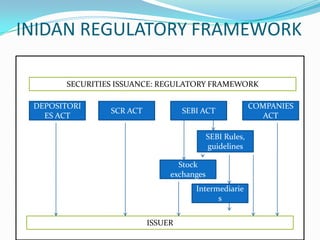
INIDAN REGULATORY FRAMEWORK
SECURITIES ISSUANCE : REGULATORY FRAMSECURITIES ISSUANCE: REGULATORY FRAMEWORK
DEPOSITORI
ES ACT
SCR ACT SEBI ACT
COMPANIES
ACT
SEBI Rules,
guidelines
Stock
exchanges
Intermediarie
s
ISSUER
AMENDMENTS
 The scr act was enacted to form a healthy market
in India.
 It controls the securities ,geographical areas for
trading ,licensing of stock exchanges ,constitution
& governance of stock exchanges & listing
agreements.
 It restricts trading of securities that are not
covered under its definition . There were several
amendments to this act ,its introduction to further
include interests of the investor.
 Securities contracts (Regulation )Rules,1957
 Securities contracts (Regulation)amendments
rules,1996
 Securities contracts (Regulation)(Appeal to
securities appellate tribunal)Rules,2000
 Securities contracts(regulation)amendments
rules,2001
 Securities contracts(regulation)amendments
rules,2003
 Securities law (amendment)act,2005
 Securities contracts (regulation)amendments,2007
 Securities
contracts(regulation)(amendment)rules,2010
 Securities contracts(regulation)(second
amendment)rules,2010
 Securities contracts(Regulation)(stock exchange &
clearing corporations)regulations,2012.
THE LATEST AMENDMENT
 It was made in the year 2012.securities
contracts(regulation )(stock exchanges & clearing
corporation)Regulations,2012[Mumbai,20thJune 2012]
IMPLICATIONS IN THE SOCIETY:
 traditionally ,the stock exchanges in India were
organizations formed generally on not-for profit &
the trading members besides rendering various
services were also owning ,controlling &
managing the stock exchanges.
 They were essentially not corporatized & working
on mutual basis.
 This type of system had its own merits & inherent
limitations
 however with the passage of time & events occurring at
the various stock exchanges ,a thought was
contemplated as why they should not be allowed to
corporatized & work on demutualization basis.
 The advantage of the new system is that the public
interest of the private interest is regulated to the
background
 The primary implications is to stop malpractices.
 After this Act ,to a certain extent investors started
trusting the stock exchange.
 There was less means of cheating & the
government had control over it .
 It reduced serious crises
THANK YOU

Securities contract act

  • 1.
  • 2.
    INTRODUCTION  The securitiescontracts(regulation)Act ,1956,is an Act to present undesirable in securities by regulating the business of dealing therein by providing for certain other matters connected therewith.  It was enacted by parliament in the seventh year of the Republic of India(1956) & extends to the whole of India .
  • 3.
    DEFINITIONS OF CERTAIN IMPORTANTTERMS In this act,  Contract  Derivative  Government security  Member  Prescribed  Recognized stock exchange  Rules  Securities appellate tribunal  Securities  Stock exchange
  • 4.
    WHAT IT DEALSWITH ? The [SC(R)A]- Securities contracts (Regulation) Act deals with :  Stock exchanges ,through a process of recognition & continued supervision.  Contracts in securities  Listing of securities on stock exchanges.
  • 5.
    WHY DID ITCOME INTO EXISTENCE ?  Stock market plays a significant role in development of the economy.  Stock market facilitates mobilization of funds from small savings of investors & channelizes these resources into various development needs of various sectors of the economy.  Stock market also provides mechanism for trading of securities thus ensuring liquidity to the investment of investors.
  • 6.
     Thus ,stockmarket facilitates transactions in securities  In order to prevent undesirable transactions in securities ,promote healthy stock market ,the securities contracts(Regulation )Act 1956 enacted by parliament vide act no2  This applying to whole of India
  • 7.
    WHO IS RESPONSIBLE& THE HISTORY BEHIND IT ?  Before 1800 ,Indian securities transactions were loans from the East Indian company  1830-Bank securities traded in Bombay  Companies act of 1850-Limited liability & Joint stock company  1861 –American civil war –cotton needs , England approached India  Immense fund flow-share mania of 1860-65
  • 8.
     End ofcivil war ,price of cotton fell , Black Friday ,July 1 ,1865,share mania came to a hall  But still no of brokers in Bombay increased  1875-Brokers association  1877-native stock & share Brokers Association ,precursor to Bombay stock exchange  Increase in economic activity due to first world war  1918-19-Several brokers manipulated standard mill & Madhavji mill ,red to crash ,forward trading halted .
  • 9.
     1920’s marketslump  Bombay legislative council-created committee to look into the Bombay exchange Activities , head- Sir Wilfred  Report stated frequent occurrence of self regulated in the market ,offenses & manipulations  1925-Another crash -> securities contracts control act [but no effective implementation]  1927-1937-5 serious crises on Bombay exchange
  • 10.
     W.B.Morrison-enquiry committeewas formed  Even with application of the committee’s recommendations ,It failed to stop malpractice  Another committee –headed by A.D.Gorwal(1951)  Securities contract (Regulation)act of 1956
  • 11.
    INIDAN REGULATORY FRAMEWORK SECURITIESISSUANCE : REGULATORY FRAMSECURITIES ISSUANCE: REGULATORY FRAMEWORK DEPOSITORI ES ACT SCR ACT SEBI ACT COMPANIES ACT SEBI Rules, guidelines Stock exchanges Intermediarie s ISSUER
  • 12.
    AMENDMENTS  The scract was enacted to form a healthy market in India.  It controls the securities ,geographical areas for trading ,licensing of stock exchanges ,constitution & governance of stock exchanges & listing agreements.  It restricts trading of securities that are not covered under its definition . There were several amendments to this act ,its introduction to further include interests of the investor.
  • 13.
     Securities contracts(Regulation )Rules,1957  Securities contracts (Regulation)amendments rules,1996  Securities contracts (Regulation)(Appeal to securities appellate tribunal)Rules,2000  Securities contracts(regulation)amendments rules,2001  Securities contracts(regulation)amendments rules,2003
  • 14.
     Securities law(amendment)act,2005  Securities contracts (regulation)amendments,2007  Securities contracts(regulation)(amendment)rules,2010  Securities contracts(regulation)(second amendment)rules,2010  Securities contracts(Regulation)(stock exchange & clearing corporations)regulations,2012.
  • 15.
    THE LATEST AMENDMENT It was made in the year 2012.securities contracts(regulation )(stock exchanges & clearing corporation)Regulations,2012[Mumbai,20thJune 2012]
  • 16.
    IMPLICATIONS IN THESOCIETY:  traditionally ,the stock exchanges in India were organizations formed generally on not-for profit & the trading members besides rendering various services were also owning ,controlling & managing the stock exchanges.  They were essentially not corporatized & working on mutual basis.  This type of system had its own merits & inherent limitations
  • 17.
     however withthe passage of time & events occurring at the various stock exchanges ,a thought was contemplated as why they should not be allowed to corporatized & work on demutualization basis.  The advantage of the new system is that the public interest of the private interest is regulated to the background  The primary implications is to stop malpractices.  After this Act ,to a certain extent investors started trusting the stock exchange.
  • 18.
     There wasless means of cheating & the government had control over it .  It reduced serious crises
  • 19.