International Trade Theory


What is international trade?
– Exchange of raw materials and manufactured

goods (and services) across national borders



Classical trade theories:
– explain national economy conditions--country

advantages--that enable such exchange to happen



New trade theories:
– explain links among natural country advantages,

government action, and industry characteristics
that enable such exchange to happen



Implications for International Business
Classical Trade Theories


Mercantilism (pre-16th century)
– Takes an us-versus-them view of trade
– Other country’s gain is our country’s loss



Free Trade theories
– Absolute Advantage (Adam Smith, 1776)
– Comparative Advantage (David Ricardo, 1817)
– Specialization of production and free flow of goods

benefit all trading partners’ economies


Free Trade refined
– Factor-proportions (Heckscher-Ohlin, 1919)
– International product life cycle (Ray Vernon, 1966)
The New Trade Theory


As output expands with specialization, an
industry’s ability to realize economies of scale
increases and unit costs decrease



Because of scale economies, world demand
supports only a few firms in such industries
(e.g., commercial aircraft, automobiles)



Countries that had an early entrant to such an
industry have an advantage:
– Fist-mover advantage
– Barrier to entry
New Trade Theory
 Global

Strategic Rivalry

– Firms gain competitive advantage trough:

intellectual property, R&D, economies of
scale and scope, experience,first mover
advantage
 National

Competitive Advantage
(Porter, 1990)
Mercantilism/Neomercantilism


Prevailed in 1500 - 1800
– Export more to “strangers” than we import to a

mass treasure, expand kingdom
– Zero-sum vs positive-sum game view of trade


Government intervenes to achieve a surplus in
exports
– King, exporters, domestic producers: happy
– Subjects: unhappy because domestic goods stay

expensive and of limited variety


Today neo-mercantilists = protectionists: some
segments of society shielded short term
mercantilism(contd.)






Government be the exporter of goods(not
the individuals)
By means of accumulation of precious
metals,gold
Limiting the
Absolute Advantage




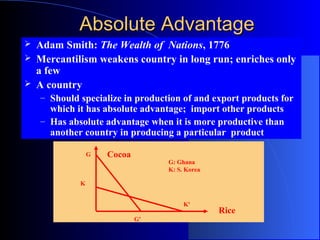
Adam Smith: The Wealth of Nations, 1776
Mercantilism weakens country in long run; enriches only
a few
A country
– Should specialize in production of and export products for

which it has absolute advantage; import other products
– Has absolute advantage when it is more productive than
another country in producing a particular product
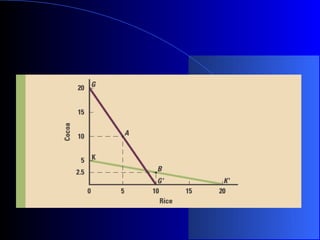
G

Cocoa

G: Ghana
K: S. Korea

K
K'
G'

Rice
Comparative Advantage






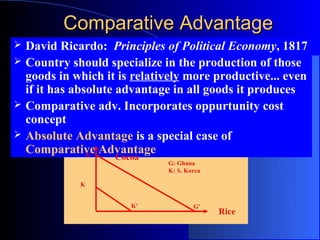
David Ricardo: Principles of Political Economy, 1817
Country should specialize in the production of those
goods in which it is relatively more productive... even
if it has absolute advantage in all goods it produces
Comparative adv. Incorporates oppurtunity cost
concept
Absolute Advantage is a special case of
Comparative Advantage
G
Cocoa

G: Ghana
K: S. Korea

K
K'

G'

Rice
Assumptions (absolute
&comparative)









Countries are driven only by the maximisation
of production &consumption.
Trade happens between only two countries
&consumption of only two goods
No transportation costs
Labour is the only factor considered for
production
Specialisation does not result in increased
efficiency
Factor Endowment theory
Heckscher (1919)-Ohlin (1933)

Differences

in factor endowments not on differences
in productivity determine patterns of trade
Absolute amounts of factor endowments matter
Leontief paradox(Wassily Leontief noble price
winner 1973)
– US has relatively more abundant capital yet imports

goods more capital intensive than those it exports
– Explanation(?):
 US has special advantage on producing new products
made with innovative technologies
 These may be less capital intensive till they reach
mass-production state
Theory of Relative Factor Endowments
(Heckscher-Ohlin)


Factor endowments vary among countries



Products differ according to the types of factors that
they need as inputs



A country has a comparative advantage in
producing products that intensively use factors of
production (resources) it has in abundance



Factors of production: labor, capital, land, human
resources, technology
International Product Life-Cycle (Vernon)


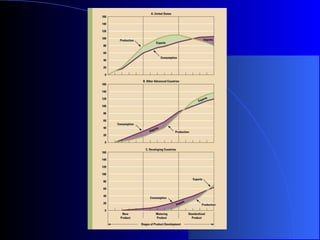
Most new products conceived / produced in the US in 20th
century



US firms kept production close to their market initially





Aid decisions; minimize risk of new product introductions
Demand not based on price; low product cost not an issue

Limited initial demand in other advanced countries initially


Exports more attractive than overseas production



When demand increases in advanced countries, production
follows



With demand expansion in secondary markets


Product becomes standardized



production moves to low production cost areas



Product now imported to US and to advanced countries
Product Life Cycle theory


Raymond Vermon (1960)



Six cycles



Cycle 1:New product development



Cycle 2:Sales in own country



Cycle 3:Limited sales in other countries



Cycle 4:regular exports from parent country



Cycle 5:Production in foreign country



Cycle 6:Reverse exports to parent country
Classic Theory Conclusion


Free Trade expands the world “pie” for goods/services
Theory Limitations:



Simple world (two countries, two products)



no transportation costs



no price differences in resources



resources immobile across countries



constant returns to scale



each country has a fixed stock of resources and no efficiency
gains in resource use from trade



full employment
New Trade Theories


Increasing returns of specialization due to economies
of scale (unit costs of production decrease)



First mover advantages (economies of scale such that
barrier to entry crated for second or third company)



Luck... first mover may be simply lucky.



Government intervention: strategic trade policy
National Competitive Advantage
(Porter, 1990)


Factor endowments




Demand conditions




large, sophisticated domestic consumer base: offers an
innovation friendly environment and a testing ground

Related and supporting industries




land, labor, capital, workforce, infrastructure
(some factors can be created...)

local suppliers cluster around producers and add to
innovation

Firm strategy, structure, rivalry


competition good, national governments can create
conditions which facilitate and nurture such conditions
Porter’s Diamond
“So What” for business?
 First

mover implications

 Location
 Foreign

Implications

Investment Decisions

 Government

Policy implications

Trade theory modified

  • 1.
  • 2.
    International Trade Theory  Whatis international trade? – Exchange of raw materials and manufactured goods (and services) across national borders  Classical trade theories: – explain national economy conditions--country advantages--that enable such exchange to happen  New trade theories: – explain links among natural country advantages, government action, and industry characteristics that enable such exchange to happen  Implications for International Business
  • 3.
    Classical Trade Theories  Mercantilism(pre-16th century) – Takes an us-versus-them view of trade – Other country’s gain is our country’s loss  Free Trade theories – Absolute Advantage (Adam Smith, 1776) – Comparative Advantage (David Ricardo, 1817) – Specialization of production and free flow of goods benefit all trading partners’ economies  Free Trade refined – Factor-proportions (Heckscher-Ohlin, 1919) – International product life cycle (Ray Vernon, 1966)
  • 4.
    The New TradeTheory  As output expands with specialization, an industry’s ability to realize economies of scale increases and unit costs decrease  Because of scale economies, world demand supports only a few firms in such industries (e.g., commercial aircraft, automobiles)  Countries that had an early entrant to such an industry have an advantage: – Fist-mover advantage – Barrier to entry
  • 5.
    New Trade Theory Global Strategic Rivalry – Firms gain competitive advantage trough: intellectual property, R&D, economies of scale and scope, experience,first mover advantage  National Competitive Advantage (Porter, 1990)
  • 6.
    Mercantilism/Neomercantilism  Prevailed in 1500- 1800 – Export more to “strangers” than we import to a mass treasure, expand kingdom – Zero-sum vs positive-sum game view of trade  Government intervenes to achieve a surplus in exports – King, exporters, domestic producers: happy – Subjects: unhappy because domestic goods stay expensive and of limited variety  Today neo-mercantilists = protectionists: some segments of society shielded short term
  • 7.
    mercantilism(contd.)    Government be theexporter of goods(not the individuals) By means of accumulation of precious metals,gold Limiting the
  • 8.
    Absolute Advantage    Adam Smith:The Wealth of Nations, 1776 Mercantilism weakens country in long run; enriches only a few A country – Should specialize in production of and export products for which it has absolute advantage; import other products – Has absolute advantage when it is more productive than another country in producing a particular product G Cocoa G: Ghana K: S. Korea K K' G' Rice
  • 10.
    Comparative Advantage     David Ricardo:Principles of Political Economy, 1817 Country should specialize in the production of those goods in which it is relatively more productive... even if it has absolute advantage in all goods it produces Comparative adv. Incorporates oppurtunity cost concept Absolute Advantage is a special case of Comparative Advantage G Cocoa G: Ghana K: S. Korea K K' G' Rice
  • 11.
    Assumptions (absolute &comparative)      Countries aredriven only by the maximisation of production &consumption. Trade happens between only two countries &consumption of only two goods No transportation costs Labour is the only factor considered for production Specialisation does not result in increased efficiency
  • 12.
    Factor Endowment theory Heckscher(1919)-Ohlin (1933) Differences in factor endowments not on differences in productivity determine patterns of trade Absolute amounts of factor endowments matter Leontief paradox(Wassily Leontief noble price winner 1973) – US has relatively more abundant capital yet imports goods more capital intensive than those it exports – Explanation(?):  US has special advantage on producing new products made with innovative technologies  These may be less capital intensive till they reach mass-production state
  • 13.
    Theory of RelativeFactor Endowments (Heckscher-Ohlin)  Factor endowments vary among countries  Products differ according to the types of factors that they need as inputs  A country has a comparative advantage in producing products that intensively use factors of production (resources) it has in abundance  Factors of production: labor, capital, land, human resources, technology
  • 14.
    International Product Life-Cycle(Vernon)  Most new products conceived / produced in the US in 20th century  US firms kept production close to their market initially    Aid decisions; minimize risk of new product introductions Demand not based on price; low product cost not an issue Limited initial demand in other advanced countries initially  Exports more attractive than overseas production  When demand increases in advanced countries, production follows  With demand expansion in secondary markets  Product becomes standardized  production moves to low production cost areas  Product now imported to US and to advanced countries
  • 15.
    Product Life Cycletheory  Raymond Vermon (1960)  Six cycles  Cycle 1:New product development  Cycle 2:Sales in own country  Cycle 3:Limited sales in other countries  Cycle 4:regular exports from parent country  Cycle 5:Production in foreign country  Cycle 6:Reverse exports to parent country
  • 17.
    Classic Theory Conclusion  FreeTrade expands the world “pie” for goods/services Theory Limitations:  Simple world (two countries, two products)  no transportation costs  no price differences in resources  resources immobile across countries  constant returns to scale  each country has a fixed stock of resources and no efficiency gains in resource use from trade  full employment
  • 18.
    New Trade Theories  Increasingreturns of specialization due to economies of scale (unit costs of production decrease)  First mover advantages (economies of scale such that barrier to entry crated for second or third company)  Luck... first mover may be simply lucky.  Government intervention: strategic trade policy
  • 19.
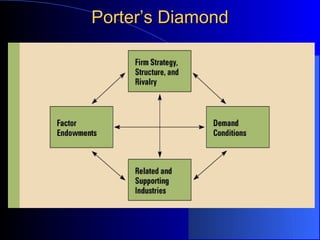
    National Competitive Advantage (Porter,1990)  Factor endowments   Demand conditions   large, sophisticated domestic consumer base: offers an innovation friendly environment and a testing ground Related and supporting industries   land, labor, capital, workforce, infrastructure (some factors can be created...) local suppliers cluster around producers and add to innovation Firm strategy, structure, rivalry  competition good, national governments can create conditions which facilitate and nurture such conditions
  • 20.
  • 21.
    “So What” forbusiness?  First mover implications  Location  Foreign Implications Investment Decisions  Government Policy implications

Editor's Notes

  • #2 This is a test
  • #11 Example: Medical Specialist is also the best medical secretary. Should this doctor spend any time on the secretarial part of the business? No? Why? Lets continue with SL and the USA... This time the terms have changed to give the USA the absolute adv. in both tea and wheat...
  • #19 Real world: many countries and many goods Transportation costs may decline with specialization Prices in different countries can be (are) effected by exchange rates. Wheat and Tea are not necessarily a one-to-one swap resources can move from country to country: labor (Mexico to US), capital (constant returns to scale: specialization does not effect the amount of resources required to produce one ton of wheat or tea) both diminishing and increasing returns to specialization exist assumed fixed stock of resources in each country. Trade can change the efficiency with which the resources are used and the stock of resources may change too (more people, more natural resources, more efficient use due to technology) Full employment implies use of resources at full efficiency...
  • #20 Commercial jet industry: studies show that 3 major manufacturers can survive. Boeing, McDonnell Douglas and Airbus already there... New entries discouraged... however, the largest potential customer is China and they want the capacity to produce... hence the battle Boeing is having with unions... either give China some of the value added activity to keep them out of mainline or lose out to Airbus or to a non-economic decision to start an industry. Luck: DeHaviland in 50s. Comet fell out of sky. 707 captured the market. (some say it was not only luck but resources. B. had produced 707 on the back of technology developed for US military--spillover effect?? what of our claim that Airbus was subsidized??)
  • #21 Factor Endowments: basic factors: natural resources, climate, location, demographics advanced factors: communications infrastructure, sophisticated and skilled labor, R&D, technological know-how advanced factors are most important: they are the result of investment by individuals, companies and government (education, general skill and knowledge stimulation, basic R&D support) Demand conditions: sophisticated home demand can create impetus for enhancing competitive advantage (Japanese consumer knowledgeable on cameras pushed J. industry to create advantage) Related and Supporting industries: internationally competitive suppliers. Creation of clusters of related industries. ex. German textile and apparel sector (high qual. cotton, wool, synthetic fibers, sewing machine needles, textile machinery) Firm Strategy, Structure, and Rivalry within a nation: Management ideologies: predominance of engineers in TMTs of Germ. and J. cos. helped improve manufacturing processes and product designs (Porter found top execs with finance backgrounds in US 70s. most CEOs of the 40 companies I studies were marketing specialists). Vigorous domestic rivalry creates persistent comp. advantage in and industry: impr. efficiency and leads to international competitiveness.
  • #23 Location: To produce laptop four stages: Basic research and development of product design (US, Japan: Apple, IBM, Motorola, TI, Toshiba, Sony) manufacture of standard electronic components (capital intensive, semi-skilled labor, high unit cost pressures: Sing., Taiwan, Malaysia) manuf. of advanced components (screens) (cap. intensive, high skilled labor, no cost pressure: Japan) final assembly (labor intensive, low skill, intense cost pressures: Mexico) First mover implications: high initial investment with years of losses... Japan LCD displays, US abandoned early tech. leadership in this technology. Policy: Apple and IBM lobbied against tariffs on LCD display imports: J. was the low cost producer, A. and IBM used these displays, the increase in import duty would reduce the world competitiveness of the A. and IBM products... Auto industry induced govt. to negotiate voluntary restraints in machine tools. result: limited competition from world-wide efficient suppliers caused the US companies to lose their WW competitive edge and lost its WW share since 85.