1853 - 2013
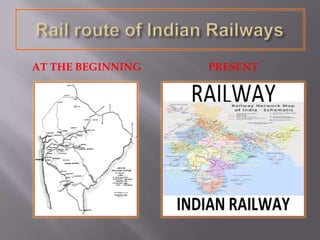
AT THE BEGINNING PRESENT
 Started on April 26, 1853 from Bombay to
thane
 The first train journeyed a distance of
22miles
 Operated by Englishmen
 At independace,42 rail systems were existing.
Due to partition India lost 40% of its existing network
 In 1951, all systems were nationalized as one unit
 In 1985,steam locomotives were phased out.
 In 1987,computerisation of reservation 1st was
carried out in Bombay
 In 1989, train numbers were standardized to four
digits
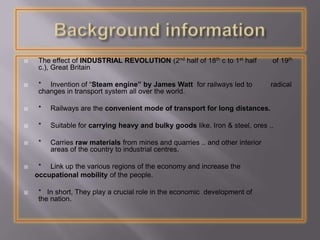
 The effect of INDUSTRIAL REVOLUTION (2nd half of 18th c to 1st half of 19th
c.), Great Britain
 * Invention of “Steam engine” by James Watt for railways led to radical
changes in transport system all over the world.
 * Railways are the convenient mode of transport for long distances.
 * Suitable for carrying heavy and bulky goods like. Iron & steel, ores ..
 * Carries raw materials from mines and quarries .. and other interior
areas of the country to industrial centres.
 * Link up the various regions of the economy and increase the
occupational mobility of the people.
 * In short, They play a crucial role in the economic development of
the nation.
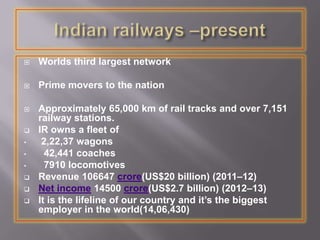
 Worlds third largest network
 Prime movers to the nation
 Approximately 65,000 km of rail tracks and over 7,151
railway stations.
 IR owns a fleet of
• 2,22,37 wagons
• 42,441 coaches
• 7910 locomotives
 Revenue 106647 crore(US$20 billion) (2011–12)
 Net income 14500 crore(US$2.7 billion) (2012–13)
 It is the lifeline of our country and it’s the biggest
employer in the world(14,06,430)
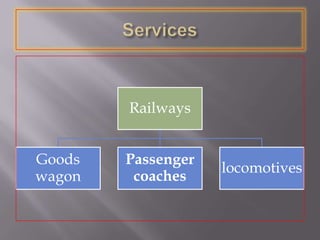
Railways
Goods
wagon
Passenger
coaches
locomotives
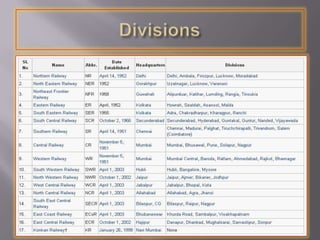
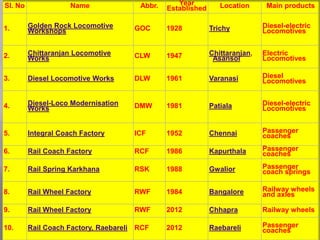
Sl. No Name Abbr. Year
Established Location Main products
1. Golden Rock Locomotive
Workshops GOC 1928 Trichy Diesel-electric
Locomotives
2. Chittaranjan Locomotive
Works CLW 1947 Chittaranjan,
Asansol
Electric
Locomotives
3. Diesel Locomotive Works DLW 1961 Varanasi Diesel
Locomotives
4. Diesel-Loco Modernisation
Works DMW 1981 Patiala Diesel-electric
Locomotives
5. Integral Coach Factory ICF 1952 Chennai Passenger
coaches
6. Rail Coach Factory RCF 1986 Kapurthala Passenger
coaches
7. Rail Spring Karkhana RSK 1988 Gwalior Passenger
coach springs
8. Rail Wheel Factory RWF 1984 Bangalore Railway wheels
and axles
9. Rail Wheel Factory RWF 2012 Chhapra Railway wheels
10. Rail Coach Factory, Raebareli RCF 2012 Raebareli Passenger
coaches
 Bharat Wagon and Engineering Co. Ltd. (BWEL)
 Centre for Railway Information Systems (CRIS)[17]
 Container Corporation of India Limited (CONCOR)
 Dedicated Freight Corridor Corporation of India Limited
(DFCCIL)
 Indian Railway Catering and Tourism Corporation Limited
(IRCTC)
 Indian Railway Construction (IRCON) International Limited
 Indian Railway Finance Corporation Limited (IRFC)
 Konkan Railway Corporation Limited (KRCL)
 Mumbai Railway Vikas Corporation (MRVC)
 Railtel Corporation of India Limited (Rail Tel)
 Rail India Technical and Economic Services Limited (RITES)
 Rail Vikas Nigam Limited (RVNL)
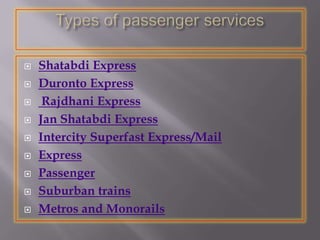
 Shatabdi Express
 Duronto Express
 Rajdhani Express
 Jan Shatabdi Express
 Intercity Superfast Express/Mail
 Express
 Passenger
 Suburban trains
 Metros and Monorails
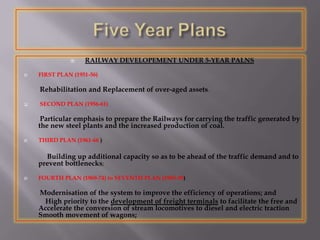
 RAILWAY DEVELOPEMENT UNDER 5-YEAR PALNS
 FIRST PLAN (1951-56)
Rehabilitation and Replacement of over-aged assets.
 SECOND PLAN (1956-61)
Particular emphasis to prepare the Railways for carrying the traffic generated by
the new steel plants and the increased production of coal.
 THIRD PLAN (1961-66 )
Building up additional capacity so as to be ahead of the traffic demand and to
prevent bottlenecks;
 FOURTH PLAN (1969-74) to SEVENTH PLAN (1985-90)
Modernisation of the system to improve the efficiency of operations; and
High priority to the development of freight terminals to facilitate the free and
Accelerate the conversion of stream locomotives to diesel and electric traction
Smooth movement of wagons;
 EIGHTH (1992-97) AND NINTH PLANS (1997-2002)
The main thrust was on Capacity generation, Man-power planning and Energy
conservation, Safety & Security, and Customer satisfaction through reliable and
better quality of services;
 TENTH PLAN ( 2002-07)
Capacity expansion through Modernization and Technological up gradation of
the railway system, Improvement in quality of service, Rationalization of tariff
and Improvement in Safety and reliability of railway services.
 ELEVENTH PLAN ( 2007-12)
 - Major initiative in shifting to PPP for building and operation of selected railway infrastructure.
 - Provision of quality passenger amenities at terminals, overall improvement in the sanitation.
 - Outsourcing routine activities to private companies.
 -Introduction of modern Rolling stock
 -Appropriate changes in designs of wagons.
What were the reasons behind the
DRAMATIC TURNAROUND was
seen in Indian Railways....
?
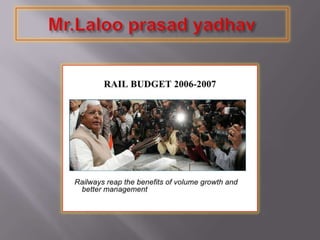
Before Laloo joined as Union Railway minister, 2004
Hopeless, loss-making organisation, white elephant.
Too little revenues but too many problems along with too many
employees.
Indian Railways was spending 91% of its revenues on salaries and
maintain its aging organisation alone.!!
This “White elephant” had a debt of about Rs.61,000 crores ($12.3 billion)
After Lallo took over IR, 2005 onwards.....
IR has turned in a cumulative cash surplus before dividend of Rs
68,778 crore ($13.9 billion).
Out of this Rs 15,898 crore has been paid as dividend, Rs 39,215
crore has been invested in rail infrastructure and Rs 13,665 crore has
been added to fund balances to reach Rs 20,483 cr.
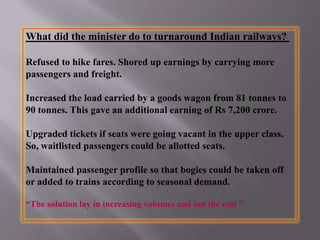
What did the minister do to turnaround Indian railways?
Refused to hike fares. Shored up earnings by carrying more
passengers and freight.
Increased the load carried by a goods wagon from 81 tonnes to
90 tonnes. This gave an additional earning of Rs 7,200 crore.
Upgraded tickets if seats were going vacant in the upper class.
So, waitlisted passengers could be allotted seats.
Maintained passenger profile so that bogies could be taken off
or added to trains according to seasonal demand.
“The solution lay in increasing volumes and not the cost ”
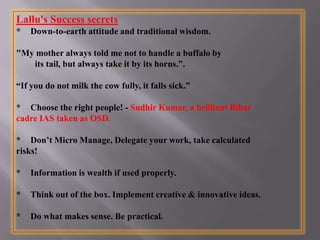
Lallu's Success secrets
* Down-to-earth attitude and traditional wisdom.
"My mother always told me not to handle a buffalo by
its tail, but always take it by its horns.”.
“If you do not milk the cow fully, it falls sick.”
* Choose the right people! - Sudhir Kumar, a brilliant Bihar
cadre IAS taken as OSD.
* Don’t Micro Manage, Delegate your work, take calculated
risks!
* Information is wealth if used properly.
* Think out of the box. Implement creative & innovative ideas.
* Do what makes sense. Be practical.
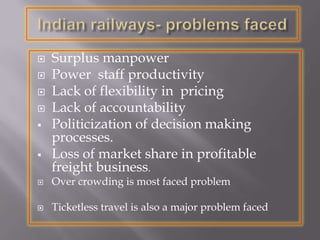
 Surplus manpower
 Power staff productivity
 Lack of flexibility in pricing
 Lack of accountability
 Politicization of decision making
processes.
 Loss of market share in profitable
freight business.
 Over crowding is most faced problem
 Ticketless travel is also a major problem faced
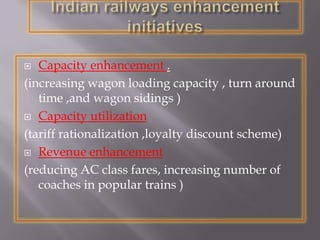
 Capacity enhancement .
(increasing wagon loading capacity , turn around
time ,and wagon sidings )
 Capacity utilization
(tariff rationalization ,loyalty discount scheme)
 Revenue enhancement
(reducing AC class fares, increasing number of
coaches in popular trains )
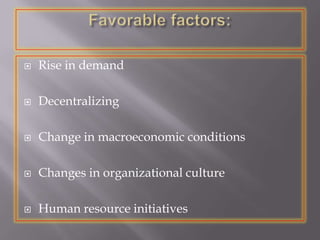
 Rise in demand
 Decentralizing
 Change in macroeconomic conditions
 Changes in organizational culture
 Human resource initiatives
Indian railways

Indian railways

  • 1.
  • 2.
  • 3.
     Started onApril 26, 1853 from Bombay to thane  The first train journeyed a distance of 22miles  Operated by Englishmen
  • 4.
     At independace,42rail systems were existing. Due to partition India lost 40% of its existing network  In 1951, all systems were nationalized as one unit  In 1985,steam locomotives were phased out.  In 1987,computerisation of reservation 1st was carried out in Bombay  In 1989, train numbers were standardized to four digits
  • 5.
     The effectof INDUSTRIAL REVOLUTION (2nd half of 18th c to 1st half of 19th c.), Great Britain  * Invention of “Steam engine” by James Watt for railways led to radical changes in transport system all over the world.  * Railways are the convenient mode of transport for long distances.  * Suitable for carrying heavy and bulky goods like. Iron & steel, ores ..  * Carries raw materials from mines and quarries .. and other interior areas of the country to industrial centres.  * Link up the various regions of the economy and increase the occupational mobility of the people.  * In short, They play a crucial role in the economic development of the nation.
  • 6.
     Worlds thirdlargest network  Prime movers to the nation  Approximately 65,000 km of rail tracks and over 7,151 railway stations.  IR owns a fleet of • 2,22,37 wagons • 42,441 coaches • 7910 locomotives  Revenue 106647 crore(US$20 billion) (2011–12)  Net income 14500 crore(US$2.7 billion) (2012–13)  It is the lifeline of our country and it’s the biggest employer in the world(14,06,430)
  • 7.
  • 9.
    Sl. No NameAbbr. Year Established Location Main products 1. Golden Rock Locomotive Workshops GOC 1928 Trichy Diesel-electric Locomotives 2. Chittaranjan Locomotive Works CLW 1947 Chittaranjan, Asansol Electric Locomotives 3. Diesel Locomotive Works DLW 1961 Varanasi Diesel Locomotives 4. Diesel-Loco Modernisation Works DMW 1981 Patiala Diesel-electric Locomotives 5. Integral Coach Factory ICF 1952 Chennai Passenger coaches 6. Rail Coach Factory RCF 1986 Kapurthala Passenger coaches 7. Rail Spring Karkhana RSK 1988 Gwalior Passenger coach springs 8. Rail Wheel Factory RWF 1984 Bangalore Railway wheels and axles 9. Rail Wheel Factory RWF 2012 Chhapra Railway wheels 10. Rail Coach Factory, Raebareli RCF 2012 Raebareli Passenger coaches
  • 10.
     Bharat Wagonand Engineering Co. Ltd. (BWEL)  Centre for Railway Information Systems (CRIS)[17]  Container Corporation of India Limited (CONCOR)  Dedicated Freight Corridor Corporation of India Limited (DFCCIL)  Indian Railway Catering and Tourism Corporation Limited (IRCTC)  Indian Railway Construction (IRCON) International Limited  Indian Railway Finance Corporation Limited (IRFC)  Konkan Railway Corporation Limited (KRCL)  Mumbai Railway Vikas Corporation (MRVC)  Railtel Corporation of India Limited (Rail Tel)  Rail India Technical and Economic Services Limited (RITES)  Rail Vikas Nigam Limited (RVNL)
  • 11.
     Shatabdi Express Duronto Express  Rajdhani Express  Jan Shatabdi Express  Intercity Superfast Express/Mail  Express  Passenger  Suburban trains  Metros and Monorails
  • 13.
     RAILWAY DEVELOPEMENTUNDER 5-YEAR PALNS  FIRST PLAN (1951-56) Rehabilitation and Replacement of over-aged assets.  SECOND PLAN (1956-61) Particular emphasis to prepare the Railways for carrying the traffic generated by the new steel plants and the increased production of coal.  THIRD PLAN (1961-66 ) Building up additional capacity so as to be ahead of the traffic demand and to prevent bottlenecks;  FOURTH PLAN (1969-74) to SEVENTH PLAN (1985-90) Modernisation of the system to improve the efficiency of operations; and High priority to the development of freight terminals to facilitate the free and Accelerate the conversion of stream locomotives to diesel and electric traction Smooth movement of wagons;
  • 14.
     EIGHTH (1992-97)AND NINTH PLANS (1997-2002) The main thrust was on Capacity generation, Man-power planning and Energy conservation, Safety & Security, and Customer satisfaction through reliable and better quality of services;  TENTH PLAN ( 2002-07) Capacity expansion through Modernization and Technological up gradation of the railway system, Improvement in quality of service, Rationalization of tariff and Improvement in Safety and reliability of railway services.  ELEVENTH PLAN ( 2007-12)  - Major initiative in shifting to PPP for building and operation of selected railway infrastructure.  - Provision of quality passenger amenities at terminals, overall improvement in the sanitation.  - Outsourcing routine activities to private companies.  -Introduction of modern Rolling stock  -Appropriate changes in designs of wagons.
  • 15.
    What were thereasons behind the DRAMATIC TURNAROUND was seen in Indian Railways.... ?
  • 17.
    Before Laloo joinedas Union Railway minister, 2004 Hopeless, loss-making organisation, white elephant. Too little revenues but too many problems along with too many employees. Indian Railways was spending 91% of its revenues on salaries and maintain its aging organisation alone.!! This “White elephant” had a debt of about Rs.61,000 crores ($12.3 billion) After Lallo took over IR, 2005 onwards..... IR has turned in a cumulative cash surplus before dividend of Rs 68,778 crore ($13.9 billion). Out of this Rs 15,898 crore has been paid as dividend, Rs 39,215 crore has been invested in rail infrastructure and Rs 13,665 crore has been added to fund balances to reach Rs 20,483 cr.
  • 18.
    What did theminister do to turnaround Indian railways? Refused to hike fares. Shored up earnings by carrying more passengers and freight. Increased the load carried by a goods wagon from 81 tonnes to 90 tonnes. This gave an additional earning of Rs 7,200 crore. Upgraded tickets if seats were going vacant in the upper class. So, waitlisted passengers could be allotted seats. Maintained passenger profile so that bogies could be taken off or added to trains according to seasonal demand. “The solution lay in increasing volumes and not the cost ”
  • 19.
    Lallu's Success secrets *Down-to-earth attitude and traditional wisdom. "My mother always told me not to handle a buffalo by its tail, but always take it by its horns.”. “If you do not milk the cow fully, it falls sick.” * Choose the right people! - Sudhir Kumar, a brilliant Bihar cadre IAS taken as OSD. * Don’t Micro Manage, Delegate your work, take calculated risks! * Information is wealth if used properly. * Think out of the box. Implement creative & innovative ideas. * Do what makes sense. Be practical.
  • 23.
     Surplus manpower Power staff productivity  Lack of flexibility in pricing  Lack of accountability  Politicization of decision making processes.  Loss of market share in profitable freight business.  Over crowding is most faced problem  Ticketless travel is also a major problem faced
  • 24.
     Capacity enhancement. (increasing wagon loading capacity , turn around time ,and wagon sidings )  Capacity utilization (tariff rationalization ,loyalty discount scheme)  Revenue enhancement (reducing AC class fares, increasing number of coaches in popular trains )
  • 25.
     Rise indemand  Decentralizing  Change in macroeconomic conditions  Changes in organizational culture  Human resource initiatives