

















SEBI
   The Securities and Exchange Board of India was
    established on April 12, 1992 in accordance with
    the provisions of the Securities and Exchange
    Board of India Act, 1992.

   Its main function is to stop fraudulent activities of
    stock market.
SECURITIES AND EXCHANGE
     BOARD OF INDIA ACT, 1992

   An Act to provide for the establishment of a Board
    to protect the interests of investors in securities
    and to promote the development of, and to
    regulate, the securities market and for matters
    connected therewith or incidental thereto.
SEBI INTRODUCTION

•   Formed: 12 April, 1992
•   Jurisdiction: Government of India
•   Headquarters: Mumbai, Maharashtra
•   Employees: 525 (in 2009)
•   Website: www.sebi.gov.in
OFFICIAL WEBSITE OF SEBI
SEBI HEADQUARTER
BOARD MEMBERS

   Mr. U. K. Sinha
   (Chairman)

   Mr. Parshant Saran
   (Whole-Time member)

   Mr. V. K. Jairath
   (Member Appointed)
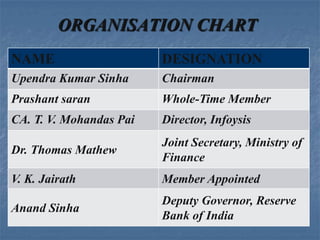
ORGANISATION CHART
NAME                     DESIGNATION
Upendra Kumar Sinha      Chairman
Prashant saran           Whole-Time Member
CA. T. V. Mohandas Pai   Director, Infoysis
                         Joint Secretary, Ministry of
Dr. Thomas Mathew
                         Finance
V. K. Jairath            Member Appointed
                         Deputy Governor, Reserve
Anand Sinha
                         Bank of India
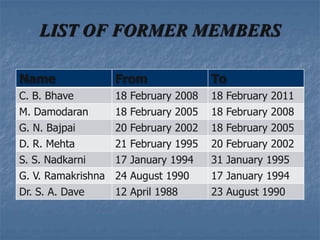
LIST OF FORMER MEMBERS

Name              From               To
C. B. Bhave       18 February 2008   18 February 2011
M. Damodaran      18 February 2005   18 February 2008
G. N. Bajpai      20 February 2002   18 February 2005
D. R. Mehta       21 February 1995   20 February 2002
S. S. Nadkarni    17 January 1994    31 January 1995
G. V. Ramakrishna 24 August 1990     17 January 1994
Dr. S. A. Dave    12 April 1988      23 August 1990
HISTORY OF SEBI

   Initially SEBI was a non statutory body without
    any statutory power.
   However in 1995, the SEBI was given additional
    statutory power by the Government of India
    through an amendment to the securities and
    Exchange Board of India Act 1992.
    In April, 1998 the SEBI was constituted as the
    regulator of capital market in India under a
    resolution of the Government of India.
ROLE OF SEBI IN MUTUAL FUNDS
   SEBI notified regulations for the mutual funds in
    1993.
   SEBI has also issued guidelines to the mutual funds
    from time to time to protect the interests of
    investors.
   All mutual funds whether promoted by public sector
    or private sector are governed by SEBI.
ROLE OF SEBI IN IPO
   The rules, regulations and procedures relating to
    public issues in India are governed by SEBI.
   Any company going public in India should get
    approval from SEBI before opening its IPO.
    Issuer company's lead managers submit the public
    issue prospectus to SEBI, provide clarification,
    make changes to the prospectus suggested by
    SEBI and get it approve.
   SEBI validate the IPO and make sure that
    document has enough information to help
    investors to take decision before applying shares
    in an IPO.
FUNCTIONS OF SEBI
(1) SEBI performs following functions:

a) Regulating the business in stock exchanges and
   any other securities markets.

b) Registering and regulating the working of stock
   brokers, sub-brokers, share transfer agents,
   bankers to an issue, trustees of trust deeds,
   registrars to an issue, merchant bankers,
   portfolio managers, investment advisers.
FUNCTIONS Cont…

c) Prohibiting fraudulent and unfair trade practices
   relating to securities markets.

(2) The duty of the Board to protect the interests of
  investors in securities and to regulate the
  securities market.

(3) Board have some powers as issuing commissions
  for the examination of witnesses or documents.
RESPONSIBILITIES OF SEBI

    SEBI has to be responsive to the needs of three
     groups, which constitute the market:
a.    the issuers of securities
b.    the investors
c.    the market intermediaries
     SEBI has three functions rolled into one body:
      quasi-legislative, quasi-judicial and quasi-executive.
POWERS OF SEBI
      Investigation:
I.      inspect the books of accounts and call for periodical returns
        from recognized stock exchanges.
II.     inspect the books of accounts of a financial intermediaries.
III.    compel certain companies to list their shares in one or more
        stock exchanges.
      Cease and desist proceedings:
I.      prosecute and judge directly the violation of certain
        provisions of the companies Act.
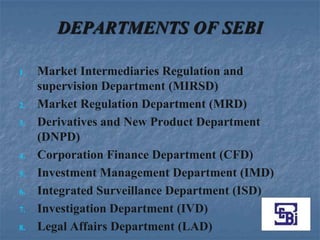
DEPARTMENTS OF SEBI

1.   Market Intermediaries Regulation and
     supervision Department (MIRSD)
2.   Market Regulation Department (MRD)
3.   Derivatives and New Product Department
     (DNPD)
4.   Corporation Finance Department (CFD)
5.   Investment Management Department (IMD)
6.   Integrated Surveillance Department (ISD)
7.   Investigation Department (IVD)
8.   Legal Affairs Department (LAD)
PROTECTION GUIDELNES GIVEN
         BY SEBI
   Eligibility Norms For Companies Issuing Security:
    No company shall make any issue of a public issue of securities, unless
    a draft prospectus has been filed with the Board, through an eligible
    Merchant Banker, at least 21 days prior to the filing of Prospectus with
    the Registrar of Companies (ROCs).


   Pricing By Companies Issuing Securities:
    A listed company whose equity shares are listed on a stock exchange,
    may freely price its equity shares and any security convertible into
    equity at a later date, offered through a public or rights issue.
GUIDELINES Cont…
   Pre issue Obligations:
    The standard of due diligence shall be such that the merchant banker
    shall satisfy himself about all the aspects of offering, veracity and
    adequacy of disclosure in the offer documents.


   Contents of Offer Document:
    Prospectus shall also contain all material information which shall be
    true and adequate so as to enable the investors to make informed
    decision on the investments in the issue.
RECENT NEWS ABOUT SEBI
                        (Oct 3, 2011)
   SEBI panel to revisit norms for IPOs, mutual funds 
•   The Securities and Exchange Board of India (SEBI) has
    decided to go for a comprehensive review of the primary
    market processes and norms governing the mutual fund
    industry.
•   The initial public offer process review will involve further
    reducing the time between closure of an issue and listing.
    At present, listing has to be made within 12 days. To help
    investors make informed judgment, SEBI has already
    asked merchant bankers (issue managers) to reduce the
    size of the application form for IPOs and disclose their
    track record of the issues managed and their performance.
Cont…
•   “We want to review the process further since our basic
    approach is to make life easier for retail investors,” top
    sources in SEBI said. SEBI is also looking at cutting down
    the number of days it takes to clear IPO applications.
•   SEBI’s role will come after the committee submits its
    recommendations.
•   It has been felt there is a need to improve buying and
    selling of mutual fund units on the floor of stock exchanges
    and expanding the base of investors in mutual funds.
BIBLIOGRAPHY

www.sebi.gov.in/
www.sebi.gov.in/Index.jsp?contentDisp=AboutSEBI
www.sebi.gov.in/acts/act15ac.html
Queries, if any, are welcome…

SEBI Presentation

  • 2.
    SEBI  The Securities and Exchange Board of India was established on April 12, 1992 in accordance with the provisions of the Securities and Exchange Board of India Act, 1992.  Its main function is to stop fraudulent activities of stock market.
  • 3.
    SECURITIES AND EXCHANGE BOARD OF INDIA ACT, 1992  An Act to provide for the establishment of a Board to protect the interests of investors in securities and to promote the development of, and to regulate, the securities market and for matters connected therewith or incidental thereto.
  • 4.
    SEBI INTRODUCTION • Formed: 12 April, 1992 • Jurisdiction: Government of India • Headquarters: Mumbai, Maharashtra • Employees: 525 (in 2009) • Website: www.sebi.gov.in
  • 5.
  • 6.
  • 7.
    BOARD MEMBERS Mr. U. K. Sinha (Chairman) Mr. Parshant Saran (Whole-Time member) Mr. V. K. Jairath (Member Appointed)
  • 8.
    ORGANISATION CHART NAME DESIGNATION Upendra Kumar Sinha Chairman Prashant saran Whole-Time Member CA. T. V. Mohandas Pai Director, Infoysis Joint Secretary, Ministry of Dr. Thomas Mathew Finance V. K. Jairath Member Appointed Deputy Governor, Reserve Anand Sinha Bank of India
  • 9.
    LIST OF FORMERMEMBERS Name From To C. B. Bhave 18 February 2008 18 February 2011 M. Damodaran 18 February 2005 18 February 2008 G. N. Bajpai 20 February 2002 18 February 2005 D. R. Mehta 21 February 1995 20 February 2002 S. S. Nadkarni 17 January 1994 31 January 1995 G. V. Ramakrishna 24 August 1990 17 January 1994 Dr. S. A. Dave 12 April 1988 23 August 1990
  • 10.
    HISTORY OF SEBI  Initially SEBI was a non statutory body without any statutory power.  However in 1995, the SEBI was given additional statutory power by the Government of India through an amendment to the securities and Exchange Board of India Act 1992.  In April, 1998 the SEBI was constituted as the regulator of capital market in India under a resolution of the Government of India.
  • 11.
    ROLE OF SEBIIN MUTUAL FUNDS  SEBI notified regulations for the mutual funds in 1993.  SEBI has also issued guidelines to the mutual funds from time to time to protect the interests of investors.  All mutual funds whether promoted by public sector or private sector are governed by SEBI.
  • 12.
    ROLE OF SEBIIN IPO  The rules, regulations and procedures relating to public issues in India are governed by SEBI.  Any company going public in India should get approval from SEBI before opening its IPO. Issuer company's lead managers submit the public issue prospectus to SEBI, provide clarification, make changes to the prospectus suggested by SEBI and get it approve.  SEBI validate the IPO and make sure that document has enough information to help investors to take decision before applying shares in an IPO.
  • 13.
    FUNCTIONS OF SEBI (1)SEBI performs following functions: a) Regulating the business in stock exchanges and any other securities markets. b) Registering and regulating the working of stock brokers, sub-brokers, share transfer agents, bankers to an issue, trustees of trust deeds, registrars to an issue, merchant bankers, portfolio managers, investment advisers.
  • 14.
    FUNCTIONS Cont… c) Prohibitingfraudulent and unfair trade practices relating to securities markets. (2) The duty of the Board to protect the interests of investors in securities and to regulate the securities market. (3) Board have some powers as issuing commissions for the examination of witnesses or documents.
  • 15.
    RESPONSIBILITIES OF SEBI  SEBI has to be responsive to the needs of three groups, which constitute the market: a. the issuers of securities b. the investors c. the market intermediaries  SEBI has three functions rolled into one body: quasi-legislative, quasi-judicial and quasi-executive.
  • 16.
    POWERS OF SEBI  Investigation: I. inspect the books of accounts and call for periodical returns from recognized stock exchanges. II. inspect the books of accounts of a financial intermediaries. III. compel certain companies to list their shares in one or more stock exchanges.  Cease and desist proceedings: I. prosecute and judge directly the violation of certain provisions of the companies Act.
  • 17.
    DEPARTMENTS OF SEBI 1. Market Intermediaries Regulation and supervision Department (MIRSD) 2. Market Regulation Department (MRD) 3. Derivatives and New Product Department (DNPD) 4. Corporation Finance Department (CFD) 5. Investment Management Department (IMD) 6. Integrated Surveillance Department (ISD) 7. Investigation Department (IVD) 8. Legal Affairs Department (LAD)
  • 18.
    PROTECTION GUIDELNES GIVEN BY SEBI  Eligibility Norms For Companies Issuing Security: No company shall make any issue of a public issue of securities, unless a draft prospectus has been filed with the Board, through an eligible Merchant Banker, at least 21 days prior to the filing of Prospectus with the Registrar of Companies (ROCs).  Pricing By Companies Issuing Securities: A listed company whose equity shares are listed on a stock exchange, may freely price its equity shares and any security convertible into equity at a later date, offered through a public or rights issue.
  • 19.
    GUIDELINES Cont…  Pre issue Obligations: The standard of due diligence shall be such that the merchant banker shall satisfy himself about all the aspects of offering, veracity and adequacy of disclosure in the offer documents.  Contents of Offer Document: Prospectus shall also contain all material information which shall be true and adequate so as to enable the investors to make informed decision on the investments in the issue.
  • 20.
    RECENT NEWS ABOUTSEBI (Oct 3, 2011)  SEBI panel to revisit norms for IPOs, mutual funds  • The Securities and Exchange Board of India (SEBI) has decided to go for a comprehensive review of the primary market processes and norms governing the mutual fund industry. • The initial public offer process review will involve further reducing the time between closure of an issue and listing. At present, listing has to be made within 12 days. To help investors make informed judgment, SEBI has already asked merchant bankers (issue managers) to reduce the size of the application form for IPOs and disclose their track record of the issues managed and their performance.
  • 21.
    Cont… • “We want to review the process further since our basic approach is to make life easier for retail investors,” top sources in SEBI said. SEBI is also looking at cutting down the number of days it takes to clear IPO applications. • SEBI’s role will come after the committee submits its recommendations. • It has been felt there is a need to improve buying and selling of mutual fund units on the floor of stock exchanges and expanding the base of investors in mutual funds.
  • 22.
  • 24.
    Queries, if any,are welcome…