Meaning and Concept 
Types of Takeovers 
Thomas Mathew 
Unit - III 
1
2 
MEANING AND CONCEPT OF TAKEOVERS 
 Takeover implies acquisition of control of 
a company which is already registered 
through the purchase or exchange of 
shares. 
 Takeover takes place usually by acquisition 
or purchase from the shareholders of a 
company their shares at a specified price 
to the extent of at least controlling interest 
in order to gain control of the company.
3 
WHAT IS TAKEOVER 
 In General term referring to transfer of control of a 
firm from one group of shareholders to another 
group of shareholders. 
 Change in the controlling interest of a corporation, 
either through a friendly acquisition or an 
unfriendly, hostile, bid. 
 When an "acquirer" takes over the control of the 
"target company", it is termed as Takeover. 
 When an acquirer acquires "substantial quantity of 
shares or voting rights" of the Target Company, it 
results into substantial acquisition of shares.
4 
Procedure for Takeover 
The takeover could take place through different 
methods. A company may acquire the shares of a 
unlisted company through what is called acquisition 
under Section 395 of the Companies Act , 1956. 
However where the shares of the company are widely 
held by the general public, it involves the process as 
set out in the SEBI (Substantial Acquisition of 
Shares and Takeovers) Regulations, 1997, as 
amended in 2002, 2004 and 2006 .
5 
The term ‘Takeover’ has not been defined under 
SEBI (Substantial Acquisition of Shares and 
Takeovers) Regulations, 1997 , the term basically 
envisages the concept of an acquirer taking over 
the control or management of the target company . 
When an acquirer, acquires substantial quantity of 
shares or voting rights of the target company, it 
results in the Substantial acquisition of Shares
6 
For the purposes of understanding the 
implications of taking over it is necessary for us to 
know what is the actual meaning of: 
[i] Acquirer, 
[ii] Target Company, 
[iii] Control, 
[iv] Promoter, 
[v] Persons acting in concert and 
[vi] substantial quantity of shares or voting rights.
7 
1. Acquirer 
An Acquirer means (includes Persons Acting in 
Concert (PAC) with him) any individual/ 
company/ any other legal entity which intends to 
acquire or acquires substantial quantity of shares 
or voting rights of target company or acquires or 
agrees to acquire control over the target company
8 
2. Target Company 
A Target company is a listed company i.e. 
whose shares are listed on any stock 
exchange and whose shares or voting 
rights are acquired/ being acquired or 
whose control is taken over/being taken 
over by an acquirer
9 
3. Control 
Control includes the right to appoint directly or 
indirectly or by virtue of agreements or in any other 
manner majority of directors on the Board of the 
target company or to control management or policy 
decisions affecting the target company.
10 
4. Promoter 
The definition of promoter after amendment in 2006 
now includes “any person who is in control of the 
target company” or “named as promoter in an offer 
document or shareholding pattern filed by the target 
company with the stock exchanges according to the 
listing agreement, whichever is later.”
Promoter….. 
The takeover code has also modified the definition of 
individual. The new definition of individual includes: 
1. Spouse, parents, sisters, brothers and children of the 
11 
promoter. 
2. A company in which 10% or more of the share capital is 
held by the promoter or his immediate relative or a 
firm/HUF in which the promoter or his immediate relative 
is a member holding an aggregate share capital of 10% or 
more. 
3. Any company in which the company specified in sub-clause 
above, holds 10% or more of the share capital. (The 
earlier threshold was 26%)
12 
5. Persons Acting in Concert (PAC) 
PACs are individual(s) /company(ies)/ any other legal 
entity(ies) who are acting together for a common 
objective or for a purpose of substantial acquisition of 
shares or voting rights or gaining control over the target 
company pursuant to an agreement or understanding 
whether formal or informal. 
Acting in concert would imply co-operation, co-ordination 
for acquisition of voting rights or control. 
This co-operation/ co-ordinated approach may either 
be direct or indirect.
13 
PAC….. 
The concept of PAC assumes significance in the context of 
substantial acquisition of shares since it is possible for an 
acquirer to acquire shares or voting rights in a company "in 
concert" with any other person in such a manner that the 
acquisition made by them may remain individually below the 
threshold limit but may collectively exceed the threshold 
limit. 
Unless the contrary is established certain entities are deemed 
to be persons acting in concert like companies with its 
holding company or subsidiary company, mutual funds with 
its sponsor / trustee/ Asset management company, etc
14 
1. Friendly or Negotiated Takeover:- 
Friendly takeover means takeover of one company 
by change in its management & control through 
negotiations between the existing promoters and 
prospective investor in a friendly manner. Thus it is 
also called Negotiated Takeover. This kind of 
takeover is resorted to further some common 
objectives of both the parties. Generally, friendly 
takeover takes place as per the provisions of 
Section 395 of the Companies Act, 1956.
15 
2. Bail Out Takeover – 
Takeover of a financially sick company by a 
financially rich company as per the 
provisions of Sick Industrial Companies 
(Special Provisions) Act, 1985 to bail out the 
former from losses.
16 
3. Hostile takeover- 
Hostile takeover is a takeover where one company 
unilaterally pursues the acquisition of shares of 
another company without being into the 
knowledge of that other company. The most 
dominant purpose which has forced most of the 
companies to resort to this kind of takeover is 
increase in market share. The hostile takeover takes 
place as per the provisions of SEBI (Substantial 
Acquisition of Shares and Takeover) Regulations, 
1997
17 
1. Horizontal Takeover- 
Takeover of one company by another company in 
the same industry. The main purpose behind this 
kind of takeover is achieving the economies of 
scale or increasing the market share. 
E.g. Takeover of Hutch by Vodafone.
18 
2. Vertical Takeover – 
Takeover by one company with its suppliers or 
customers. The former is known as Backward 
integration and latter is known as Forward 
integration. 
The main purpose behind this kind of 
takeover is reduction in costs. 
E.g. takeover of Sona Steerings Ltd. By Maruti 
Udyog Ltd. is backward takeover.
19 
3. Conglomerate takeover: 
Takeover of one company by another 
company operating in totally different 
industries. The main purpose of this kind of 
takeover is diversification. 
Eg. General Motors and EDS 
(Electronic Data Systems [EDS], specialized in 
information technology and data services, was 
acquired by giant automaker General Motors in 
1984.)
20 
 The first player in this battle was Reliance 
Industries Limited (RIL), in the late 1980’s. 
 Armed with 10.05 percentage stake in L&T 
was aspiring to acquire as a whole. 
 For L&T it was life and death issue. But 
then L&T was successful to fought back 
tooth and nail. 
 At that time major stake holder of L&T were 
LIC and UTI.
21 
 On November 18, 2001 the threat again raised for L&T 
when RIL sold its entire stake to Grasim (A. V. Birla 
group) at 46 percent higher price than market.(167 to 
209/306) 
 On October 13, 2002 Grasim made a public 
announcement of open offer to acquire 20 percent stake 
in L&T at Rs.190 per share. 
 On November 8, 2002 the SEBI asked not to proceed with 
this offer since it wanted to investigate the matter. 
 Further, on January 27, 2003 Grasim made a counter 
proposal of vertical de-merger of cement business to L&T 
board. 
 Grasim valued L&T’s cement business at Rs. 130/- per 
share and made open offer to acquire control of the 
cement business / company.
22 
 By April 2003, the SEBI came to conclusion that 
Grasim had not violated Takeover Code, and 
that its offer was valid subject to making some 
additional disclosures. 
 However Grasim had got only 0.38 percent stake 
in open offer. 
 But with the help of its subsidiary co. it 
managed to get 15.73 percent of L&T equity 
capital. 
 Thereafter, in June 2003 itself the L&T 
management and Birla’s planned out a deal to 
carry out a structured de-merger of cement 
business of L&T .
23 
 It was decided that post de-merger, Grasim will 
acquire the control of the resultant cement company. 
[UlraTech] 
 However, L&T managed to retain certain key assets 
like L&T brand, ready mix cement (RMC) business, 
the gas power plant in Andhra Pradesh, and the entire 
residential and office property of the cement division. 
 As a part of the scheme of de-merger L&T was allotted 
20 percent of UlraTech’s equity. 
 The open offer by Grasim was meant for not only 
taking control of UltraTech, but to give a chance to 
FIs to bring down their stake, in the process making 
heavy capital gains.
24 
 In acquiring L&T’s cement business, Birla had a 
simple motive of ‘growth through acquisition’ 
 After acquisition the combined capacity of Grasim 
and UltraTech went up to 31 mn. tones, making 
Grasim the largest producer in India and the eighth 
largest in the world. 
 While Grasim was strong in the Southern markets, 
L&T was strong in the rest of India. L&T’s strong 
distribution network was very vital to Grasim to 
push its own brands also.
25 
 On 2004 July 6 Larsen & Toubro and Grasim 
Industries announced the completion of the 
scheme of demerger L&T’s cement division with 
Grasim having acquired a majority stake in the 
company for around Rs.2,200 crore. 
 Grasim, which has cement brands such as Birla 
Plus and Birla Super, was allowed to use the 
L&T Cement brand till March 31, 2005. 
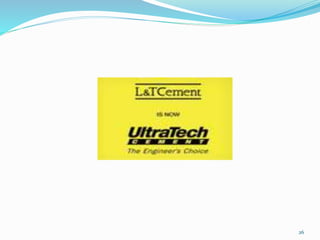
However, the company decided not to use the 
L&T Cement brand anymore and instead has 
now chosen the UltraTech brand. 
 Along with Birla Plus and Birla Super, UltraTech 
is positioned as a national brand ………… AND
26
27 
DIFFERENCE BETWEEN A MERGER AND A TAKEOVER 
In a general sense, mergers and takeovers (or 
acquisitions) are very similar corporate actions - 
they combine two previously separate firms into 
a single legal entity. 
A company that combines itself with another can 
experience boosted economies of scale, greater 
sales revenue and market share in its market, 
broadened diversification and increased tax 
efficiency.
A merger involves the mutual decision of two 
companies to combine and become one entity; it can 
be seen as a decision made by two "equals". A typical 
merger, in other words, involves two relatively equal 
companies, which combine to become one legal 
entity with the goal of producing a company that is 
worth more than the sum of its parts. 
In a merger of two corporations, the shareholders 
usually have their shares in the old company 
exchanged for an equal number of shares in the 
merged entity. 
28
A takeover, or acquisition, on the other hand, is characterized 
by the purchase of a smaller company by a much larger one. 
This combination of "unequals" can produce the same benefits 
as a merger, but it does not necessarily have to be a mutual 
decision. A larger company can initiate a hostile takeover of a 
smaller firm, which essentially amounts to buying the 
company in the face of resistance from the smaller company's 
management. Unlike in a merger, in an acquisition, the 
acquiring firm usually offers a cash price per share to the target 
firm's shareholders or the acquiring firm's share's to the 
shareholders of the target firm according to a specified 
conversion ratio. 
29
30

Takeovers

  • 1.
    Meaning and Concept Types of Takeovers Thomas Mathew Unit - III 1
  • 2.
    2 MEANING ANDCONCEPT OF TAKEOVERS  Takeover implies acquisition of control of a company which is already registered through the purchase or exchange of shares.  Takeover takes place usually by acquisition or purchase from the shareholders of a company their shares at a specified price to the extent of at least controlling interest in order to gain control of the company.
  • 3.
    3 WHAT ISTAKEOVER  In General term referring to transfer of control of a firm from one group of shareholders to another group of shareholders.  Change in the controlling interest of a corporation, either through a friendly acquisition or an unfriendly, hostile, bid.  When an "acquirer" takes over the control of the "target company", it is termed as Takeover.  When an acquirer acquires "substantial quantity of shares or voting rights" of the Target Company, it results into substantial acquisition of shares.
  • 4.
    4 Procedure forTakeover The takeover could take place through different methods. A company may acquire the shares of a unlisted company through what is called acquisition under Section 395 of the Companies Act , 1956. However where the shares of the company are widely held by the general public, it involves the process as set out in the SEBI (Substantial Acquisition of Shares and Takeovers) Regulations, 1997, as amended in 2002, 2004 and 2006 .
  • 5.
    5 The term‘Takeover’ has not been defined under SEBI (Substantial Acquisition of Shares and Takeovers) Regulations, 1997 , the term basically envisages the concept of an acquirer taking over the control or management of the target company . When an acquirer, acquires substantial quantity of shares or voting rights of the target company, it results in the Substantial acquisition of Shares
  • 6.
    6 For thepurposes of understanding the implications of taking over it is necessary for us to know what is the actual meaning of: [i] Acquirer, [ii] Target Company, [iii] Control, [iv] Promoter, [v] Persons acting in concert and [vi] substantial quantity of shares or voting rights.
  • 7.
    7 1. Acquirer An Acquirer means (includes Persons Acting in Concert (PAC) with him) any individual/ company/ any other legal entity which intends to acquire or acquires substantial quantity of shares or voting rights of target company or acquires or agrees to acquire control over the target company
  • 8.
    8 2. TargetCompany A Target company is a listed company i.e. whose shares are listed on any stock exchange and whose shares or voting rights are acquired/ being acquired or whose control is taken over/being taken over by an acquirer
  • 9.
    9 3. Control Control includes the right to appoint directly or indirectly or by virtue of agreements or in any other manner majority of directors on the Board of the target company or to control management or policy decisions affecting the target company.
  • 10.
    10 4. Promoter The definition of promoter after amendment in 2006 now includes “any person who is in control of the target company” or “named as promoter in an offer document or shareholding pattern filed by the target company with the stock exchanges according to the listing agreement, whichever is later.”
  • 11.
    Promoter….. The takeovercode has also modified the definition of individual. The new definition of individual includes: 1. Spouse, parents, sisters, brothers and children of the 11 promoter. 2. A company in which 10% or more of the share capital is held by the promoter or his immediate relative or a firm/HUF in which the promoter or his immediate relative is a member holding an aggregate share capital of 10% or more. 3. Any company in which the company specified in sub-clause above, holds 10% or more of the share capital. (The earlier threshold was 26%)
  • 12.
    12 5. PersonsActing in Concert (PAC) PACs are individual(s) /company(ies)/ any other legal entity(ies) who are acting together for a common objective or for a purpose of substantial acquisition of shares or voting rights or gaining control over the target company pursuant to an agreement or understanding whether formal or informal. Acting in concert would imply co-operation, co-ordination for acquisition of voting rights or control. This co-operation/ co-ordinated approach may either be direct or indirect.
  • 13.
    13 PAC….. Theconcept of PAC assumes significance in the context of substantial acquisition of shares since it is possible for an acquirer to acquire shares or voting rights in a company "in concert" with any other person in such a manner that the acquisition made by them may remain individually below the threshold limit but may collectively exceed the threshold limit. Unless the contrary is established certain entities are deemed to be persons acting in concert like companies with its holding company or subsidiary company, mutual funds with its sponsor / trustee/ Asset management company, etc
  • 14.
    14 1. Friendlyor Negotiated Takeover:- Friendly takeover means takeover of one company by change in its management & control through negotiations between the existing promoters and prospective investor in a friendly manner. Thus it is also called Negotiated Takeover. This kind of takeover is resorted to further some common objectives of both the parties. Generally, friendly takeover takes place as per the provisions of Section 395 of the Companies Act, 1956.
  • 15.
    15 2. BailOut Takeover – Takeover of a financially sick company by a financially rich company as per the provisions of Sick Industrial Companies (Special Provisions) Act, 1985 to bail out the former from losses.
  • 16.
    16 3. Hostiletakeover- Hostile takeover is a takeover where one company unilaterally pursues the acquisition of shares of another company without being into the knowledge of that other company. The most dominant purpose which has forced most of the companies to resort to this kind of takeover is increase in market share. The hostile takeover takes place as per the provisions of SEBI (Substantial Acquisition of Shares and Takeover) Regulations, 1997
  • 17.
    17 1. HorizontalTakeover- Takeover of one company by another company in the same industry. The main purpose behind this kind of takeover is achieving the economies of scale or increasing the market share. E.g. Takeover of Hutch by Vodafone.
  • 18.
    18 2. VerticalTakeover – Takeover by one company with its suppliers or customers. The former is known as Backward integration and latter is known as Forward integration. The main purpose behind this kind of takeover is reduction in costs. E.g. takeover of Sona Steerings Ltd. By Maruti Udyog Ltd. is backward takeover.
  • 19.
    19 3. Conglomeratetakeover: Takeover of one company by another company operating in totally different industries. The main purpose of this kind of takeover is diversification. Eg. General Motors and EDS (Electronic Data Systems [EDS], specialized in information technology and data services, was acquired by giant automaker General Motors in 1984.)
  • 20.
    20  Thefirst player in this battle was Reliance Industries Limited (RIL), in the late 1980’s.  Armed with 10.05 percentage stake in L&T was aspiring to acquire as a whole.  For L&T it was life and death issue. But then L&T was successful to fought back tooth and nail.  At that time major stake holder of L&T were LIC and UTI.
  • 21.
    21  OnNovember 18, 2001 the threat again raised for L&T when RIL sold its entire stake to Grasim (A. V. Birla group) at 46 percent higher price than market.(167 to 209/306)  On October 13, 2002 Grasim made a public announcement of open offer to acquire 20 percent stake in L&T at Rs.190 per share.  On November 8, 2002 the SEBI asked not to proceed with this offer since it wanted to investigate the matter.  Further, on January 27, 2003 Grasim made a counter proposal of vertical de-merger of cement business to L&T board.  Grasim valued L&T’s cement business at Rs. 130/- per share and made open offer to acquire control of the cement business / company.
  • 22.
    22  ByApril 2003, the SEBI came to conclusion that Grasim had not violated Takeover Code, and that its offer was valid subject to making some additional disclosures.  However Grasim had got only 0.38 percent stake in open offer.  But with the help of its subsidiary co. it managed to get 15.73 percent of L&T equity capital.  Thereafter, in June 2003 itself the L&T management and Birla’s planned out a deal to carry out a structured de-merger of cement business of L&T .
  • 23.
    23  Itwas decided that post de-merger, Grasim will acquire the control of the resultant cement company. [UlraTech]  However, L&T managed to retain certain key assets like L&T brand, ready mix cement (RMC) business, the gas power plant in Andhra Pradesh, and the entire residential and office property of the cement division.  As a part of the scheme of de-merger L&T was allotted 20 percent of UlraTech’s equity.  The open offer by Grasim was meant for not only taking control of UltraTech, but to give a chance to FIs to bring down their stake, in the process making heavy capital gains.
  • 24.
    24  Inacquiring L&T’s cement business, Birla had a simple motive of ‘growth through acquisition’  After acquisition the combined capacity of Grasim and UltraTech went up to 31 mn. tones, making Grasim the largest producer in India and the eighth largest in the world.  While Grasim was strong in the Southern markets, L&T was strong in the rest of India. L&T’s strong distribution network was very vital to Grasim to push its own brands also.
  • 25.
    25  On2004 July 6 Larsen & Toubro and Grasim Industries announced the completion of the scheme of demerger L&T’s cement division with Grasim having acquired a majority stake in the company for around Rs.2,200 crore.  Grasim, which has cement brands such as Birla Plus and Birla Super, was allowed to use the L&T Cement brand till March 31, 2005. However, the company decided not to use the L&T Cement brand anymore and instead has now chosen the UltraTech brand.  Along with Birla Plus and Birla Super, UltraTech is positioned as a national brand ………… AND
  • 26.
  • 27.
    27 DIFFERENCE BETWEENA MERGER AND A TAKEOVER In a general sense, mergers and takeovers (or acquisitions) are very similar corporate actions - they combine two previously separate firms into a single legal entity. A company that combines itself with another can experience boosted economies of scale, greater sales revenue and market share in its market, broadened diversification and increased tax efficiency.
  • 28.
    A merger involvesthe mutual decision of two companies to combine and become one entity; it can be seen as a decision made by two "equals". A typical merger, in other words, involves two relatively equal companies, which combine to become one legal entity with the goal of producing a company that is worth more than the sum of its parts. In a merger of two corporations, the shareholders usually have their shares in the old company exchanged for an equal number of shares in the merged entity. 28
  • 29.
    A takeover, oracquisition, on the other hand, is characterized by the purchase of a smaller company by a much larger one. This combination of "unequals" can produce the same benefits as a merger, but it does not necessarily have to be a mutual decision. A larger company can initiate a hostile takeover of a smaller firm, which essentially amounts to buying the company in the face of resistance from the smaller company's management. Unlike in a merger, in an acquisition, the acquiring firm usually offers a cash price per share to the target firm's shareholders or the acquiring firm's share's to the shareholders of the target firm according to a specified conversion ratio. 29
  • 30.