Securities and Exchange Board of India
NELSON KURIAKOSE
www.lead.ac.in
The Securities and Exchange Board of India was
enacted on April 12, 1992 in accordance with the provisions of
the Securities and Exchange Board of India Act, 1992.
The Preamble of the Securities and Exchange Board
of India describes the basic functions of the Securities and
Exchange Board of India as "...to protect the interests of
investors in securities and to promote the development of,
and to regulate the securities market and for matters
connected therewith or incidental thereto"
It was established by The Government of India on
12 April 1988 and given statutory powers in 1992 with SEBI
Act 1992 being passed by the Indian Parliament. SEBI has
its headquarters at the business district of Bandra Kurla
Complex in Mumbai.
Initially SEBI was a non statutory body without any
statutory power. However in 1995, the SEBI was given
additional statutory power by the Government of India
through an amendment to the Securities and Exchange Board
of India Act, 1992. In April 1988 the SEBI was constituted
as the regulator of capital markets in India under a resolution
of the Government of India.
The Preamble of the Securities and Exchange
Board of India describes the basic functions of the Securities
and Exchange Board of India as "...to protect the interests
of investors in securities and to promote the development
of, and to regulate the securities market and for matters
connected therewith or incidental thereto".
SEBI has to be responsive to the needs of three
groups, which constitute the market:
• the issuers of securities
• the investors
• the market intermediaries.
The overall objectives of SEBI are to protect the
interest of investors and to promote the development of stock
exchange and to regulate the activities of stock market. The
objectives of SEBI are:
1. To regulate the activities of stock exchange.
2. To protect the rights of investors and ensuring safety to
their investment.
3. To prevent fraudulent and malpractices by having
balance between self regulation of business and its
statutory regulations.
4. To regulate and develop a code of conduct for
intermediaries such as brokers, underwriters, etc.
The SEBI performs functions to meet its objectives.
To meet three objectives SEBI has three important functions.
These are:
i. Protective functions
ii. Developmental functions
iii. Regulatory functions.
These functions are performed by SEBI to protect the
interest of investor and provide safety of investment.
As protective functions SEBI performs following
functions:
(i) It Checks Price Rigging:
Price rigging refers to manipulating the prices of
securities with the main objective of inflating or depressing the
market price of securities. SEBI prohibits such practice because
this can defraud and cheat the investors.
(ii) It Prohibits Insider trading:
Insider is any person connected with the company
such as directors, promoters etc. These insiders have sensitive
information which affects the prices of the securities. This
information is not available to people at large but the insiders
get this privileged information by working inside the company
and if they use this information to make profit, then it is known
as insider trading
(iii) SEBI prohibits fraudulent and Unfair Trade Practices:
SEBI does not allow the companies to make
misleading statements which are likely to induce the sale or
purchase of securities by any other person.
(iv) SEBI undertakes steps to educate investors so that they are
able to evaluate the securities of various companies and select
the most profitable securities.
(v) SEBI promotes fair practices and code of conduct in
security market by taking following steps:
(a) SEBI has issued guidelines to protect the interest
of debenture-holders wherein companies cannot change terms
in midterm.
(b) SEBI is empowered to investigate cases of insider
trading and has provisions for stiff fine and imprisonment.
(c) SEBI has stopped the practice of making
preferential allotment of shares unrelated to market prices.
These functions are performed by the SEBI to
promote and develop activities in stock exchange and
increase the business in stock exchange. Under
developmental categories following functions are performed
by SEBI:
(i) SEBI promotes training of intermediaries of the securities
market.
(ii) SEBI tries to promote activities of stock exchange by
adopting flexible and adoptable approach in following way:
a) SEBI has permitted internet trading through
registered stock brokers.
b) SEBI has made underwriting optional to reduce
the cost of issue.
c) Even initial public offer of primary market is
permitted through stock exchange.
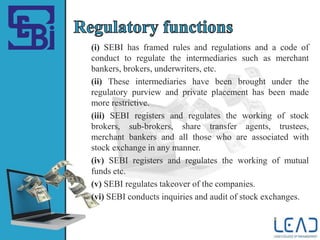
(i) SEBI has framed rules and regulations and a code of
conduct to regulate the intermediaries such as merchant
bankers, brokers, underwriters, etc.
(ii) These intermediaries have been brought under the
regulatory purview and private placement has been made
more restrictive.
(iii) SEBI registers and regulates the working of stock
brokers, sub-brokers, share transfer agents, trustees,
merchant bankers and all those who are associated with
stock exchange in any manner.
(iv) SEBI registers and regulates the working of mutual
funds etc.
(v) SEBI regulates takeover of the companies.
(vi) SEBI conducts inquiries and audit of stock exchanges.
For the discharge of its functions efficiently, SEBI
has been vested with the following powers:
• to approve by−laws of stock exchanges SEBI
• to require the stock exchange to amend their by−laws.
• inspect the books of accounts and call for periodical
returns from recognized stock exchanges.
• inspect the books of accounts of a financial
intermediaries.
• compel certain companies to list their shares in one or
more stock exchanges.
• registration brokers.
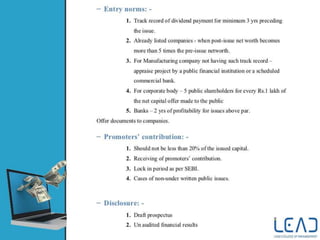
Company: Anew company is one, which has not completed
12 months commercial production and does not have audited
results. And the promoters do not have a track record. These
companies have to issue shares only at par.
(b). New Company set-up by Existing Company:
When a new company is being set-up by existing
companies with a five year track record of consistent
profitability and a contribution of at least 50% in the
equity of new company, it can issue its shares at
premium.
(c). Private and closely held companies:
These having a track record of consistent profitability for
at least three years, shall be permitted to price their
issues freely.
The issue price shall be determined only by the issues
in consultation with lead managers ton the issue.
(d). Existing Listed companies:
It will be allowed to raise fresh capital by freely pricing
expanded capital provided the promoter’s contribution is
50%on first Rs.100crores of issue, 40% on next Rs.200
crores, 30% on next Rs 300 crores and 15% on balance
issue amount.
 Stock Exchange
(a) Board of Directors of stock exchange has to be
reconstituted so as to include non-members, public
representatives, government representative to the extent
of 50% of total number of members.
(b)Capital adequacy norms have been laid down for
members of various stock exchanges depending upon
their turnover of trade and other factors.
(c). Working hours for all stock exchanges have been
fixed uniformly.
(d). All the recognized stock exchanges will have to
inform about the transaction within 24 hours.
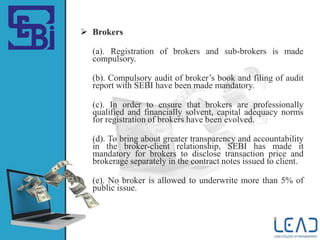
 Brokers
(a). Registration of brokers and sub-brokers is made
compulsory.
(b). Compulsory audit of broker’s book and filing of audit
report with SEBI have been made mandatory.
(c). In order to ensure that brokers are professionally
qualified and financially solvent, capital adequacy norms
for registration of brokers have been evolved.
(d). To bring about greater transparency and accountability
in the broker-client relationship, SEBI has made it
mandatory for brokers to disclose transaction price and
brokerage separately in the contract notes issued to client.
(e). No broker is allowed to underwrite more than 5% of
public issue.
nelson@lead.ac.in
Thank you

Sebi

  • 1.
    Securities and ExchangeBoard of India NELSON KURIAKOSE www.lead.ac.in
  • 2.
    The Securities andExchange Board of India was enacted on April 12, 1992 in accordance with the provisions of the Securities and Exchange Board of India Act, 1992. The Preamble of the Securities and Exchange Board of India describes the basic functions of the Securities and Exchange Board of India as "...to protect the interests of investors in securities and to promote the development of, and to regulate the securities market and for matters connected therewith or incidental thereto"
  • 3.
    It was establishedby The Government of India on 12 April 1988 and given statutory powers in 1992 with SEBI Act 1992 being passed by the Indian Parliament. SEBI has its headquarters at the business district of Bandra Kurla Complex in Mumbai. Initially SEBI was a non statutory body without any statutory power. However in 1995, the SEBI was given additional statutory power by the Government of India through an amendment to the Securities and Exchange Board of India Act, 1992. In April 1988 the SEBI was constituted as the regulator of capital markets in India under a resolution of the Government of India.
  • 4.
    The Preamble ofthe Securities and Exchange Board of India describes the basic functions of the Securities and Exchange Board of India as "...to protect the interests of investors in securities and to promote the development of, and to regulate the securities market and for matters connected therewith or incidental thereto". SEBI has to be responsive to the needs of three groups, which constitute the market: • the issuers of securities • the investors • the market intermediaries.
  • 5.
    The overall objectivesof SEBI are to protect the interest of investors and to promote the development of stock exchange and to regulate the activities of stock market. The objectives of SEBI are: 1. To regulate the activities of stock exchange. 2. To protect the rights of investors and ensuring safety to their investment. 3. To prevent fraudulent and malpractices by having balance between self regulation of business and its statutory regulations. 4. To regulate and develop a code of conduct for intermediaries such as brokers, underwriters, etc.
  • 6.
    The SEBI performsfunctions to meet its objectives. To meet three objectives SEBI has three important functions. These are: i. Protective functions ii. Developmental functions iii. Regulatory functions.
  • 7.
    These functions areperformed by SEBI to protect the interest of investor and provide safety of investment. As protective functions SEBI performs following functions: (i) It Checks Price Rigging: Price rigging refers to manipulating the prices of securities with the main objective of inflating or depressing the market price of securities. SEBI prohibits such practice because this can defraud and cheat the investors. (ii) It Prohibits Insider trading: Insider is any person connected with the company such as directors, promoters etc. These insiders have sensitive information which affects the prices of the securities. This information is not available to people at large but the insiders get this privileged information by working inside the company and if they use this information to make profit, then it is known as insider trading
  • 8.
    (iii) SEBI prohibitsfraudulent and Unfair Trade Practices: SEBI does not allow the companies to make misleading statements which are likely to induce the sale or purchase of securities by any other person. (iv) SEBI undertakes steps to educate investors so that they are able to evaluate the securities of various companies and select the most profitable securities. (v) SEBI promotes fair practices and code of conduct in security market by taking following steps: (a) SEBI has issued guidelines to protect the interest of debenture-holders wherein companies cannot change terms in midterm. (b) SEBI is empowered to investigate cases of insider trading and has provisions for stiff fine and imprisonment. (c) SEBI has stopped the practice of making preferential allotment of shares unrelated to market prices.
  • 9.
    These functions areperformed by the SEBI to promote and develop activities in stock exchange and increase the business in stock exchange. Under developmental categories following functions are performed by SEBI: (i) SEBI promotes training of intermediaries of the securities market. (ii) SEBI tries to promote activities of stock exchange by adopting flexible and adoptable approach in following way: a) SEBI has permitted internet trading through registered stock brokers. b) SEBI has made underwriting optional to reduce the cost of issue. c) Even initial public offer of primary market is permitted through stock exchange.
  • 10.
    (i) SEBI hasframed rules and regulations and a code of conduct to regulate the intermediaries such as merchant bankers, brokers, underwriters, etc. (ii) These intermediaries have been brought under the regulatory purview and private placement has been made more restrictive. (iii) SEBI registers and regulates the working of stock brokers, sub-brokers, share transfer agents, trustees, merchant bankers and all those who are associated with stock exchange in any manner. (iv) SEBI registers and regulates the working of mutual funds etc. (v) SEBI regulates takeover of the companies. (vi) SEBI conducts inquiries and audit of stock exchanges.
  • 11.
    For the dischargeof its functions efficiently, SEBI has been vested with the following powers: • to approve by−laws of stock exchanges SEBI • to require the stock exchange to amend their by−laws. • inspect the books of accounts and call for periodical returns from recognized stock exchanges. • inspect the books of accounts of a financial intermediaries. • compel certain companies to list their shares in one or more stock exchanges. • registration brokers.
  • 16.
    Company: Anew companyis one, which has not completed 12 months commercial production and does not have audited results. And the promoters do not have a track record. These companies have to issue shares only at par. (b). New Company set-up by Existing Company: When a new company is being set-up by existing companies with a five year track record of consistent profitability and a contribution of at least 50% in the equity of new company, it can issue its shares at premium.
  • 17.
    (c). Private andclosely held companies: These having a track record of consistent profitability for at least three years, shall be permitted to price their issues freely. The issue price shall be determined only by the issues in consultation with lead managers ton the issue. (d). Existing Listed companies: It will be allowed to raise fresh capital by freely pricing expanded capital provided the promoter’s contribution is 50%on first Rs.100crores of issue, 40% on next Rs.200 crores, 30% on next Rs 300 crores and 15% on balance issue amount.
  • 21.
     Stock Exchange (a)Board of Directors of stock exchange has to be reconstituted so as to include non-members, public representatives, government representative to the extent of 50% of total number of members. (b)Capital adequacy norms have been laid down for members of various stock exchanges depending upon their turnover of trade and other factors. (c). Working hours for all stock exchanges have been fixed uniformly. (d). All the recognized stock exchanges will have to inform about the transaction within 24 hours.
  • 22.
     Brokers (a). Registrationof brokers and sub-brokers is made compulsory. (b). Compulsory audit of broker’s book and filing of audit report with SEBI have been made mandatory. (c). In order to ensure that brokers are professionally qualified and financially solvent, capital adequacy norms for registration of brokers have been evolved. (d). To bring about greater transparency and accountability in the broker-client relationship, SEBI has made it mandatory for brokers to disclose transaction price and brokerage separately in the contract notes issued to client. (e). No broker is allowed to underwrite more than 5% of public issue.
  • 23.
  • 24.