RELATIONSHIP MARKETING:
MEANING & SCOPE
MEANING
Is a philosophy or theory of the way of doing

business by building relationships – Internally
and Externally.
Relationship with three primary Stakeholders –
Shareholders, Employees and Customers.
It is about understanding the relationship
framework in totality (why, what and how) in
order to define the organizational goals and
objectives.
EVOLUTION OF RM
1960s – Direct Mail
1970s – Direct Response Marketing /

Advertising
Late ’70s – Direct Marketing
1980s – Database Marketing
Late ’80s – One-to-one Marketing
1990s – Loyalty Marketing
Late ’90s – Relationship Marketing
CHARACTERISTICS
Business Strategy: Involves all the resources of the

organization aimed at enhancing relationship with
stakeholders of the company
Two-way Relationship: Mutual benefit to all the
parties involved
Pragmatic: Factual and practical. Relies on
information.
One-2-one: Customised to suit individuals. No ‘onefits-all’ strategy.
Dynamic: Need for details and scope for constant
improvement.
TYPES OF CUSTOMER RELATIONSHIPS
Strategic

Relationship:
An
emotional
connection between the entities. Understanding
the length, depth and width of relationships. A
long-term relationship. Ex: FMCG Buying, Bank
Accounts.
Tactical Relationship: Based on mutual
convenience.
Committed
for
a
single
transaction. A short-term relationship. Starting
point for a strategic relationship.
Ex: Insurance, Travel and Tourism, Healthcare,
One-time Buying.
FUNDAMENTAL CONCEPTS OF CRM
Customer Satisfaction: Delivering products to

match / exceed customer expectations.
Providing higher value through enhanced
benefits.
Customer Retention: Activity that retains
profitable customers. Mutually beneficial.
Loyalty is the ultimate point of retention.
Customer Loyalty: Continued buying. An
element of emotional attachment. Satisfied
customers become loyal over a period of time.
PLANNING RM STRATEGIES
The Path
Identify key areas of relationship (why)
Fix realistic objectives (what)
Plan the relationship route (how)

The Essentials
Resources: The Feasibilities
Medium: The Channel
Communication: The Message
BASIC RM STRATEGIES
Acquisition Strategies
Allocation of Resources
STP based on information available
Providing need-specific products
Effective reach - Media
Retention Strategies
The Retention Road-map: Suspect – Prospect Buyer – Customer – Loyal Customer – Advocate
The Strategies: “Activity – Status – Next Steps” Analysis.
CRM : AN INTORDUCTION
DEFINITION
CRM is the strategic use of
Information, Processes, Technology and
People to manage the customer’s
relationship with the company’s various
operations, viz., marketing, sales,
services and support, across the
customer life cycle.
CRM CONCEPTS

Customer Life Cycle (CLC): CLC is the total time that

the customer is engaged with the company derived from
the customer’s experience and viewpoint.
Customer Asset: Customers as company’s assets. Loyal
customers earn long-tern revenues.
Customer Value: Differentiating valuable customers
from the rest. High-value customers generate higher
revenues at lesser costs.
Customer Touch Points: TPs are the means / media that
is used to interact with the customers. TP interactions
must be targeted to a specific customer and allow for a
response through a conversation / transaction / reply /
feedback etc.
UNDERSTANDING CRM
CRM is a total discipline.
CRM is a strategic tool.
CRM reaps long term benefits.
CRM is an enterprise plan.
CRM works on a set of processes.
CRM links to all operations that touch

customers.
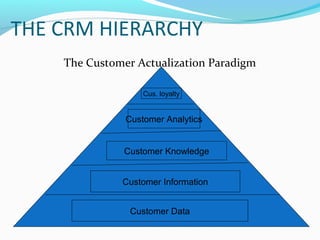
THE CRM HIERARCHY
The Customer Actualization Paradigm
Cus. loyalty

Customer Analytics
Customer Knowledge
Customer Information
Customer Data
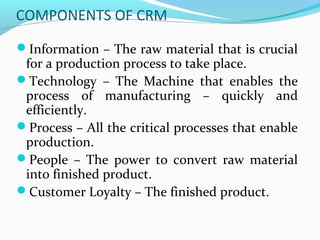
COMPONENTS OF CRM
Information – The raw material that is crucial

for a production process to take place.
Technology – The Machine that enables the
process of manufacturing – quickly and
efficiently.
Process – All the critical processes that enable
production.
People – The power to convert raw material
into finished product.
Customer Loyalty – The finished product.
INFORMATION
Managing information is critical for success of

business
Crucial for forecasting and strategic decision making
Customer information is a tangible asset that is
inventoried and managed
Obtained from various sources – Internal and
External
Scattered and crude, refined with the help of
technology
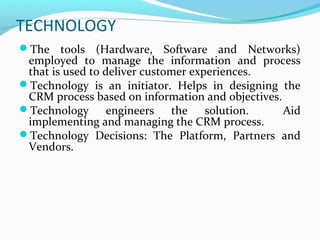
TECHNOLOGY
The tools (Hardware, Software and Networks)

employed to manage the information and process
that is used to deliver customer experiences.
Technology is an initiator. Helps in designing the
CRM process based on information and objectives.
Technology
engineers the solution.
Aid
implementing and managing the CRM process.
Technology Decisions: The Platform, Partners and
Vendors.
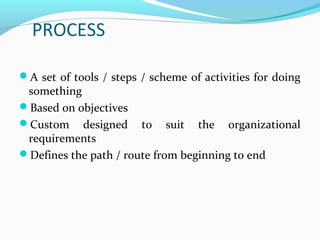
PROCESS
A set of tools / steps / scheme of activities for doing

something
Based on objectives
Custom designed to suit the organizational
requirements
Defines the path / route from beginning to end
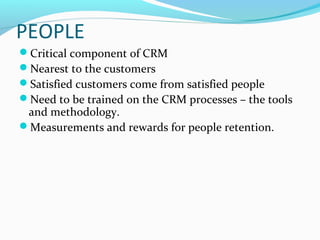
PEOPLE
Critical component of CRM
Nearest to the customers
Satisfied customers come from satisfied people
Need to be trained on the CRM processes – the tools

and methodology.
Measurements and rewards for people retention.
Planning a CRM Project
Basics
After Marketing
Joint Marketing
Frequency Marketing
Interactive Marketing
Individual Marketing
Co-branding

Up Selling
Cross Selling
Affiliate Partnering
Strategic Partnering
Customization
Customerisation
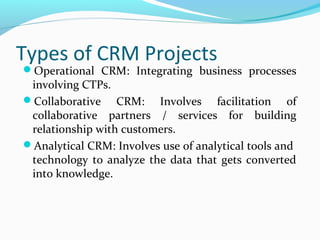
Types of CRM Projects

Operational CRM: Integrating business processes

involving CTPs.
Collaborative CRM: Involves facilitation of
collaborative partners / services for building
relationship with customers.
Analytical CRM: Involves use of analytical tools and
technology to analyze the data that gets converted
into knowledge.
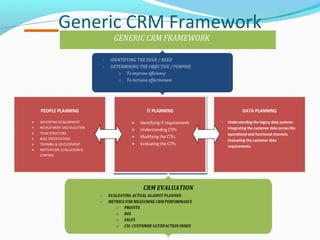
Generic CRM Framework
GENERIC CRM FRAMEWORK

-

IDENTIFYING THE ISSUE / NEED
DETERMINING THE OBJECTIVE / PURPOSE
o To improve efficiency
o To increase effectiveness

PEOPLE PLANNING
•
•
•
•
•
•

IT PLANNING
•
•
•
•

IDENTIFYNG REQUIREMENT
RECRUITMENT AND SELECTION
TEAM STRUCTURE
ROLE SPECIFICATION
TRAINING & DEVELOPMENT
MOTIVATION, EVALUATION &
CONTROL

Identifying IT requirements
Understanding CTPs
Modifying the CTPs
Evaluating the CTPs

CRM EVALUATION
-

EVALUATING ACTUAL AGAINST PLANNED
METRICS FOR MEASURING CRM PERFORMANCE
o PROFITS
o ROI
o SALES
o CSI: CUSTOMER SATISFACTION INDEX

DATA PLANNING
-

Understanding the legacy data systems
Integrating the customer data across the
operational and functional channels
Evaluating the customer data
requirements.
Purpose / Objectives






Improve Marketing Productivity: Increase marketing
efficiency
through
reducing
distribution
costs,
streamlining
order
processing
and
inventory
management, reducing acquisition costs and through
retaining customer; enhance marketing effectiveness
through segmenting, targeting and positioning,
personalizing and customizing, partnering to enter new
markets and develop new products.
Enhance Mutual Benefits: Personalize the offerings,
anticipate and serve the emerging needs of the customers,
Carving a niche and enjoying the advantage of
competitive differentials.
Customer
Loyalty:
Building
relationship,
being
committed, satisfy the expectations, listening to
customers, fine tune service processes, partnering and
building customer loyalty.
Programs – Based on Purpose
Continuity Marketing
B2C Markets: After-marketing in the form of after sales

relationship building efforts; Loyalty Programs in the
form of special treatments given to privileged
customers; and cross selling
B2B Markets: Special sourcing arrangements, preferred
customer programs, JIT arrangements.
Programs – Based on Purpose
One-to-one Marketing / Individual Marketing or

Account based Marketing
B2C

Markets: Permission marketing via direct
marketing methods, and personalization
B2B Markets: Key account Management, Global
account management programs.
Programs – Based on Purpose
Partnering / Co-marketing
B2C Markets: Affinity Partnering for mutual benefits

using endorsement strategies or co-branding, by
creating a new brand to target a new segment.
B2B Markets: Co-designing, strategic partnership and
co-marketing for improved efficiency and mutual
benefits.
CRM Planning - People
Identifying the right employees
Team structure – the number of members in a team

and the number of teams per project needs to be
decided.
Management
by
partnership
or
individual
management also needs to be decided.
Decisions regarding role specification with respect to
who plays what role in CRM management.
Training employees on building effective customer

interactions, handling complaints, motivating
them through right incentives and planning a
provision for all these
Monitoring process performance will safeguard
against failure and give roadmap for further
CRM Planning - IT
Identifying the IT requirements: IT requirements in

the form of software, hardware, network, technology
enable d CTPs
Understanding IT based CTPs like internet, mobile,
telephone etc.
Modifying CTPs for improved performance, by
enabling efficient technology systems
Evaluating the CTPs using metrics
CRM Planning- Data
Understanding the legacy data systems, that are there

within the organisation.
Integrating the data across the functional and
operational channels to get a 360 degree view of the
customers
Evaluating the data to identify the requirements for
CRM.
CRM – Performance Evaluation
Defining metrics for performance evaluation – the

balanced scorecard method.
To evaluate if programs adhere to expectations
To take corrective actions in terms of modifying
existing processes or to develop new processes
Building a relationship model and developing a
performance metric confirming the objectives set.

Crm 1

  • 1.
  • 2.
    MEANING Is a philosophyor theory of the way of doing business by building relationships – Internally and Externally. Relationship with three primary Stakeholders – Shareholders, Employees and Customers. It is about understanding the relationship framework in totality (why, what and how) in order to define the organizational goals and objectives.
  • 3.
    EVOLUTION OF RM 1960s– Direct Mail 1970s – Direct Response Marketing / Advertising Late ’70s – Direct Marketing 1980s – Database Marketing Late ’80s – One-to-one Marketing 1990s – Loyalty Marketing Late ’90s – Relationship Marketing
  • 4.
    CHARACTERISTICS Business Strategy: Involvesall the resources of the organization aimed at enhancing relationship with stakeholders of the company Two-way Relationship: Mutual benefit to all the parties involved Pragmatic: Factual and practical. Relies on information. One-2-one: Customised to suit individuals. No ‘onefits-all’ strategy. Dynamic: Need for details and scope for constant improvement.
  • 5.
    TYPES OF CUSTOMERRELATIONSHIPS Strategic Relationship: An emotional connection between the entities. Understanding the length, depth and width of relationships. A long-term relationship. Ex: FMCG Buying, Bank Accounts. Tactical Relationship: Based on mutual convenience. Committed for a single transaction. A short-term relationship. Starting point for a strategic relationship. Ex: Insurance, Travel and Tourism, Healthcare, One-time Buying.
  • 6.
    FUNDAMENTAL CONCEPTS OFCRM Customer Satisfaction: Delivering products to match / exceed customer expectations. Providing higher value through enhanced benefits. Customer Retention: Activity that retains profitable customers. Mutually beneficial. Loyalty is the ultimate point of retention. Customer Loyalty: Continued buying. An element of emotional attachment. Satisfied customers become loyal over a period of time.
  • 7.
    PLANNING RM STRATEGIES ThePath Identify key areas of relationship (why) Fix realistic objectives (what) Plan the relationship route (how) The Essentials Resources: The Feasibilities Medium: The Channel Communication: The Message
  • 8.
    BASIC RM STRATEGIES AcquisitionStrategies Allocation of Resources STP based on information available Providing need-specific products Effective reach - Media Retention Strategies The Retention Road-map: Suspect – Prospect Buyer – Customer – Loyal Customer – Advocate The Strategies: “Activity – Status – Next Steps” Analysis.
  • 9.
    CRM : ANINTORDUCTION
  • 10.
    DEFINITION CRM is thestrategic use of Information, Processes, Technology and People to manage the customer’s relationship with the company’s various operations, viz., marketing, sales, services and support, across the customer life cycle.
  • 11.
    CRM CONCEPTS Customer LifeCycle (CLC): CLC is the total time that the customer is engaged with the company derived from the customer’s experience and viewpoint. Customer Asset: Customers as company’s assets. Loyal customers earn long-tern revenues. Customer Value: Differentiating valuable customers from the rest. High-value customers generate higher revenues at lesser costs. Customer Touch Points: TPs are the means / media that is used to interact with the customers. TP interactions must be targeted to a specific customer and allow for a response through a conversation / transaction / reply / feedback etc.
  • 12.
    UNDERSTANDING CRM CRM isa total discipline. CRM is a strategic tool. CRM reaps long term benefits. CRM is an enterprise plan. CRM works on a set of processes. CRM links to all operations that touch customers.
  • 13.
    THE CRM HIERARCHY TheCustomer Actualization Paradigm Cus. loyalty Customer Analytics Customer Knowledge Customer Information Customer Data
  • 14.
    COMPONENTS OF CRM Information– The raw material that is crucial for a production process to take place. Technology – The Machine that enables the process of manufacturing – quickly and efficiently. Process – All the critical processes that enable production. People – The power to convert raw material into finished product. Customer Loyalty – The finished product.
  • 15.
    INFORMATION Managing information iscritical for success of business Crucial for forecasting and strategic decision making Customer information is a tangible asset that is inventoried and managed Obtained from various sources – Internal and External Scattered and crude, refined with the help of technology
  • 16.
    TECHNOLOGY The tools (Hardware,Software and Networks) employed to manage the information and process that is used to deliver customer experiences. Technology is an initiator. Helps in designing the CRM process based on information and objectives. Technology engineers the solution. Aid implementing and managing the CRM process. Technology Decisions: The Platform, Partners and Vendors.
  • 17.
    PROCESS A set oftools / steps / scheme of activities for doing something Based on objectives Custom designed to suit the organizational requirements Defines the path / route from beginning to end
  • 18.
    PEOPLE Critical component ofCRM Nearest to the customers Satisfied customers come from satisfied people Need to be trained on the CRM processes – the tools and methodology. Measurements and rewards for people retention.
  • 19.
  • 20.
    Basics After Marketing Joint Marketing FrequencyMarketing Interactive Marketing Individual Marketing Co-branding Up Selling Cross Selling Affiliate Partnering Strategic Partnering Customization Customerisation
  • 21.
    Types of CRMProjects Operational CRM: Integrating business processes involving CTPs. Collaborative CRM: Involves facilitation of collaborative partners / services for building relationship with customers. Analytical CRM: Involves use of analytical tools and technology to analyze the data that gets converted into knowledge.
  • 22.
    Generic CRM Framework GENERICCRM FRAMEWORK - IDENTIFYING THE ISSUE / NEED DETERMINING THE OBJECTIVE / PURPOSE o To improve efficiency o To increase effectiveness PEOPLE PLANNING • • • • • • IT PLANNING • • • • IDENTIFYNG REQUIREMENT RECRUITMENT AND SELECTION TEAM STRUCTURE ROLE SPECIFICATION TRAINING & DEVELOPMENT MOTIVATION, EVALUATION & CONTROL Identifying IT requirements Understanding CTPs Modifying the CTPs Evaluating the CTPs CRM EVALUATION - EVALUATING ACTUAL AGAINST PLANNED METRICS FOR MEASURING CRM PERFORMANCE o PROFITS o ROI o SALES o CSI: CUSTOMER SATISFACTION INDEX DATA PLANNING - Understanding the legacy data systems Integrating the customer data across the operational and functional channels Evaluating the customer data requirements.
  • 23.
    Purpose / Objectives    ImproveMarketing Productivity: Increase marketing efficiency through reducing distribution costs, streamlining order processing and inventory management, reducing acquisition costs and through retaining customer; enhance marketing effectiveness through segmenting, targeting and positioning, personalizing and customizing, partnering to enter new markets and develop new products. Enhance Mutual Benefits: Personalize the offerings, anticipate and serve the emerging needs of the customers, Carving a niche and enjoying the advantage of competitive differentials. Customer Loyalty: Building relationship, being committed, satisfy the expectations, listening to customers, fine tune service processes, partnering and building customer loyalty.
  • 24.
    Programs – Basedon Purpose Continuity Marketing B2C Markets: After-marketing in the form of after sales relationship building efforts; Loyalty Programs in the form of special treatments given to privileged customers; and cross selling B2B Markets: Special sourcing arrangements, preferred customer programs, JIT arrangements.
  • 25.
    Programs – Basedon Purpose One-to-one Marketing / Individual Marketing or Account based Marketing B2C Markets: Permission marketing via direct marketing methods, and personalization B2B Markets: Key account Management, Global account management programs.
  • 26.
    Programs – Basedon Purpose Partnering / Co-marketing B2C Markets: Affinity Partnering for mutual benefits using endorsement strategies or co-branding, by creating a new brand to target a new segment. B2B Markets: Co-designing, strategic partnership and co-marketing for improved efficiency and mutual benefits.
  • 27.
    CRM Planning -People Identifying the right employees Team structure – the number of members in a team and the number of teams per project needs to be decided. Management by partnership or individual management also needs to be decided. Decisions regarding role specification with respect to who plays what role in CRM management. Training employees on building effective customer interactions, handling complaints, motivating them through right incentives and planning a provision for all these Monitoring process performance will safeguard against failure and give roadmap for further
  • 28.
    CRM Planning -IT Identifying the IT requirements: IT requirements in the form of software, hardware, network, technology enable d CTPs Understanding IT based CTPs like internet, mobile, telephone etc. Modifying CTPs for improved performance, by enabling efficient technology systems Evaluating the CTPs using metrics
  • 29.
    CRM Planning- Data Understandingthe legacy data systems, that are there within the organisation. Integrating the data across the functional and operational channels to get a 360 degree view of the customers Evaluating the data to identify the requirements for CRM.
  • 30.
    CRM – PerformanceEvaluation Defining metrics for performance evaluation – the balanced scorecard method. To evaluate if programs adhere to expectations To take corrective actions in terms of modifying existing processes or to develop new processes Building a relationship model and developing a performance metric confirming the objectives set.