Securities
&
Exchange
Board of
India,
ACT 1992
Chaired by:
C B Bhave
GROUP MEMBERS
NAME ROLL NO
ONKAR BIRJE 05
VINAYAK HALAPETI 13
PRITEE PINGALE 38
SAIPARESH WALAWALKAR 52
SOMESH ZUJAM 54
Contents
 Introduction
 Board
 Objectives
 Powers of SEBI
 Functions
 Role of SEBI
 SEBI guidelines
 Departments under SEBI
 SMAC
 Current plans
 Amendment bill
 Major Challenges faced by SEBI
INTRODUTION
The Securities and Exchange Board of India was
established by the Government of India on 12th April
1988 as an interim administration body to promote
orderly and healthy growth of the securities market and
for investor protection.
It was functioned under the overall administrative
control of the Ministry of Finance of the GOI.
The SEBI was given the statutory powers on 30th Jan
1992 through an Ordinance.
The Ordinance was later replaced by an Act of
Parliament known as the Securities and Exchange Board
of India Act 1992.
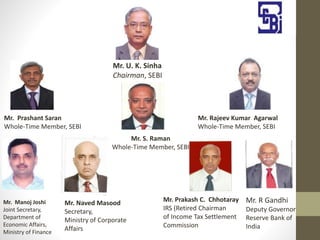
The Board
Mr. U. K. Sinha
Chairman, SEBI
Mr. Rajeev Kumar Agarwal
Whole-Time Member, SEBI
Mr. Prashant Saran
Whole-Time Member, SEBI
Mr. Manoj Joshi
Joint Secretary,
Department of
Economic Affairs,
Ministry of Finance
Mr. Naved Masood
Secretary,
Ministry of Corporate
Affairs
Mr. Prakash C. Chhotaray
IRS (Retired Chairman
of Income Tax Settlement
Commission
Mr. R Gandhi
Deputy Governor
Reserve Bank of
India
Mr. S. Raman
Whole-Time Member, SEBI
OBJECTIVES
The primary objective of SEBI is to promote healthy and
orderly growth -of the securities market and secure
investor protection. The objectives of SEBI are as follows:
Regulation of Stock Exchange:
 Protection to the Investors
 Checking the insider Trading
Control over Brokers
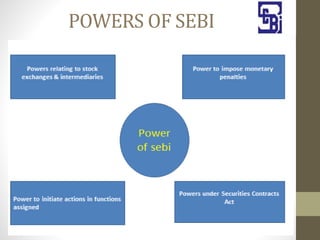
POWERS OF SEBI
FUNCTIONS
Section 11 of the SEBI Act , there are mainly two types of
functions. They are;
1.Regulatory Functions
2.Developmental Functions
1. Regulatory Functions
o Regulating stock exchanges and any other securities
markets.
o Registering and regulating intermediaries
o Promoting and regulating self-regulatory organizations
o Prohibiting insider trading
o Regulating substantial acquisition of share and take over
of companies.
o Levying fees or other charges for carrying out the
purpose of this section.
2. Developmental Functions
• Promoting investor’s education
• Training of intermediaries
• Conducting research and publishing information useful to
all market participants.
• Promotion of fair practices
• Promotion of self regulatory organizations
ROLE OF SEBI
To make rules and regulation
To educate brokers and investors
To encourage investor
Safeguard the investors interest
Development of stock and share markets
To stop all fraud and malpractices
Provide license to brokers
SEBI Guidelines
• SEBI has brought out a number of guidelines separately,
from time to time, for primary market, secondary
market, mutual funds, merchant bankers, foreign
institutional investors, investor protection etc.
• 1. Guidelines for Primary Market.
(a). New Company
(b). New Company set-up by Existing Companies
(c). Private and closely held companies
(d). Existing Listed companies
• 2. Guidelines for Secondary Market:
Stock Exchange
Brokers
• 3.Foreign Institutional Investors(FII)
Allowed to invest
Restriction on the volume
• 4.Guidelines to issue of Bonus Shares
Provision in the Articles of Association
The bonus is made out of free reserves
No bonus issue can be made within 12 months of any
public issue/rights issue.
5. Guidelines for Companies Act
• Free pricing of issues.
• Underwriting made mandatory.
• Issue of shares at par.
6. Investor protection
• New issues
• Investor education
• Stock invest
VARIOUS DEPARTMENTS
UNDER SEBI
The Primary Market.
The Issue Management and Intermediaries Department.
The Secondary Market.
Institutional Investment Department (MF and FII),
Mergers and Acquisition.
Legal Department (all legal matters).
SECURITIES MARKET
AWARENESS CAMPAIGN (SMAC)
1. Workshops
2. Advertisements
3. Educative Material
4. Website dedicated to investors Education
5. All India Radio
6. Cautionary Message on Television
RELATION WITH THE CENTRAL
GOVERNMENT
The activities of SEBI are financed by grants from Central
Government, in addition to fees, charges etc. collected
by SEBI.
The fund called SEBI General Fund is set up, to which, all
fees, charges and grants are credited.
This fund is used to meet the expenses of the Board and
to pay salary of staff and members of the body
Current Plans of SEBI
To impose restrictions on willful defaulters
overhaul of private investment fund regulation
To reduce listing time period for firms
Risk profiling of listed firms intermediaries
To introduce mutual fund retirement plans with tax
benefits
AMENDMENT BILL
SEBI AMENDMENT BILL, 2013:-
Passed by the Rajya Sabha on 5th September 2013.
Widen the area for eligible candidates for the post of
Presiding Officer at the Securities Appellate Tribunal (SAT).
The Bill extends eligibility criteria for SAT Presiding Officer’s
role & includes sitting or retired Judges of a High Court with a
minimum service of 7 years.
Major Challenges faced by SEBI
Cross Border Trading
Issuers & Investors are expanding their horizons beyond
their home markets
Investors becoming much more demanding
Penetration of mutual fund in India
• REGIONAL OFFICES
1. New Delhi
2. Kolkata
3. Chennai
4. Ahmadabad
• LOCAL OFFICES
1. Jaipur
2. Bangalore
3. Guwahati
4. Bhubaneswar
5. Patna
6. Kochi
7. Chandigarh
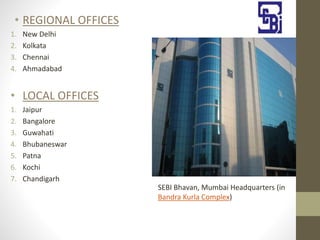
SEBI Bhavan, Mumbai Headquarters (in
Bandra Kurla Complex)
REFERANCES
• www.wikipedia.org
• www.sebi.gov.in
• Regulation of Securities Markets Book – Abdul Kadir Khan
SEBI ACT 1992

SEBI ACT 1992

  • 1.
  • 2.
    GROUP MEMBERS NAME ROLLNO ONKAR BIRJE 05 VINAYAK HALAPETI 13 PRITEE PINGALE 38 SAIPARESH WALAWALKAR 52 SOMESH ZUJAM 54
  • 3.
    Contents  Introduction  Board Objectives  Powers of SEBI  Functions  Role of SEBI  SEBI guidelines  Departments under SEBI  SMAC  Current plans  Amendment bill  Major Challenges faced by SEBI
  • 4.
    INTRODUTION The Securities andExchange Board of India was established by the Government of India on 12th April 1988 as an interim administration body to promote orderly and healthy growth of the securities market and for investor protection. It was functioned under the overall administrative control of the Ministry of Finance of the GOI. The SEBI was given the statutory powers on 30th Jan 1992 through an Ordinance. The Ordinance was later replaced by an Act of Parliament known as the Securities and Exchange Board of India Act 1992.
  • 5.
  • 6.
    Mr. U. K.Sinha Chairman, SEBI Mr. Rajeev Kumar Agarwal Whole-Time Member, SEBI Mr. Prashant Saran Whole-Time Member, SEBI Mr. Manoj Joshi Joint Secretary, Department of Economic Affairs, Ministry of Finance Mr. Naved Masood Secretary, Ministry of Corporate Affairs Mr. Prakash C. Chhotaray IRS (Retired Chairman of Income Tax Settlement Commission Mr. R Gandhi Deputy Governor Reserve Bank of India Mr. S. Raman Whole-Time Member, SEBI
  • 7.
    OBJECTIVES The primary objectiveof SEBI is to promote healthy and orderly growth -of the securities market and secure investor protection. The objectives of SEBI are as follows: Regulation of Stock Exchange:  Protection to the Investors  Checking the insider Trading Control over Brokers
  • 8.
  • 9.
    FUNCTIONS Section 11 ofthe SEBI Act , there are mainly two types of functions. They are; 1.Regulatory Functions 2.Developmental Functions
  • 10.
    1. Regulatory Functions oRegulating stock exchanges and any other securities markets. o Registering and regulating intermediaries o Promoting and regulating self-regulatory organizations o Prohibiting insider trading o Regulating substantial acquisition of share and take over of companies. o Levying fees or other charges for carrying out the purpose of this section.
  • 11.
    2. Developmental Functions •Promoting investor’s education • Training of intermediaries • Conducting research and publishing information useful to all market participants. • Promotion of fair practices • Promotion of self regulatory organizations
  • 12.
    ROLE OF SEBI Tomake rules and regulation To educate brokers and investors To encourage investor Safeguard the investors interest Development of stock and share markets To stop all fraud and malpractices Provide license to brokers
  • 13.
    SEBI Guidelines • SEBIhas brought out a number of guidelines separately, from time to time, for primary market, secondary market, mutual funds, merchant bankers, foreign institutional investors, investor protection etc. • 1. Guidelines for Primary Market. (a). New Company (b). New Company set-up by Existing Companies (c). Private and closely held companies (d). Existing Listed companies
  • 14.
    • 2. Guidelinesfor Secondary Market: Stock Exchange Brokers • 3.Foreign Institutional Investors(FII) Allowed to invest Restriction on the volume
  • 15.
    • 4.Guidelines toissue of Bonus Shares Provision in the Articles of Association The bonus is made out of free reserves No bonus issue can be made within 12 months of any public issue/rights issue. 5. Guidelines for Companies Act • Free pricing of issues. • Underwriting made mandatory. • Issue of shares at par.
  • 16.
    6. Investor protection •New issues • Investor education • Stock invest
  • 17.
    VARIOUS DEPARTMENTS UNDER SEBI ThePrimary Market. The Issue Management and Intermediaries Department. The Secondary Market. Institutional Investment Department (MF and FII), Mergers and Acquisition. Legal Department (all legal matters).
  • 18.
    SECURITIES MARKET AWARENESS CAMPAIGN(SMAC) 1. Workshops 2. Advertisements 3. Educative Material 4. Website dedicated to investors Education 5. All India Radio 6. Cautionary Message on Television
  • 19.
    RELATION WITH THECENTRAL GOVERNMENT The activities of SEBI are financed by grants from Central Government, in addition to fees, charges etc. collected by SEBI. The fund called SEBI General Fund is set up, to which, all fees, charges and grants are credited. This fund is used to meet the expenses of the Board and to pay salary of staff and members of the body
  • 20.
    Current Plans ofSEBI To impose restrictions on willful defaulters overhaul of private investment fund regulation To reduce listing time period for firms Risk profiling of listed firms intermediaries To introduce mutual fund retirement plans with tax benefits
  • 21.
    AMENDMENT BILL SEBI AMENDMENTBILL, 2013:- Passed by the Rajya Sabha on 5th September 2013. Widen the area for eligible candidates for the post of Presiding Officer at the Securities Appellate Tribunal (SAT). The Bill extends eligibility criteria for SAT Presiding Officer’s role & includes sitting or retired Judges of a High Court with a minimum service of 7 years.
  • 22.
    Major Challenges facedby SEBI Cross Border Trading Issuers & Investors are expanding their horizons beyond their home markets Investors becoming much more demanding Penetration of mutual fund in India
  • 23.
    • REGIONAL OFFICES 1.New Delhi 2. Kolkata 3. Chennai 4. Ahmadabad • LOCAL OFFICES 1. Jaipur 2. Bangalore 3. Guwahati 4. Bhubaneswar 5. Patna 6. Kochi 7. Chandigarh SEBI Bhavan, Mumbai Headquarters (in Bandra Kurla Complex)
  • 24.
    REFERANCES • www.wikipedia.org • www.sebi.gov.in •Regulation of Securities Markets Book – Abdul Kadir Khan