Securing Microservices in Hybrid Cloud
By Komes Subramaniam, Senthil Velusamy
T-Mobile USA
Unless otherwise indicated, these slides are © 2013 -2018 Pivotal Software, Inc. and licensed under a Creative Commons
Attribution-NonCommercial license: http://creativecommons.org/licenses/by -nc/3.0/
About us
Komes Subramaniam, Sr. Manager, Digital Services Group
• 18+ years of IT experience
• Responsible for Digital Transformation Architecture, API Products
and Platform Management
• Member of OSS working group @ T-Mobile
• Passion for running and biking
2
Senthil Velusamy, Sr. Member of Technical Staff, Digital Customer Experience
• 18+ years of product and technology experience
• Responsible for strategy, technical and service architecture for Mobile
Apps Ecosystem
• Head of Mobile Center of Excellence, Wi-Fi Alliance board for T-Mobile
• Passion for running and cooking
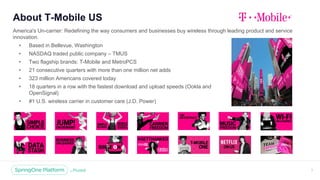
About T-Mobile US
America's Un-carrier: Redefining the way consumers and businesses buy wireless through leading product and service
innovation.
• Based in Bellevue, Washington
• NASDAQ traded public company – TMUS
• Two flagship brands: T-Mobile and MetroPCS
• 21 consecutive quarters with more than one million net adds
• 323 million Americans covered today
• 18 quarters in a row with the fastest download and upload speeds (Ookla and
OpenSignal)
• #1 U.S. wireless carrier in customer care (J.D. Power)
3
About T-Mobile US (cont..)
4
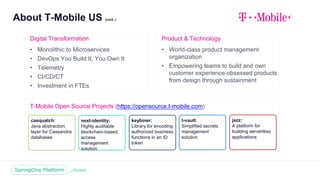
T-Mobile Open Source Projects (https://opensource.t-mobile.com)
Digital Transformation
• Monolithic to Microservices
• DevOps You Build It, You Own It
• Telemetry
• CI/CD/CT
• Investment in FTEs
Product & Technology
• World-class product management
organization
• Empowering teams to build and own
customer experience-obsessed products
from design through sustainment
casquatch:
Java abstraction
layer for Cassandra
databases
next-identity:
Highly auditable
blockchain-based,
access
management
solution
keybiner:
Library for encoding
authorized business
functions in an ID
token
t-vault:
Simplified secrets
management
solution
jazz:
A platform for
building serverless
applications
Unless otherwise indicated, these slides are © 2013 -2018 Pivotal Software, Inc. and licensed under a Creative Commons
Attribution-NonCommercial license: http://creativecommons.org/licenses/by -nc/3.0/
Traditional API /Service Security
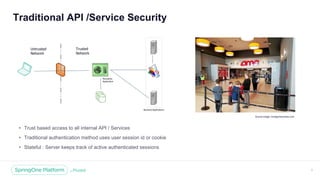
• Trust based access to all internal API / Services
• Traditional authentication method uses user session id or cookie
• Stateful : Server keeps track of active authenticated sessions
5
Source image: montgomerynews.com
Unless otherwise indicated, these slides are © 2013 -2018 Pivotal Software, Inc. and licensed under a Creative Commons
Attribution-NonCommercial license: http://creativecommons.org/licenses/by -nc/3.0/
Securing Microservices
6
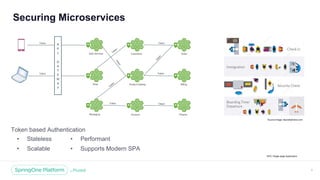
Token based Authentication
• Stateless
• Scalable
SPA: Single page Application
• Performant
• Supports Modern SPA
Source image: depositphotos.com
Unless otherwise indicated, these slides are © 2013 -2018 Pivotal Software, Inc. and licensed under a Creative Commons
Attribution-NonCommercial license: http://creativecommons.org/licenses/by -nc/3.0/
JWT, ODIC
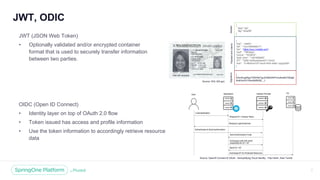
JWT (JSON Web Token)
• Optionally validated and/or encrypted container
format that is used to securely transfer information
between two parties.
7
{
“type”:”jwt”,
“alg”:”sha256”
}
{
"exp" : “xx600",
"iat" : "1xxx1699266017",
"iss" : "https://xxx.t-mobile.com",
"aud" : “TMOApp",
"nonce" : "NONCE",
"auth_time" : "1481699265",
“AT" : "3285.4326xyabbss521112m4",
"sub" : "U-9645rra1cf7-0xxxf-450c-bdbe-1yyyyy926“
}
PayloadandclaimsHeader
Source: OpenID Connect & OAuth - Demystifying Cloud Identity - Filip Hanik, Sree Tumidi
{
bGmI4ujxjRgc7OKKNATgvXGMADfnFmrwfwxBoTM2g8
8ndi3mGU1i6xo2jr6NQE_..}
Signature
OIDC (Open ID Connect)
• Identity layer on top of OAuth 2.0 flow
• Token issued has access and profile information
• Use the token information to accordingly retrieve resource
data
Source: DOL.WA.gov
Unless otherwise indicated, these slides are © 2013 -2018 Pivotal Software, Inc. and licensed under a Creative Commons
Attribution-NonCommercial license: http://creativecommons.org/licenses/by -nc/3.0/
T-Mobile API Access Process (TAAP)
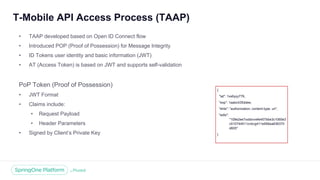
• TAAP developed based on Open ID Connect flow
• Introduced POP (Proof of Possession) for Message Integrity
• ID Tokens user identity and basic information (JWT)
• AT (Access Token) is based on JWT and supports self-validation
PoP Token (Proof of Possession)
• JWT Format
• Claims include:
• Request Payload
• Header Parameters
• Signed by Client’s Private Key
{
"iat": 1xx6yyy776,
"exp": 1aabc435ddee,
"ehts": "authorization; content-type, uri",
"edts":
"109e2ee7xxbbvvefe457bbe3c1065e3
c510744511cnbvg411e956ea836370
d605"
}
Unless otherwise indicated, these slides are © 2013 -2018 Pivotal Software, Inc. and licensed under a Creative Commons
Attribution-NonCommercial license: http://creativecommons.org/licenses/by -nc/3.0/
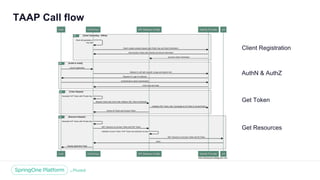
TAAP Call flow
Client Registration
AuthN & AuthZ
Get Token
Get Resources
Unless otherwise indicated, these slides are © 2013 -2018 Pivotal Software, Inc. and licensed under a Creative Commons
Attribution-NonCommercial license: http://creativecommons.org/licenses/by -nc/3.0/
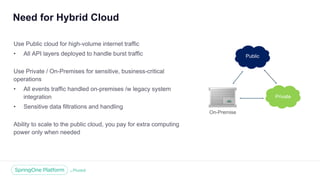
Use Public cloud for high-volume internet traffic
• All API layers deployed to handle burst traffic
Use Private / On-Premises for sensitive, business-critical
operations
• All events traffic handled on-premises /w legacy system
integration
• Sensitive data filtrations and handling
Ability to scale to the public cloud, you pay for extra computing
power only when needed
Need for Hybrid Cloud
Public
Private
On-Premise
Unless otherwise indicated, these slides are © 2013 -2018 Pivotal Software, Inc. and licensed under a Creative Commons
Attribution-NonCommercial license: http://creativecommons.org/licenses/by -nc/3.0/
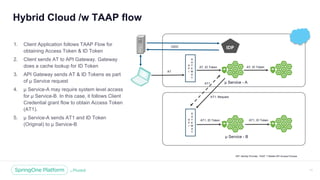
Hybrid Cloud /w TAAP flow
11
IDP: Identity Provider, TAAP: T-Mobile API Access Process
A
P
I
G
A
T
E
W
A
Y
IDPOIDC
AT, ID Token
AT
AT1 µ Service - A
1. Client Application follows TAAP Flow for
obtaining Access Token & ID Token
2. Client sends AT to API Gateway. Gateway
does a cache lookup for ID Token
3. API Gateway sends AT & ID Tokens as part
of µ Service request
4. µ Service-A may require system level access
for µ Service-B. In this case, it follows Client
Credential grant flow to obtain Access Token
(AT1).
5. µ Service-A sends AT1 and ID Token
(Original) to µ Service-B
AT, ID Token
A
P
I
G
A
T
E
W
A
Y
AT1, ID Token
µ Service - B
AT1, ID Token
AT1, Request
T-Mobile App : Evolution to TAAP for Secure API Access in
Hybrid Cloud
• T-Mobile App Overview
• Using Opaque Token and its challenges
• Evolution to TAAP based Token and its benefits
Unless otherwise indicated, these slides are © 2013 -2018 Pivotal Software, Inc. and licensed under a Creative Commons
Attribution-NonCommercial license: http://creativecommons.org/licenses/by -nc/3.0/
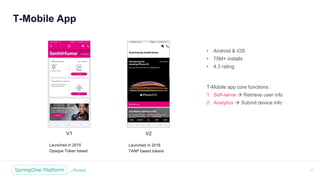
T-Mobile App
13
• Android & iOS
• 75M+ installs
• 4.3 rating
V1
Launched in 2015
Opaque Token based
V2
Launched in 2018
TAAP based tokens
T-Mobile app core functions :
1. Self-serve  Retrieve user info
2. Analytics  Submit device info
Unless otherwise indicated, these slides are © 2013 -2018 Pivotal Software, Inc. and licensed under a Creative Commons
Attribution-NonCommercial license: http://creativecommons.org/licenses/by -nc/3.0/
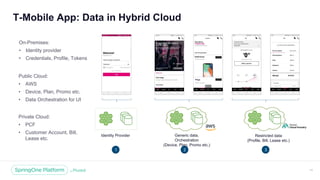
T-Mobile App: Data in Hybrid Cloud
14
On-Premises:
• Identity provider
• Credentials, Profile, Tokens
Public Cloud:
• AWS
• Device, Plan, Promo etc.
• Data Orchestration for UI
Private Cloud:
• PCF
• Customer Account, Bill,
Lease etc.
(425)-xxx-yyyy
Priya
(425)-xyz-yyyy
Identity Provider Generic data,
Orchestration
(Device, Plan, Promo etc.)
Restricted data
(Profile, Bill, Lease etc.)
1 2 3
Unless otherwise indicated, these slides are © 2013 -2018 Pivotal Software, Inc. and licensed under a Creative Commons
Attribution-NonCommercial license: http://creativecommons.org/licenses/by -nc/3.0/
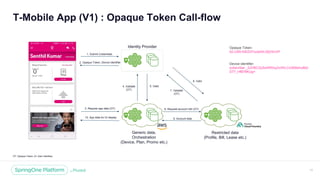
T-Mobile App (V1) : Opaque Token Call-flow
15
OT: Opaque Token, UI: User Interface
Generic data,
Orchestration
(Device, Plan, Promo etc.)
Restricted data
(Profile, Bill, Lease etc.)
Identity Provider Opaque Token:
02.USR.KtDZXYxzleIDLWjOSvVP
Device identifier:
subscriber._0JOBCZpSwWWxyZxXKLCs3t56shu8bd
D77_HfB76KUg=
1. Submit Credentials
2. Opaque Token, Device Identifier
3. Request app data (OT)
10. App data for UI display
4. Validate
(OT)
5. Valid
7. Validate
(OT)
8. Valid
6. Request account info (OT)
9. Account data
Unless otherwise indicated, these slides are © 2013 -2018 Pivotal Software, Inc. and licensed under a Creative Commons
Attribution-NonCommercial license: http://creativecommons.org/licenses/by -nc/3.0/
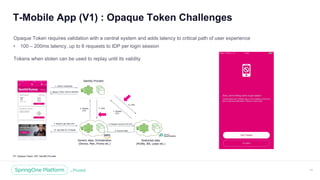
T-Mobile App (V1) : Opaque Token Challenges
16
Opaque Token requires validation with a central system and adds latency to critical path of user experience
• 100 – 200ms latency, up to 6 requests to IDP per login session
Tokens when stolen can be used to replay until its validity
OT: Opaque Token, IDP: Identify Provider
Unless otherwise indicated, these slides are © 2013 -2018 Pivotal Software, Inc. and licensed under a Creative Commons
Attribution-NonCommercial license: http://creativecommons.org/licenses/by -nc/3.0/
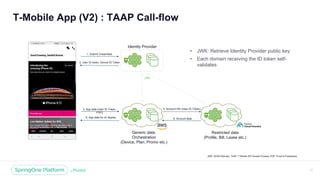
T-Mobile App (V2) : TAAP Call-flow
17
JWK: JSON Web key, TAAP: T-Mobile API Access Process, POP: Proof of Possession
Generic data,
Orchestration
(Device, Plan, Promo etc.)
Restricted data
(Profile, Bill, Lease etc.)
Identity Provider
1. Submit Credentials
2. User ID token, Device ID Token
3. App data (User ID Token,
POP)
6. App data for UI display
4. Account info (User ID Token)
5. Account data
JWK
• JWK: Retrieve Identity Provider public key
• Each domain receiving the ID token self-
validates
Unless otherwise indicated, these slides are © 2013 -2018 Pivotal Software, Inc. and licensed under a Creative Commons
Attribution-NonCommercial license: http://creativecommons.org/licenses/by -nc/3.0/
T-Mobile App (V2) : TAAP Tokens
18
{
"iss": "https://xxxxx.t-mobile.com",
"network": {
id: “35679xxx0011980”
phone: “425xxxyyy”},
"device": {
"cnf": "-----BEGIN PUBLIC KEY-----
nMIIBIjANBgkqhkiG9w0BAQE
FAAOCAQ8AMIIBCgKCAQEA5
oaIEnqExSKXK/J7mvgx...........
n-----END PUBLIC KEY-----"
},
"exp": 1aabc435ddee,
"aud": “TMOApp",
"iat": 1xx6yyy776
}
Device ID Token User ID Token Proof Of Possession (POP)
{
"iat": 1xx6yyy776,
"exp": 1aabc435ddee,
"iss": "https://xxxxx.t-mobile.com",
"aud": "TMOApp",
"auth_time": 1536870785,
"sub": "U-xxxxx-yyyyyy-zzzzzzzz",
"amr": [ "password“ ],
"cnf": "-----BEGIN PUBLIC KEY-----
nMIIBIjANBgkqhkiG9w0BAQE
FAAOCAQ8AMIIBCgKCAQEA5
oaIEnqExSKXK/J7mvgx...........
.........n-----END PUBLIC KEY--
---",
"usn": “abcabcabcabcabc",
"ent": {
"acct": [
{
"r": “XX",
"tst": “YY",
"line_count": 5,
"lines": [
{
"phnum": “1234567890",
"r": “Z"
}
]
{
"iat": 1xx6yyy776,
"exp": 1aabc435ddee,
"ehts": "a11ept;x-tmo-device-os;x-
txx-yym;x-b3-paxxyyyzznid;x-
aao-clixxt-name;x-tmo-model;x-
nno-cvcnt-version;x-dat;x-tmo-
xnbvce-os-
version;authorization;x-tmo-
oem-id;x-b3-spanid;x-tmo-post-
sequence-number;x-b3-
traceid;content-length;content-
type",
"edts":
"109e2ee7xxbbvvefe457bbe3c
1065e3c510744511cnbvg411e
956ea836370d605"
}
Unless otherwise indicated, these slides are © 2013 -2018 Pivotal Software, Inc. and licensed under a Creative Commons
Attribution-NonCommercial license: http://creativecommons.org/licenses/by -nc/3.0/
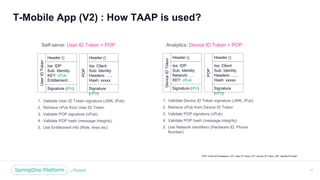
T-Mobile App (V2) : How TAAP is used?
19
POP: Proof of Possession, UIT: User ID Token, DIT: Device ID Token, IDP: Identity Provider
Header ()
Iss: IDP
Sub: Identity
KEY: cPub
Entitlement:…
Signature (iPri)
UserIDToken
Header ()
Iss: Client
Sub: Identity
Headers: …..
Hash: xxxxx
Signature
(cPri)
POP
Self-serve: User ID Token + POP
1. Validate User ID Token signature (JWK, iPub)
2. Retrieve cPub from User ID Token
3. Validate POP signature (cPub)
4. Validate POP hash (message integrity)
5. Use Entitlement info (Role, lines etc)
Header ()
Iss: IDP
Sub: Identity
Network: …
KEY: cPub
Signature (iPri)
DeviceIDToken
Header ()
Iss: Client
Sub: Identity
Headers: …..
Hash: xxxxx
Signature
(cPri)
POP
Analytics: Device ID Token + POP
1. Validate Device ID Token signature (JWK, iPub)
2. Retrieve cPub from Device ID Token
3. Validate POP signature (cPub)
4. Validate POP hash (message integrity)
5. Use Network identifiers (Hardware ID, Phone
Number)
Unless otherwise indicated, these slides are © 2013 -2018 Pivotal Software, Inc. and licensed under a Creative Commons
Attribution-NonCommercial license: http://creativecommons.org/licenses/by -nc/3.0/
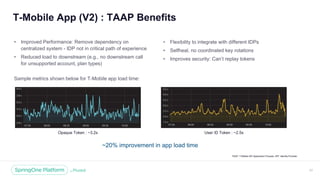
T-Mobile App (V2) : TAAP Benefits
20
TAAP: T-Mobile API Application Process, IDP: Identity Provider
• Improved Performance: Remove dependency on
centralized system - IDP not in critical path of experience
• Reduced load to downstream (e.g., no downstream call
for unsupported account, plan types)
Sample metrics shown below for T-Mobile app load time:
Opaque Token : ~3.2s User ID Token : ~2.5s
~20% improvement in app load time
• Flexibility to integrate with different IDPs
• Selfheal, no coordinated key rotations
• Improves security: Can’t replay tokens
> Stay Connected.
#springone@s1p
@komethagan, @mvsenthil

Securing Microservices in Hybrid Cloud

  • 1.
    Securing Microservices inHybrid Cloud By Komes Subramaniam, Senthil Velusamy T-Mobile USA
  • 2.
    Unless otherwise indicated,these slides are © 2013 -2018 Pivotal Software, Inc. and licensed under a Creative Commons Attribution-NonCommercial license: http://creativecommons.org/licenses/by -nc/3.0/ About us Komes Subramaniam, Sr. Manager, Digital Services Group • 18+ years of IT experience • Responsible for Digital Transformation Architecture, API Products and Platform Management • Member of OSS working group @ T-Mobile • Passion for running and biking 2 Senthil Velusamy, Sr. Member of Technical Staff, Digital Customer Experience • 18+ years of product and technology experience • Responsible for strategy, technical and service architecture for Mobile Apps Ecosystem • Head of Mobile Center of Excellence, Wi-Fi Alliance board for T-Mobile • Passion for running and cooking
  • 3.
    About T-Mobile US America'sUn-carrier: Redefining the way consumers and businesses buy wireless through leading product and service innovation. • Based in Bellevue, Washington • NASDAQ traded public company – TMUS • Two flagship brands: T-Mobile and MetroPCS • 21 consecutive quarters with more than one million net adds • 323 million Americans covered today • 18 quarters in a row with the fastest download and upload speeds (Ookla and OpenSignal) • #1 U.S. wireless carrier in customer care (J.D. Power) 3
  • 4.
    About T-Mobile US(cont..) 4 T-Mobile Open Source Projects (https://opensource.t-mobile.com) Digital Transformation • Monolithic to Microservices • DevOps You Build It, You Own It • Telemetry • CI/CD/CT • Investment in FTEs Product & Technology • World-class product management organization • Empowering teams to build and own customer experience-obsessed products from design through sustainment casquatch: Java abstraction layer for Cassandra databases next-identity: Highly auditable blockchain-based, access management solution keybiner: Library for encoding authorized business functions in an ID token t-vault: Simplified secrets management solution jazz: A platform for building serverless applications
  • 5.
    Unless otherwise indicated,these slides are © 2013 -2018 Pivotal Software, Inc. and licensed under a Creative Commons Attribution-NonCommercial license: http://creativecommons.org/licenses/by -nc/3.0/ Traditional API /Service Security • Trust based access to all internal API / Services • Traditional authentication method uses user session id or cookie • Stateful : Server keeps track of active authenticated sessions 5 Source image: montgomerynews.com
  • 6.
    Unless otherwise indicated,these slides are © 2013 -2018 Pivotal Software, Inc. and licensed under a Creative Commons Attribution-NonCommercial license: http://creativecommons.org/licenses/by -nc/3.0/ Securing Microservices 6 Token based Authentication • Stateless • Scalable SPA: Single page Application • Performant • Supports Modern SPA Source image: depositphotos.com
  • 7.
    Unless otherwise indicated,these slides are © 2013 -2018 Pivotal Software, Inc. and licensed under a Creative Commons Attribution-NonCommercial license: http://creativecommons.org/licenses/by -nc/3.0/ JWT, ODIC JWT (JSON Web Token) • Optionally validated and/or encrypted container format that is used to securely transfer information between two parties. 7 { “type”:”jwt”, “alg”:”sha256” } { "exp" : “xx600", "iat" : "1xxx1699266017", "iss" : "https://xxx.t-mobile.com", "aud" : “TMOApp", "nonce" : "NONCE", "auth_time" : "1481699265", “AT" : "3285.4326xyabbss521112m4", "sub" : "U-9645rra1cf7-0xxxf-450c-bdbe-1yyyyy926“ } PayloadandclaimsHeader Source: OpenID Connect & OAuth - Demystifying Cloud Identity - Filip Hanik, Sree Tumidi { bGmI4ujxjRgc7OKKNATgvXGMADfnFmrwfwxBoTM2g8 8ndi3mGU1i6xo2jr6NQE_..} Signature OIDC (Open ID Connect) • Identity layer on top of OAuth 2.0 flow • Token issued has access and profile information • Use the token information to accordingly retrieve resource data Source: DOL.WA.gov
  • 8.
    Unless otherwise indicated,these slides are © 2013 -2018 Pivotal Software, Inc. and licensed under a Creative Commons Attribution-NonCommercial license: http://creativecommons.org/licenses/by -nc/3.0/ T-Mobile API Access Process (TAAP) • TAAP developed based on Open ID Connect flow • Introduced POP (Proof of Possession) for Message Integrity • ID Tokens user identity and basic information (JWT) • AT (Access Token) is based on JWT and supports self-validation PoP Token (Proof of Possession) • JWT Format • Claims include: • Request Payload • Header Parameters • Signed by Client’s Private Key { "iat": 1xx6yyy776, "exp": 1aabc435ddee, "ehts": "authorization; content-type, uri", "edts": "109e2ee7xxbbvvefe457bbe3c1065e3 c510744511cnbvg411e956ea836370 d605" }
  • 9.
    Unless otherwise indicated,these slides are © 2013 -2018 Pivotal Software, Inc. and licensed under a Creative Commons Attribution-NonCommercial license: http://creativecommons.org/licenses/by -nc/3.0/ TAAP Call flow Client Registration AuthN & AuthZ Get Token Get Resources
  • 10.
    Unless otherwise indicated,these slides are © 2013 -2018 Pivotal Software, Inc. and licensed under a Creative Commons Attribution-NonCommercial license: http://creativecommons.org/licenses/by -nc/3.0/ Use Public cloud for high-volume internet traffic • All API layers deployed to handle burst traffic Use Private / On-Premises for sensitive, business-critical operations • All events traffic handled on-premises /w legacy system integration • Sensitive data filtrations and handling Ability to scale to the public cloud, you pay for extra computing power only when needed Need for Hybrid Cloud Public Private On-Premise
  • 11.
    Unless otherwise indicated,these slides are © 2013 -2018 Pivotal Software, Inc. and licensed under a Creative Commons Attribution-NonCommercial license: http://creativecommons.org/licenses/by -nc/3.0/ Hybrid Cloud /w TAAP flow 11 IDP: Identity Provider, TAAP: T-Mobile API Access Process A P I G A T E W A Y IDPOIDC AT, ID Token AT AT1 µ Service - A 1. Client Application follows TAAP Flow for obtaining Access Token & ID Token 2. Client sends AT to API Gateway. Gateway does a cache lookup for ID Token 3. API Gateway sends AT & ID Tokens as part of µ Service request 4. µ Service-A may require system level access for µ Service-B. In this case, it follows Client Credential grant flow to obtain Access Token (AT1). 5. µ Service-A sends AT1 and ID Token (Original) to µ Service-B AT, ID Token A P I G A T E W A Y AT1, ID Token µ Service - B AT1, ID Token AT1, Request
  • 12.
    T-Mobile App :Evolution to TAAP for Secure API Access in Hybrid Cloud • T-Mobile App Overview • Using Opaque Token and its challenges • Evolution to TAAP based Token and its benefits
  • 13.
    Unless otherwise indicated,these slides are © 2013 -2018 Pivotal Software, Inc. and licensed under a Creative Commons Attribution-NonCommercial license: http://creativecommons.org/licenses/by -nc/3.0/ T-Mobile App 13 • Android & iOS • 75M+ installs • 4.3 rating V1 Launched in 2015 Opaque Token based V2 Launched in 2018 TAAP based tokens T-Mobile app core functions : 1. Self-serve  Retrieve user info 2. Analytics  Submit device info
  • 14.
    Unless otherwise indicated,these slides are © 2013 -2018 Pivotal Software, Inc. and licensed under a Creative Commons Attribution-NonCommercial license: http://creativecommons.org/licenses/by -nc/3.0/ T-Mobile App: Data in Hybrid Cloud 14 On-Premises: • Identity provider • Credentials, Profile, Tokens Public Cloud: • AWS • Device, Plan, Promo etc. • Data Orchestration for UI Private Cloud: • PCF • Customer Account, Bill, Lease etc. (425)-xxx-yyyy Priya (425)-xyz-yyyy Identity Provider Generic data, Orchestration (Device, Plan, Promo etc.) Restricted data (Profile, Bill, Lease etc.) 1 2 3
  • 15.
    Unless otherwise indicated,these slides are © 2013 -2018 Pivotal Software, Inc. and licensed under a Creative Commons Attribution-NonCommercial license: http://creativecommons.org/licenses/by -nc/3.0/ T-Mobile App (V1) : Opaque Token Call-flow 15 OT: Opaque Token, UI: User Interface Generic data, Orchestration (Device, Plan, Promo etc.) Restricted data (Profile, Bill, Lease etc.) Identity Provider Opaque Token: 02.USR.KtDZXYxzleIDLWjOSvVP Device identifier: subscriber._0JOBCZpSwWWxyZxXKLCs3t56shu8bd D77_HfB76KUg= 1. Submit Credentials 2. Opaque Token, Device Identifier 3. Request app data (OT) 10. App data for UI display 4. Validate (OT) 5. Valid 7. Validate (OT) 8. Valid 6. Request account info (OT) 9. Account data
  • 16.
    Unless otherwise indicated,these slides are © 2013 -2018 Pivotal Software, Inc. and licensed under a Creative Commons Attribution-NonCommercial license: http://creativecommons.org/licenses/by -nc/3.0/ T-Mobile App (V1) : Opaque Token Challenges 16 Opaque Token requires validation with a central system and adds latency to critical path of user experience • 100 – 200ms latency, up to 6 requests to IDP per login session Tokens when stolen can be used to replay until its validity OT: Opaque Token, IDP: Identify Provider
  • 17.
    Unless otherwise indicated,these slides are © 2013 -2018 Pivotal Software, Inc. and licensed under a Creative Commons Attribution-NonCommercial license: http://creativecommons.org/licenses/by -nc/3.0/ T-Mobile App (V2) : TAAP Call-flow 17 JWK: JSON Web key, TAAP: T-Mobile API Access Process, POP: Proof of Possession Generic data, Orchestration (Device, Plan, Promo etc.) Restricted data (Profile, Bill, Lease etc.) Identity Provider 1. Submit Credentials 2. User ID token, Device ID Token 3. App data (User ID Token, POP) 6. App data for UI display 4. Account info (User ID Token) 5. Account data JWK • JWK: Retrieve Identity Provider public key • Each domain receiving the ID token self- validates
  • 18.
    Unless otherwise indicated,these slides are © 2013 -2018 Pivotal Software, Inc. and licensed under a Creative Commons Attribution-NonCommercial license: http://creativecommons.org/licenses/by -nc/3.0/ T-Mobile App (V2) : TAAP Tokens 18 { "iss": "https://xxxxx.t-mobile.com", "network": { id: “35679xxx0011980” phone: “425xxxyyy”}, "device": { "cnf": "-----BEGIN PUBLIC KEY----- nMIIBIjANBgkqhkiG9w0BAQE FAAOCAQ8AMIIBCgKCAQEA5 oaIEnqExSKXK/J7mvgx........... n-----END PUBLIC KEY-----" }, "exp": 1aabc435ddee, "aud": “TMOApp", "iat": 1xx6yyy776 } Device ID Token User ID Token Proof Of Possession (POP) { "iat": 1xx6yyy776, "exp": 1aabc435ddee, "iss": "https://xxxxx.t-mobile.com", "aud": "TMOApp", "auth_time": 1536870785, "sub": "U-xxxxx-yyyyyy-zzzzzzzz", "amr": [ "password“ ], "cnf": "-----BEGIN PUBLIC KEY----- nMIIBIjANBgkqhkiG9w0BAQE FAAOCAQ8AMIIBCgKCAQEA5 oaIEnqExSKXK/J7mvgx........... .........n-----END PUBLIC KEY-- ---", "usn": “abcabcabcabcabc", "ent": { "acct": [ { "r": “XX", "tst": “YY", "line_count": 5, "lines": [ { "phnum": “1234567890", "r": “Z" } ] { "iat": 1xx6yyy776, "exp": 1aabc435ddee, "ehts": "a11ept;x-tmo-device-os;x- txx-yym;x-b3-paxxyyyzznid;x- aao-clixxt-name;x-tmo-model;x- nno-cvcnt-version;x-dat;x-tmo- xnbvce-os- version;authorization;x-tmo- oem-id;x-b3-spanid;x-tmo-post- sequence-number;x-b3- traceid;content-length;content- type", "edts": "109e2ee7xxbbvvefe457bbe3c 1065e3c510744511cnbvg411e 956ea836370d605" }
  • 19.
    Unless otherwise indicated,these slides are © 2013 -2018 Pivotal Software, Inc. and licensed under a Creative Commons Attribution-NonCommercial license: http://creativecommons.org/licenses/by -nc/3.0/ T-Mobile App (V2) : How TAAP is used? 19 POP: Proof of Possession, UIT: User ID Token, DIT: Device ID Token, IDP: Identity Provider Header () Iss: IDP Sub: Identity KEY: cPub Entitlement:… Signature (iPri) UserIDToken Header () Iss: Client Sub: Identity Headers: ….. Hash: xxxxx Signature (cPri) POP Self-serve: User ID Token + POP 1. Validate User ID Token signature (JWK, iPub) 2. Retrieve cPub from User ID Token 3. Validate POP signature (cPub) 4. Validate POP hash (message integrity) 5. Use Entitlement info (Role, lines etc) Header () Iss: IDP Sub: Identity Network: … KEY: cPub Signature (iPri) DeviceIDToken Header () Iss: Client Sub: Identity Headers: ….. Hash: xxxxx Signature (cPri) POP Analytics: Device ID Token + POP 1. Validate Device ID Token signature (JWK, iPub) 2. Retrieve cPub from Device ID Token 3. Validate POP signature (cPub) 4. Validate POP hash (message integrity) 5. Use Network identifiers (Hardware ID, Phone Number)
  • 20.
    Unless otherwise indicated,these slides are © 2013 -2018 Pivotal Software, Inc. and licensed under a Creative Commons Attribution-NonCommercial license: http://creativecommons.org/licenses/by -nc/3.0/ T-Mobile App (V2) : TAAP Benefits 20 TAAP: T-Mobile API Application Process, IDP: Identity Provider • Improved Performance: Remove dependency on centralized system - IDP not in critical path of experience • Reduced load to downstream (e.g., no downstream call for unsupported account, plan types) Sample metrics shown below for T-Mobile app load time: Opaque Token : ~3.2s User ID Token : ~2.5s ~20% improvement in app load time • Flexibility to integrate with different IDPs • Selfheal, no coordinated key rotations • Improves security: Can’t replay tokens
  • 21.

Editor's Notes

  • #3 About us, I m komes.. been with IT for long time in various service sector companies. Thanks for taking time to attend this session. I am Senthil. I head the mCOE at T-Mobile. My responsibility include strategic, technological guidance to mobile apps solution that includes both internal as well partner apps. I support around 20 apps that are in T-Mobile portfolio.
  • #4 T-Mobile started a wireless revolution, un-carrier movement , understanding customer pain points. Part of some of these uncarrier movements that has redefined wireless. We made moves that were never heard of in our industry to meet customer needs. We got rid of long term contracts, as part of Simple Choice, eliminated roaming charges as part of simple global, introduced unlimited data plans, taxes n fee included as part of T-Mobile One etc. As a result of all the uncarrier moves, we had 100% growth in the company in the last five years. We have added more than 1+ million customers for 21 quarters in a row Growth is a natural evolution for us, because as our network has expanded. In 2012, none of our customers had 4G LTE. Today, we cover 323 million people. T-Mobile delivers an outstanding customer service, and has received the highest score of any company, ever, in the 2018 J.D. Power U.S. Wireless Customer Care study.
  • #5 In order to adapt to this evolution, T-Mobile started a digital transformation in our Technology organization to make things faster, better and cheaper . The mission is to increase velocity, quality and throughput while reducing risk and eliminating pain points for both our customers and ourselves. One key thing to callout is our investment on FTEs to ensure the inherent knowledge and IPs stay within the team to continue our journey. Another critical change to help drive our success, has been merging product and technology teams to empower teams to build and own end-end from design to operations. As we embark the journey to be a world-class technology leader, we started to share our best practices and learnings through open source projects. We have several project that are open sourced and these projects used across different countries in the world. The topic that we discuss today was also part of the digital transformation and sharing of our learnings. I will have Komes takes us through next few slides to set on the foundation for the topic.
  • #6 Traditional service/api security is trust based. Just like once you got ticket in movie complex, you are good to go to any movie you want. Most places don’t have check at movie gate OR no checking on seat placement. We follow similar approach in traditional security model where web application server takes care of incoming request session validation. If its good, web server allowed to make request to the back end services. Pretty much it can make call to any server. Drawback: Servers need to validate with web application service about session validity and state. In modern SPA, its not scalable solution. Centralized system for session management is an another alternative.
  • #7 Microservices arch become popular because of Netflix and Amazon success. Microservices promotes independent develop and deployment. Scalability and Reusability are key benefits. Having centralized session management would make more complexity in MS world and we want to make sure every cross domain communication authN and AuthZ validation. For instance, for air travel, After booking your ticket, You are getting an boarding pass, checking in, TSA check and Boarding Time.. Some times, if you lucky, you get selected randomly.
  • #8 JWT used for securely transfer information between two parties. Optionally validation can included to make sure the legitimation of the content. Driving License is example OAuth 2 : User Authorization delegation protocol
  • #13 Thanks Komes. Komes has set the foundation for TAAP. In the next few slides, I will walk us through the journey of T-Mobile app from opaque token to TAAP. I will be covering Overview of T-Mobile app, challenges of using opaque token and the benefits of transitioning to TAAP
  • #14 How many of you have worked on mobile apps? T-Mobile app is a mobile application that is available in both Android and iOS. Its preloaded on all Android devices that T-Mobile sells and there are more than 75M downloads of the app. T-Mobile app is key to self-service channel and it serves as the first touchpoint to T-Mobile for our customers. Our customers can message, shop, pay bill, call us from the app. The app also collects analytics data that will be used to improve the app experience. The key takeaway for the slide is there are 2 core functions: Self-serve, analytics collection. I will be refereeing to these 2 functions through out the slides and mapping it to 2 versions of application. V1 launched in 2015 uses Opaque toke, and V2 launched in 2018 is based on TAAP.
  • #15 Komes discussed about how Hybrid cloud is used in enterprise. Here is an example of how its used by T-Mobile app. T-Mobile app data is stored across different infrastructure On-Perm to Cloud. All login, credential related information are stored on-perm. Data that can be used across customers are stored in public cloud. E.g., device info, device images, plan information etc. Restricted data like customer bill, usage, account info are all stored in private cloud at PCF. The experience services specific to app to orchestrate data from different sources is also in AWS cloud So to recap: Mobile app that has self-serve & analytics Two version of apps 3 different infrastructures
  • #16 V1 of T-Mobile app was based on Opaque tokens to get self-serve data. And device identifiers were used to submit analytics data.   User submits the credentials and once successfully validated the response includes a Opaque token and a device identifier. These are short string of hexadecimal characters that means nothing for the receiving application. It need to send the opaque token back to IDP to check its validity. If its valid then it continues with the application business logic to retrieve data. When it requires data from a different cloud or on-perm it passes the opaque token in the request. The receiving app does the same to validate the token with IDP. If you recall, Komes mentioned earlier that traditional API security is based on session ids.. And opaque tokens are based on session ids, valid for a duration.
  • #17 There are 2 key challenges with Opaque token. The receiving application always dependent on a centralized system and in this case the IDP to complete its operation. There are multiple calls for a given session across different domains and this impacts the user experience. The second challenge is when Opaque tokens are valid its blindly trusted. When OT are stolen it can be used to replay until its validity to access any APIs that just depends on OT validation.
  • #18 The V2 of T-Mobile app launched early this year used TAAP.   User submits the credentials and once successfully validated the response includes a user ID token and a device ID token. These are JWTs that had identify of the user and device in respective tokens. When requests are made to get app data the userID token and POP isi included for message integrity. The UID is validated by the microservice itself and there is no dependency on IDP. The applications that would want to validate ID tokens fetched the IDP publick key using JWK. . When it requires data from a different cloud or on-perm it passes the UIT in the request and the receiving app follows the same process to self-validate.
  • #19 There are 3 token used in v2 of app derived based on TAAP flow.   Device ID token: Includes identity of the device like hardware ID, phone number. When diagnostic information is to be submitted the Device ID token is used.   User ID token: Generated based on successful authentication of the credentials and it includes basic profile information. These information can be used at the microservice to determine subsequent calls.   POP: POP token is used along with ID tokens for message integrity.