#RSAC
1
#RSAC
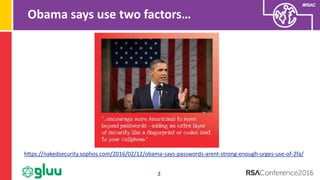
Obama says use two factors…
2
https://nakedsecurity.sophos.com/2016/02/12/obama-says-passwords-arent-strong-enough-urges-use-of-2fa/
#RSAC
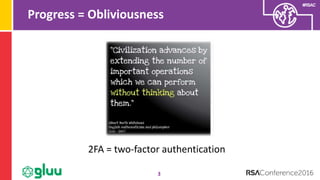
Progress = Obliviousness
3
2FA = two-factor authentication
#RSAC
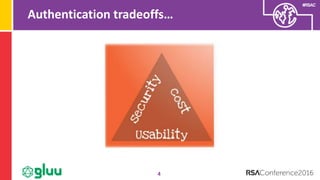
Authentication tradeoffs…
4
#RSAC
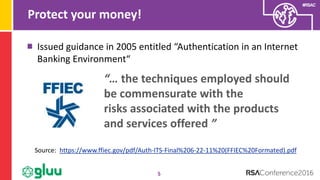
Protect your money!
5
Issued guidance in 2005 entitled “Authentication in an Internet
Banking Environment“
Source: https://www.ffiec.gov/pdf/Auth-ITS-Final%206-22-11%20(FFIEC%20Formated).pdf
“… the techniques employed should
be commensurate with the
risks associated with the products
and services offered ”
#RSAC
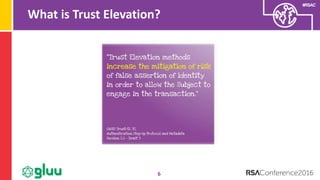
What is Trust Elevation?
6
#RSAC
Agenda
7
Background on authentication technology: where are we today?
Deep Dive into OAuth2: what features does it have to support
Trust Elevation
Trust Elevation across domain boundaries
GOAL: Make you aware of some of the challenges we face to
enable Trust Elevation
#RSAC
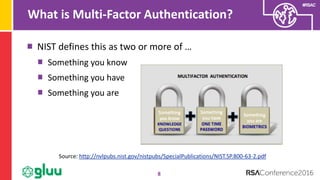
What is Multi-Factor Authentication?
8
NIST defines this as two or more of …
Something you know
Something you have
Something you are
Source: http://nvlpubs.nist.gov/nistpubs/SpecialPublications/NIST.SP.800-63-2.pdf
#RSAC
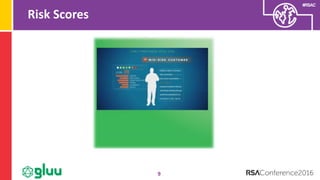
Risk Scores
9
#RSAC
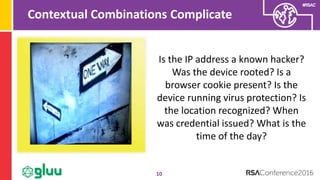
Contextual Combinations Complicate
10
Is the IP address a known hacker?
Was the device rooted? Is a
browser cookie present? Is the
device running virus protection? Is
the location recognized? When
was credential issued? What is the
time of the day?
#RSAC
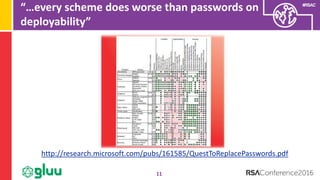
“…every scheme does worse than passwords on
deployability”
11
http://research.microsoft.com/pubs/161585/QuestToReplacePasswords.pdf
#RSAC
OAuth2 will make 2FA more “deployable”
12
Applications should use Standard API’s for
authentication and Trust Elevation!
No “one-offs”
http://nordicapis.com/api-security-oauth-openid-connect-depth/
Good Intro to Oauth2:
#RSAC
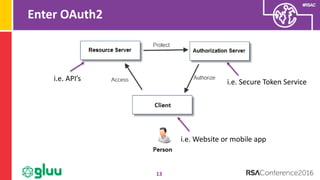
Enter OAuth2
13
i.e. API’s
i.e. Website or mobile app
i.e. Secure Token Service
#RSAC
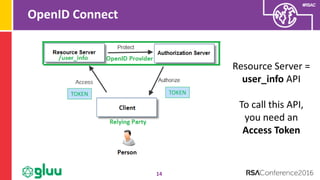
OpenID Connect
14
Resource Server =
user_info API
To call this API,
you need an
Access Token
TOKENTOKEN
#RSAC
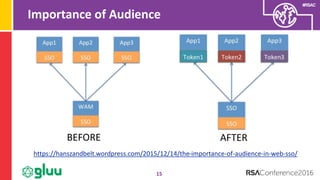
Importance of Audience
15
https://hanszandbelt.wordpress.com/2015/12/14/the-importance-of-audience-in-web-sso/
BEFORE AFTER
#RSAC
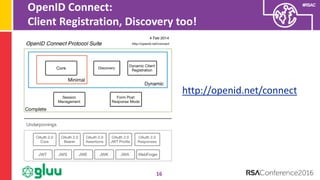
OpenID Connect:
Client Registration, Discovery too!
16
http://openid.net/connect
#RSAC
Overview of Authorization Code Flow
17
Relying Party (RP) redirects person to OpenID Provider (OP) for
authorization
Authentication happens only once!
OP returns code to RP
RP uses code to get tokens from OP
RP uses access token to obtain user claims from /user_info API:
{“given_name”: “Mike”,
“family_name”: “Schwartz”}
#RSAC
OpenID Connect id_token
18
Information about
authentication event
{
"iss": "https://server.example.com",
“sub": "248289761001",
"aud": "3214244",
"iat": 1311195570,
"exp": 1311281970,
“auth_time”: 131195001,
“acr”: http://example.com/basic_bio”
“amr”: [‘eye’, ‘pwd’, ‘12’]
}
#RSAC
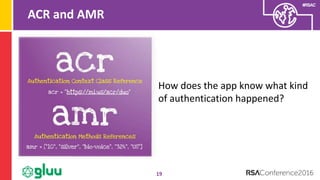
ACR and AMR
19
How does the app know what kind
of authentication happened?
#RSAC
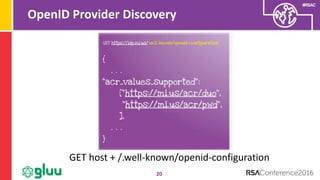
OpenID Provider Discovery
20
GET host + /.well-known/openid-configuration
#RSAC
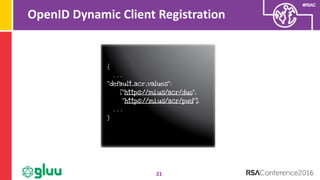
OpenID Dynamic Client Registration
21
#RSAC
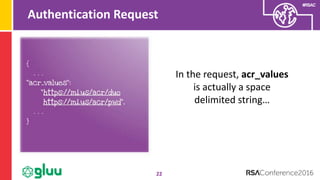
Authentication Request
22
In the request, acr_values
is actually a space
delimited string…
#RSAC
id_token
23
Returned id_token
confirms acr and amr
values
{
"iss": "https://server.example.com",
“sub": "248289761001",
"aud": "3214244",
"iat": 1311195570,
"exp": 1311281970,
“auth_time”: 131195001,
“acr”: http://example.com/basic_bio”
“amr”: [‘eye’, ‘pwd’, ‘12’]
}
#RSAC
App Policy
24
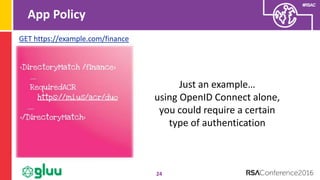
GET https://example.com/finance
Just an example…
using OpenID Connect alone,
you could require a certain
type of authentication
#RSAC
Best Practice:
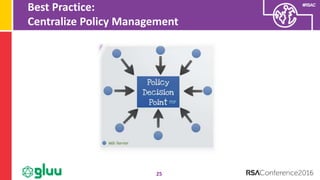
Centralize Policy Management
25
#RSAC
UMA
26
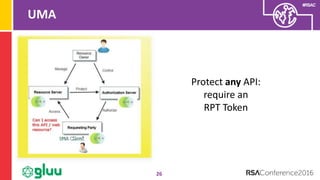
Protect any API:
require an
RPT Token
#RSAC
UMA In 60 seconds
27
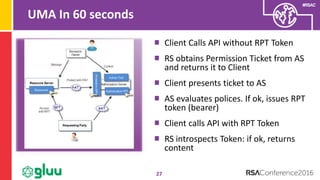
Client Calls API without RPT Token
RS obtains Permission Ticket from AS
and returns it to Client
Client presents ticket to AS
AS evaluates polices. If ok, issues RPT
token (bearer)
Client calls API with RPT Token
RS introspects Token: if ok, returns
content
#RSAC
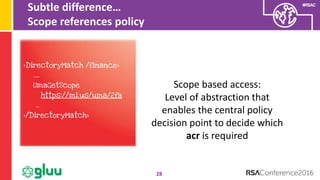
Subtle difference…
Scope references policy
28
Scope based access:
Level of abstraction that
enables the central policy
decision point to decide which
acr is required
#RSAC
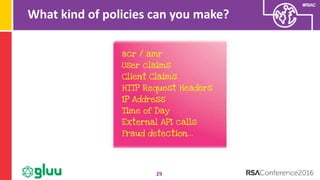
What kind of policies can you make?
29
#RSAC
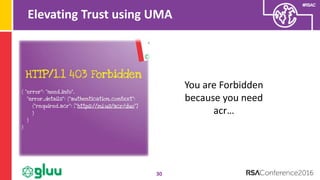
Elevating Trust using UMA
30
You are Forbidden
because you need
acr…
#RSAC
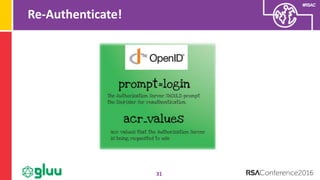
Re-Authenticate!
31
#RSAC
Part III: Intedomain trust elevation
32
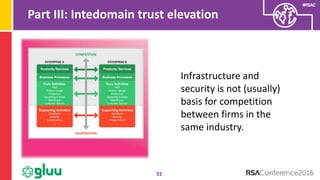
Infrastructure and
security is not (usually)
basis for competition
between firms in the
same industry.
#RSAC
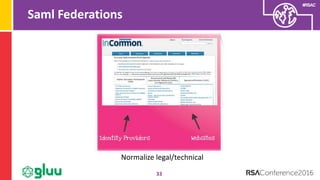
Saml Federations
33
Normalize legal/technical
#RSAC
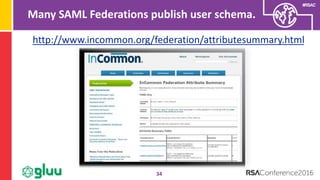
Many SAML Federations publish user schema.
34
http://www.incommon.org/federation/attributesummary.html
#RSAC
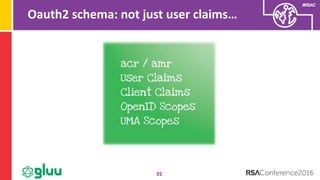
Oauth2 schema: not just user claims…
35
#RSAC
Collaboration on ACR / AMR values
36
So what values should we
use for amr and acr?
https://tools.ietf.org/html/draft-jones-oauth-amr-values-05
This IETF draft defines some AMR’s… but its inadequate
#RSAC
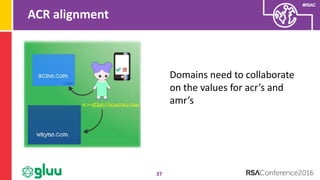
ACR alignment
37
Domains need to collaborate
on the values for acr’s and
amr’s
#RSAC
OTTO – Kantara Initiative Work Group
38
http://kantarainitiative.org/confluence/display/OTTO/Home
Open Trust Taxonomy for OAuth2
#RSAC
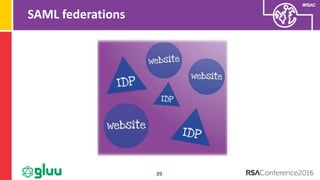
SAML federations
39
#RSAC
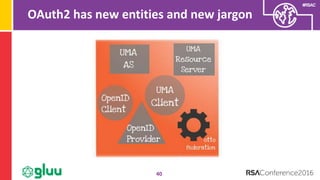
OAuth2 has new entities and new jargon
40
#RSAC
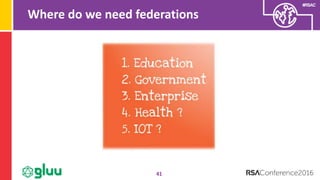
Where do we need federations
41
#RSAC
Summary
42
We don’t lack ways to identify people, but we lack agreement on
the relative strength of these mechanisms.
OAuth2 enables centralized risk based trust elevation, driving
down the cost of deployment—the main impediment to 2FA
adoption.
To enable trust elevation across domains, federations are
needed.
#RSAC
Action items
43
Don’t limit your planning to two-factor authentication. Make a
plan for trust elevation!
Start architecting your applications to leverage central policy
decision point—not for all fine grained authorization, but for
key security escalations.
If you work in an ecosystem, consider collaborating (even with
your competitors) to drive down the cost of security.
#RSAC
44

RSA Conference 2016: Don't Use Two-Factor Authentication... Unless You Need It!

Editor's Notes

  • #3 For the first time, the President of the United States advised citizens to use two-factor authentication. But he didn’t say when to use two factor authentication… Let’s face it… two factor authentication is a pain in the butt. I don’t want to get a SMS every time I turn on my TV. Ideally, I’d like to use two factor authentication never! I’d like my devices to just know who I am!
  • #5 But there is a tradeoff between security, usability, and cost (or deployability). If there was a technology out there that was really secure, super easy to use, and cheap… we’d be using it. In fact, in many ways, passwords offer one of the most attractive triangles out there today.
  • #6 Internet banking has always been at the forefront of digital person identification. Know your customer is the first rule of banking, but how do you know someone when they show up at your branch as a stream of electrons? Not surprisingly, banks have been at the forefront of what we call “trust-elevation”. For example, you may login with a password, but when you add a new wire recipient, maybe you receive a text. That’s text is a simple example of trust elevation– its because the bank wants to be even more sure its you.
  • #7  There is a technical committee at OASIS, a standards organization, who is working on standards for Trust-Elevation. They came up with this definition. Its sort of a weird oxymoronic definition… but it works. They want to increment the decrementing of risk. But this is actually a very useful definition—notice it doesn’t assume we ever know who the person is. We only can reduce the risk that its not the person we think it is… no authentication technique is 100%. On the Internet, we’re basically never really sure its you!
  • #9 We have a lot of technology to identify a person. I’m not going to go into it here. Check out my slides from the talk I gave on Monday where I detailed about 80 tricks we can use to authenticate a person. Let’s just say that we don’t have any shortage of technologies for person authentication. I assure you… the reason everyone is still using passwords is not because no one can think of some better way!
  • #10 In addition to the classic “what you know”, “what you have”, “what your are” techniques, today we can mitigate a lot of risk by looking at the context of an authentication. Perhaps we have a positive biometic authentication, but the ip address indicates that the person is in a foreign country, and that it’s an IP address used recently by a known hacker.
  • #11 So if you ever hoped to create some kind of uber-matrix, where you rate the various types of authentication, and how good they are…. Its really impossible. First of all, individual types are not the same. How complex is the password? How sensitive is the fingerprint scanner? Etc. etc. etc…. And how does fingerprint + password compare relative to mobile token + fraud detection?
  • #12 So with all these techniques for person identification available to us? Why are we still using passwords at almost every website and mobile application? It goes back to cost? Cost is a big part of deployability. There was no license fee for passwords. It was easy for developers to implement. Users understand passwords—they aren’t going to call your help desk because they don’t undertand how to use it. And it was inexpensive to automate password recovery—support costs are low.
  • #13 To justify the cost of two-factor authentication, we’re going to have to make sure its used by a lot of applications. This is where OAuth2 come in.