Securing online services by combining smart
     cards and web-based applications


               A.   Olivier Potonniée, Asad Ali, Laurent Castillo,
                                  Darmawan Suwirya, Karen Lu


                                                       Gemalto
                                             Technology & Innovations


                         November 17, 2012 – JS.everywhere()
Overview

 The need for strong authentication

 Existing solutions

 A new, usable, smart-card-based authentication

 Smart card JavaScript API
    SConnect, a Gemalto browser extension
    Upcoming W3C standardization activity


       November 17, 2012 – JS.everywhere()        2
Introduction

  Web applications are part of our daily lives
     Environment: work; communication; social
     Applications: banking; shopping; entrainment


  Security breaches & online identity thefts are on the rise
     This can happen on both the client side and server side.


  User authentication is the door keeper

  Impact of security breaches
     Financial loss and pain to institutions and customers
     Loss of key assets, reputation damage


        November 17, 2012 – JS.everywhere()                     3
Authentication: Current State
   Most websites use single factor authentication – Password

   Passwords are universally accepted as weak
         One major breach lead to release of 32 million passwords *
         Nearly 50% of users use names, slang words, dictionary words or trivial
         passwords *
         Strong password use is hard to enforce


   Usability of username/password
         Easy to use
         Too many passwords to remember
         Reuse passwords or use simple passwords


* http://www.imperva.com/docs/WP_Consumer_Password_Worst_Practices.pdf


             November 17, 2012 – JS.everywhere()                                   4
Single Sign-On
                                                                        SAML2

 Delegation
    Service Providers delegate authentication to an Identity Provider
    Sign-on once to access different web services
    Use one set of credentials to login to different services


 Benefits
    Users: Remember one password instead of dozens
    Providers: Easier to secure one system than to secure many


 Even greater need for strong authentication
    Puts all one’s eggs in one basket
    Most systems still use username and password
    Break one, break all


       November 17, 2012 – JS.everywhere()                                      5
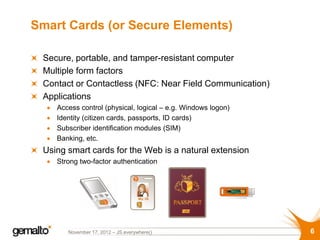
Smart Cards (or Secure Elements)

 Secure, portable, and tamper-resistant computer
 Multiple form factors
 Contact or Contactless (NFC: Near Field Communication)
 Applications
    Access control (physical, logical – e.g. Windows logon)
    Identity (citizen cards, passports, ID cards)
    Subscriber identification modules (SIM)
    Banking, etc.
 Using smart cards for the Web is a natural extension
    Strong two-factor authentication


       November 17, 2012 – JS.everywhere()                    6
Using Smart Cards in Web Applications

                                                                       Installation &
                                                                       maintenance
         The missing
            piece
                                                                  Proprietary, specific
                                                                       (e.g. TLS
    Standard API                                    Application     authentication)
supported by all major
  operating systems,                  ?             Middleware    Some are [Industry]
  but not accessible                                                  Standards
from web applications                         PC/SC API             (e.g. MS CAPI,
                                                                  PKCS#11, Java API)
                                               Smart card
     Proprietary                             reader Drivers


              November 17, 2012 – JS.everywhere()                                         7
Enabling technology:

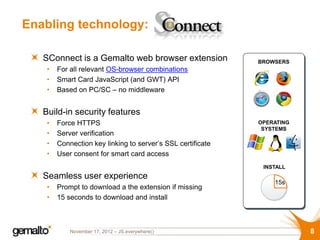
   SConnect is a Gemalto web browser extension               BROWSERS
    •   For all relevant OS-browser combinations
    •   Smart Card JavaScript (and GWT) API
    •   Based on PC/SC – no middleware


   Build-in security features
    •   Force HTTPS                                          OPERATING
                                                             SYSTEMS
    •   Server verification
    •   Connection key linking to server’s SSL certificate
    •   User consent for smart card access
                                                              INSTALL
   Seamless user experience
                                                                 15s
    •   Prompt to download a the extension if missing
    •   15 seconds to download and install


            November 17, 2012 – JS.everywhere()                          8
The smart card JS API: insertion events
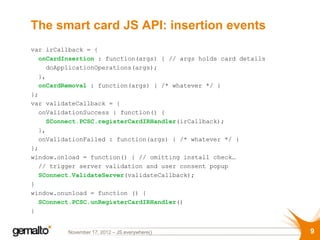
var irCallback = {
  onCardInsertion : function(args) { // args holds card details
    doApplicationOperations(args);
  },
  onCardRemoval : function(args) { /* whatever */ }
};
var validateCallback = {
  onValidationSuccess : function() {
    SConnect.PCSC.registerCardIRHandler(irCallback);
  },
  onValidationFailed : function(args) { /* whatever */ }
};
window.onload = function() { // omitting install check…
  // trigger server validation and user consent popup
  SConnect.ValidateServer(validateCallback);
}
window.onunload = function () {
  SConnect.PCSC.unRegisterCardIRHandler()
}


          November 17, 2012 – JS.everywhere()                     9
The smart card JS API: card communication

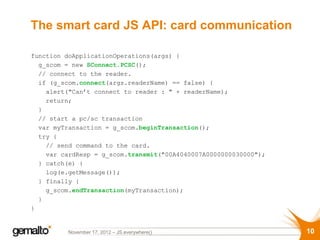
function doApplicationOperations(args) {
  var g_scom = new SConnect.PCSC();
  // connect to the reader.
  if (g_scom.connect(args.readerName) == false) {
    alert("Can’t connect to reader : " + readerName);
    return;
  }
  // start a pc/sc transaction
  var myTransaction = g_scom.beginTransaction();
  try {
    // send command to the card.
    var cardResp = g_scom.transmit("00A4040007A0000000030000");
  } catch(e) {
    log(e.getMessage());
  } finally {
    g_scom.endTransaction(myTransaction);
  }
}


          November 17, 2012 – JS.everywhere()                     10
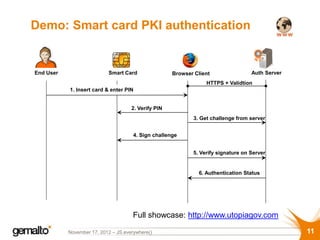
Demo: Smart card PKI authentication


End User                   Smart Card                Browser Client                Auth Server
                                                                 HTTPS + Validtion
           1. Insert card & enter PIN


                                     2. Verify PIN
                                                            3. Get challenge from server


                                      4. Sign challenge


                                                            5. Verify signature on Server


                                                              6. Authentication Status


                                      Full showcase: http://www.utopiagov.com

           November 17, 2012 – JS.everywhere()                                                   11
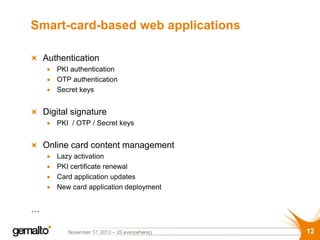
Smart-card-based web applications

    Authentication
       PKI authentication
       OTP authentication
       Secret keys


    Digital signature
       PKI / OTP / Secret keys


    Online card content management
       Lazy activation
       PKI certificate renewal
       Card application updates
       New card application deployment


…

          November 17, 2012 – JS.everywhere()   12
Standardization

 Benefits
    Removes the need for a browser extension
    Increase the number OS/browser combination (esp. on mobile)
    No dependency on proprietary solution


 W3C APIs
    SysApp Working Group, launched in Q4 2012
        Runtime environment and APIs that let trusted applications integrate
        closely with the operating system's functionality
        Smart card (Secure Element) in phase 2
    Secure Element API expected in 2014
    Near Field Communications (NFC) Working Group
        Includes: Communication with contactless cards


       November 17, 2012 – JS.everywhere()                                     13
Conclusions

 Internet Security…
    Single-factor, knowledge based authentication is weak


 Smart Cards…
    Provide enhanced security while working within the constraints of
    established enterprise and government frameworks


 Market…
    Adoption occurs only when increased security makes economic
    sense


 Standards…
    W3C Secure Element and NFC APIs


       November 17, 2012 – JS.everywhere()                              14
Thanks

                                      Questions ?


November 17, 2012 – JS.everywhere()                 15

Securing online services by combining smart cards and web-based applications

  • 1.
    Securing online servicesby combining smart cards and web-based applications A. Olivier Potonniée, Asad Ali, Laurent Castillo, Darmawan Suwirya, Karen Lu Gemalto Technology & Innovations November 17, 2012 – JS.everywhere()
  • 2.
    Overview The needfor strong authentication Existing solutions A new, usable, smart-card-based authentication Smart card JavaScript API SConnect, a Gemalto browser extension Upcoming W3C standardization activity November 17, 2012 – JS.everywhere() 2
  • 3.
    Introduction Webapplications are part of our daily lives Environment: work; communication; social Applications: banking; shopping; entrainment Security breaches & online identity thefts are on the rise This can happen on both the client side and server side. User authentication is the door keeper Impact of security breaches Financial loss and pain to institutions and customers Loss of key assets, reputation damage November 17, 2012 – JS.everywhere() 3
  • 4.
    Authentication: Current State Most websites use single factor authentication – Password Passwords are universally accepted as weak One major breach lead to release of 32 million passwords * Nearly 50% of users use names, slang words, dictionary words or trivial passwords * Strong password use is hard to enforce Usability of username/password Easy to use Too many passwords to remember Reuse passwords or use simple passwords * http://www.imperva.com/docs/WP_Consumer_Password_Worst_Practices.pdf November 17, 2012 – JS.everywhere() 4
  • 5.
    Single Sign-On SAML2 Delegation Service Providers delegate authentication to an Identity Provider Sign-on once to access different web services Use one set of credentials to login to different services Benefits Users: Remember one password instead of dozens Providers: Easier to secure one system than to secure many Even greater need for strong authentication Puts all one’s eggs in one basket Most systems still use username and password Break one, break all November 17, 2012 – JS.everywhere() 5
  • 6.
    Smart Cards (orSecure Elements) Secure, portable, and tamper-resistant computer Multiple form factors Contact or Contactless (NFC: Near Field Communication) Applications Access control (physical, logical – e.g. Windows logon) Identity (citizen cards, passports, ID cards) Subscriber identification modules (SIM) Banking, etc. Using smart cards for the Web is a natural extension Strong two-factor authentication November 17, 2012 – JS.everywhere() 6
  • 7.
    Using Smart Cardsin Web Applications Installation & maintenance The missing piece Proprietary, specific (e.g. TLS Standard API Application authentication) supported by all major operating systems, ? Middleware Some are [Industry] but not accessible Standards from web applications PC/SC API (e.g. MS CAPI, PKCS#11, Java API) Smart card Proprietary reader Drivers November 17, 2012 – JS.everywhere() 7
  • 8.
    Enabling technology: SConnect is a Gemalto web browser extension BROWSERS • For all relevant OS-browser combinations • Smart Card JavaScript (and GWT) API • Based on PC/SC – no middleware Build-in security features • Force HTTPS OPERATING SYSTEMS • Server verification • Connection key linking to server’s SSL certificate • User consent for smart card access INSTALL Seamless user experience 15s • Prompt to download a the extension if missing • 15 seconds to download and install November 17, 2012 – JS.everywhere() 8
  • 9.
    The smart cardJS API: insertion events var irCallback = { onCardInsertion : function(args) { // args holds card details doApplicationOperations(args); }, onCardRemoval : function(args) { /* whatever */ } }; var validateCallback = { onValidationSuccess : function() { SConnect.PCSC.registerCardIRHandler(irCallback); }, onValidationFailed : function(args) { /* whatever */ } }; window.onload = function() { // omitting install check… // trigger server validation and user consent popup SConnect.ValidateServer(validateCallback); } window.onunload = function () { SConnect.PCSC.unRegisterCardIRHandler() } November 17, 2012 – JS.everywhere() 9
  • 10.
    The smart cardJS API: card communication function doApplicationOperations(args) { var g_scom = new SConnect.PCSC(); // connect to the reader. if (g_scom.connect(args.readerName) == false) { alert("Can’t connect to reader : " + readerName); return; } // start a pc/sc transaction var myTransaction = g_scom.beginTransaction(); try { // send command to the card. var cardResp = g_scom.transmit("00A4040007A0000000030000"); } catch(e) { log(e.getMessage()); } finally { g_scom.endTransaction(myTransaction); } } November 17, 2012 – JS.everywhere() 10
  • 11.
    Demo: Smart cardPKI authentication End User Smart Card Browser Client Auth Server HTTPS + Validtion 1. Insert card & enter PIN 2. Verify PIN 3. Get challenge from server 4. Sign challenge 5. Verify signature on Server 6. Authentication Status Full showcase: http://www.utopiagov.com November 17, 2012 – JS.everywhere() 11
  • 12.
    Smart-card-based web applications Authentication PKI authentication OTP authentication Secret keys Digital signature PKI / OTP / Secret keys Online card content management Lazy activation PKI certificate renewal Card application updates New card application deployment … November 17, 2012 – JS.everywhere() 12
  • 13.
    Standardization Benefits Removes the need for a browser extension Increase the number OS/browser combination (esp. on mobile) No dependency on proprietary solution W3C APIs SysApp Working Group, launched in Q4 2012 Runtime environment and APIs that let trusted applications integrate closely with the operating system's functionality Smart card (Secure Element) in phase 2 Secure Element API expected in 2014 Near Field Communications (NFC) Working Group Includes: Communication with contactless cards November 17, 2012 – JS.everywhere() 13
  • 14.
    Conclusions Internet Security… Single-factor, knowledge based authentication is weak Smart Cards… Provide enhanced security while working within the constraints of established enterprise and government frameworks Market… Adoption occurs only when increased security makes economic sense Standards… W3C Secure Element and NFC APIs November 17, 2012 – JS.everywhere() 14
  • 15.
    Thanks Questions ? November 17, 2012 – JS.everywhere() 15

Editor's Notes

  • #8 Communication StackSmart card communication standardStandard API supported by all major operating systems, but not accessible from web applicationsMiddleware – browser / platform dependentCAPI on Windows, PKCS#11, OpenCard Framework (OCF), JSR 177, SIM Toolkit…UsabilityUser interface not coupled with web applicationTerminology not understood by non-technical usersDifferent architectures for browsers / platformsDifferent middleware on different platformsSoftware upgrade issuesEnd user installation issuesMiddleware-based TLS mutual authenticationPros: Conventional smart cards; strong authenticationCons: Browser / platform dependency; Usability, a single use caseJava appletPros: Complete and standardized smart card APICons: requires Java VMInternet smart cardPros: Security; Easy to use once setupCons: IP routing setup, legacy cards