The Evolution of API Security for
Client Side Applications
June 30, 2021
johann@wso2.com
Head of Solutions Architecture for IAM @ WSO2
Johann Dilantha Nallathamby
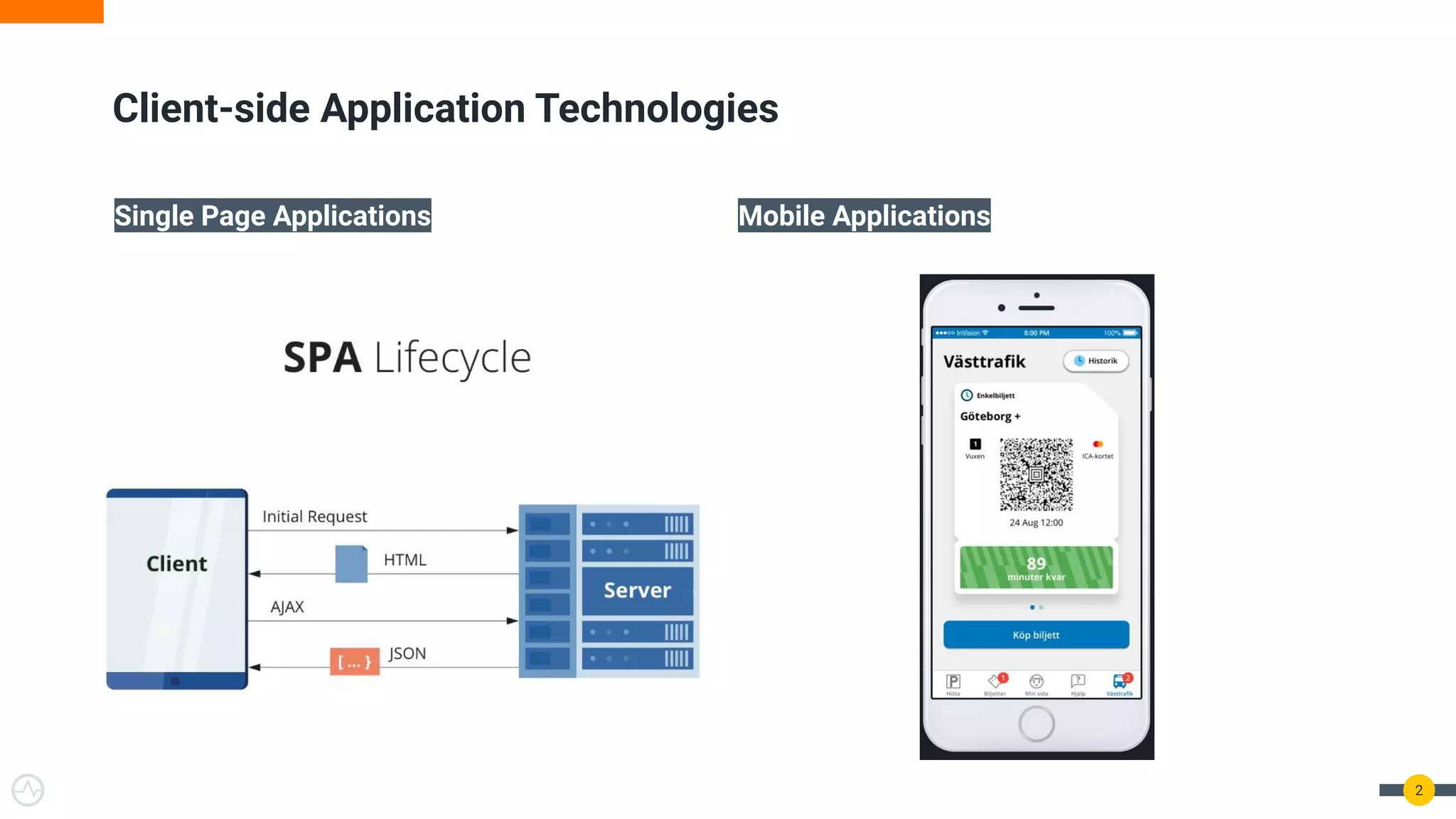
Single Page Applications Mobile Applications
2
Client-side Application Technologies
Did Client-side Applications
exist before OAuth 2.0?
3
While Client-side Applications have existed before the introduction of OpenID
Connect and OAuth 2.0, the advent of OAuth 2.0 and OIDC definitely stirred up a
debate on the right way of performing authentication and API authorization for
Client-side Applications.
OpenID Connect has become the de-facto standard to authenticate users in Client-side
Applications and OAuth 2.0 has become the defacto standard to authorize API
invocations in Client-side Applications.
Client-side Applications can be classified as OAuth 2.0 Public Clients.
Client-side Applications & OAuth 2.0
4
1. They cannot store the client secret completely securely on the client-side
2. They cannot store the access tokens completely securely on the client-side
OAuth 2.0 Public Clients
5
Threats and Mitigation Strategies for
OAuth 2.0 Public Clients
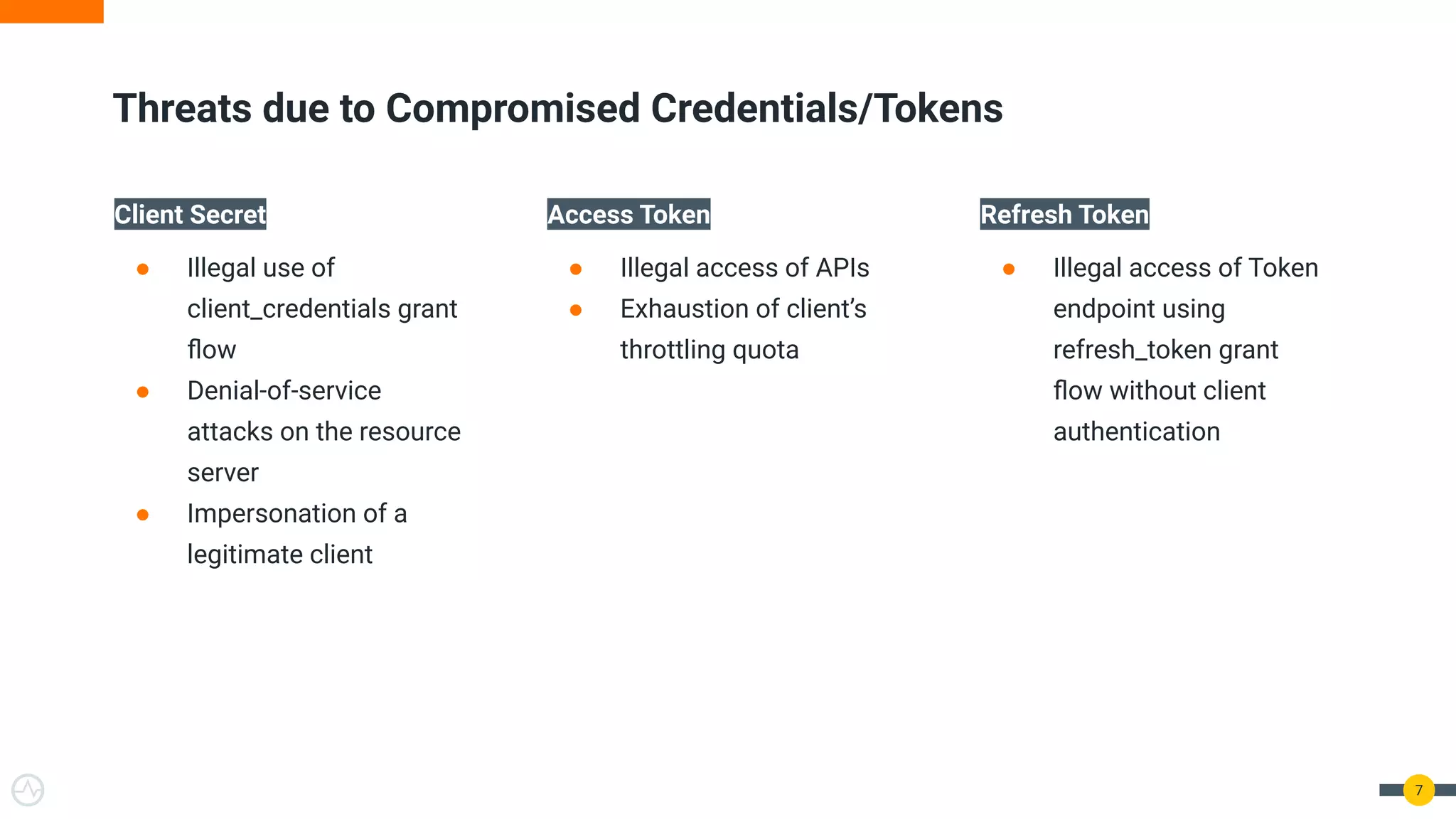
Threats due to Compromised Credentials/Tokens
7
Client Secret
● Illegal use of
client_credentials grant
flow
● Denial-of-service
attacks on the resource
server
● Impersonation of a
legitimate client
Access Token
● Illegal access of APIs
● Exhaustion of client’s
throttling quota
Refresh Token
● Illegal access of Token
endpoint using
refresh_token grant
flow without client
authentication
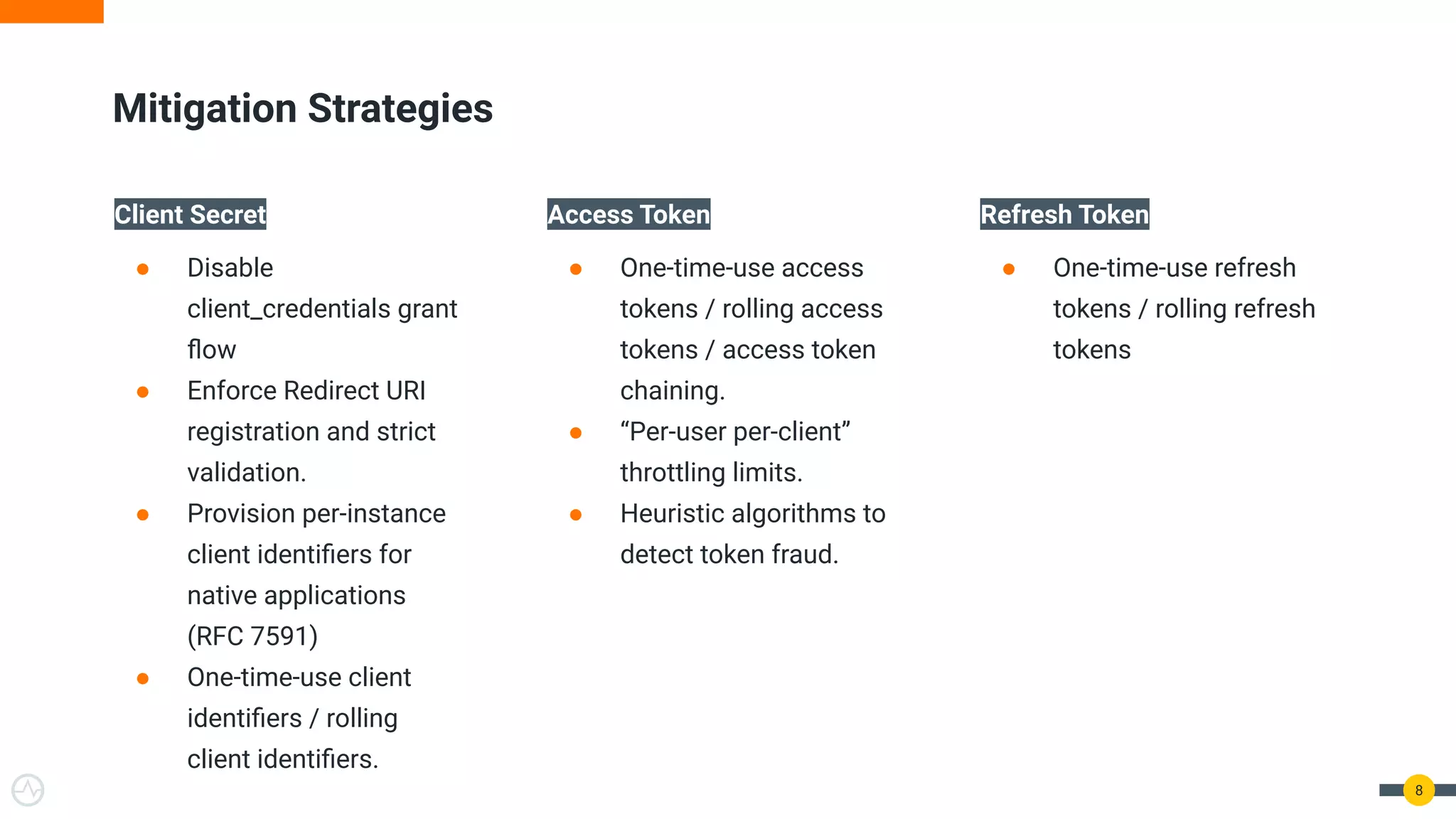
Mitigation Strategies
8
Client Secret
● Disable
client_credentials grant
flow
● Enforce Redirect URI
registration and strict
validation.
● Provision per-instance
client identifiers for
native applications
(RFC 7591)
● One-time-use client
identifiers / rolling
client identifiers.
Access Token
● One-time-use access
tokens / rolling access
tokens / access token
chaining.
● “Per-user per-client”
throttling limits.
● Heuristic algorithms to
detect token fraud.
Refresh Token
● One-time-use refresh
tokens / rolling refresh
tokens
The Evolution
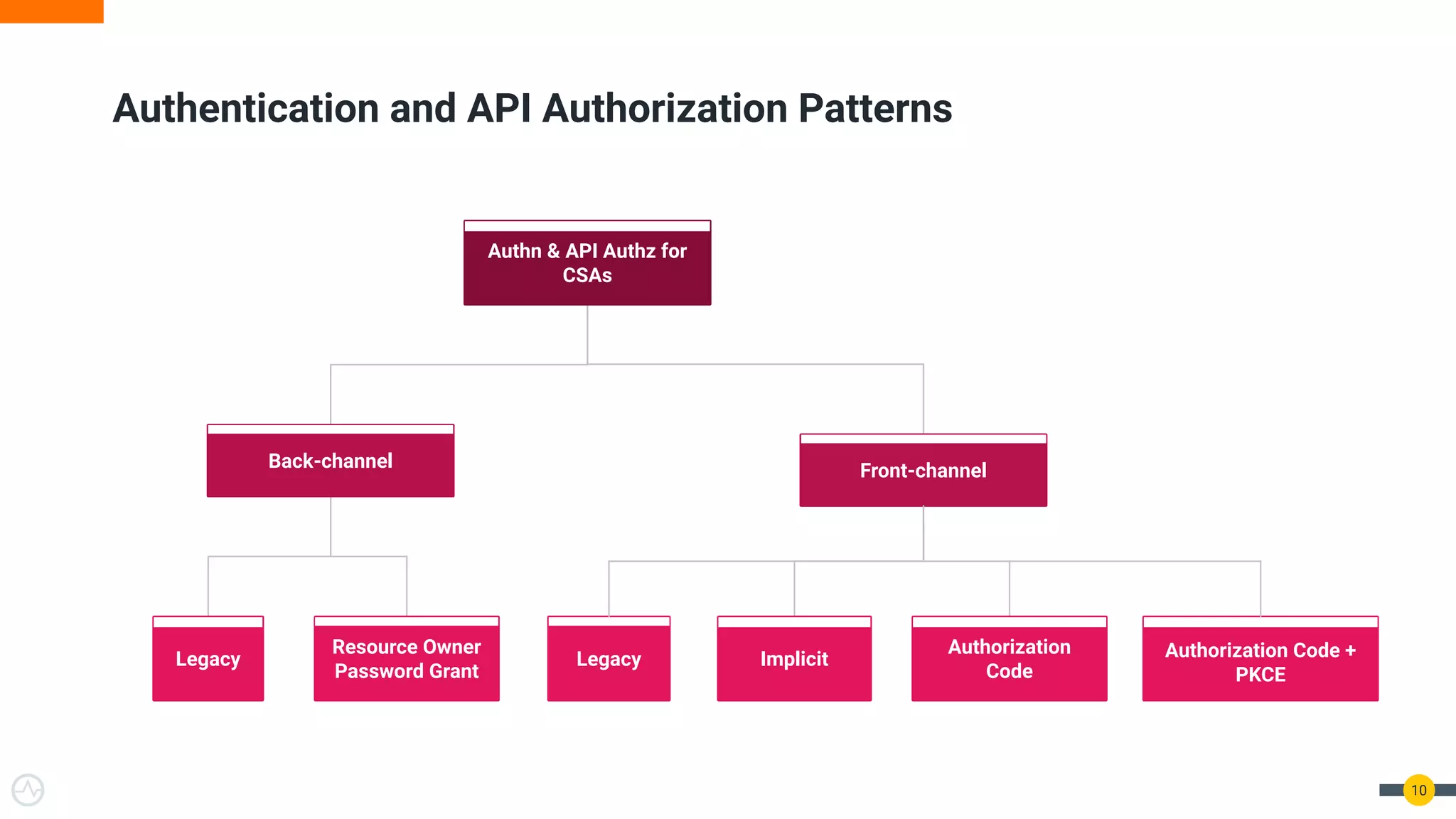
Authentication and API Authorization Patterns
10
Authn & API Authz for
CSAs
Back-channel Front-channel
Implicit
Resource Owner
Password Grant
Legacy Authorization Code +
PKCE
Legacy
Authorization
Code
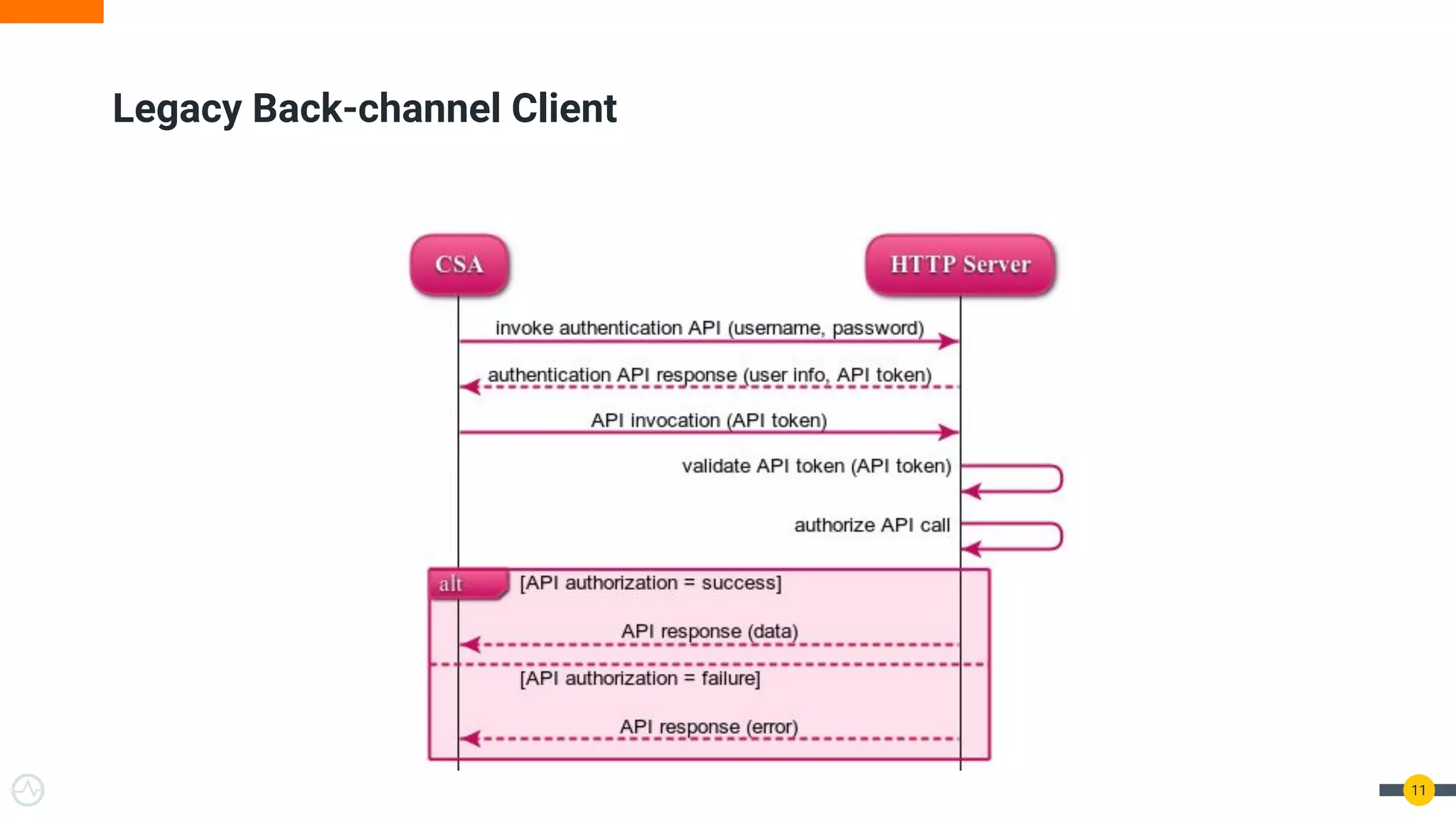
Legacy Back-channel Client
11
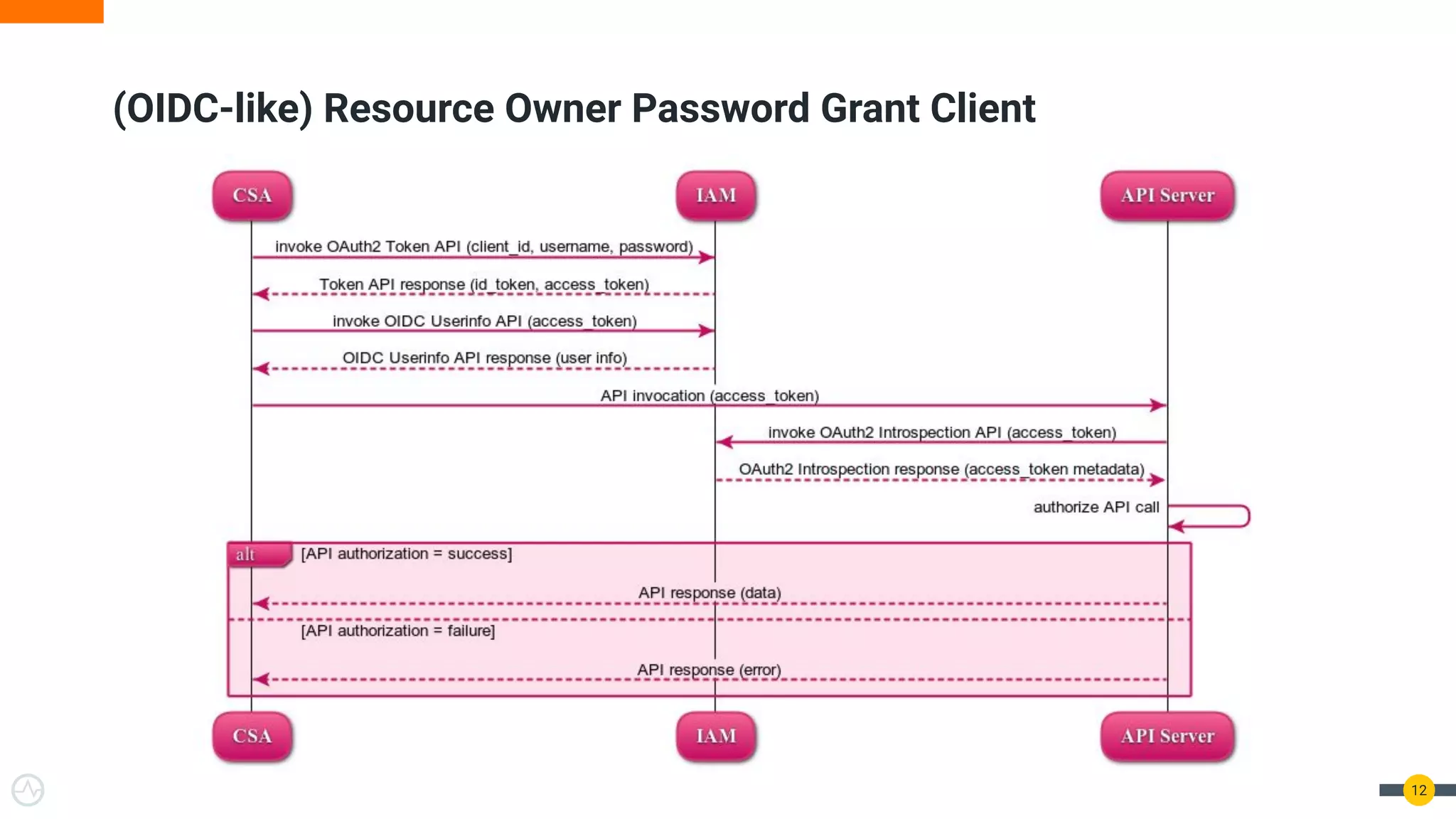
(OIDC-like) Resource Owner Password Grant Client
12
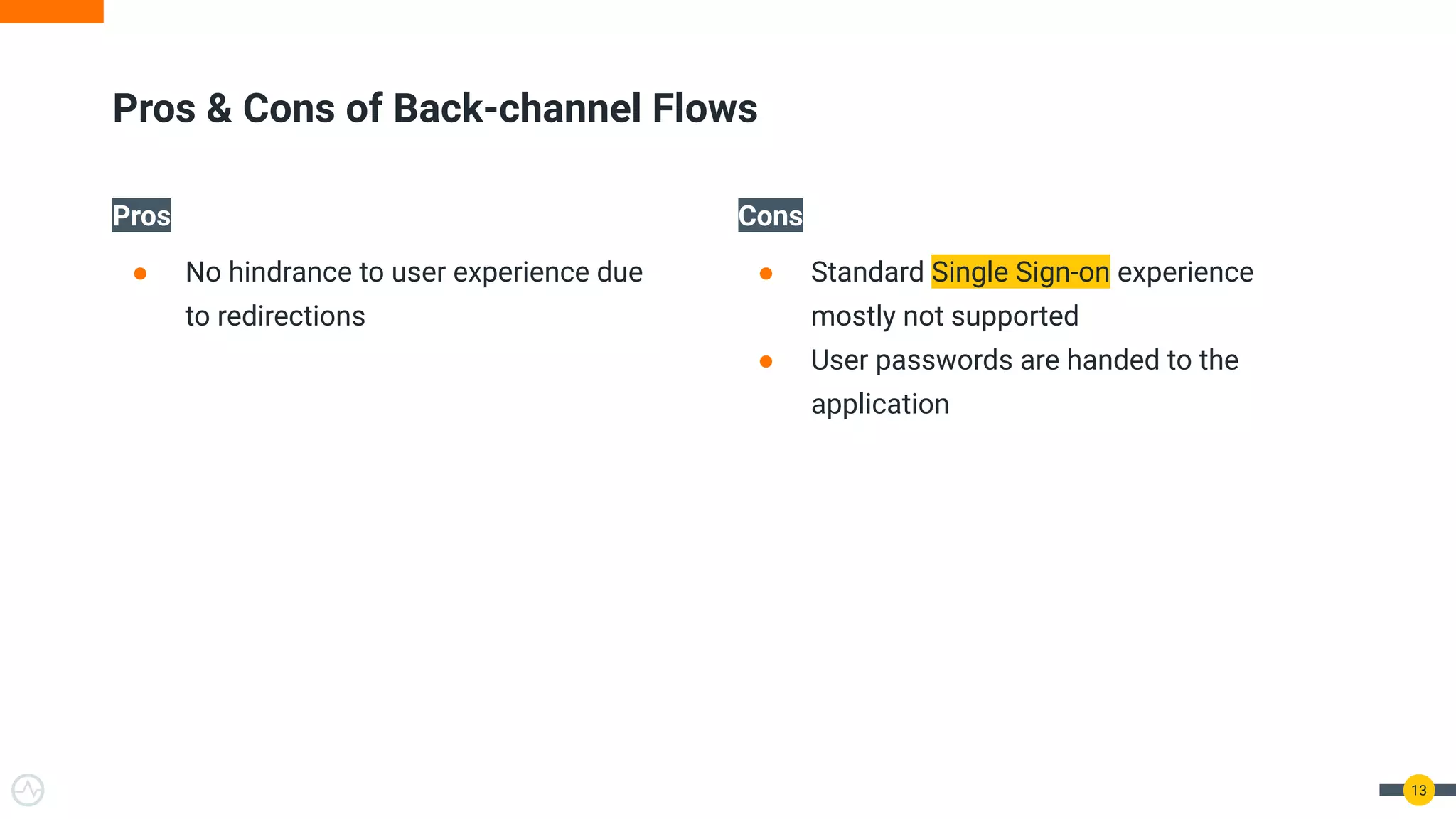
Pros
● No hindrance to user experience due
to redirections
Cons
● Standard Single Sign-on experience
mostly not supported
● User passwords are handed to the
application
13
Pros & Cons of Back-channel Flows
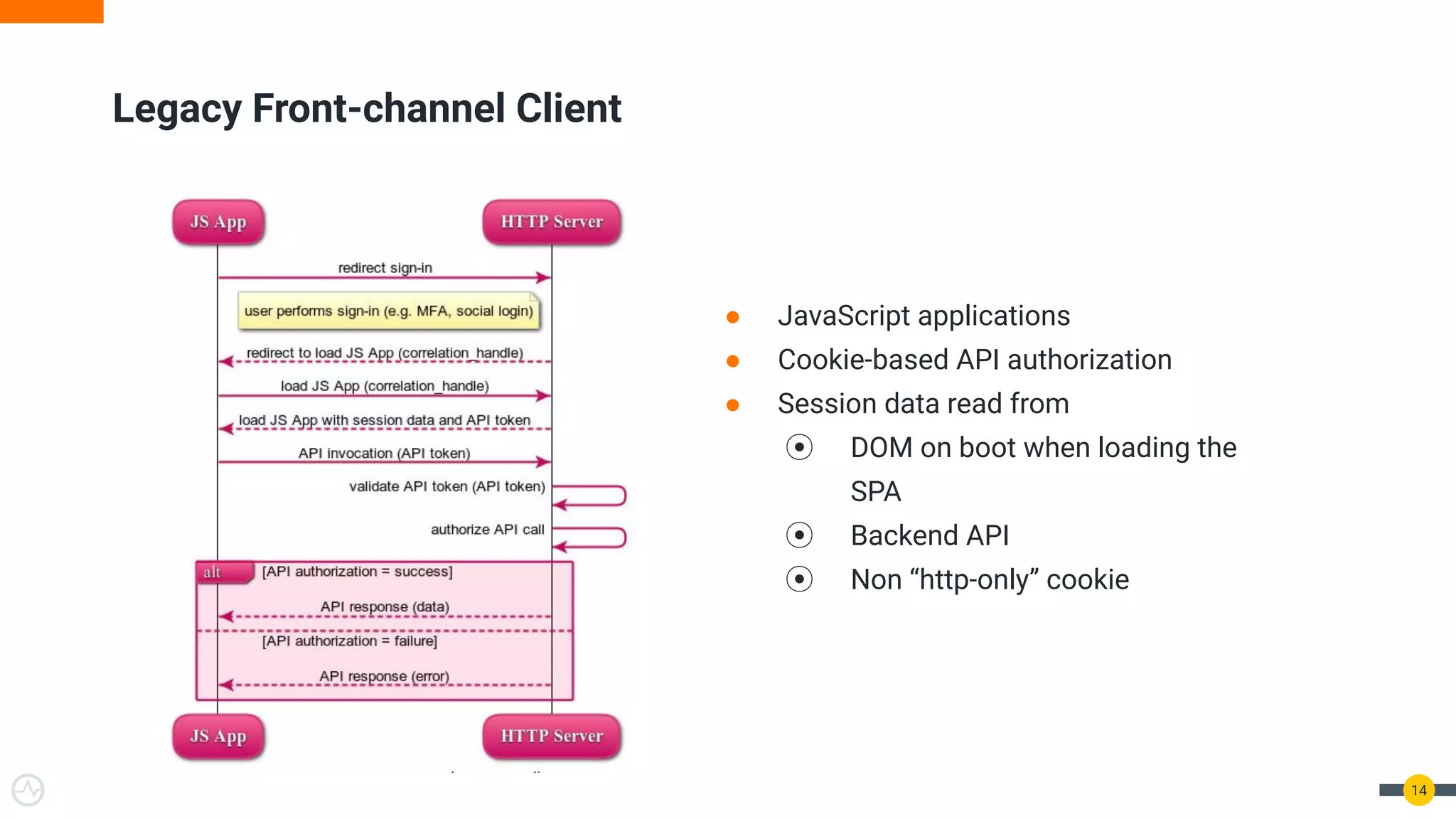
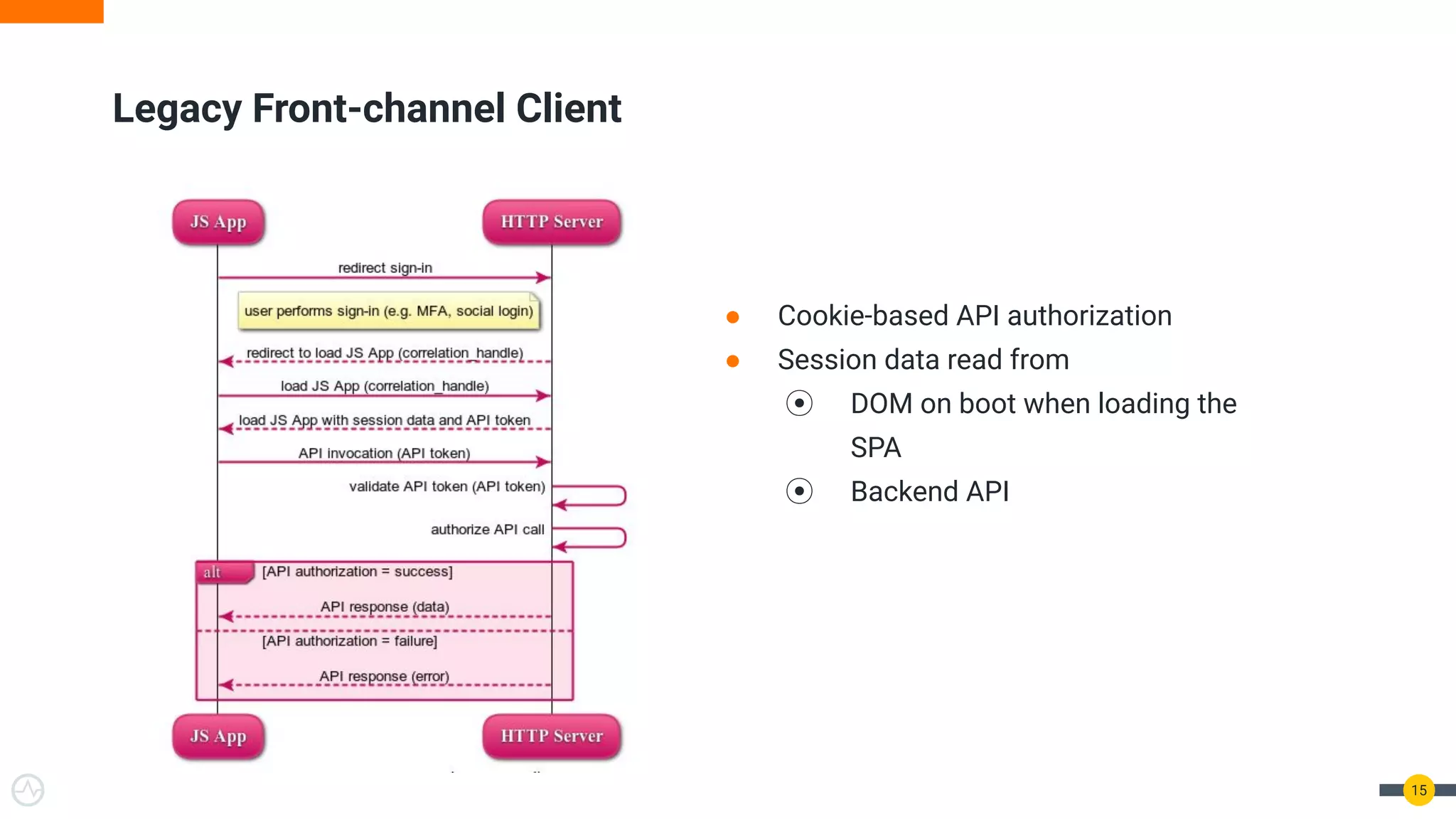
Legacy Front-channel Client
14
● JavaScript applications
● Cookie-based API authorization
● Session data read from
⦿ DOM on boot when loading the
SPA
⦿ Backend API
⦿ Non “http-only” cookie
Legacy Front-channel Client
15
● Cookie-based API authorization
● Session data read from
⦿ DOM on boot when loading the
SPA
⦿ Backend API
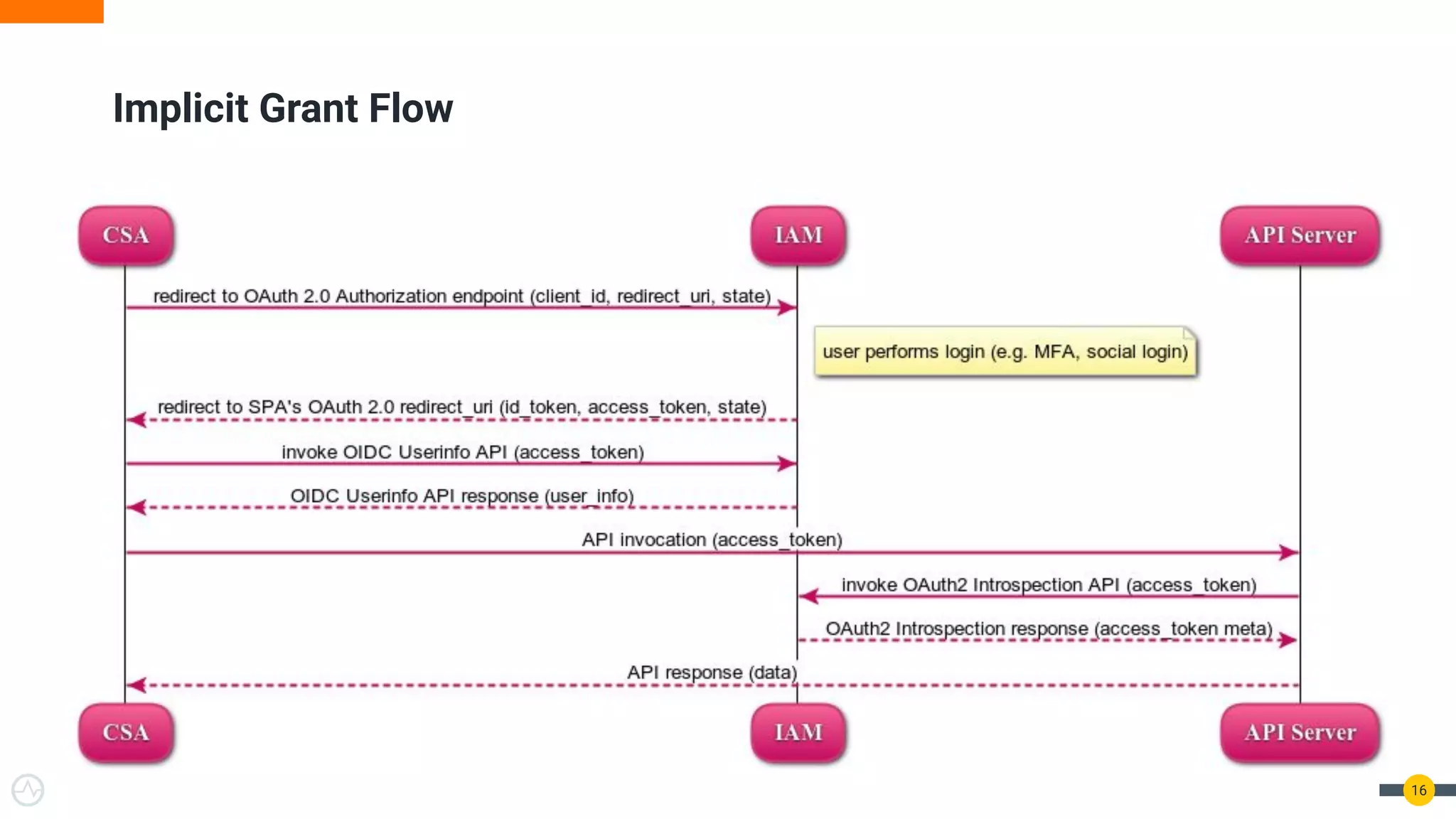
Implicit Grant Flow
16
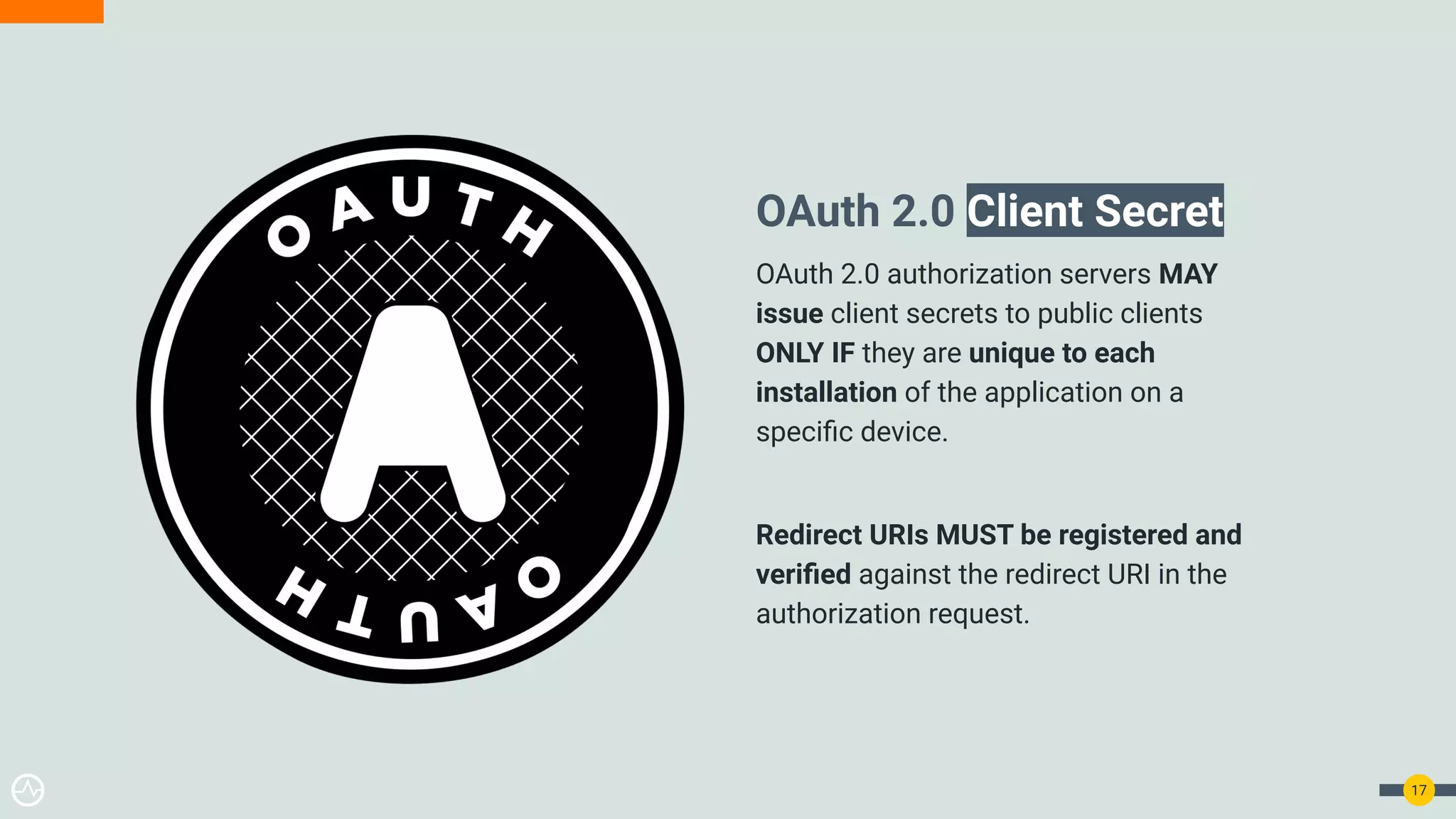
17
OAuth 2.0 Client Secret
OAuth 2.0 authorization servers MAY
issue client secrets to public clients
ONLY IF they are unique to each
installation of the application on a
specific device.
Redirect URIs MUST be registered and
verified against the redirect URI in the
authorization request.
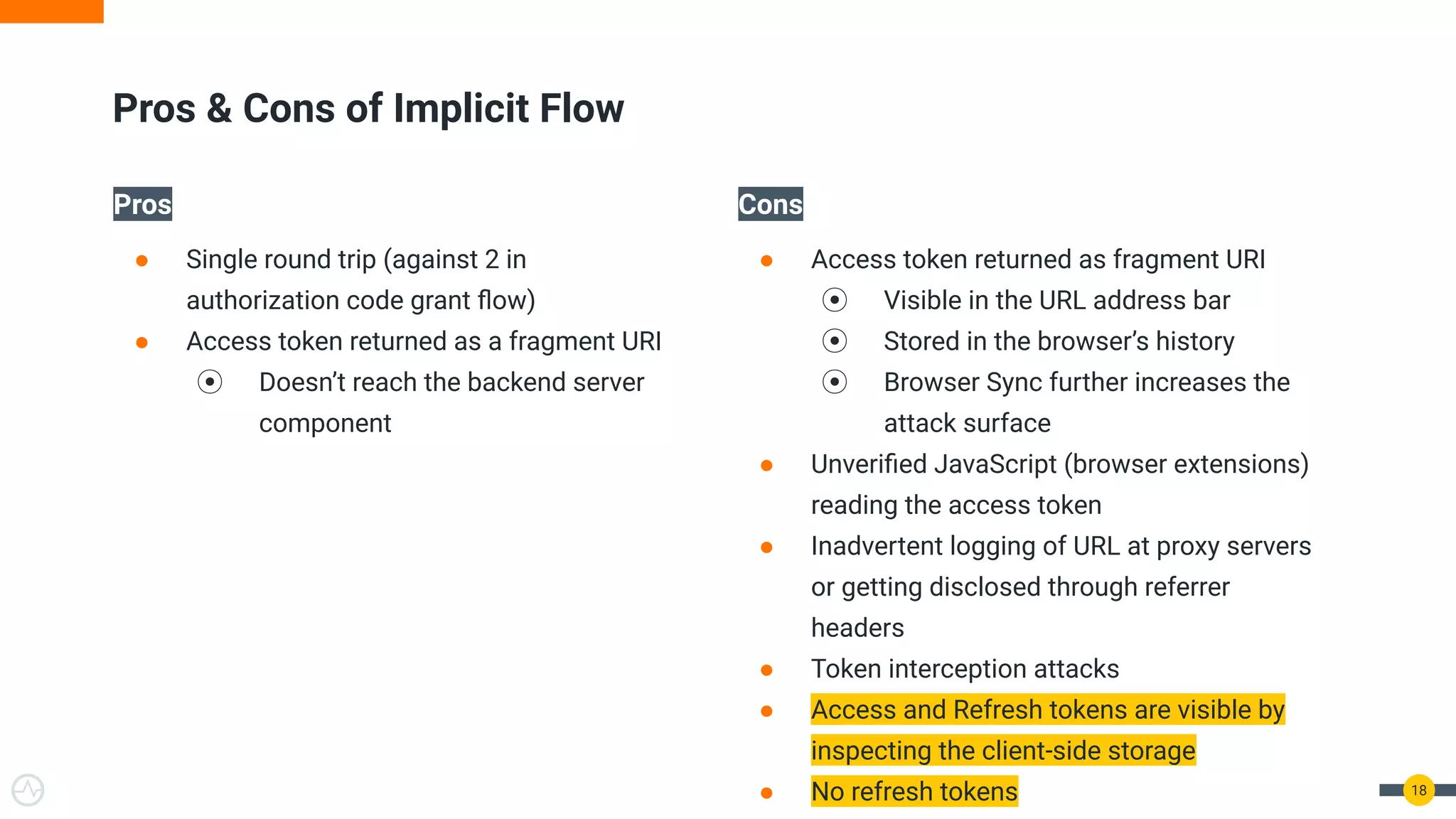
Pros
● Single round trip (against 2 in
authorization code grant flow)
● Access token returned as a fragment URI
⦿ Doesn’t reach the backend server
component
Cons
● Access token returned as fragment URI
⦿ Visible in the URL address bar
⦿ Stored in the browser’s history
⦿ Browser Sync further increases the
attack surface
● Unverified JavaScript (browser extensions)
reading the access token
● Inadvertent logging of URL at proxy servers
or getting disclosed through referrer
headers
● Token interception attacks
● Access and Refresh tokens are visible by
inspecting the client-side storage
● No refresh tokens 18
Pros & Cons of Implicit Flow
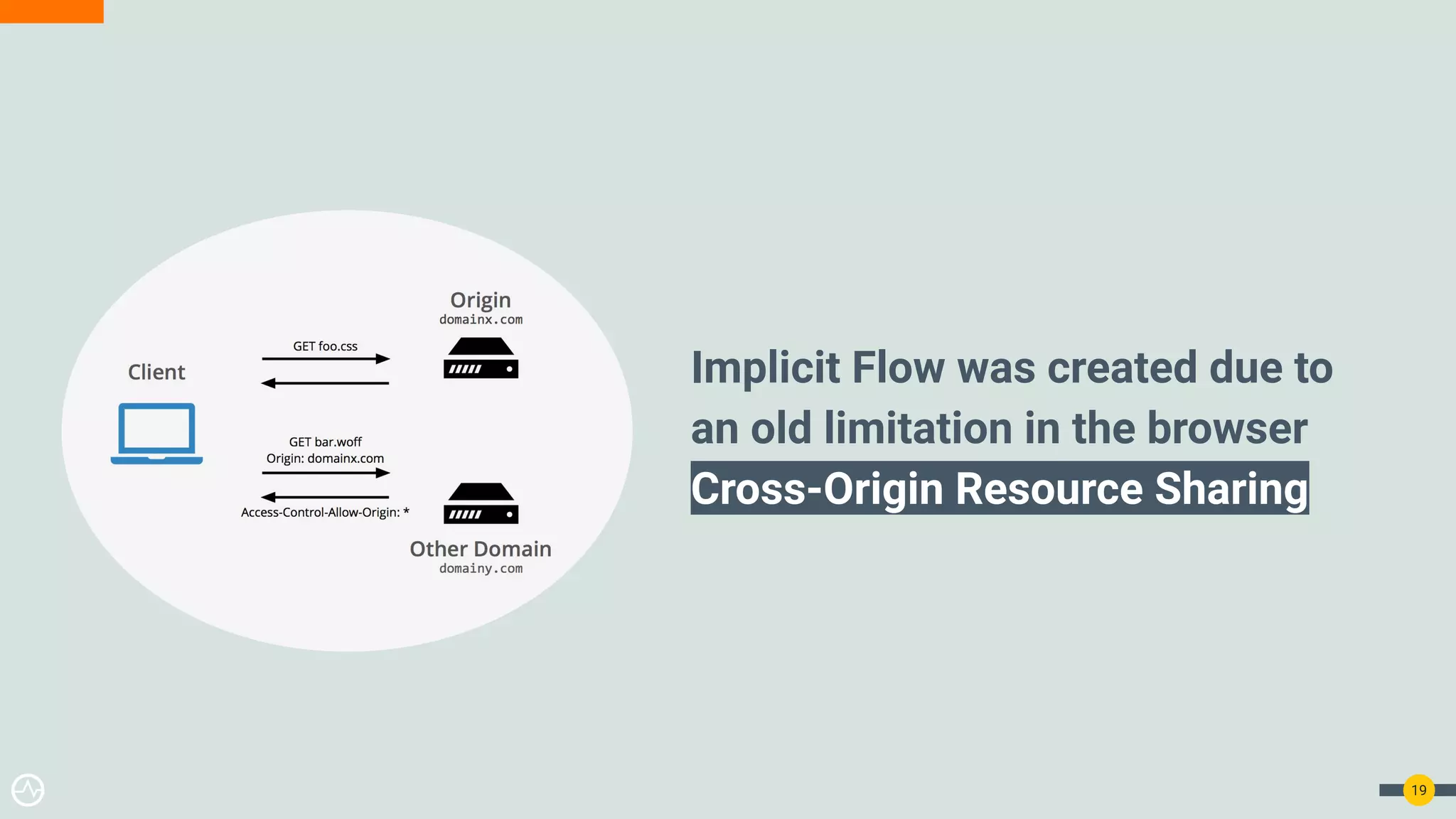
Implicit Flow was created due to
an old limitation in the browser
Cross-Origin Resource Sharing
19
PKCE
Mitigates Code Interception Attack
20
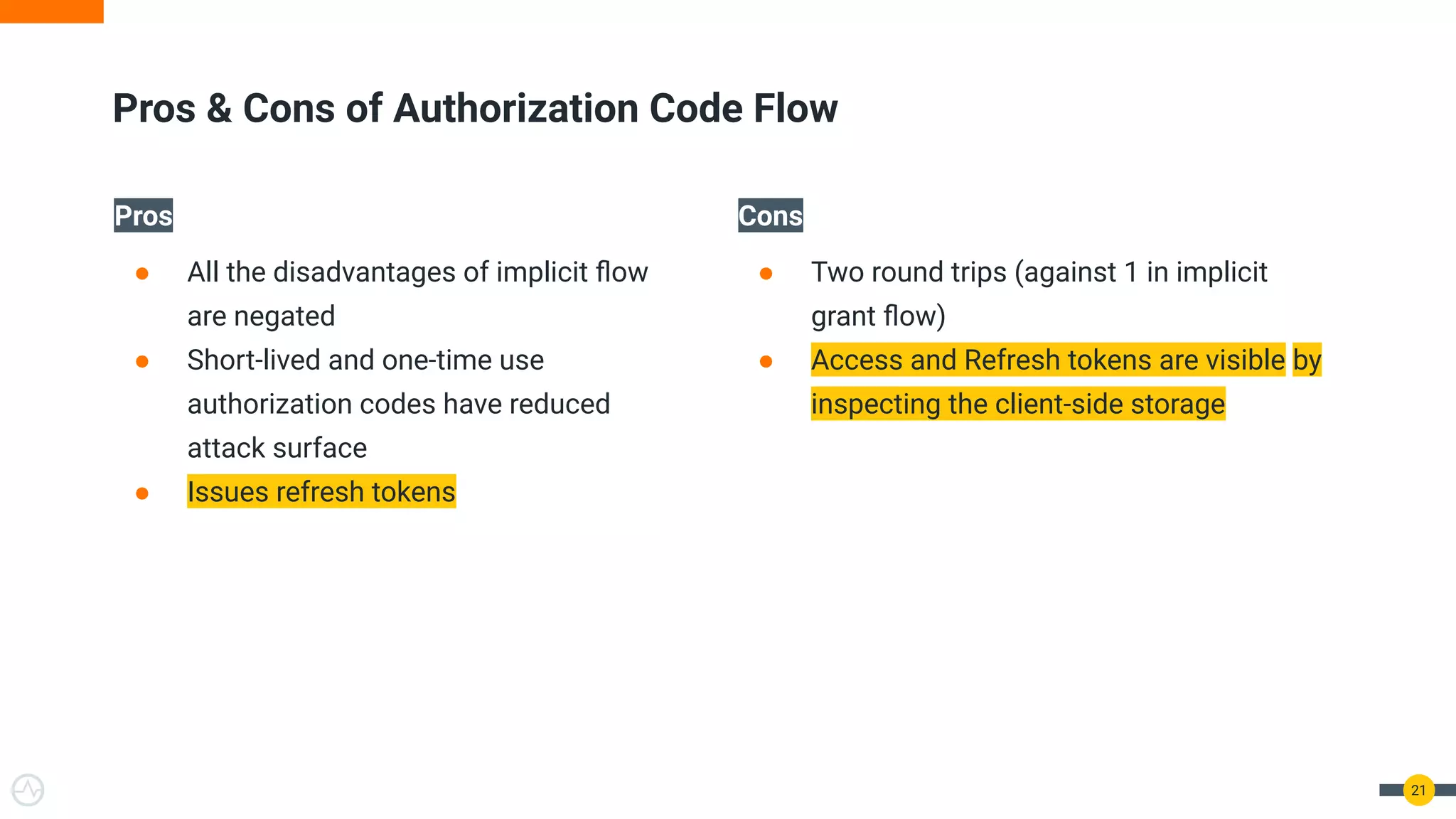
Pros
● All the disadvantages of implicit flow
are negated
● Short-lived and one-time use
authorization codes have reduced
attack surface
● Issues refresh tokens
Cons
● Two round trips (against 1 in implicit
grant flow)
● Access and Refresh tokens are visible by
inspecting the client-side storage
21
Pros & Cons of Authorization Code Flow
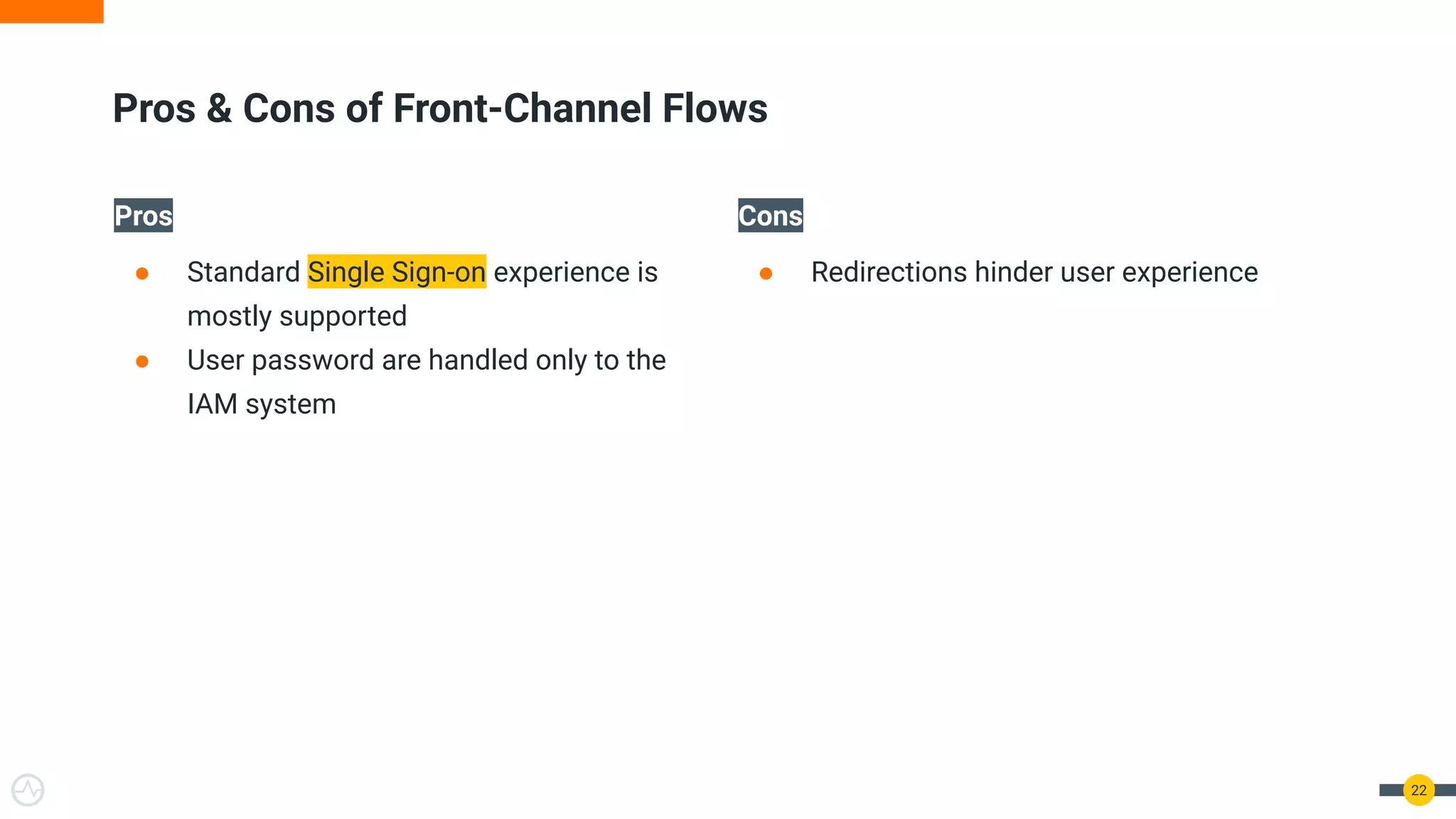
Pros
● Standard Single Sign-on experience is
mostly supported
● User password are handled only to the
IAM system
Cons
● Redirections hinder user experience
22
Pros & Cons of Front-Channel Flows
23
Improving the Redirection Experience OAuth 2.0 Public Clients
JavaScript Parent/Child Windows or Modals
https://medium.com/@johann_nallathamby/user-experiences-for-iam-on-the-web-2d3
9aa49f388
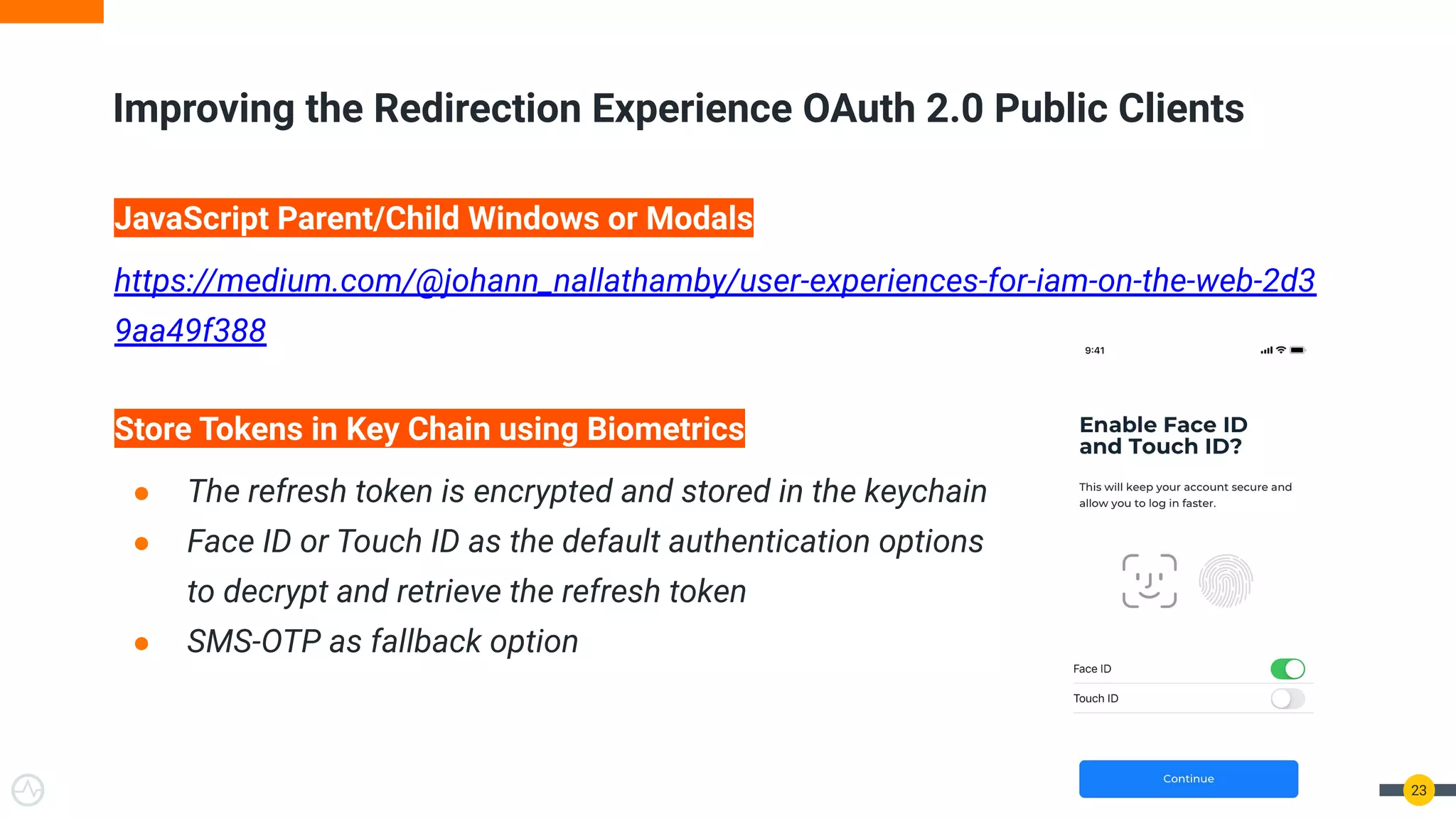
Store Tokens in Key Chain using Biometrics
● The refresh token is encrypted and stored in the keychain
● Face ID or Touch ID as the default authentication options
to decrypt and retrieve the refresh token
● SMS-OTP as fallback option
1. Thorough audits of source code, knowing exactly which third-party libraries are
being used in the application.
2. Have a strong Content Security Policy (CSP).
3. Most importantly be confident in your ability to build a secure the OAuth 2.0
Public Client.
Developer Challenges in OAuth 2.0 Public Clients
24
Securing Tokens at Rest in SPAs
26
Tokens Love Cookies
● Options to store Tokens in OAuth 2.0 public clients:
⦿ HTML5 Web Storage (localStorage and sessionStorage)
⦿ Cookies
● Cookies:
⦿ “httpOnly” - Built in protection against cross-site scripting
(XSS)
⦿ “Secure”
⦿ Support CORS
⦿ Vulnerable to CSRF
⦾ Synchronization Token pattern
⦾ Double-submit Cookie pattern
Cookies are preferred over HTML5 web storage with enough CSRF
protection ensured
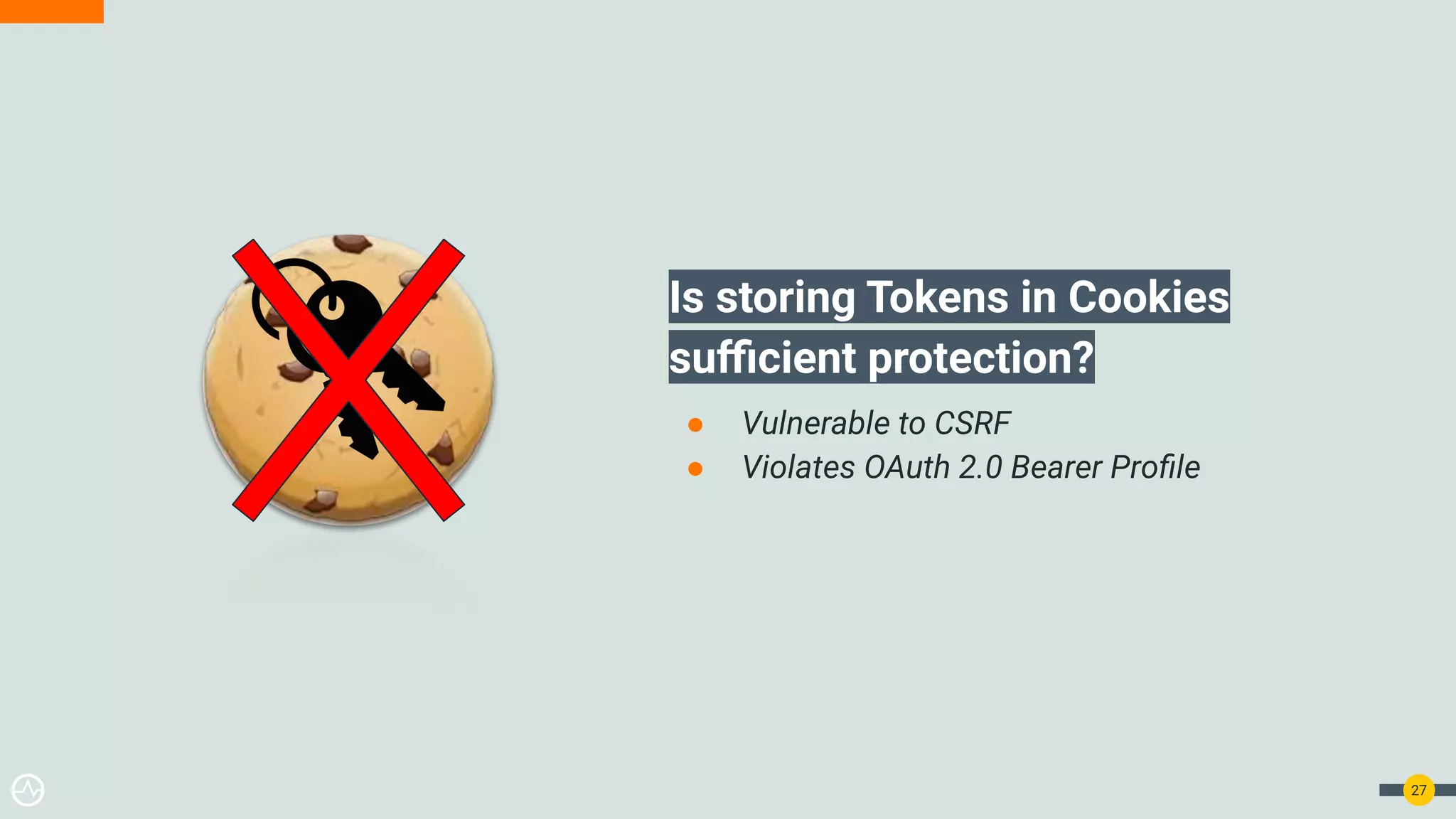
Is storing Tokens in Cookies
sufficient protection?
● Vulnerable to CSRF
● Violates OAuth 2.0 Bearer Profile
27
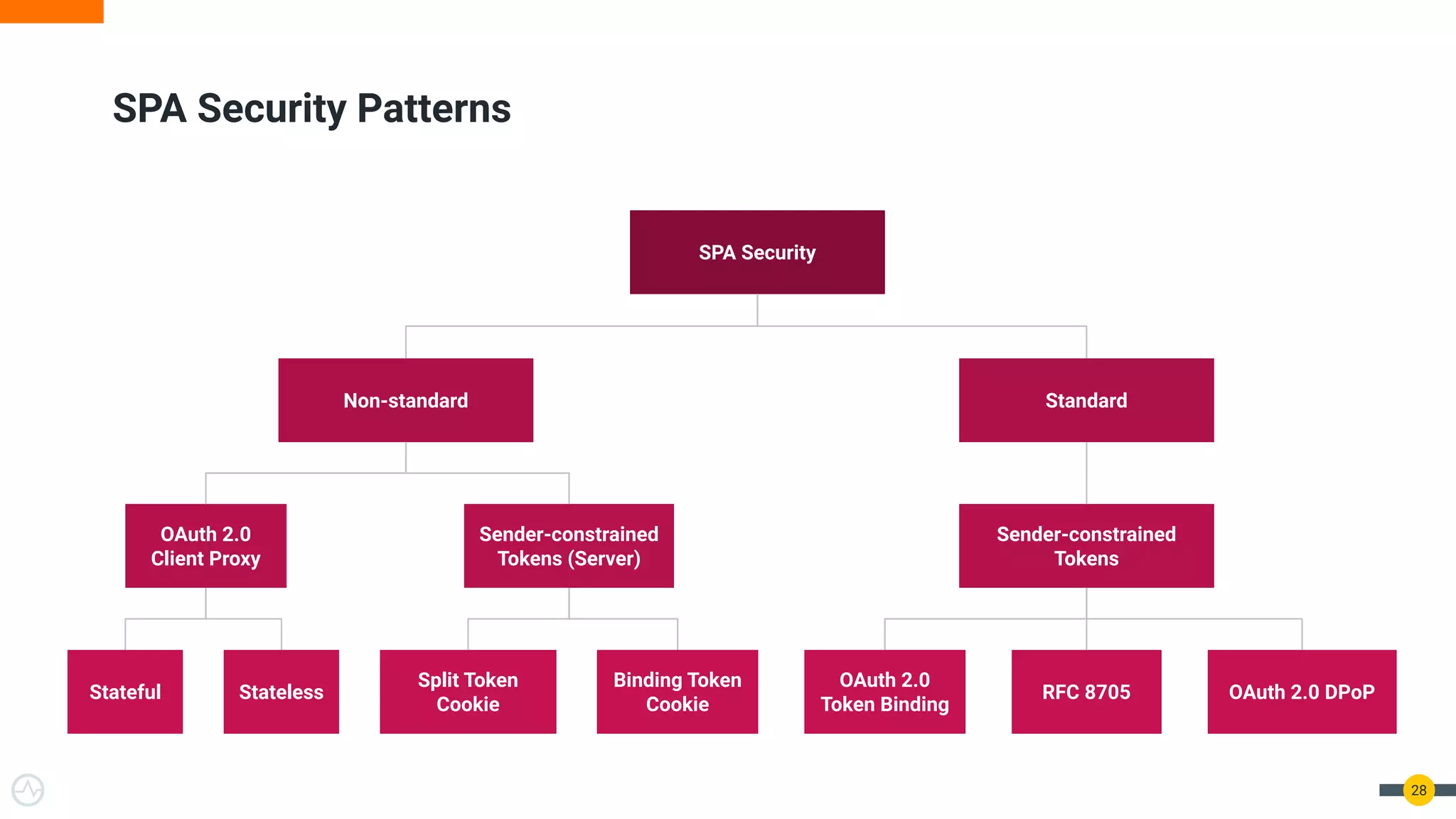
SPA Security Patterns
28
SPA Security
Non-standard Standard
Sender-constrained
Tokens
Sender-constrained
Tokens (Server)
OAuth 2.0
Client Proxy
Binding Token
Cookie
Split Token
Cookie
Stateless
Stateful
OAuth 2.0
Token Binding
OAuth 2.0 DPoP
RFC 8705
29
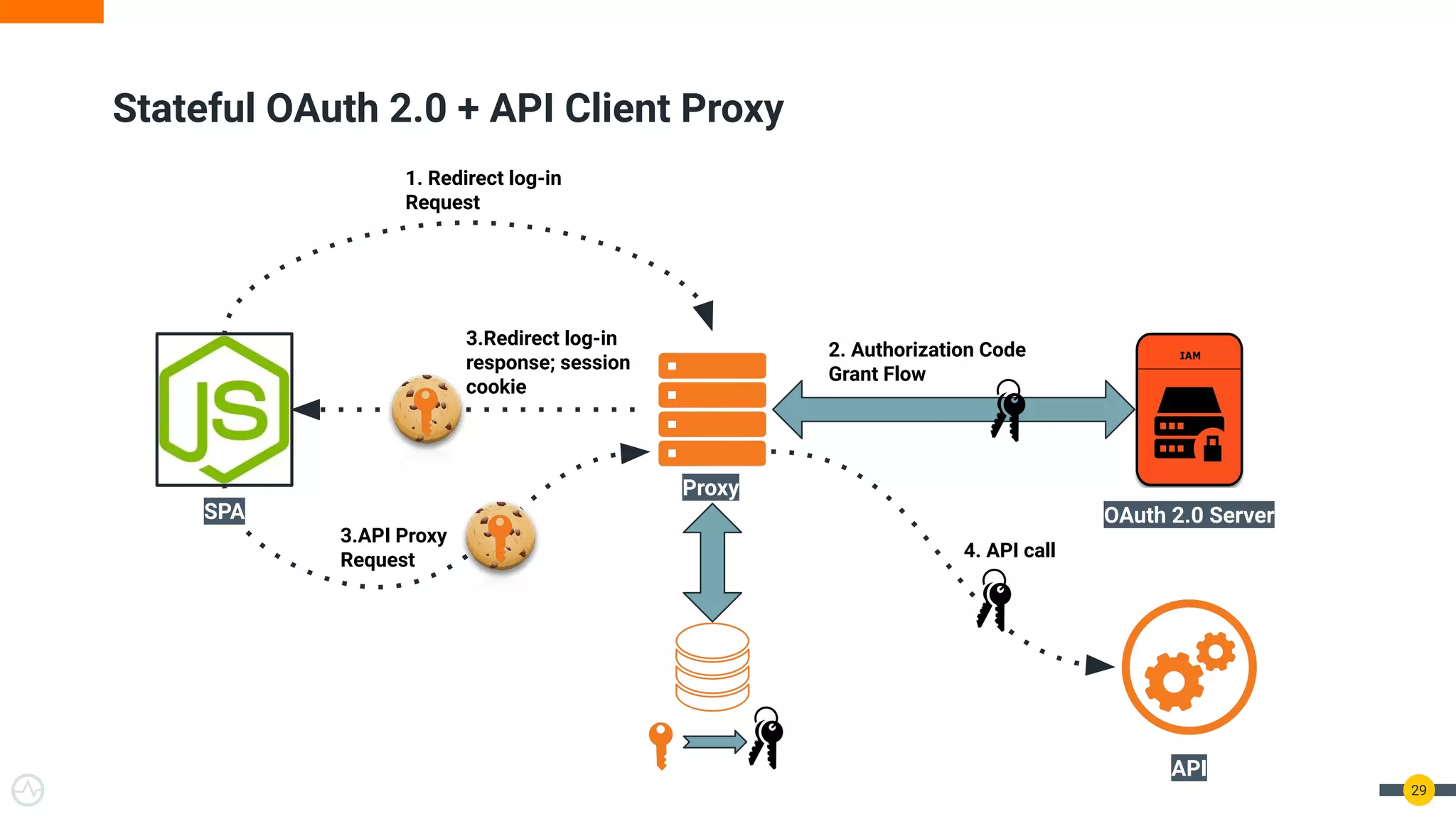
Stateful OAuth 2.0 + API Client Proxy
1. Redirect log-in
Request
2. Authorization Code
Grant Flow
3.Redirect log-in
response; session
cookie
3.API Proxy
Request 4. API call
API
Proxy
OAuth 2.0 Server
SPA
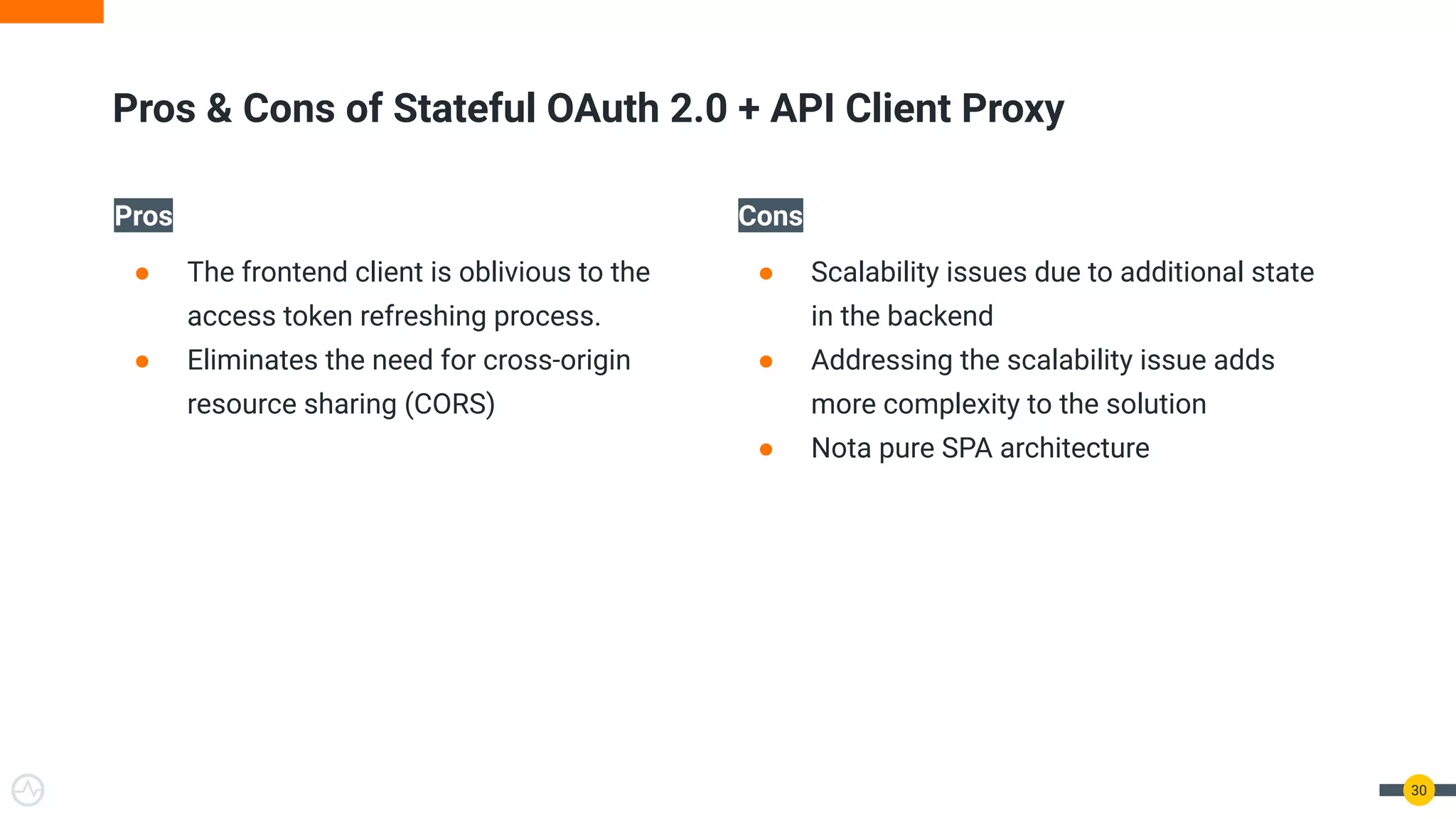
Pros
● The frontend client is oblivious to the
access token refreshing process.
● Eliminates the need for cross-origin
resource sharing (CORS)
Cons
● Scalability issues due to additional state
in the backend
● Addressing the scalability issue adds
more complexity to the solution
● Nota pure SPA architecture
30
Pros & Cons of Stateful OAuth 2.0 + API Client Proxy
31
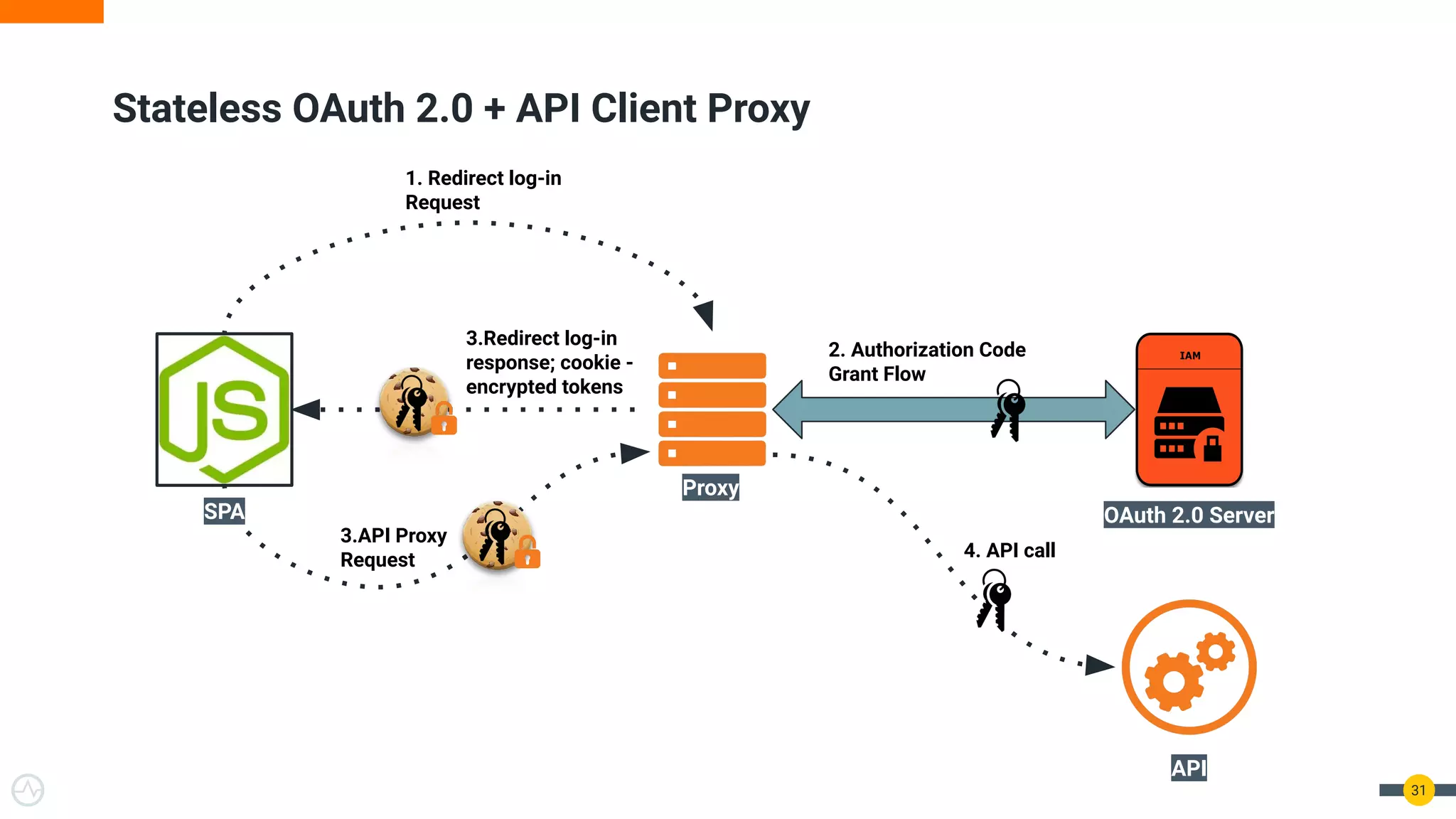
Stateless OAuth 2.0 + API Client Proxy
1. Redirect log-in
Request
2. Authorization Code
Grant Flow
3.Redirect log-in
response; cookie -
encrypted tokens
3.API Proxy
Request 4. API call
SPA OAuth 2.0 Server
API
Proxy
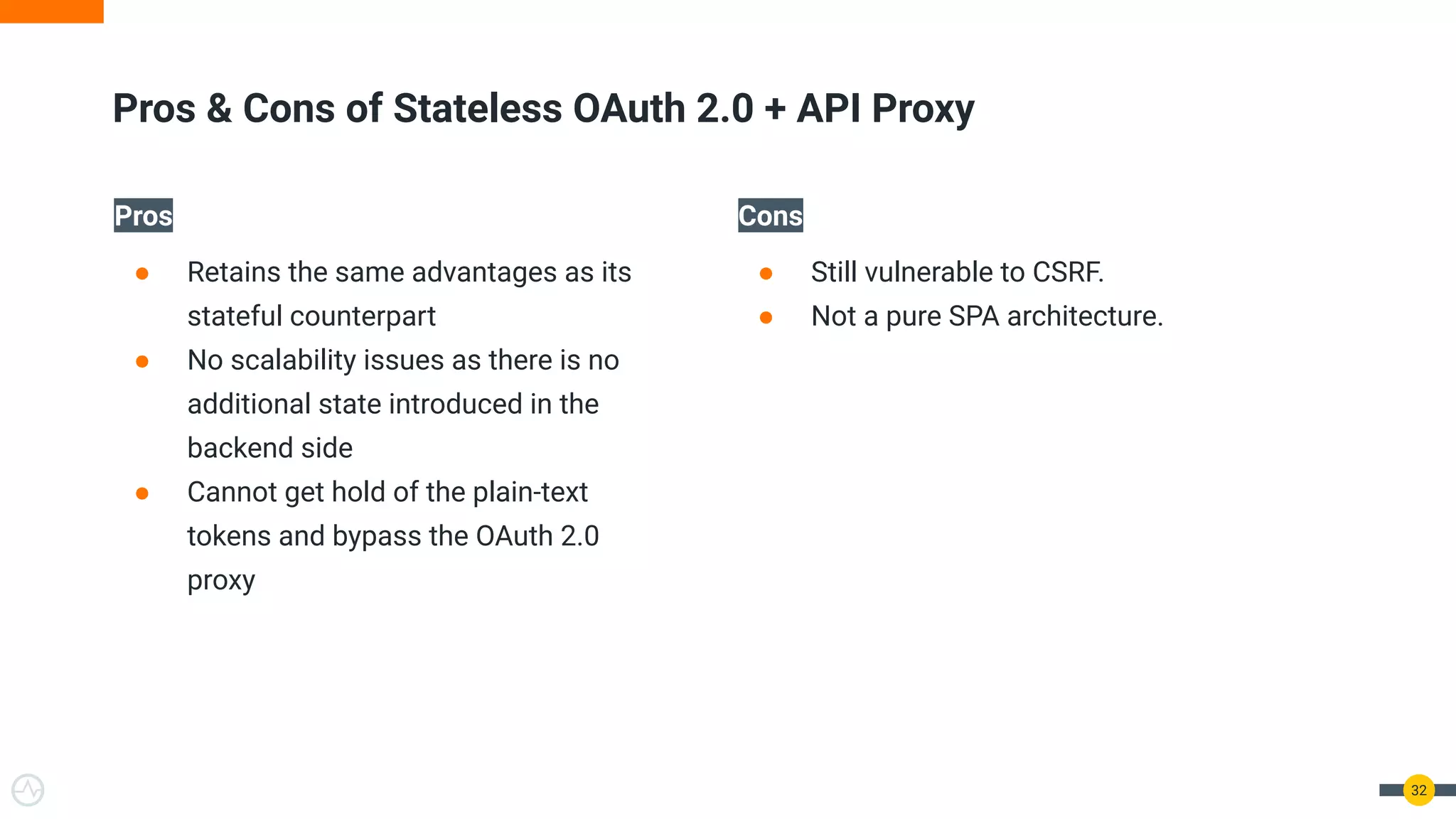
Pros
● Retains the same advantages as its
stateful counterpart
● No scalability issues as there is no
additional state introduced in the
backend side
● Cannot get hold of the plain-text
tokens and bypass the OAuth 2.0
proxy
Cons
● Still vulnerable to CSRF.
● Not a pure SPA architecture.
32
Pros & Cons of Stateless OAuth 2.0 + API Proxy
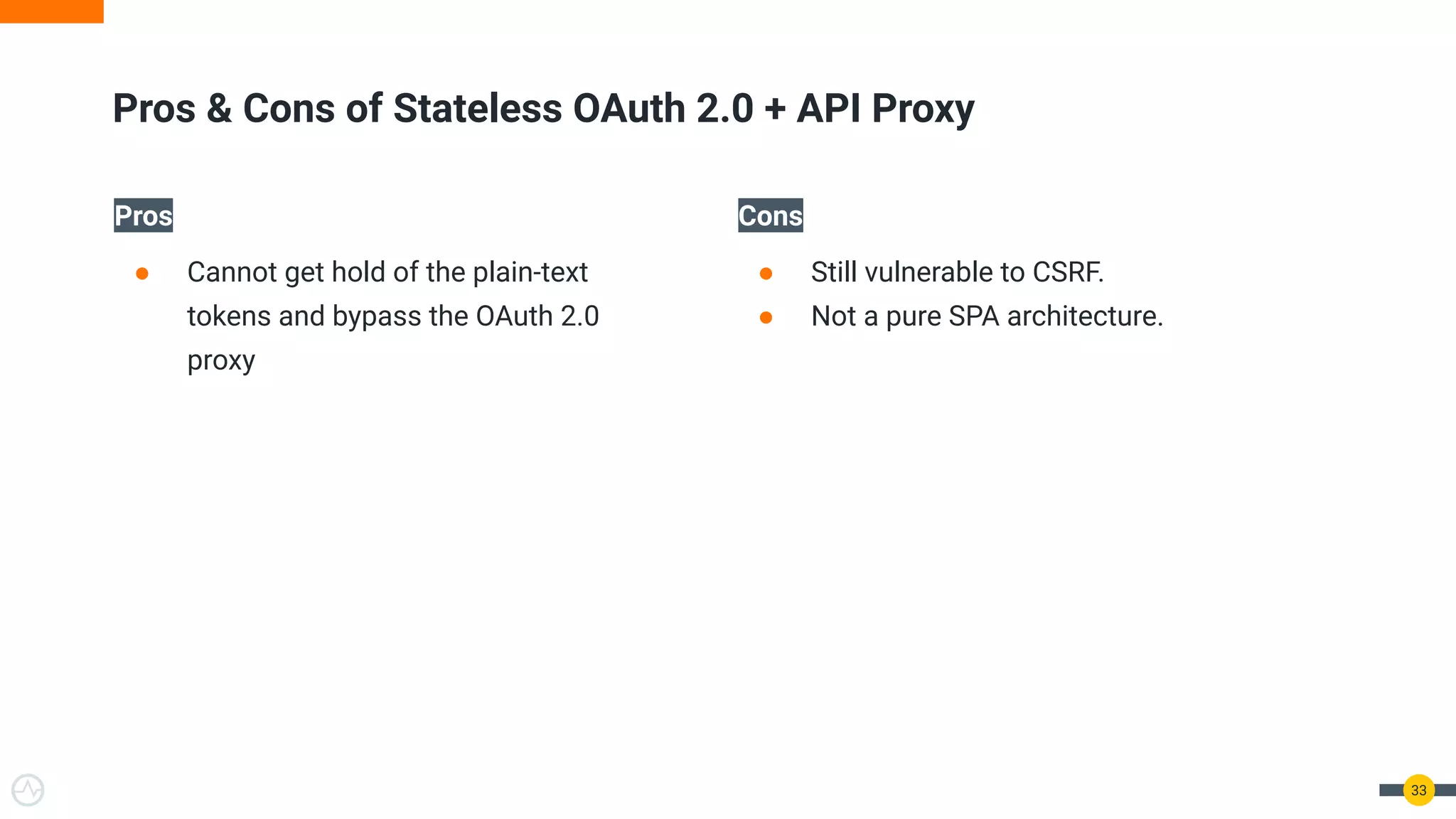
Pros
● Cannot get hold of the plain-text
tokens and bypass the OAuth 2.0
proxy
Cons
● Still vulnerable to CSRF.
● Not a pure SPA architecture.
33
Pros & Cons of Stateless OAuth 2.0 + API Proxy
34
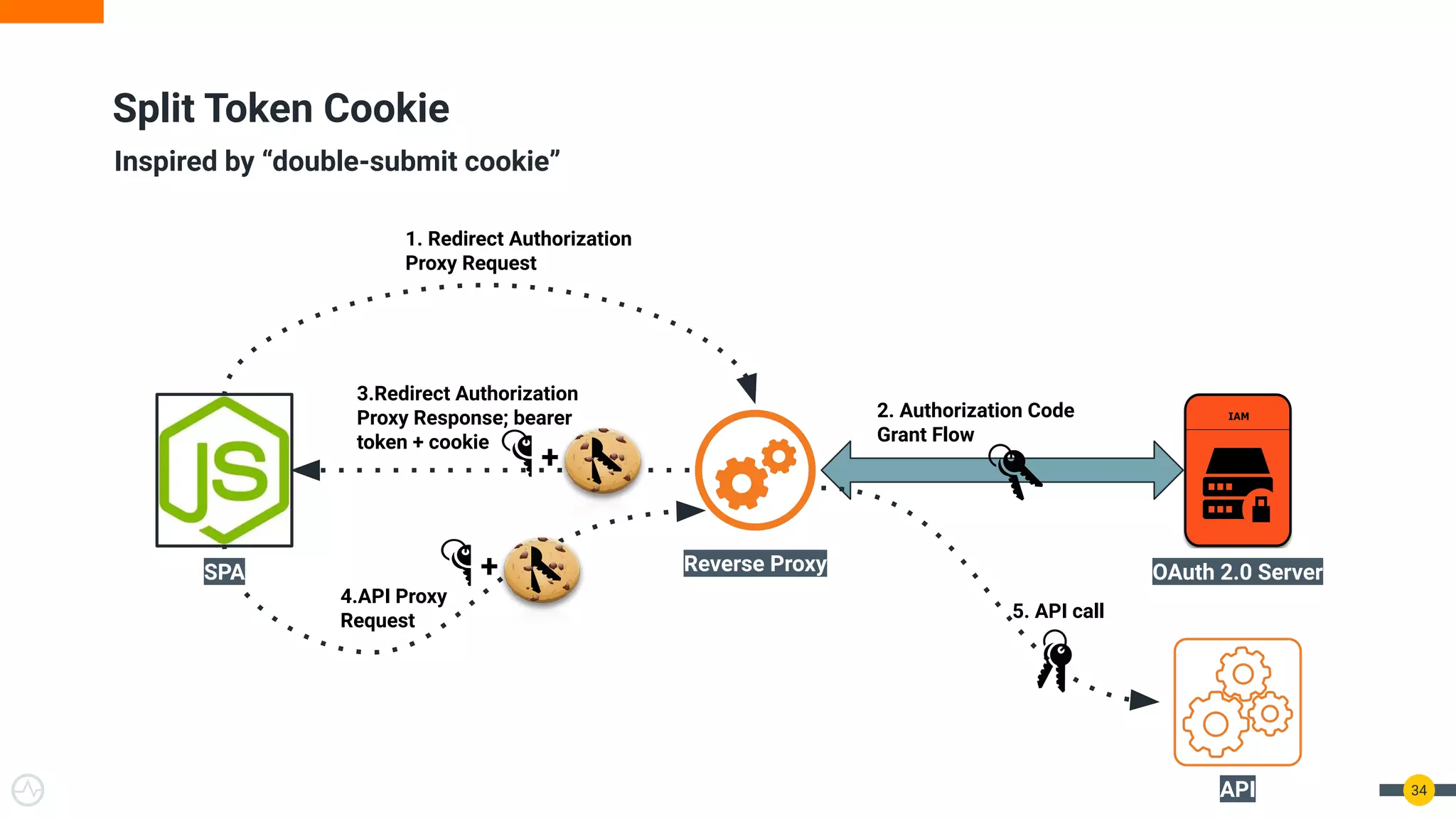
1. Redirect Authorization
Proxy Request
2. Authorization Code
Grant Flow
3.Redirect Authorization
Proxy Response; bearer
token + cookie
4.API Proxy
Request 5. API call
Inspired by “double-submit cookie”
Split Token Cookie
+
+
SPA
API
OAuth 2.0 Server
Reverse Proxy
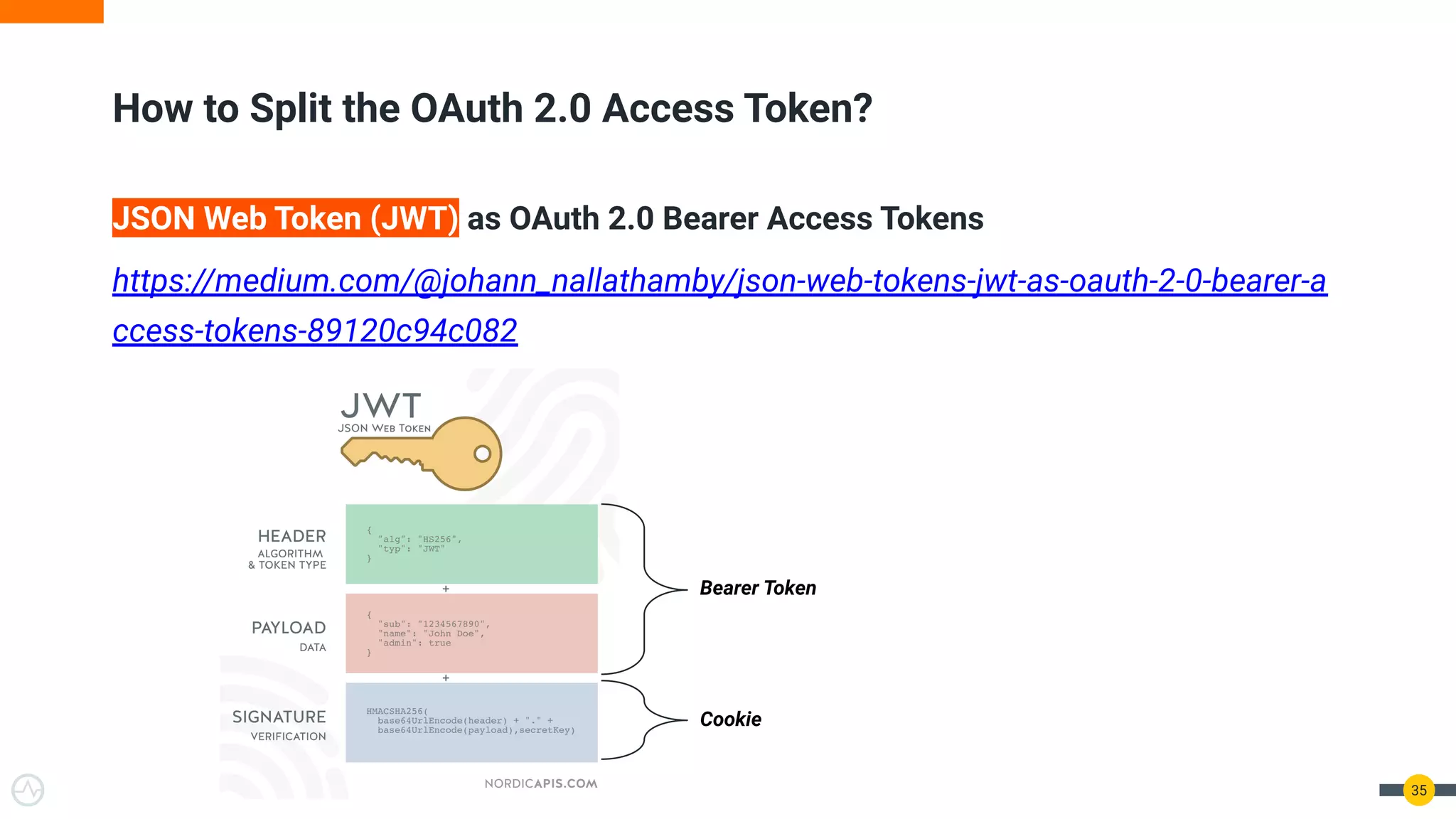
JSON Web Token (JWT) as OAuth 2.0 Bearer Access Tokens
https://medium.com/@johann_nallathamby/json-web-tokens-jwt-as-oauth-2-0-bearer-a
ccess-tokens-89120c94c082
35
How to Split the OAuth 2.0 Access Token?
Cookie
Bearer Token
36
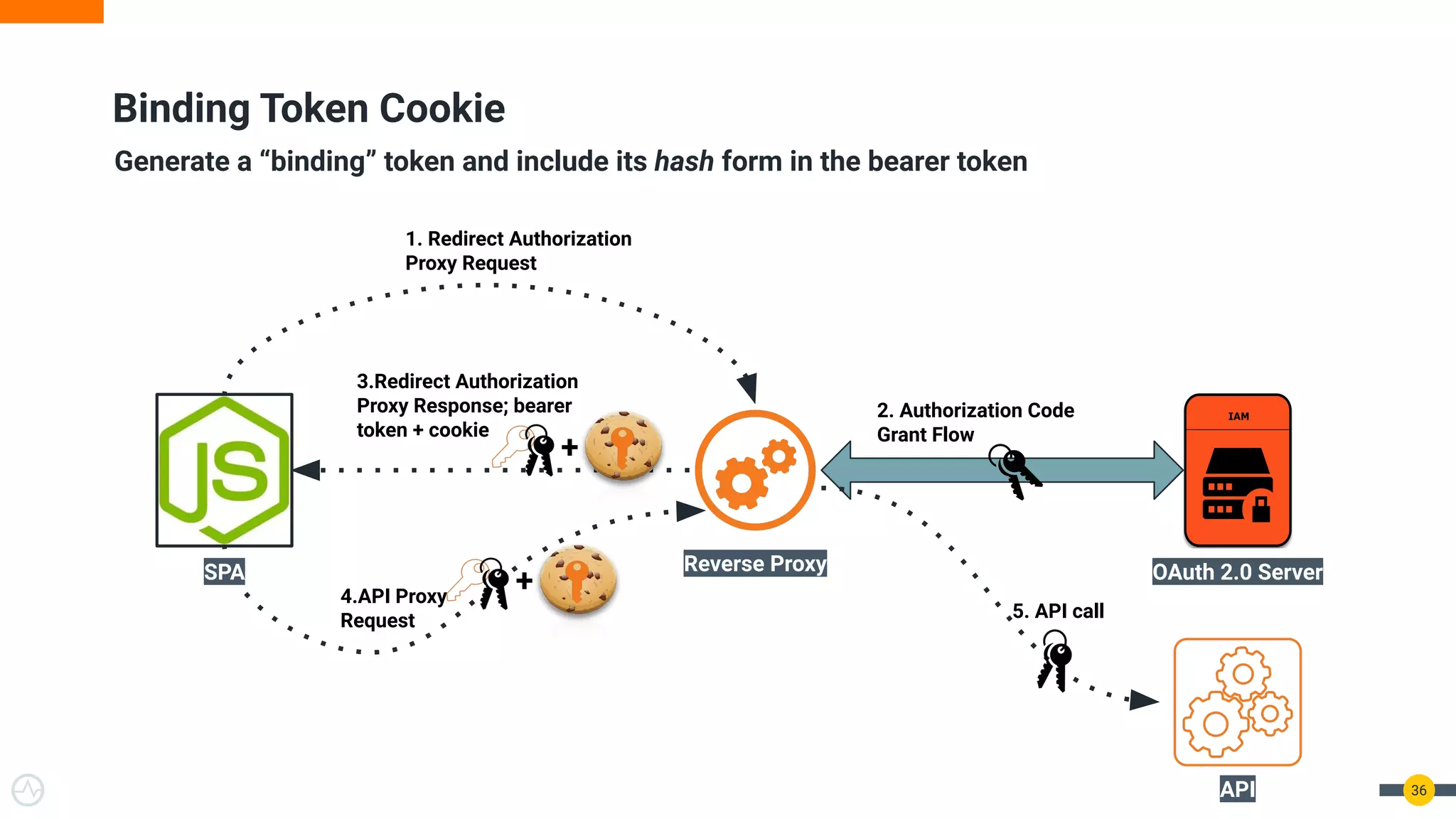
1. Redirect Authorization
Proxy Request
2. Authorization Code
Grant Flow
3.Redirect Authorization
Proxy Response; bearer
token + cookie
4.API Proxy
Request 5. API call
Binding Token Cookie
Generate a “binding” token and include its hash form in the bearer token
+
+
SPA Reverse Proxy OAuth 2.0 Server
API
37
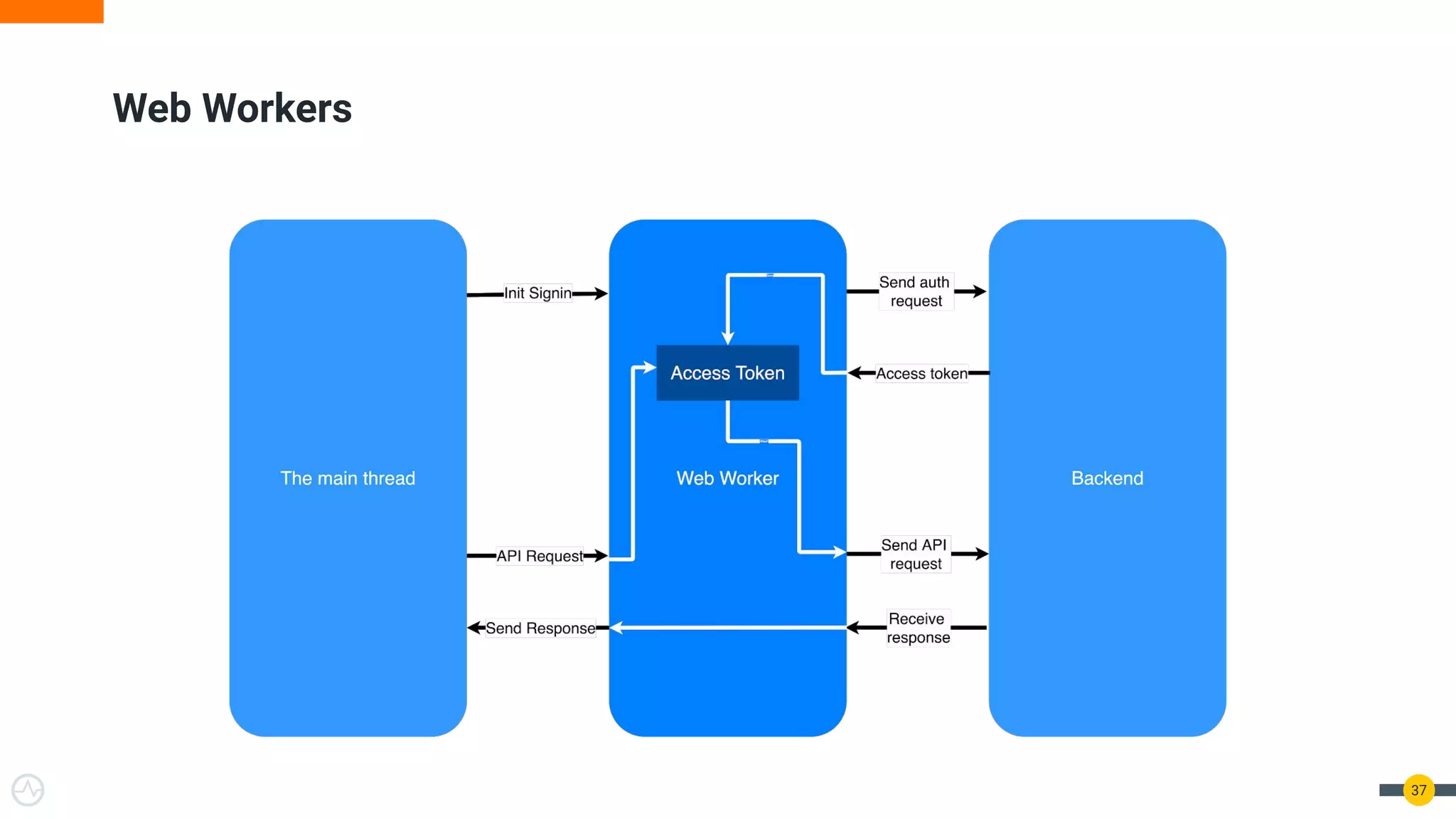
Web Workers
38
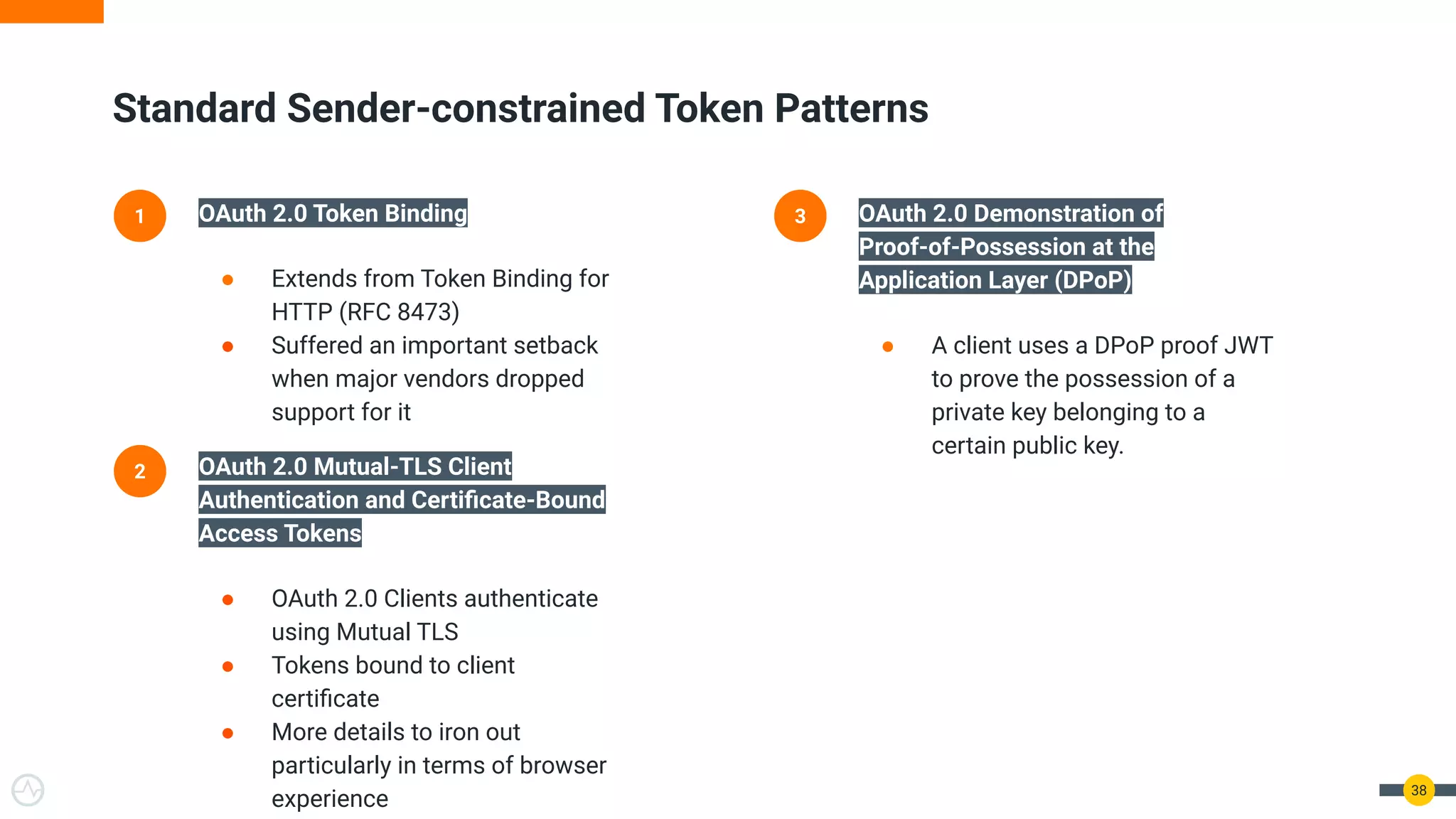
1 OAuth 2.0 Token Binding
● Extends from Token Binding for
HTTP (RFC 8473)
● Suffered an important setback
when major vendors dropped
support for it
2 OAuth 2.0 Mutual-TLS Client
Authentication and Certificate-Bound
Access Tokens
● OAuth 2.0 Clients authenticate
using Mutual TLS
● Tokens bound to client
certificate
● More details to iron out
particularly in terms of browser
experience
3 OAuth 2.0 Demonstration of
Proof-of-Possession at the
Application Layer (DPoP)
● A client uses a DPoP proof JWT
to prove the possession of a
private key belonging to a
certain public key.
Standard Sender-constrained Token Patterns
39
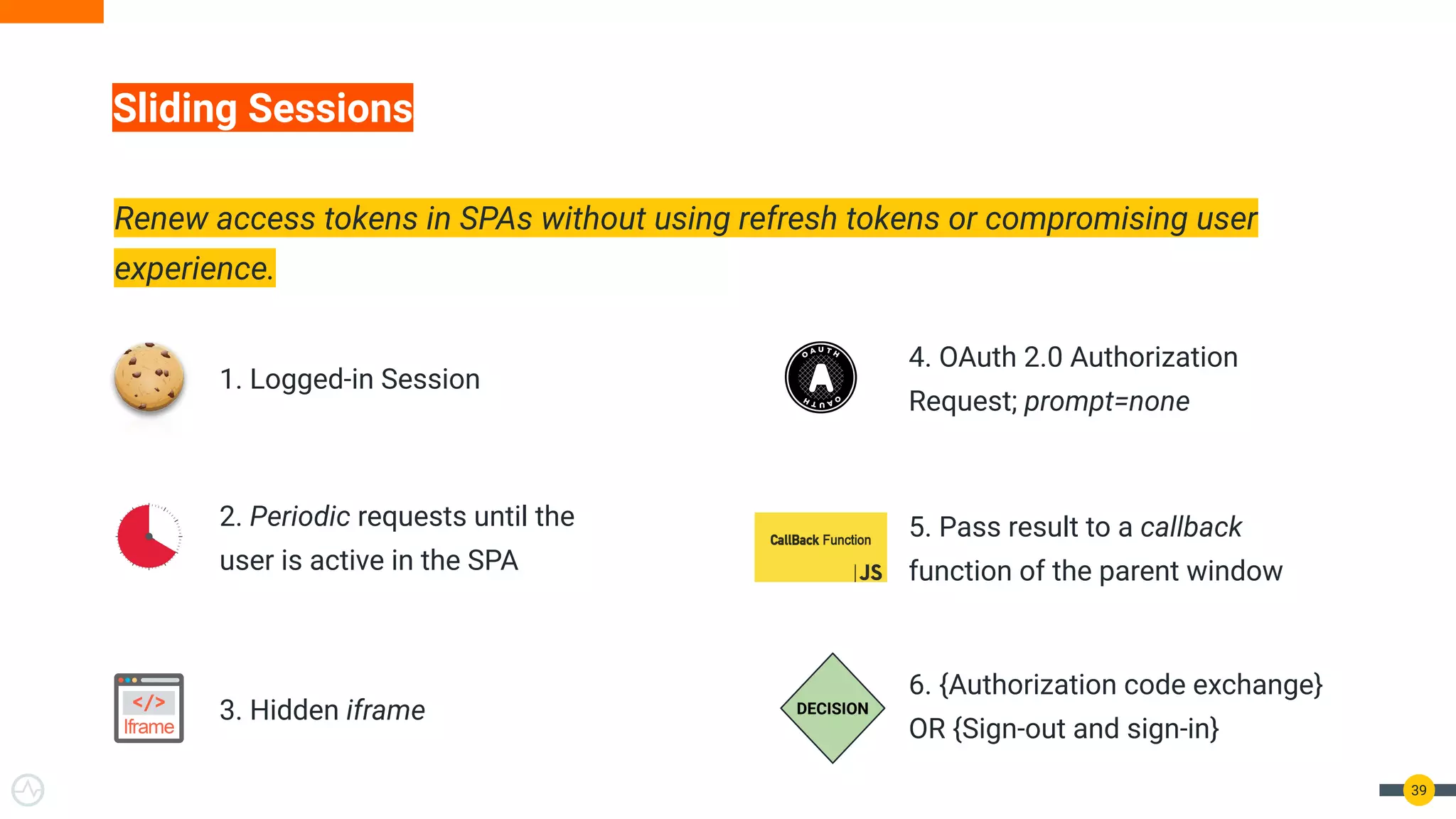
Sliding Sessions
Renew access tokens in SPAs without using refresh tokens or compromising user
experience.
1. Logged-in Session
2. Periodic requests until the
user is active in the SPA
3. Hidden iframe
5. Pass result to a callback
function of the parent window
4. OAuth 2.0 Authorization
Request; prompt=none
6. {Authorization code exchange}
OR {Sign-out and sign-in}
DECISION
OAuth 2.0 for Mobile Native Applications
The Evolution of OAuth 2.0 for Mobile Native Applications
41
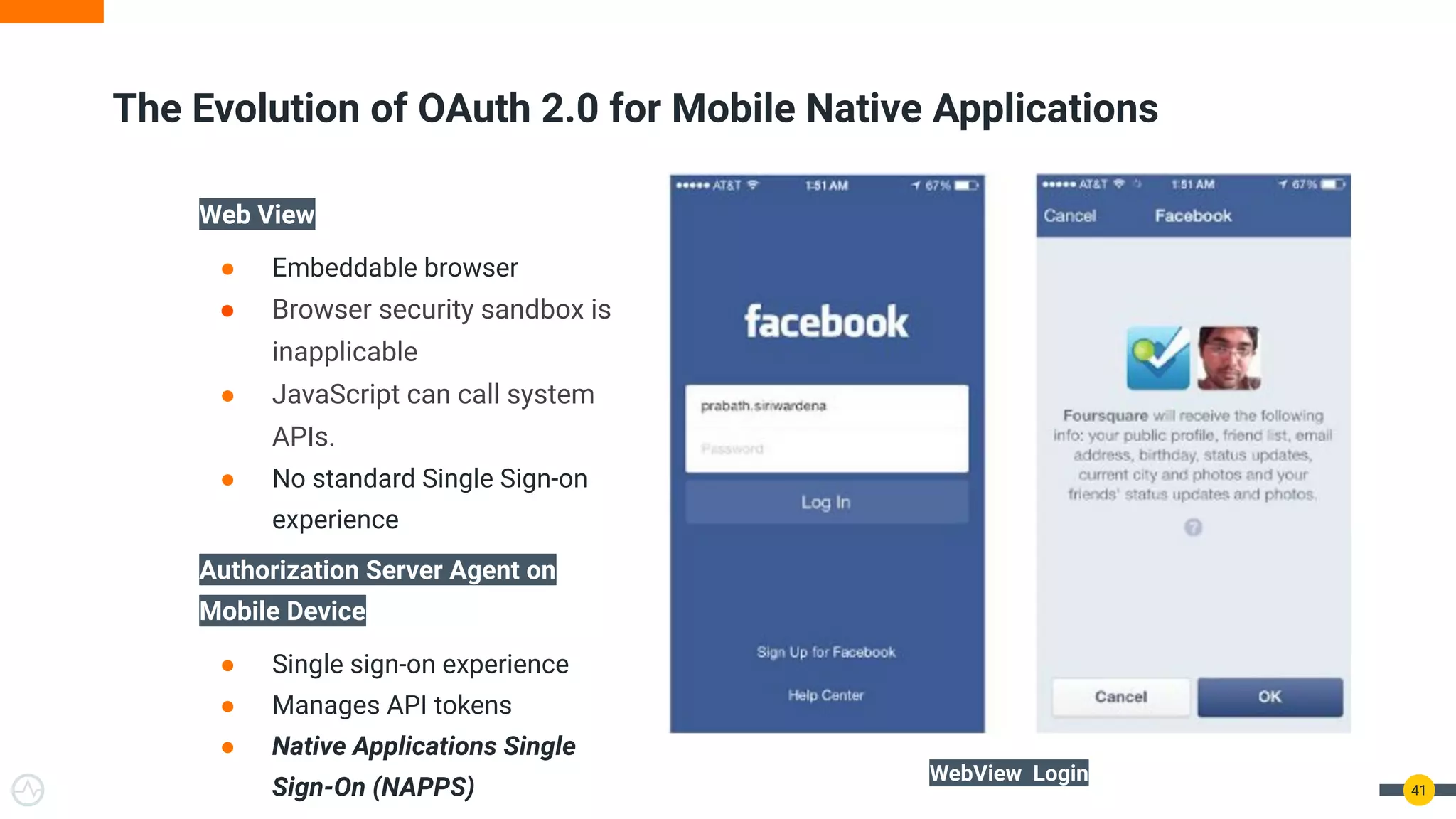
Web View
● Embeddable browser
● Browser security sandbox is
inapplicable
● JavaScript can call system
APIs.
● No standard Single Sign-on
experience
Authorization Server Agent on
Mobile Device
● Single sign-on experience
● Manages API tokens
● Native Applications Single
Sign-On (NAPPS)
WebView Login
42
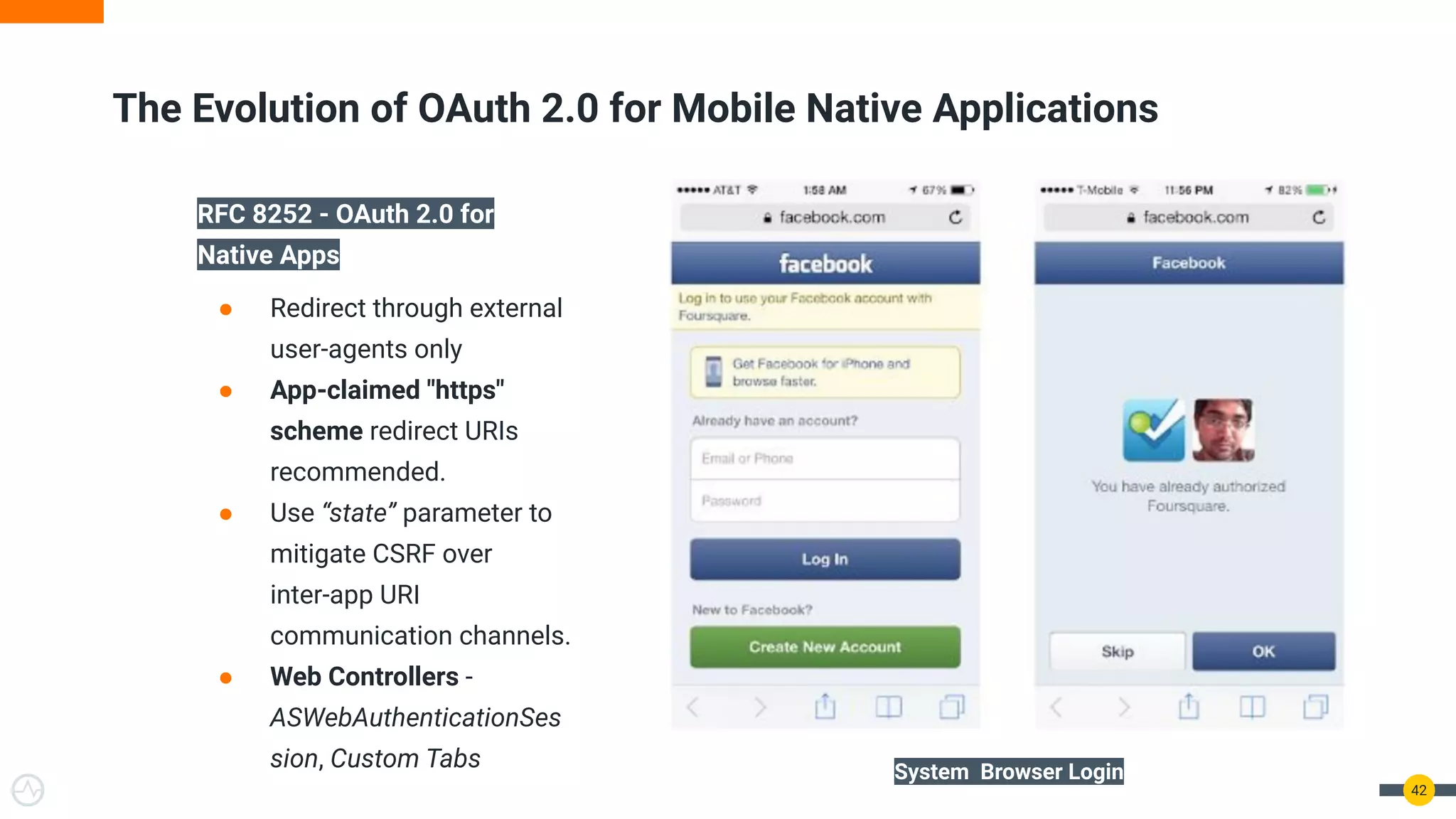
RFC 8252 - OAuth 2.0 for
Native Apps
● Redirect through external
user-agents only
● App-claimed "https"
scheme redirect URIs
recommended.
● Use “state” parameter to
mitigate CSRF over
inter-app URI
communication channels.
● Web Controllers -
ASWebAuthenticationSes
sion, Custom Tabs
The Evolution of OAuth 2.0 for Mobile Native Applications
System Browser Login
References
44
References
1. https://medium.com/@johann_nallathamby/a-primer-on-oauth-2-0-for-client-side
-applications-part-1-46072e3023d8
2. https://medium.com/@johann_nallathamby/a-primer-on-oauth-2-0-for-client-side
-applications-part-2-c234d0adb608
3. https://medium.com/@johann_nallathamby/a-primer-on-oauth-2-0-for-client-side
-applications-part-3-e1f0b56d4e07
4. https://medium.com/@johann_nallathamby/a-primer-on-oauth-2-0-for-client-side
-applications-part-4-be07e55fca64
Closing Remarks
Unfortunately, “bulletproof” security in Client-side
Applications DOES NOT EXIST!!
Protect against common types of attacks
Reduce the overall attack surface
The RIGHT solution for you depends on your application
requirements, BUT always consider moving away from a
browser storage design to a Backend-For-Frontend (BFF).
one,.
THANK YOU
wso2.com

[APIdays INTERFACE 2021] The Evolution of API Security for Client-side Applications

  • 1.
    The Evolution ofAPI Security for Client Side Applications June 30, 2021 johann@wso2.com Head of Solutions Architecture for IAM @ WSO2 Johann Dilantha Nallathamby
  • 2.
    Single Page ApplicationsMobile Applications 2 Client-side Application Technologies
  • 3.
  • 4.
    While Client-side Applicationshave existed before the introduction of OpenID Connect and OAuth 2.0, the advent of OAuth 2.0 and OIDC definitely stirred up a debate on the right way of performing authentication and API authorization for Client-side Applications. OpenID Connect has become the de-facto standard to authenticate users in Client-side Applications and OAuth 2.0 has become the defacto standard to authorize API invocations in Client-side Applications. Client-side Applications can be classified as OAuth 2.0 Public Clients. Client-side Applications & OAuth 2.0 4
  • 5.
    1. They cannotstore the client secret completely securely on the client-side 2. They cannot store the access tokens completely securely on the client-side OAuth 2.0 Public Clients 5
  • 6.
    Threats and MitigationStrategies for OAuth 2.0 Public Clients
  • 7.
    Threats due toCompromised Credentials/Tokens 7 Client Secret ● Illegal use of client_credentials grant flow ● Denial-of-service attacks on the resource server ● Impersonation of a legitimate client Access Token ● Illegal access of APIs ● Exhaustion of client’s throttling quota Refresh Token ● Illegal access of Token endpoint using refresh_token grant flow without client authentication
  • 8.
    Mitigation Strategies 8 Client Secret ●Disable client_credentials grant flow ● Enforce Redirect URI registration and strict validation. ● Provision per-instance client identifiers for native applications (RFC 7591) ● One-time-use client identifiers / rolling client identifiers. Access Token ● One-time-use access tokens / rolling access tokens / access token chaining. ● “Per-user per-client” throttling limits. ● Heuristic algorithms to detect token fraud. Refresh Token ● One-time-use refresh tokens / rolling refresh tokens
  • 9.
  • 10.
    Authentication and APIAuthorization Patterns 10 Authn & API Authz for CSAs Back-channel Front-channel Implicit Resource Owner Password Grant Legacy Authorization Code + PKCE Legacy Authorization Code
  • 11.
  • 12.
    (OIDC-like) Resource OwnerPassword Grant Client 12
  • 13.
    Pros ● No hindranceto user experience due to redirections Cons ● Standard Single Sign-on experience mostly not supported ● User passwords are handed to the application 13 Pros & Cons of Back-channel Flows
  • 14.
    Legacy Front-channel Client 14 ●JavaScript applications ● Cookie-based API authorization ● Session data read from ⦿ DOM on boot when loading the SPA ⦿ Backend API ⦿ Non “http-only” cookie
  • 15.
    Legacy Front-channel Client 15 ●Cookie-based API authorization ● Session data read from ⦿ DOM on boot when loading the SPA ⦿ Backend API
  • 16.
  • 17.
    17 OAuth 2.0 ClientSecret OAuth 2.0 authorization servers MAY issue client secrets to public clients ONLY IF they are unique to each installation of the application on a specific device. Redirect URIs MUST be registered and verified against the redirect URI in the authorization request.
  • 18.
    Pros ● Single roundtrip (against 2 in authorization code grant flow) ● Access token returned as a fragment URI ⦿ Doesn’t reach the backend server component Cons ● Access token returned as fragment URI ⦿ Visible in the URL address bar ⦿ Stored in the browser’s history ⦿ Browser Sync further increases the attack surface ● Unverified JavaScript (browser extensions) reading the access token ● Inadvertent logging of URL at proxy servers or getting disclosed through referrer headers ● Token interception attacks ● Access and Refresh tokens are visible by inspecting the client-side storage ● No refresh tokens 18 Pros & Cons of Implicit Flow
  • 19.
    Implicit Flow wascreated due to an old limitation in the browser Cross-Origin Resource Sharing 19
  • 20.
  • 21.
    Pros ● All thedisadvantages of implicit flow are negated ● Short-lived and one-time use authorization codes have reduced attack surface ● Issues refresh tokens Cons ● Two round trips (against 1 in implicit grant flow) ● Access and Refresh tokens are visible by inspecting the client-side storage 21 Pros & Cons of Authorization Code Flow
  • 22.
    Pros ● Standard SingleSign-on experience is mostly supported ● User password are handled only to the IAM system Cons ● Redirections hinder user experience 22 Pros & Cons of Front-Channel Flows
  • 23.
    23 Improving the RedirectionExperience OAuth 2.0 Public Clients JavaScript Parent/Child Windows or Modals https://medium.com/@johann_nallathamby/user-experiences-for-iam-on-the-web-2d3 9aa49f388 Store Tokens in Key Chain using Biometrics ● The refresh token is encrypted and stored in the keychain ● Face ID or Touch ID as the default authentication options to decrypt and retrieve the refresh token ● SMS-OTP as fallback option
  • 24.
    1. Thorough auditsof source code, knowing exactly which third-party libraries are being used in the application. 2. Have a strong Content Security Policy (CSP). 3. Most importantly be confident in your ability to build a secure the OAuth 2.0 Public Client. Developer Challenges in OAuth 2.0 Public Clients 24
  • 25.
    Securing Tokens atRest in SPAs
  • 26.
    26 Tokens Love Cookies ●Options to store Tokens in OAuth 2.0 public clients: ⦿ HTML5 Web Storage (localStorage and sessionStorage) ⦿ Cookies ● Cookies: ⦿ “httpOnly” - Built in protection against cross-site scripting (XSS) ⦿ “Secure” ⦿ Support CORS ⦿ Vulnerable to CSRF ⦾ Synchronization Token pattern ⦾ Double-submit Cookie pattern Cookies are preferred over HTML5 web storage with enough CSRF protection ensured
  • 27.
    Is storing Tokensin Cookies sufficient protection? ● Vulnerable to CSRF ● Violates OAuth 2.0 Bearer Profile 27
  • 28.
    SPA Security Patterns 28 SPASecurity Non-standard Standard Sender-constrained Tokens Sender-constrained Tokens (Server) OAuth 2.0 Client Proxy Binding Token Cookie Split Token Cookie Stateless Stateful OAuth 2.0 Token Binding OAuth 2.0 DPoP RFC 8705
  • 29.
    29 Stateful OAuth 2.0+ API Client Proxy 1. Redirect log-in Request 2. Authorization Code Grant Flow 3.Redirect log-in response; session cookie 3.API Proxy Request 4. API call API Proxy OAuth 2.0 Server SPA
  • 30.
    Pros ● The frontendclient is oblivious to the access token refreshing process. ● Eliminates the need for cross-origin resource sharing (CORS) Cons ● Scalability issues due to additional state in the backend ● Addressing the scalability issue adds more complexity to the solution ● Nota pure SPA architecture 30 Pros & Cons of Stateful OAuth 2.0 + API Client Proxy
  • 31.
    31 Stateless OAuth 2.0+ API Client Proxy 1. Redirect log-in Request 2. Authorization Code Grant Flow 3.Redirect log-in response; cookie - encrypted tokens 3.API Proxy Request 4. API call SPA OAuth 2.0 Server API Proxy
  • 32.
    Pros ● Retains thesame advantages as its stateful counterpart ● No scalability issues as there is no additional state introduced in the backend side ● Cannot get hold of the plain-text tokens and bypass the OAuth 2.0 proxy Cons ● Still vulnerable to CSRF. ● Not a pure SPA architecture. 32 Pros & Cons of Stateless OAuth 2.0 + API Proxy
  • 33.
    Pros ● Cannot gethold of the plain-text tokens and bypass the OAuth 2.0 proxy Cons ● Still vulnerable to CSRF. ● Not a pure SPA architecture. 33 Pros & Cons of Stateless OAuth 2.0 + API Proxy
  • 34.
    34 1. Redirect Authorization ProxyRequest 2. Authorization Code Grant Flow 3.Redirect Authorization Proxy Response; bearer token + cookie 4.API Proxy Request 5. API call Inspired by “double-submit cookie” Split Token Cookie + + SPA API OAuth 2.0 Server Reverse Proxy
  • 35.
    JSON Web Token(JWT) as OAuth 2.0 Bearer Access Tokens https://medium.com/@johann_nallathamby/json-web-tokens-jwt-as-oauth-2-0-bearer-a ccess-tokens-89120c94c082 35 How to Split the OAuth 2.0 Access Token? Cookie Bearer Token
  • 36.
    36 1. Redirect Authorization ProxyRequest 2. Authorization Code Grant Flow 3.Redirect Authorization Proxy Response; bearer token + cookie 4.API Proxy Request 5. API call Binding Token Cookie Generate a “binding” token and include its hash form in the bearer token + + SPA Reverse Proxy OAuth 2.0 Server API
  • 37.
  • 38.
    38 1 OAuth 2.0Token Binding ● Extends from Token Binding for HTTP (RFC 8473) ● Suffered an important setback when major vendors dropped support for it 2 OAuth 2.0 Mutual-TLS Client Authentication and Certificate-Bound Access Tokens ● OAuth 2.0 Clients authenticate using Mutual TLS ● Tokens bound to client certificate ● More details to iron out particularly in terms of browser experience 3 OAuth 2.0 Demonstration of Proof-of-Possession at the Application Layer (DPoP) ● A client uses a DPoP proof JWT to prove the possession of a private key belonging to a certain public key. Standard Sender-constrained Token Patterns
  • 39.
    39 Sliding Sessions Renew accesstokens in SPAs without using refresh tokens or compromising user experience. 1. Logged-in Session 2. Periodic requests until the user is active in the SPA 3. Hidden iframe 5. Pass result to a callback function of the parent window 4. OAuth 2.0 Authorization Request; prompt=none 6. {Authorization code exchange} OR {Sign-out and sign-in} DECISION
  • 40.
    OAuth 2.0 forMobile Native Applications
  • 41.
    The Evolution ofOAuth 2.0 for Mobile Native Applications 41 Web View ● Embeddable browser ● Browser security sandbox is inapplicable ● JavaScript can call system APIs. ● No standard Single Sign-on experience Authorization Server Agent on Mobile Device ● Single sign-on experience ● Manages API tokens ● Native Applications Single Sign-On (NAPPS) WebView Login
  • 42.
    42 RFC 8252 -OAuth 2.0 for Native Apps ● Redirect through external user-agents only ● App-claimed "https" scheme redirect URIs recommended. ● Use “state” parameter to mitigate CSRF over inter-app URI communication channels. ● Web Controllers - ASWebAuthenticationSes sion, Custom Tabs The Evolution of OAuth 2.0 for Mobile Native Applications System Browser Login
  • 43.
  • 44.
    44 References 1. https://medium.com/@johann_nallathamby/a-primer-on-oauth-2-0-for-client-side -applications-part-1-46072e3023d8 2. https://medium.com/@johann_nallathamby/a-primer-on-oauth-2-0-for-client-side -applications-part-2-c234d0adb608 3.https://medium.com/@johann_nallathamby/a-primer-on-oauth-2-0-for-client-side -applications-part-3-e1f0b56d4e07 4. https://medium.com/@johann_nallathamby/a-primer-on-oauth-2-0-for-client-side -applications-part-4-be07e55fca64
  • 45.
  • 46.
    Unfortunately, “bulletproof” securityin Client-side Applications DOES NOT EXIST!! Protect against common types of attacks Reduce the overall attack surface The RIGHT solution for you depends on your application requirements, BUT always consider moving away from a browser storage design to a Backend-For-Frontend (BFF). one,.
  • 47.