Microsoft Security Development
Lifecycle (SDL)
Razi Rais | Senior Software Engineer | Microsoft
Who am I?
https://razibinrais.com
www.linkedin.com/in/razirais
https://github.com/razi-rais
Tech Foundation User Group
 Founder
 Established in 2011
 IT Pros and Developers
 Open for all to join!
JOIN  https://www.meetup.com/techfoundation
Key Takeaways
 Understand SDL (Secure Development Lifecycle)
 Process & Practices needed for SDL
 Threat Modeling
 Q&A
 Slides  will be emailed to you!
 Reach out for full workshop!
History of SDL | Started with a memo!!
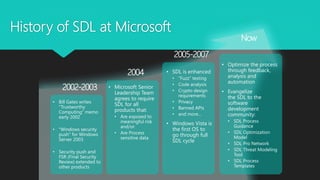
History of SDL at Microsoft
• Bill Gates writes
“Trustworthy
Computing” memo
early 2002
• “Windows security
push” for Windows
Server 2003
• Security push and
FSR (Final Security
Review) extended to
other products
• Microsoft Senior
Leadership Team
agrees to require
SDL for all
products that:
• Are exposed to
meaningful risk
and/or
• Are Process
sensitive data
• SDL is enhanced
• “Fuzz” testing
• Code analysis
• Crypto design
requirements
• Privacy
• Banned APIs
• and more…
• Windows Vista is
the first OS to
go through full
SDL cycle
• Optimize the process
through feedback,
analysis and
automation
• Evangelize
the SDL to the
software
development
community:
• SDL Process
Guidance
• SDL Optimization
Model
• SDL Pro Network
• SDL Threat Modeling
Tool
• SDL Process
Templates
2002-2003
2004
2005-2007
Now
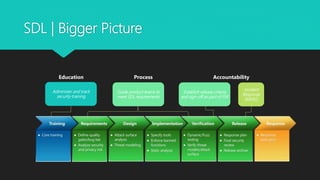
SDL | Bigger Picture
Education Accountability
Administer and track
security training
Incident
Response
(MSRC)
Establish release criteria
and sign-off as part of FSR
Process
Guide product teams to
meet SDL requirements
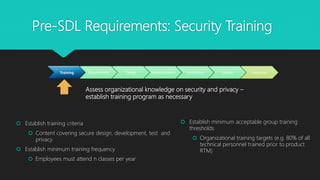
Pre-SDL Requirements: Security Training
Requirements Design Implementation Verification Release Response
Assess organizational knowledge on security and privacy –
establish training program as necessary
 Establish training criteria
 Content covering secure design, development, test and
privacy
 Establish minimum training frequency
 Employees must attend n classes per year
 Establish minimum acceptable group training
thresholds
 Organizational training targets (e.g. 80% of all
technical personnel trained prior to product
RTM)
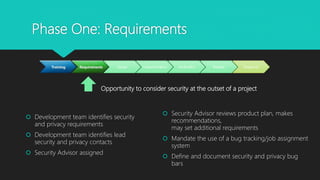
Phase One: Requirements
Opportunity to consider security at the outset of a project
Design Implementation Verification Release Response
 Security Advisor reviews product plan, makes
recommendations,
may set additional requirements
 Mandate the use of a bug tracking/job assignment
system
 Define and document security and privacy bug
bars
 Development team identifies security
and privacy requirements
 Development team identifies lead
security and privacy contacts
 Security Advisor assigned
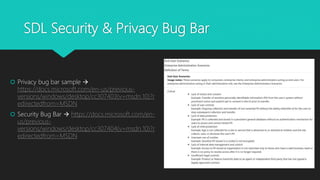
SDL Security & Privacy Bug Bar
 Privacy bug bar sample 
https://docs.microsoft.com/en-us/previous-
versions/windows/desktop/cc307403(v=msdn.10)?r
edirectedfrom=MSDN
 Security Bug Bar  https://docs.microsoft.com/en-
us/previous-
versions/windows/desktop/cc307404(v=msdn.10)?r
edirectedfrom=MSDN
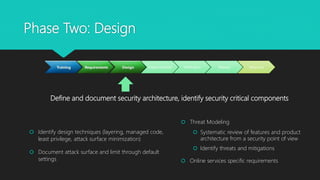
Phase Two: Design
 Identify design techniques (layering, managed code,
least privilege, attack surface minimization)
 Document attack surface and limit through default
settings
Define and document security architecture, identify security critical components
Implementation Verification Release Response
 Threat Modeling
 Systematic review of features and product
architecture from a security point of view
 Identify threats and mitigations
 Online services specific requirements
Phase Three: Implementation
Full spectrum review – used to determine processes, documentation
and tools necessary to ensure secure deployment and operation
Verification Release Response
 Specification of approved build tools and
options
 Static analysis (PREFix, /analyze (PREfast),
FXCop)
 Banned APIs
 Use of operating system “defense in depth”
protections
(NX, ASLR and HeapTermination)
 Online services specific requirements (e.g.,
Cross-site scripting ,
SQL Injection etc.)
 Consider other recommendations (e.g.,
Standard Annotation Language (SAL))
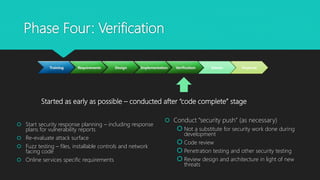
Phase Four: Verification
Started as early as possible – conducted after “code complete” stage
Release Response
 Start security response planning – including response
plans for vulnerability reports
 Re-evaluate attack surface
 Fuzz testing – files, installable controls and network
facing code
 Online services specific requirements
 Conduct “security push” (as necessary)
 Not a substitute for security work done during
development
 Code review
 Penetration testing and other security testing
 Review design and architecture in light of new
threats
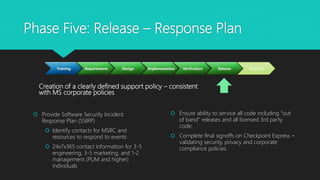
Phase Five: Release – Response Plan
Creation of a clearly defined support policy – consistent
with MS corporate policies
Response
 Provide Software Security Incident
Response Plan (SSIRP)
 Identify contacts for MSRC and
resources to respond to events
 24x7x365 contact information for 3-5
engineering, 3-5 marketing, and 1-2
management (PUM and higher)
individuals
 Ensure ability to service all code including “out
of band” releases and all licensed 3rd party
code.
 Complete final signoffs on Checkpoint Express –
validating security, privacy and corporate
compliance policies
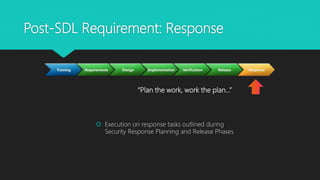
Post-SDL Requirement: Response
“Plan the work, work the plan…”
 Execution on response tasks outlined during
Security Response Planning and Release Phases
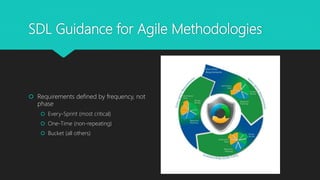
SDL Guidance for Agile Methodologies
 Requirements defined by frequency, not
phase
 Every-Sprint (most critical)
 One-Time (non-repeating)
 Bucket (all others)
Alert: SDL Requires Process Improvement!
 Simply “looking for bugs” doesn’t make
software secure
 Must reduce the chance vulnerabilities enter
into design and code
 Requires executive commitment
 Requires ongoing process improvement
 Requires education & training
 Requires tools and automation
 Requires incentives and consequences
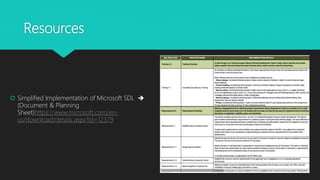
Resources
 Simplified Implementation of Microsoft SDL 
(Document & Planning
Sheet)https://www.microsoft.com/en-
us/download/details.aspx?id=12379
Resources
 Practical Guide to A Practical Guide to Designing
Secure Health Solutions Using Microsoft Azure 
https://aka.ms/azureindustrysecurity
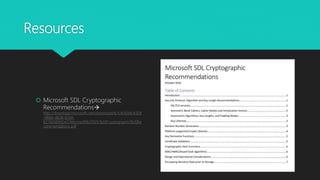
Resources
 Microsoft SDL Cryptographic
Recommendations
http://download.microsoft.com/download/6/3/A/63AFA3DF
-BB84-4B38-8704-
B27605B99DA7/Microsoft%20SDL%20Cryptographic%20Re
commendations.pdf
Resources
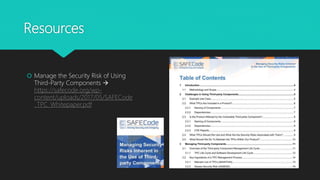
 Manage the Security Risk of Using
Third-Party Components 
https://safecode.org/wp-
content/uploads/2017/05/SAFECode
_TPC_Whitepaper.pdf
Resources
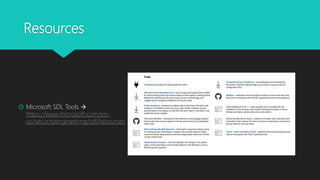
 Microsoft SDL Tools 
https://www.microsoft.com/en-
us/securityengineering/sdl/resources
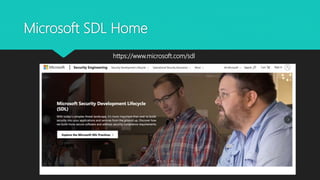
Microsoft SDL Home
https://www.microsoft.com/sdl
Threat Modeling
 Why?
 Find security and privacy problems when
there’s time to fix them
 Security Development Lifecycle (SDL)
requirement
 Deliver more secure products
 Who?
 The bad guys will do a good job of it!
 Maybe you will…your choice
 What?
 A repeatable process to find and address threats
to your product
 When?
 The earlier you start, the more time to plan and
fix
 Worst case is when you’re trying to ship/release
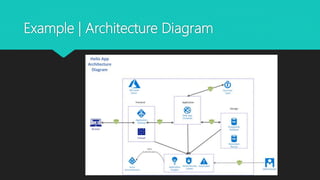
Example | Architecture Diagram
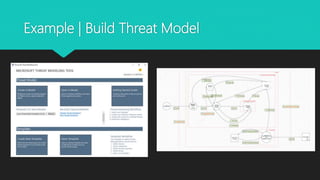
Example | Build Threat Model
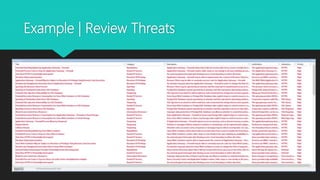
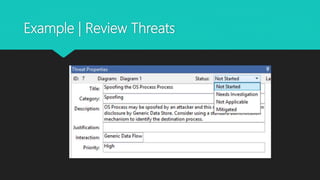
Example | Review Threats
Resources
 Microsoft Threat Modeling Tool: https://www.microsoft.com/en-
us/securityengineering/sdl/threatmodeling
 Microsoft Secure Development Lifecycle: https://www.microsoft.com/en-
us/securityengineering/sdl
 Threat Modeling Course: https://www.linkedin.com/learning/learning-threat-modeling-for-
security-professionals/
 Getting Started Guide: https://docs.microsoft.com/en-us/azure/security/develop/threat-
modeling-tool-getting-started
 Introduction to SDL: https://download.microsoft.com/download/9/3/5/935520EC-D9E2-413E-BEA7-
0B865A79B18C/Introduction%20to%20the%20Microsoft%20Security%20Development%20Lifecycle%20
(SDL).ppsx

Microsoft Security Development Lifecycle

  • 1.
    Microsoft Security Development Lifecycle(SDL) Razi Rais | Senior Software Engineer | Microsoft
  • 2.
  • 3.
    Tech Foundation UserGroup  Founder  Established in 2011  IT Pros and Developers  Open for all to join! JOIN  https://www.meetup.com/techfoundation
  • 4.
    Key Takeaways  UnderstandSDL (Secure Development Lifecycle)  Process & Practices needed for SDL  Threat Modeling  Q&A  Slides  will be emailed to you!  Reach out for full workshop!
  • 5.
    History of SDL| Started with a memo!!
  • 6.
    History of SDLat Microsoft • Bill Gates writes “Trustworthy Computing” memo early 2002 • “Windows security push” for Windows Server 2003 • Security push and FSR (Final Security Review) extended to other products • Microsoft Senior Leadership Team agrees to require SDL for all products that: • Are exposed to meaningful risk and/or • Are Process sensitive data • SDL is enhanced • “Fuzz” testing • Code analysis • Crypto design requirements • Privacy • Banned APIs • and more… • Windows Vista is the first OS to go through full SDL cycle • Optimize the process through feedback, analysis and automation • Evangelize the SDL to the software development community: • SDL Process Guidance • SDL Optimization Model • SDL Pro Network • SDL Threat Modeling Tool • SDL Process Templates 2002-2003 2004 2005-2007 Now
  • 7.
    SDL | BiggerPicture Education Accountability Administer and track security training Incident Response (MSRC) Establish release criteria and sign-off as part of FSR Process Guide product teams to meet SDL requirements
  • 8.
    Pre-SDL Requirements: SecurityTraining Requirements Design Implementation Verification Release Response Assess organizational knowledge on security and privacy – establish training program as necessary  Establish training criteria  Content covering secure design, development, test and privacy  Establish minimum training frequency  Employees must attend n classes per year  Establish minimum acceptable group training thresholds  Organizational training targets (e.g. 80% of all technical personnel trained prior to product RTM)
  • 9.
    Phase One: Requirements Opportunityto consider security at the outset of a project Design Implementation Verification Release Response  Security Advisor reviews product plan, makes recommendations, may set additional requirements  Mandate the use of a bug tracking/job assignment system  Define and document security and privacy bug bars  Development team identifies security and privacy requirements  Development team identifies lead security and privacy contacts  Security Advisor assigned
  • 10.
    SDL Security &Privacy Bug Bar  Privacy bug bar sample  https://docs.microsoft.com/en-us/previous- versions/windows/desktop/cc307403(v=msdn.10)?r edirectedfrom=MSDN  Security Bug Bar  https://docs.microsoft.com/en- us/previous- versions/windows/desktop/cc307404(v=msdn.10)?r edirectedfrom=MSDN
  • 11.
    Phase Two: Design Identify design techniques (layering, managed code, least privilege, attack surface minimization)  Document attack surface and limit through default settings Define and document security architecture, identify security critical components Implementation Verification Release Response  Threat Modeling  Systematic review of features and product architecture from a security point of view  Identify threats and mitigations  Online services specific requirements
  • 12.
    Phase Three: Implementation Fullspectrum review – used to determine processes, documentation and tools necessary to ensure secure deployment and operation Verification Release Response  Specification of approved build tools and options  Static analysis (PREFix, /analyze (PREfast), FXCop)  Banned APIs  Use of operating system “defense in depth” protections (NX, ASLR and HeapTermination)  Online services specific requirements (e.g., Cross-site scripting , SQL Injection etc.)  Consider other recommendations (e.g., Standard Annotation Language (SAL))
  • 13.
    Phase Four: Verification Startedas early as possible – conducted after “code complete” stage Release Response  Start security response planning – including response plans for vulnerability reports  Re-evaluate attack surface  Fuzz testing – files, installable controls and network facing code  Online services specific requirements  Conduct “security push” (as necessary)  Not a substitute for security work done during development  Code review  Penetration testing and other security testing  Review design and architecture in light of new threats
  • 14.
    Phase Five: Release– Response Plan Creation of a clearly defined support policy – consistent with MS corporate policies Response  Provide Software Security Incident Response Plan (SSIRP)  Identify contacts for MSRC and resources to respond to events  24x7x365 contact information for 3-5 engineering, 3-5 marketing, and 1-2 management (PUM and higher) individuals  Ensure ability to service all code including “out of band” releases and all licensed 3rd party code.  Complete final signoffs on Checkpoint Express – validating security, privacy and corporate compliance policies
  • 15.
    Post-SDL Requirement: Response “Planthe work, work the plan…”  Execution on response tasks outlined during Security Response Planning and Release Phases
  • 16.
    SDL Guidance forAgile Methodologies  Requirements defined by frequency, not phase  Every-Sprint (most critical)  One-Time (non-repeating)  Bucket (all others)
  • 17.
    Alert: SDL RequiresProcess Improvement!  Simply “looking for bugs” doesn’t make software secure  Must reduce the chance vulnerabilities enter into design and code  Requires executive commitment  Requires ongoing process improvement  Requires education & training  Requires tools and automation  Requires incentives and consequences
  • 18.
    Resources  Simplified Implementationof Microsoft SDL  (Document & Planning Sheet)https://www.microsoft.com/en- us/download/details.aspx?id=12379
  • 19.
    Resources  Practical Guideto A Practical Guide to Designing Secure Health Solutions Using Microsoft Azure  https://aka.ms/azureindustrysecurity
  • 20.
    Resources  Microsoft SDLCryptographic Recommendations http://download.microsoft.com/download/6/3/A/63AFA3DF -BB84-4B38-8704- B27605B99DA7/Microsoft%20SDL%20Cryptographic%20Re commendations.pdf
  • 21.
    Resources  Manage theSecurity Risk of Using Third-Party Components  https://safecode.org/wp- content/uploads/2017/05/SAFECode _TPC_Whitepaper.pdf
  • 22.
    Resources  Microsoft SDLTools  https://www.microsoft.com/en- us/securityengineering/sdl/resources
  • 23.
  • 24.
    Threat Modeling  Why? Find security and privacy problems when there’s time to fix them  Security Development Lifecycle (SDL) requirement  Deliver more secure products  Who?  The bad guys will do a good job of it!  Maybe you will…your choice  What?  A repeatable process to find and address threats to your product  When?  The earlier you start, the more time to plan and fix  Worst case is when you’re trying to ship/release
  • 25.
  • 26.
    Example | BuildThreat Model
  • 27.
  • 28.
  • 29.
    Resources  Microsoft ThreatModeling Tool: https://www.microsoft.com/en- us/securityengineering/sdl/threatmodeling  Microsoft Secure Development Lifecycle: https://www.microsoft.com/en- us/securityengineering/sdl  Threat Modeling Course: https://www.linkedin.com/learning/learning-threat-modeling-for- security-professionals/  Getting Started Guide: https://docs.microsoft.com/en-us/azure/security/develop/threat- modeling-tool-getting-started  Introduction to SDL: https://download.microsoft.com/download/9/3/5/935520EC-D9E2-413E-BEA7- 0B865A79B18C/Introduction%20to%20the%20Microsoft%20Security%20Development%20Lifecycle%20 (SDL).ppsx