Secure communication
Most popular encryption algorithms overview
Agenda
One-time pad
Stream ciphers
A5/1
Symmetric block ciphers
DES (weak), 3DES (secure), AES (secure)
Asymmetric block ciphers
RSA (slow)
Elliptic curves (fast)
One-time pad
Main features:
Totally secure crypto technic
A key has to be the same length as
a plain text
A key has to be truly random
XOR operation is often used to
combine a key and a text
Impractical in most cases due to the
above key length requirement
Stream ciphers
Inspiration from the one-time pad
Types:
synchronous
self-synchronizing
LFSR (linear feedback shift registers)
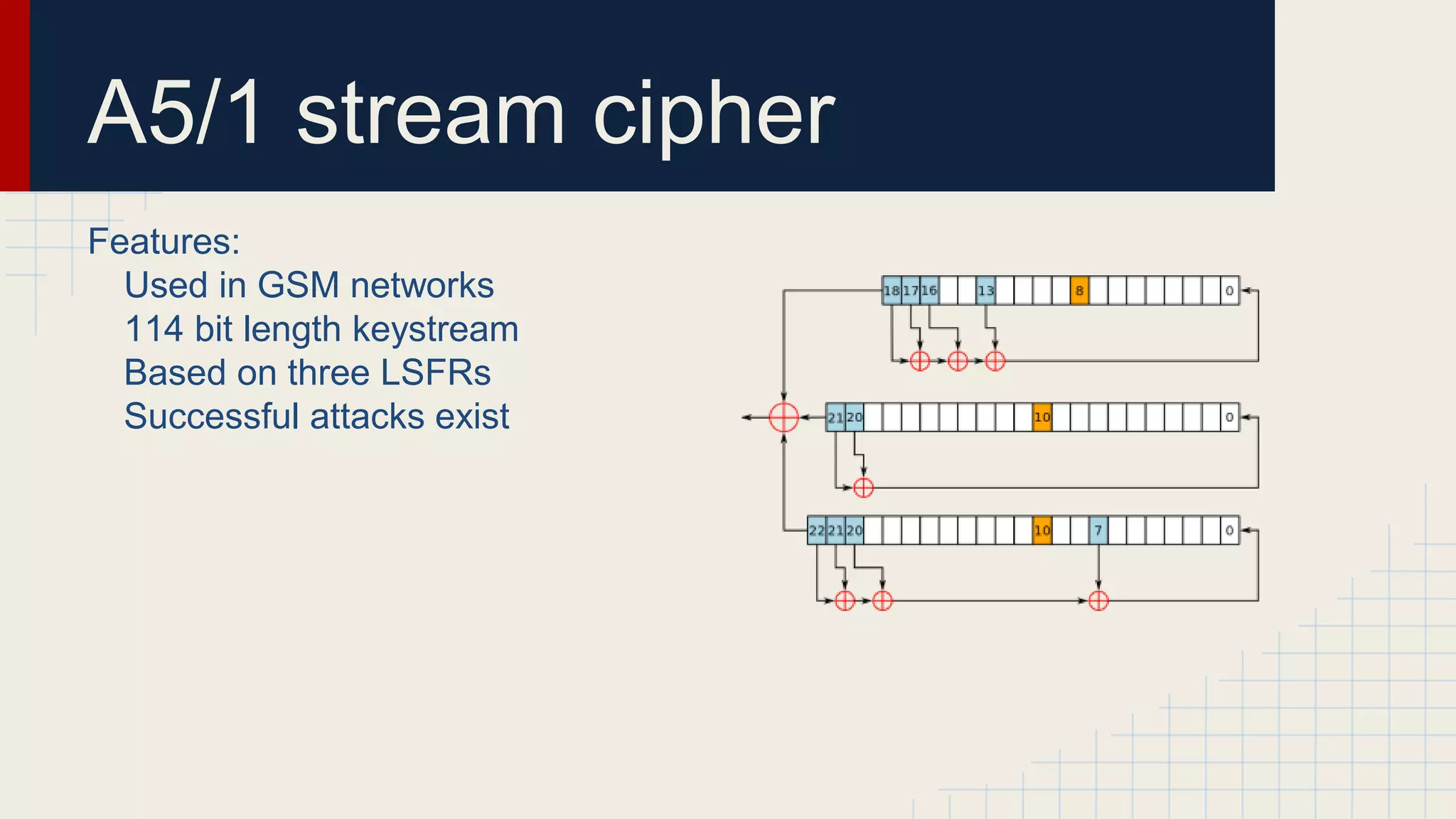
A5/1 stream cipher
Features:
Used in GSM networks
114 bit length keystream
Based on three LSFRs
Successful attacks exist
DES
DES, Data Encryption Standard, was
developed in the 1970s at IBM and
based on design of Horst Feistel.
It is a symmetric-key algorithm based
on Feistel network.
Key size is 56 bits only and it is
considered insecure now.
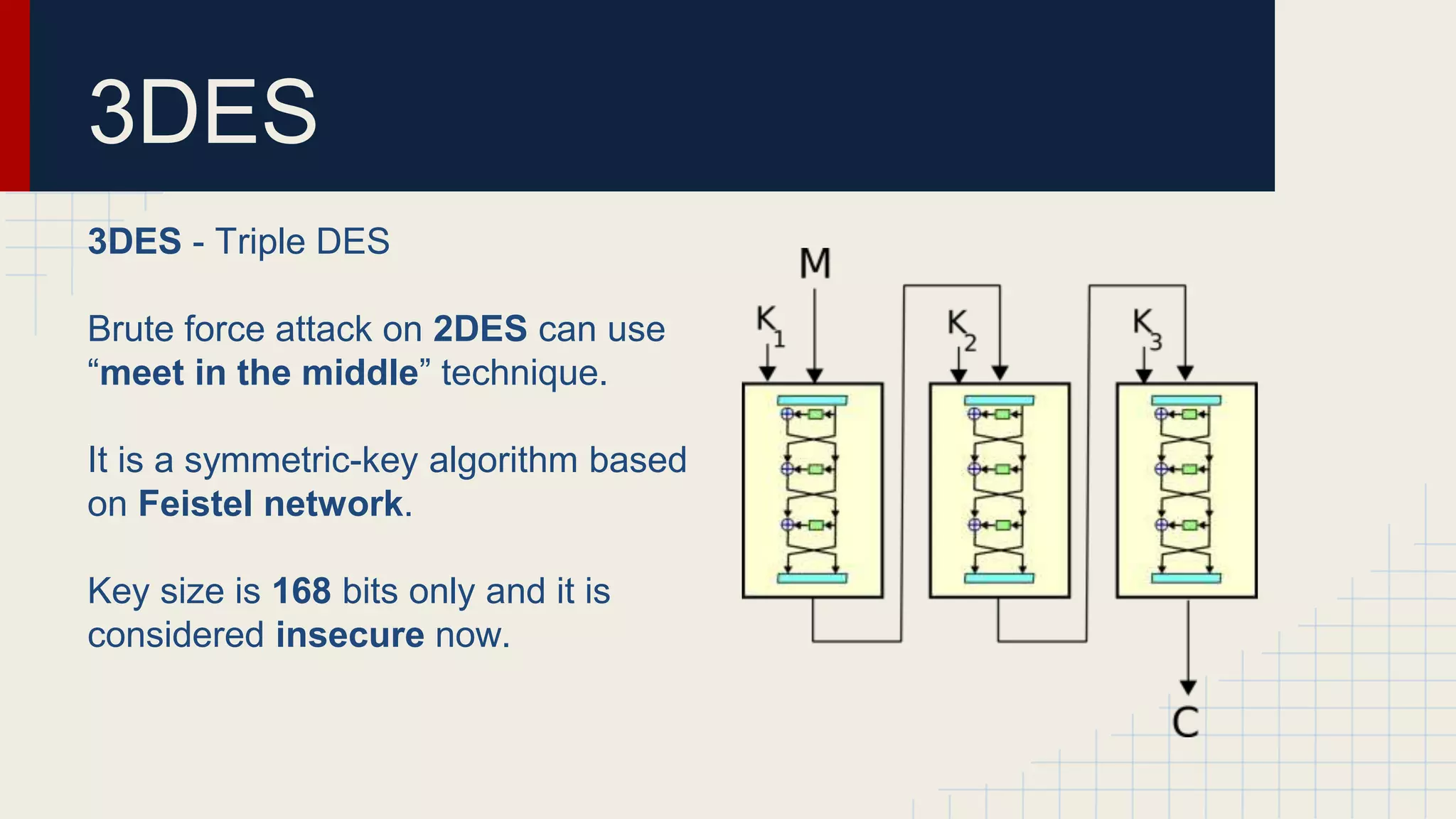
3DES
3DES - Triple DES
Brute force attack on 2DES can use
“meet in the middle” technique.
It is a symmetric-key algorithm based
on Feistel network.
Key size is 168 bits only and it is
considered insecure now.
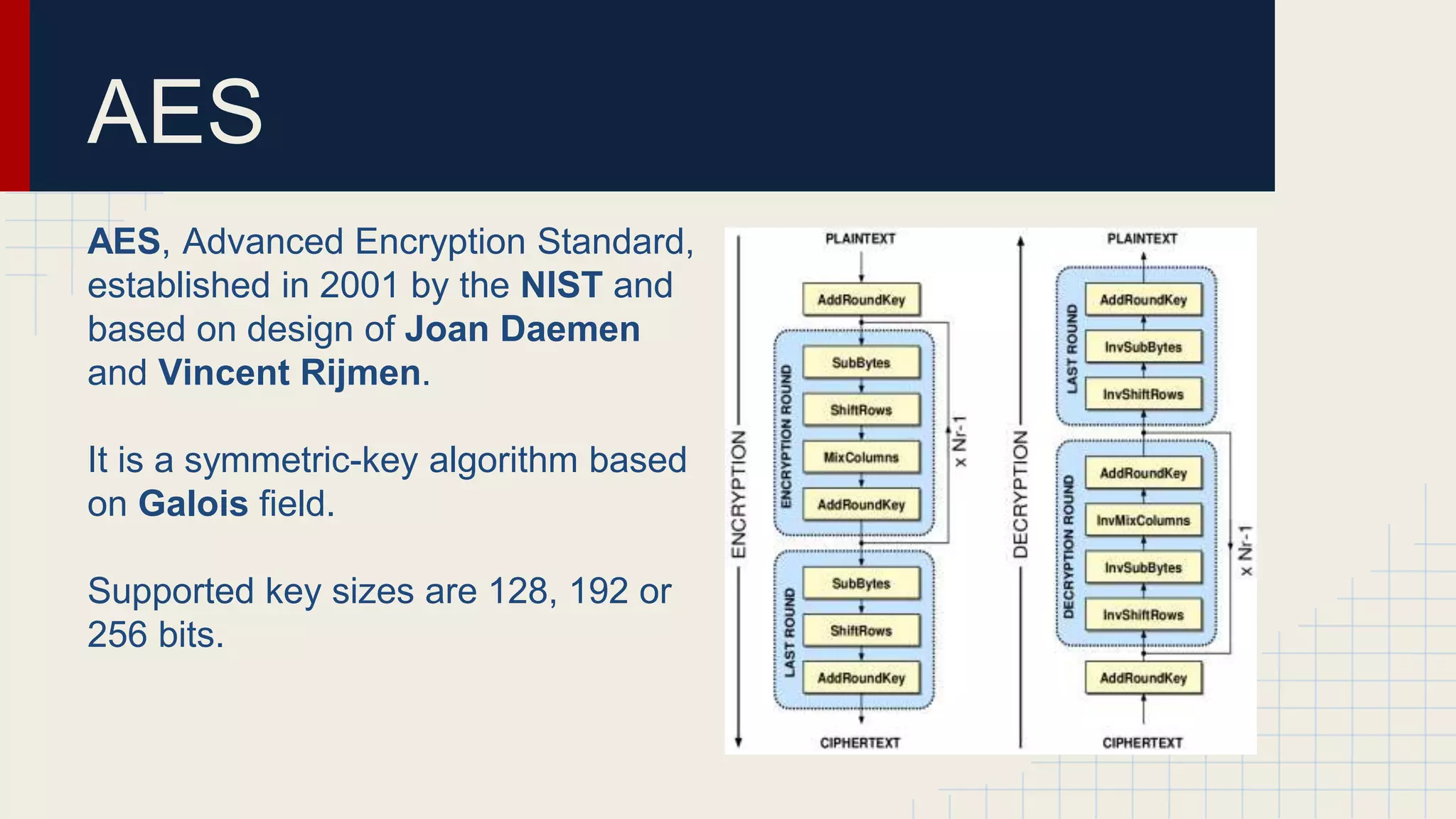
AES
AES, Advanced Encryption Standard,
established in 2001 by the NIST and
based on design of Joan Daemen
and Vincent Rijmen.
It is a symmetric-key algorithm based
on Galois field.
Supported key sizes are 128, 192 or
256 bits.
Block cipher modes
A mode of operation is used to encrypt more than one block of plain
data. The following is the list of some popular modes:
ECB - Electronic Codebook - the simplest mode
CBC - Cipher Block Chaining
OFB - Output Feedback - makes a synchronous stream cipher
CFB - Cipher Feedback - makes a self-synchronizing stream cipher
CTR - Counter - makes a synchronous stream cipher
RSA
RSA, described in 1977, was called
after its inventors Ron Rivest, Adi
Shamir, and Leonard Adleman.
It is a public key algorithm.
Key size could be in range of 1024 to
4096 bits
It is a relatively slow algorithm and
usually used to share keys for
symmetric algorithms.
Elliptic curve cryptography
It is based on the algebraic structure of
elliptic curves.
This is the fastest public key algorithm
as of now.
256 bit ECC public key provides
security compared to 3072 bit RSA
public key.
References
Introduction to Cryptography by Christof Paar
Cryptography and Computer Privacy
My blog
Learning Network Programming

Secure communication

  • 1.
    Secure communication Most popularencryption algorithms overview
  • 2.
    Agenda One-time pad Stream ciphers A5/1 Symmetricblock ciphers DES (weak), 3DES (secure), AES (secure) Asymmetric block ciphers RSA (slow) Elliptic curves (fast)
  • 3.
    One-time pad Main features: Totallysecure crypto technic A key has to be the same length as a plain text A key has to be truly random XOR operation is often used to combine a key and a text Impractical in most cases due to the above key length requirement
  • 4.
    Stream ciphers Inspiration fromthe one-time pad Types: synchronous self-synchronizing LFSR (linear feedback shift registers)
  • 5.
    A5/1 stream cipher Features: Usedin GSM networks 114 bit length keystream Based on three LSFRs Successful attacks exist
  • 6.
    DES DES, Data EncryptionStandard, was developed in the 1970s at IBM and based on design of Horst Feistel. It is a symmetric-key algorithm based on Feistel network. Key size is 56 bits only and it is considered insecure now.
  • 7.
    3DES 3DES - TripleDES Brute force attack on 2DES can use “meet in the middle” technique. It is a symmetric-key algorithm based on Feistel network. Key size is 168 bits only and it is considered insecure now.
  • 8.
    AES AES, Advanced EncryptionStandard, established in 2001 by the NIST and based on design of Joan Daemen and Vincent Rijmen. It is a symmetric-key algorithm based on Galois field. Supported key sizes are 128, 192 or 256 bits.
  • 9.
    Block cipher modes Amode of operation is used to encrypt more than one block of plain data. The following is the list of some popular modes: ECB - Electronic Codebook - the simplest mode CBC - Cipher Block Chaining OFB - Output Feedback - makes a synchronous stream cipher CFB - Cipher Feedback - makes a self-synchronizing stream cipher CTR - Counter - makes a synchronous stream cipher
  • 10.
    RSA RSA, described in1977, was called after its inventors Ron Rivest, Adi Shamir, and Leonard Adleman. It is a public key algorithm. Key size could be in range of 1024 to 4096 bits It is a relatively slow algorithm and usually used to share keys for symmetric algorithms.
  • 11.
    Elliptic curve cryptography Itis based on the algebraic structure of elliptic curves. This is the fastest public key algorithm as of now. 256 bit ECC public key provides security compared to 3072 bit RSA public key.
  • 12.
    References Introduction to Cryptographyby Christof Paar Cryptography and Computer Privacy
  • 13.