Information Security
Department ofComputer Science
and
Name :Turai Swathi
Admin No: 25EG305A54
Course1 : Seminar Review-2
Supervisor
Name : Dr.Yeddu Kondalu
Designation:Assistant Professor
2.
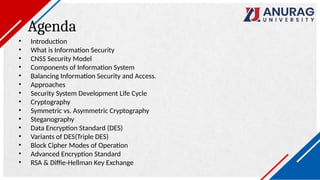
Agenda
• Introduction
• Whatis Information Security
• CNSS Security Model
• Components of Information System
• Balancing Information Security and Access.
• Approaches
• Security System Development Life Cycle
• Cryptography
• Symmetric vs. Asymmetric Cryptography
• Steganography
• Data Encryption Standard (DES)
• Variants of DES(Triple DES)
• Block Cipher Modes of Operation
• Advanced Encryption Standard
• RSA & Diffie-Hellman Key Exchange
3.
Data Encryption Standard(DES) - Structure
Block Cipher Encryption
DES operates as a block cipher,
meaning it encrypts data in
fixed-size blocks (64 bits). Each
block undergoes multiple
rounds of complex
transformations, mixing and
permuting the data based on the
key.
Multiple Rounds
The encryption process in DES
involves 16 identical rounds of
operations, including
substitution, permutation, and
key mixing. These rounds
enhance the security by
diffusing and confusing the
input data.
56-Bit Key Length
DES utilizes a 56-bit key for its
operations. While this was
considered robust at the time
of its invention (1970s),
modern computing power has
made this key length
vulnerable to brute-force
attacks.
Ex: A 16-Step Safe Lock
Think of DES like a safe with 16
distinct locking steps. To open
it, you need to correctly navigate
each step. The more steps, the
more complex the process.
5.
DES - Analysis& Security
Despite its historical significance, the Data Encryption
Standard (DES) is no longer considered secure for
protecting sensitive information today. Its primary
vulnerability lies in its relatively short 56-bit key length.
Modern computing power, including specialized hardware
and cloud computing, can perform a brute-force attack on a
56-bit key within a matter of hours or even minutes.
Therefore, DES is now primarily used for educational
purposes or as a component within more secure, enhanced
cryptographic systems.
Example: An Old-Style Lock
Consider DES as an old-style lock that, with enough
effort and the right tools (modern computing power),
can be picked. While it served its purpose in its era,
it's no match for today's sophisticated lock-picking
techniques.
6.
Variants of DES:Extending Security with 3DES
To address the security vulnerabilities of the original DES due to its
short key length, a more robust variant called Triple DES (3DES or
TDES) was developed. 3DES significantly enhances security by
applying the DES algorithm multiple times.
Instead of a single encryption pass, 3DES typically uses three
applications of the DES algorithm with either two or three distinct
keys. This multi-layered encryption process makes brute-force
attacks significantly more computationally intensive, thus
improving its resistance to attacks compared to single DES.
Example: Three-Locked Suitcase
Imagine locking your suitcase three times with
different, unique keys. An attacker would need to
unlock it three separate times, each with a different
key, making it far more secure than just one lock.
7.
DES Enhancements(Simple Process)
ThePower of Three (3DES)
To overcome the security limitations of the original DES, the Triple DES (3DES) algorithm was
developed. This variant applies the DES encryption algorithm three times in succession, using either two
or three different keys, significantly increasing its security.
Key 1 Encryption
The plaintext is encrypted with the
first key.
Key 2 Decryption
The result is then decrypted with the
second key.
Key 3 Encryption
Finally, the output is encrypted again
with the third (or first) key.
This triple application makes 3DES much harder to crack than the original DES, providing a significantly larger
effective key length.
8.
Block Cipher Modesof Operation
Block cipher modes of operation define how a block cipher algorithm (like DES or AES) should be used
to encrypt data longer than a single block. They describe how to divide plaintext into blocks and how to
process those blocks securely.
1
ECB (Electronic Codebook) Mode
In ECB mode, each plaintext block is encrypted
independently using the same key. This
simplicity comes at a cost: identical plaintext
blocks will produce identical ciphertext blocks,
making patterns detectable and vulnerable to
analysis.
2
CBC (Cipher Block Chaining) Mode
CBC mode introduces a chaining mechanism.
Each plaintext block is XORed with the previous
ciphertext block before encryption. This
dependency ensures that identical plaintext
blocks produce different ciphertext blocks,
significantly improving security and hiding
patterns.
9.
Think of sendingmultiple letters. With ECB, each letter is
sealed separately. If you send the same letter twice, it
looks identical.
With CBC, each letter's sealing process is mixed with
details from the previous letter, so even if you send the
same message twice, the sealed version looks different,
making it harder for an attacker to spot patterns.
Example: Mixing Up Letters
10.
Advanced Encryption Standard(AES)
The Advanced Encryption Standard (AES) is the current standard
for symmetric-key encryption, adopted worldwide by governments,
banks, and major corporations for securing sensitive information. It
was established by the National Institute of Standards and
Technology (NIST) in 2001 to replace DES.
AES supports key lengths of 128, 192, or 256 bits, offering
significantly higher security than DES. The number of encryption
rounds varies with the key length: 10 rounds for 128-bit keys, 12 for
192-bit keys, and 14 for 256-bit keys. Its design prioritizes both speed
and security.
Example: High-Tech Digital Vault
Imagine AES as a high-tech digital vault protecting your credit card
details when you shop online. Its robust design and strong keys ensure
your financial information remains secure from unauthorized access.
12.
RSA & Diffie-HellmanKey Exchange
RSA (Rivest–Shamir–Adleman)
An asymmetric encryption algorithm using a pair
of keys: a public key for encryption and a private
key for decryption. It relies on the computational
difficulty of factoring large prime numbers.
• Use: Secure data transmission, digital signatures,
key exchange.
Diffie-Hellman Key Exchange
A method for two parties to establish a shared secret
key over an insecure communication channel without
transmitting the key itself. It relies on the difficulty of
the discrete logarithm problem.
• Use: Establishing secure session keys for symmetric
encryption.



![OPERATING SYSTEM UNIT-1 [Autosaved].pptx](https://cdn.slidesharecdn.com/ss_thumbnails/operatingsystemunit-1autosaved-250916174638-ee20439e-thumbnail.jpg?width=640&height=640&fit=bounds)


![OPERATING SYSTEM UNIT-1 [Autosaved].pptx](https://cdn.slidesharecdn.com/ss_thumbnails/operatingsystemunit-1autosaved-250602162951-72288d92-thumbnail.jpg?width=640&height=640&fit=bounds)


