ENCRYPTION TECHNIQUES
AUGUST 2016
OVERVIEW
Hashing vs Encryption
Hashing
Ciphers
PKI
Signing
Performance
Hashing vs Encryption
Hashing is designed to be one way
Encryption is designed to be 2 way
Don't use a hash when you mean to encrypt
Don't encrypt when you should use a hash
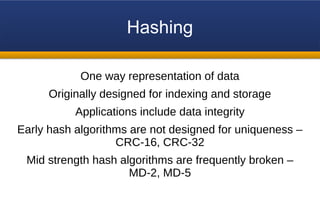
Hashing
One way representation of data
Originally designed for indexing and storage
Applications include data integrity
Early hash algorithms are not designed for uniqueness –
CRC-16, CRC-32
Mid strength hash algorithms are frequently broken –
MD-2, MD-5
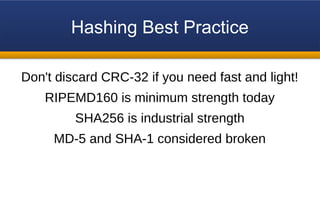
Hashing Best Practice
Don't discard CRC-32 if you need fast and light!
RIPEMD160 is minimum strength today
SHA256 is industrial strength
MD-5 and SHA-1 considered broken
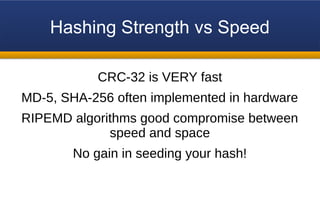
Hashing Strength vs Speed
CRC-32 is VERY fast
MD-5, SHA-256 often implemented in hardware
RIPEMD algorithms good compromise between
speed and space
No gain in seeding your hash!
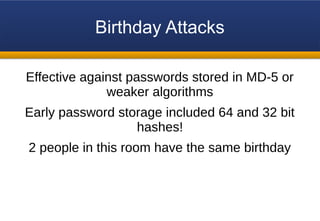
Birthday Attacks
Effective against passwords stored in MD-5 or
weaker algorithms
Early password storage included 64 and 32 bit
hashes!
2 people in this room have the same birthday
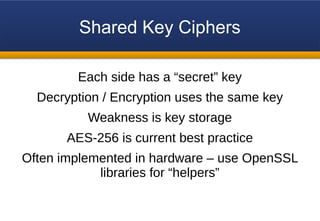
Shared Key Ciphers
Each side has a “secret” key
Decryption / Encryption uses the same key
Weakness is key storage
AES-256 is current best practice
Often implemented in hardware – use OpenSSL
libraries for “helpers”
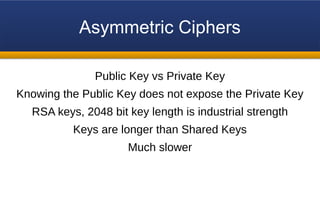
Asymmetric Ciphers
Public Key vs Private Key
Knowing the Public Key does not expose the Private Key
RSA keys, 2048 bit key length is industrial strength
Keys are longer than Shared Keys
Much slower
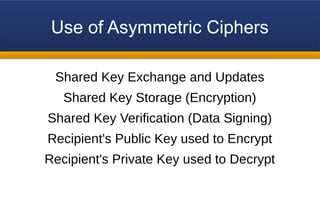
Use of Asymmetric Ciphers
Shared Key Exchange and Updates
Shared Key Storage (Encryption)
Shared Key Verification (Data Signing)
Recipient's Public Key used to Encrypt
Recipient's Private Key used to Decrypt
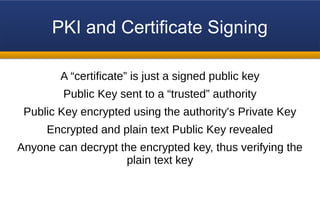
PKI and Certificate Signing
A “certificate” is just a signed public key
Public Key sent to a “trusted” authority
Public Key encrypted using the authority's Private Key
Encrypted and plain text Public Key revealed
Anyone can decrypt the encrypted key, thus verifying the
plain text key
PKI Chains
Limited number of trusted authorities
Intermediate authorities signed by trusted
authorities
Certificates signed by trusted authority or
intermediate authority
Enables distributed but controlled key signing
Data Signing
Not all encryption is designed for security
Data signature is the reverse of data encryption
(private key used to encrypt, public key can be
used to verify)
HMAC
HMAC is a signature equivalent for shared key
ciphers
As with all shared key ciphers, public key can be
used to protect the HMAC key
HMAC is for verification only – HMAC verified data
can be in plain text
No need to encrypt if you don't need to
Encryption Performance
Use the Known Algorithms. They are probably
implemented in hardware.
Don't mess with the algorithms
Don't encrypt when you need to hash
Don't hash when you need to encrypt
bcrypt
Hashing algorithm based on an encryption
algorithm.
Disadvantage: slow
Advantage: slow, can be made slower
Use only for small chunks of data (passwords)

Encryption Techniques

  • 1.
  • 2.
  • 3.
    Hashing vs Encryption Hashingis designed to be one way Encryption is designed to be 2 way Don't use a hash when you mean to encrypt Don't encrypt when you should use a hash
  • 4.
    Hashing One way representationof data Originally designed for indexing and storage Applications include data integrity Early hash algorithms are not designed for uniqueness – CRC-16, CRC-32 Mid strength hash algorithms are frequently broken – MD-2, MD-5
  • 5.
    Hashing Best Practice Don'tdiscard CRC-32 if you need fast and light! RIPEMD160 is minimum strength today SHA256 is industrial strength MD-5 and SHA-1 considered broken
  • 6.
    Hashing Strength vsSpeed CRC-32 is VERY fast MD-5, SHA-256 often implemented in hardware RIPEMD algorithms good compromise between speed and space No gain in seeding your hash!
  • 7.
    Birthday Attacks Effective againstpasswords stored in MD-5 or weaker algorithms Early password storage included 64 and 32 bit hashes! 2 people in this room have the same birthday
  • 8.
    Shared Key Ciphers Eachside has a “secret” key Decryption / Encryption uses the same key Weakness is key storage AES-256 is current best practice Often implemented in hardware – use OpenSSL libraries for “helpers”
  • 9.
    Asymmetric Ciphers Public Keyvs Private Key Knowing the Public Key does not expose the Private Key RSA keys, 2048 bit key length is industrial strength Keys are longer than Shared Keys Much slower
  • 10.
    Use of AsymmetricCiphers Shared Key Exchange and Updates Shared Key Storage (Encryption) Shared Key Verification (Data Signing) Recipient's Public Key used to Encrypt Recipient's Private Key used to Decrypt
  • 11.
    PKI and CertificateSigning A “certificate” is just a signed public key Public Key sent to a “trusted” authority Public Key encrypted using the authority's Private Key Encrypted and plain text Public Key revealed Anyone can decrypt the encrypted key, thus verifying the plain text key
  • 12.
    PKI Chains Limited numberof trusted authorities Intermediate authorities signed by trusted authorities Certificates signed by trusted authority or intermediate authority Enables distributed but controlled key signing
  • 13.
    Data Signing Not allencryption is designed for security Data signature is the reverse of data encryption (private key used to encrypt, public key can be used to verify)
  • 14.
    HMAC HMAC is asignature equivalent for shared key ciphers As with all shared key ciphers, public key can be used to protect the HMAC key HMAC is for verification only – HMAC verified data can be in plain text No need to encrypt if you don't need to
  • 15.
    Encryption Performance Use theKnown Algorithms. They are probably implemented in hardware. Don't mess with the algorithms Don't encrypt when you need to hash Don't hash when you need to encrypt
  • 16.
    bcrypt Hashing algorithm basedon an encryption algorithm. Disadvantage: slow Advantage: slow, can be made slower Use only for small chunks of data (passwords)