Considerations for
AAS CRP Impact Evaluation
     Workshop on Strengthening Impact
      Evaluation in Natural Resource
               Management
                    WorldFish, Penang, Malaysia
                       4-5 September 2012


 Making a difference in the lives of the poor
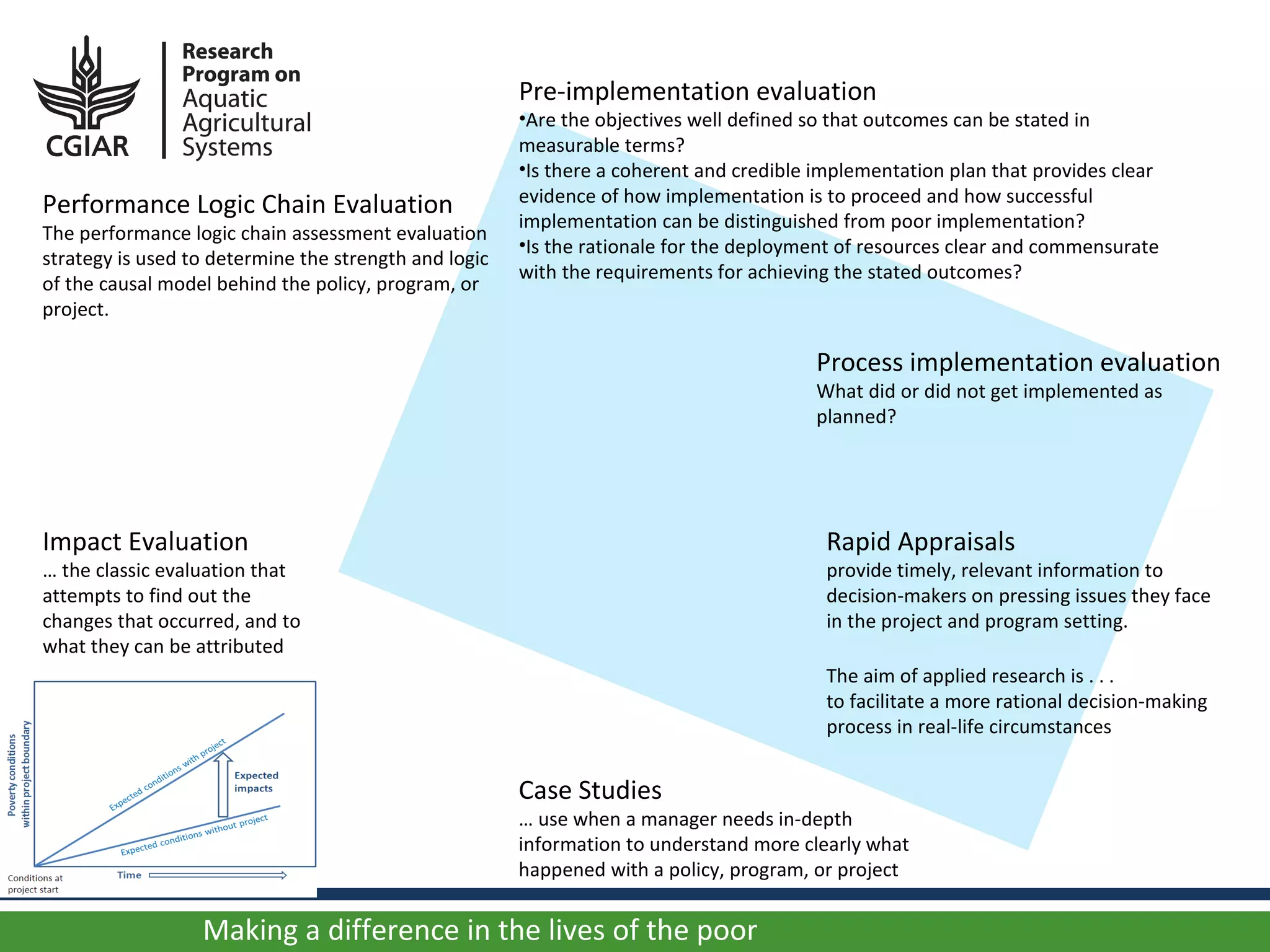
Pre-implementation evaluation
                                                       •Are the objectives well defined so that outcomes can be stated in
                                                       measurable terms?
                                                       •Is there a coherent and credible implementation plan that provides clear
Performance Logic Chain Evaluation                     evidence of how implementation is to proceed and how successful
                                                       implementation can be distinguished from poor implementation?
The performance logic chain assessment evaluation
                                                       •Is the rationale for the deployment of resources clear and commensurate
strategy is used to determine the strength and logic
                                                       with the requirements for achieving the stated outcomes?
of the causal model behind the policy, program, or
project.

                                                                                        Process implementation evaluation
                                                                                        What did or did not get implemented as
                                                                                        planned?


Impact Evaluation                                                                         Rapid Appraisals
… the classic evaluation that                                                             provide timely, relevant information to
attempts to find out the                                                                  decision-makers on pressing issues they face
changes that occurred, and to                                                             in the project and program setting.
what they can be attributed
                                                                                          The aim of applied research is . . .
                                                                                          to facilitate a more rational decision-making
                                                                                          process in real-life circumstances


                                                       Case Studies
                                                       … use when a manager needs in-depth
                                                       information to understand more clearly what
                                                       happened with a policy, program, or project


                  Making a difference in the lives of the poor
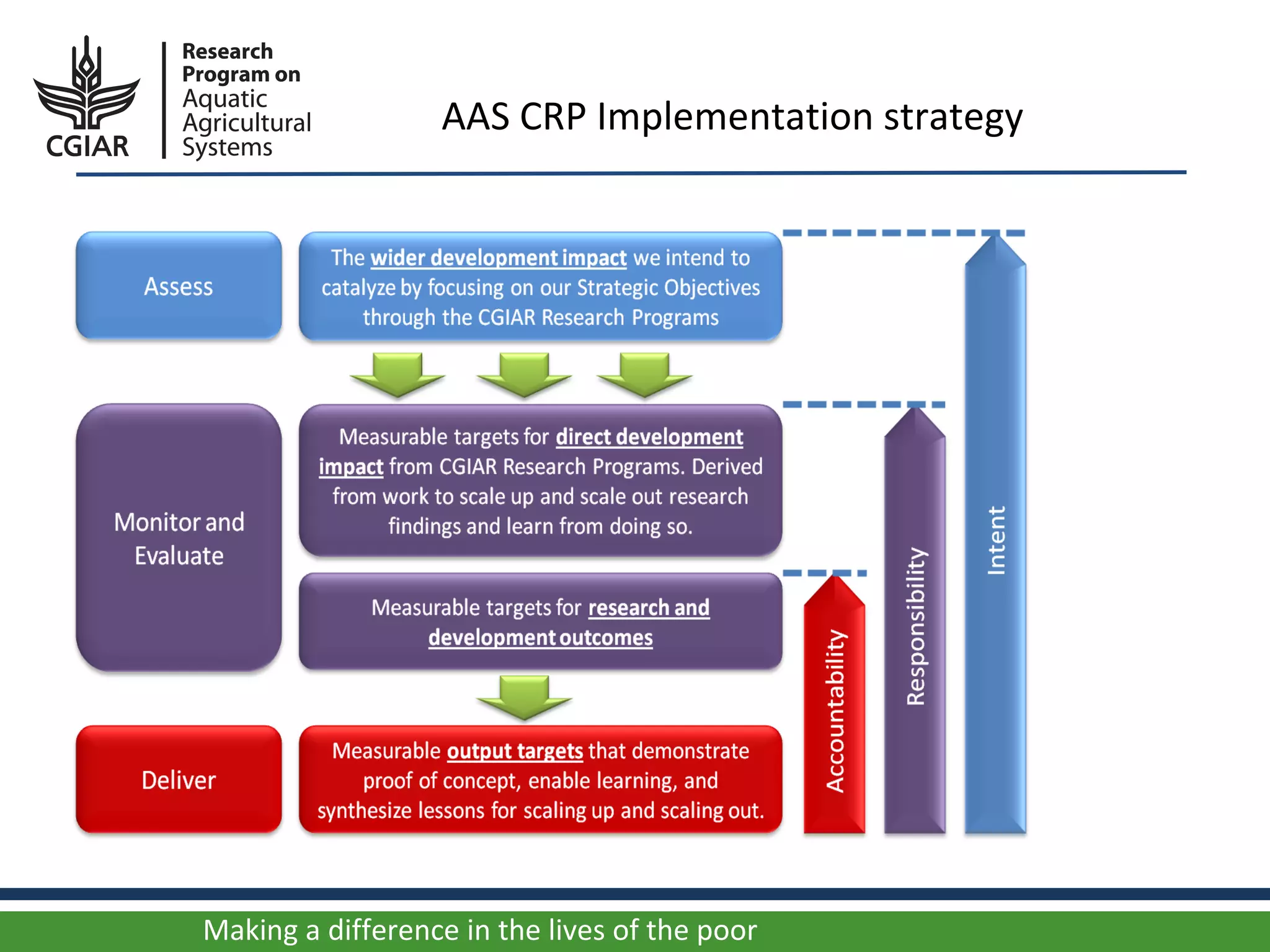
AAS CRP Implementation strategy


Making a difference in the lives of the poor
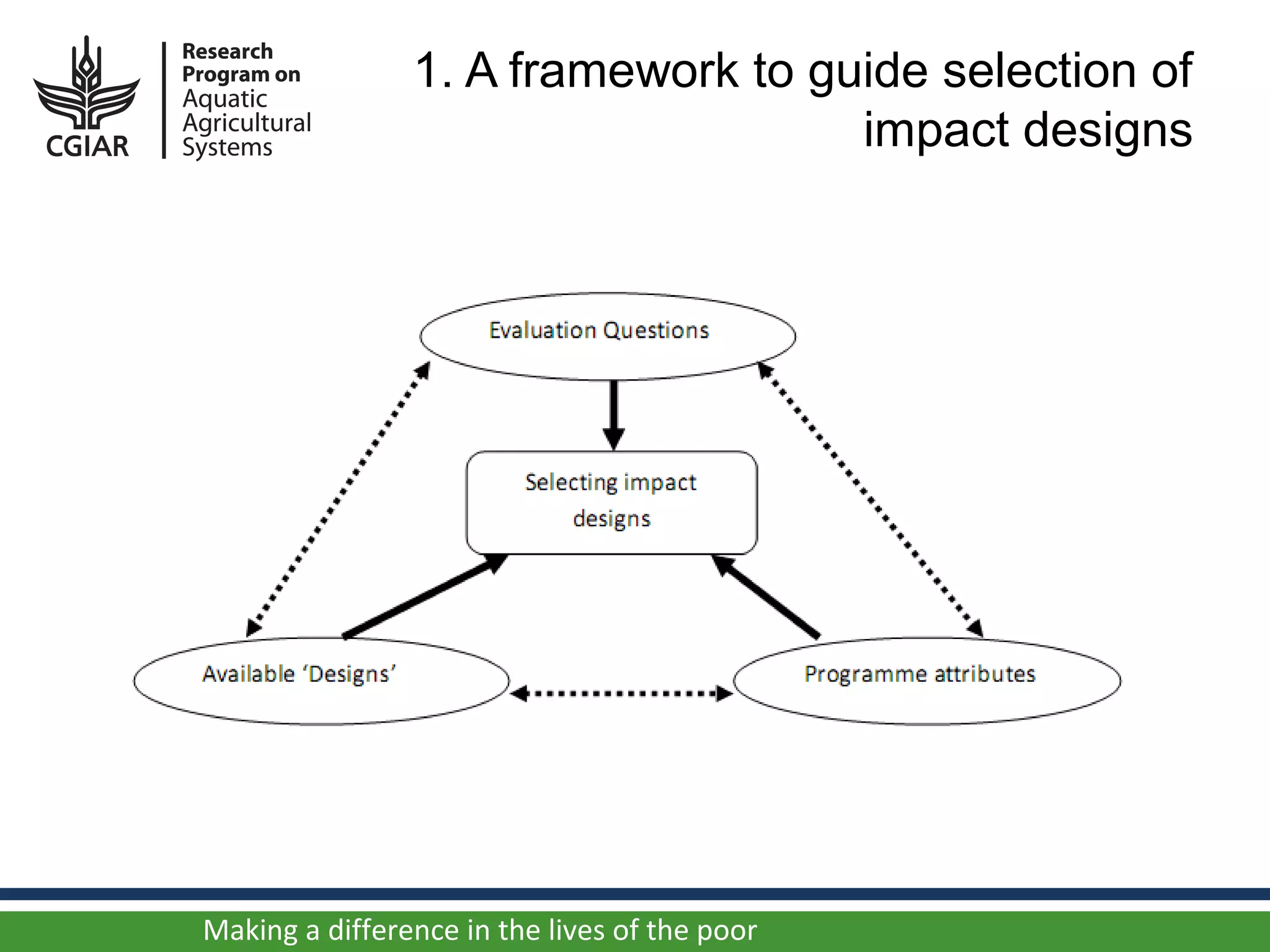
1. A framework to guide selection of
                                    impact designs


Making a difference in the lives of the poor
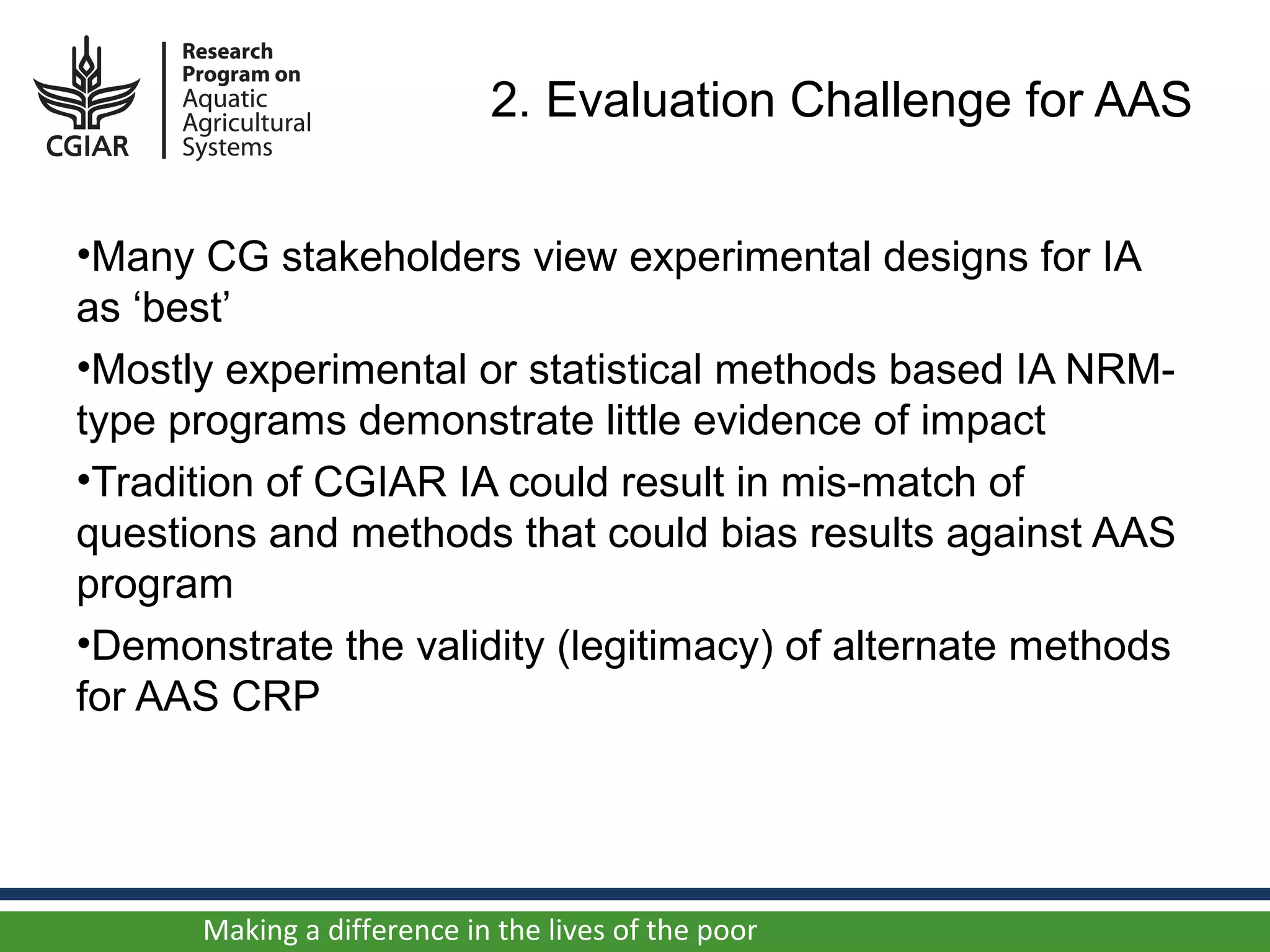
2. Evaluation Challenge for AAS


•Many CG stakeholders view experimental designs for IA
as ‘best’
•Mostly experimental or statistical methods based IA NRM-
type programs demonstrate little evidence of impact
•Tradition of CGIAR IA could result in mis-match of
questions and methods that could bias results against AAS
program
•Demonstrate the validity (legitimacy) of alternate methods
for AAS CRP


      Making a difference in the lives of the poor
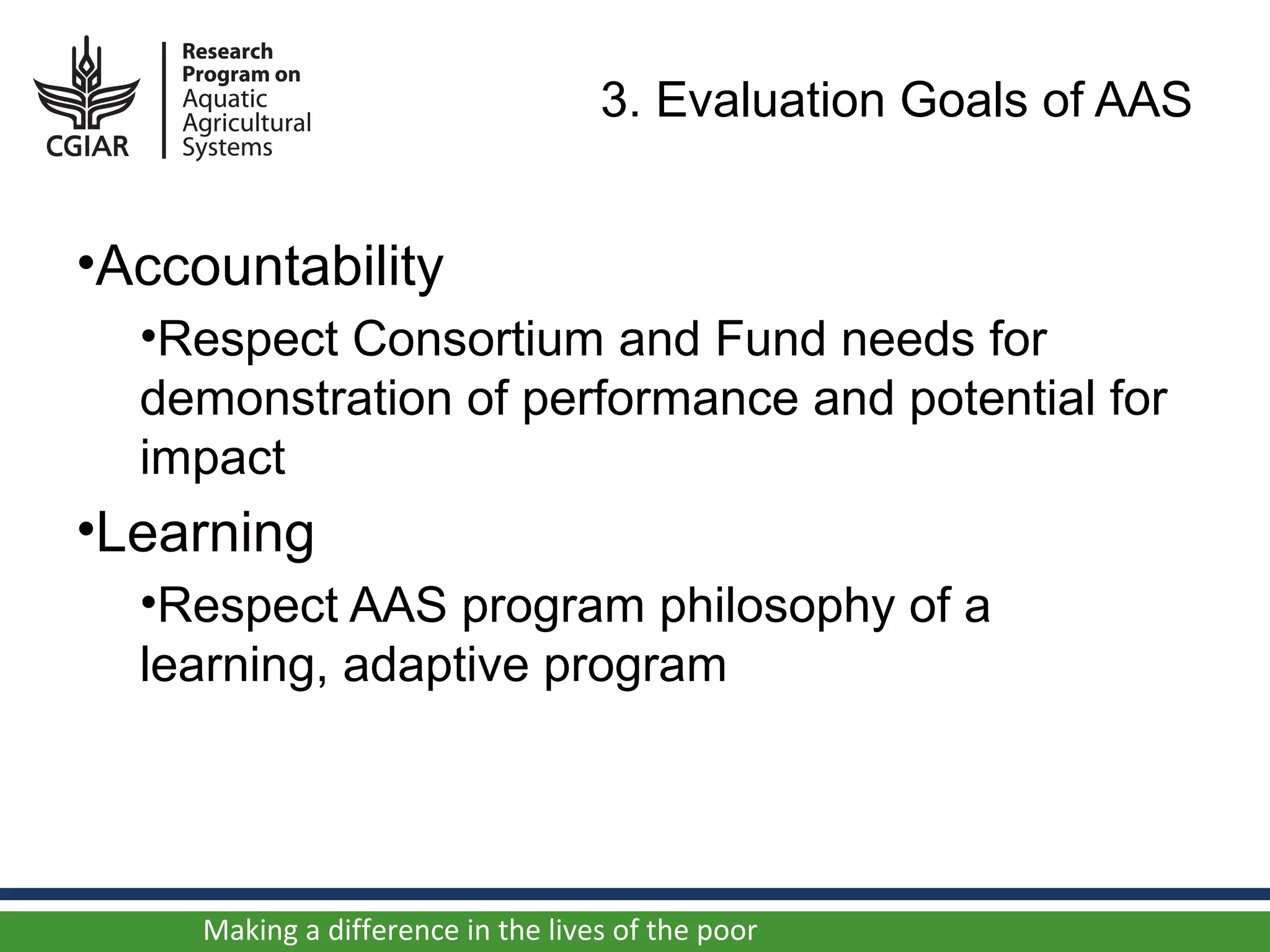
3. Evaluation Goals of AAS


•Accountability
  •Respect Consortium and Fund needs for
  demonstration of performance and potential for
  impact
•Learning
  •Respect AAS program philosophy of a
  learning, adaptive program


     Making a difference in the lives of the poor
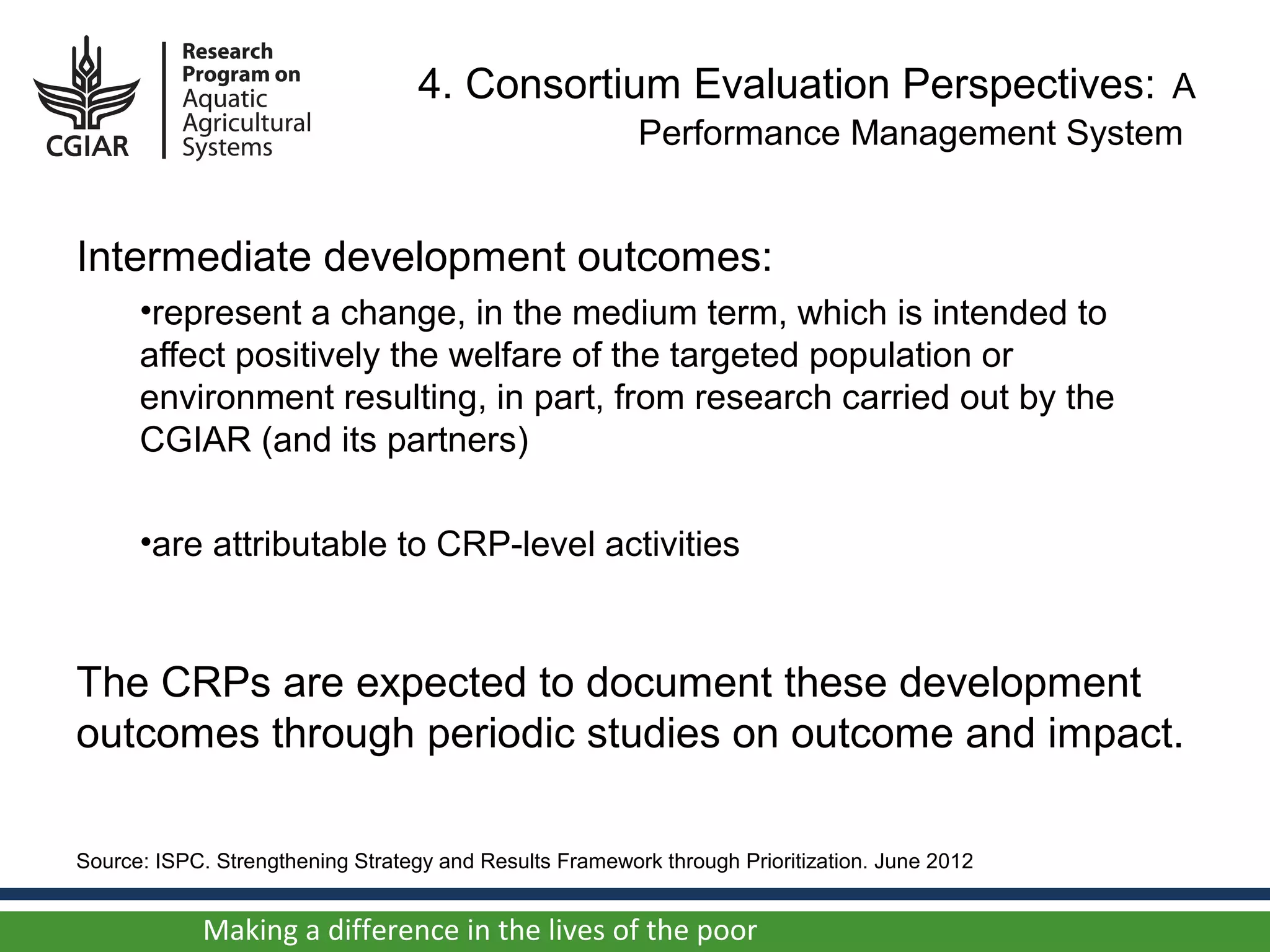
4. Consortium Evaluation Perspectives: A
                                                         Performance Management System


Intermediate development outcomes:
      •represent a change, in the medium term, which is intended to
      affect positively the welfare of the targeted population or
      environment resulting, in part, from research carried out by the
      CGIAR (and its partners)

      •are attributable to CRP-level activities


The CRPs are expected to document these development
outcomes through periodic studies on outcome and impact.

Source: ISPC. Strengthening Strategy and Results Framework through Prioritization. June 2012


            Making a difference in the lives of the poor
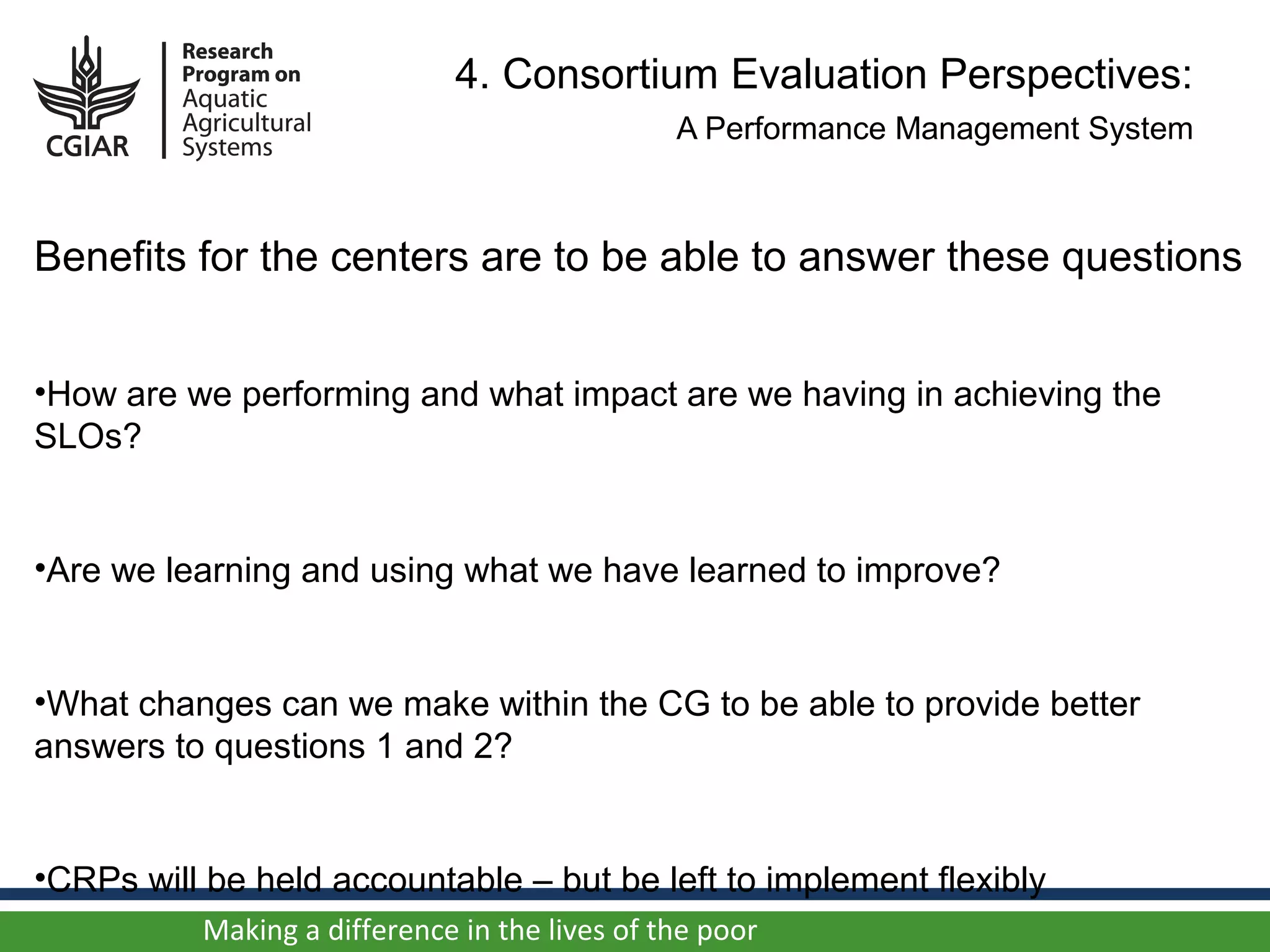
4. Consortium Evaluation Perspectives:
                                               A Performance Management System


Benefits for the centers are to be able to answer these questions


•How are we performing and what impact are we having in achieving the
SLOs?


•Are we learning and using what we have learned to improve?


•What changes can we make within the CG to be able to provide better
answers to questions 1 and 2?


•CRPs will be held accountable – but be left to implement flexibly
          Making a difference in the lives of the poor
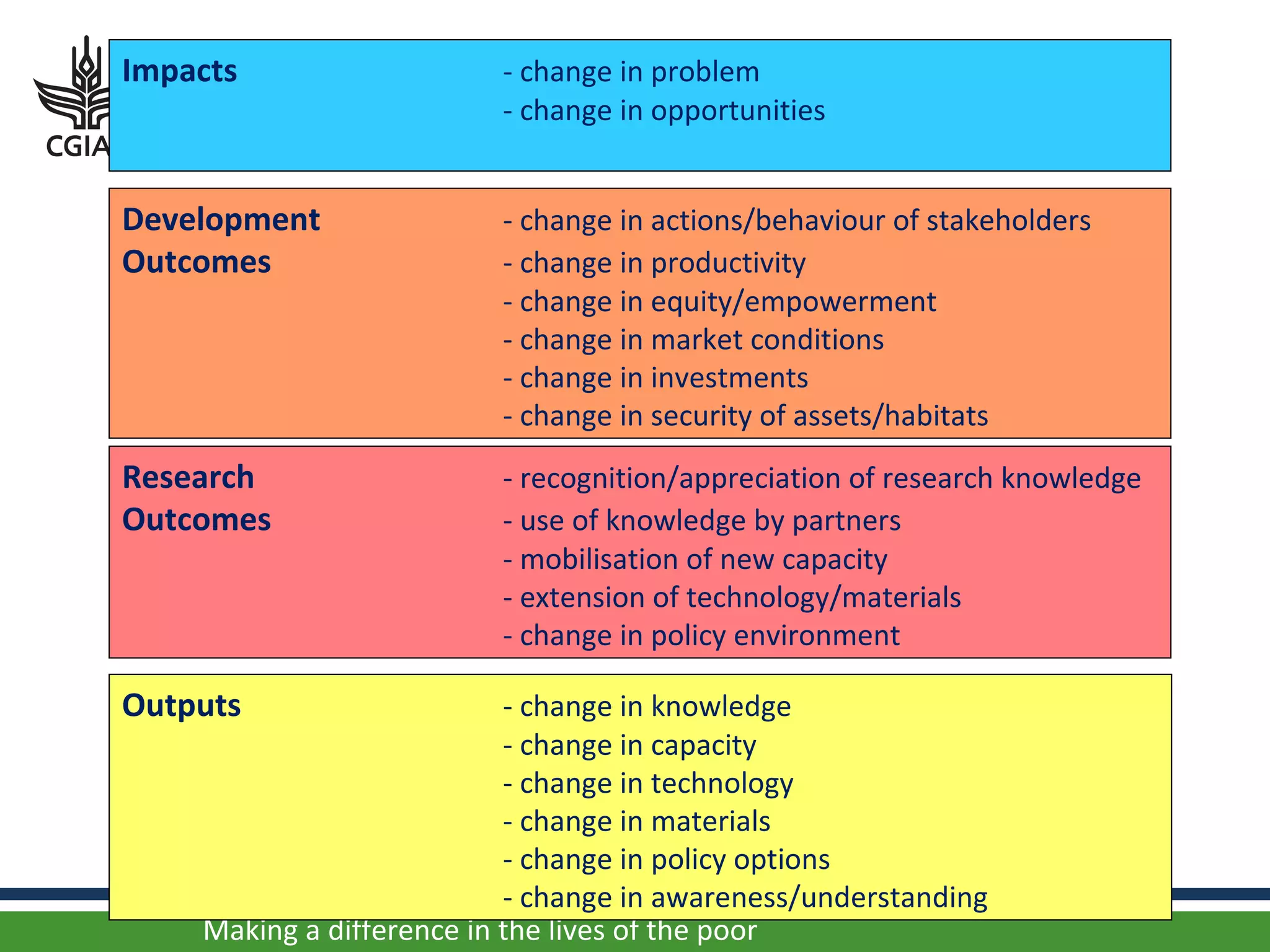
Impacts                   - change in problem
                          - change in opportunities


Development               - change in actions/behaviour of stakeholders
Outcomes                  - change in productivity
                          - change in equity/empowerment
                          - change in market conditions
                          - change in investments
                          - change in security of assets/habitats
Research                  - recognition/appreciation of research knowledge
Outcomes                  - use of knowledge by partners
                          - mobilisation of new capacity
                          - extension of technology/materials
                          - change in policy environment

Outputs                    - change in knowledge
                           - change in capacity
                           - change in technology
                           - change in materials
                           - change in policy options
                           - change in awareness/understanding
    Making a difference in the lives of the poor
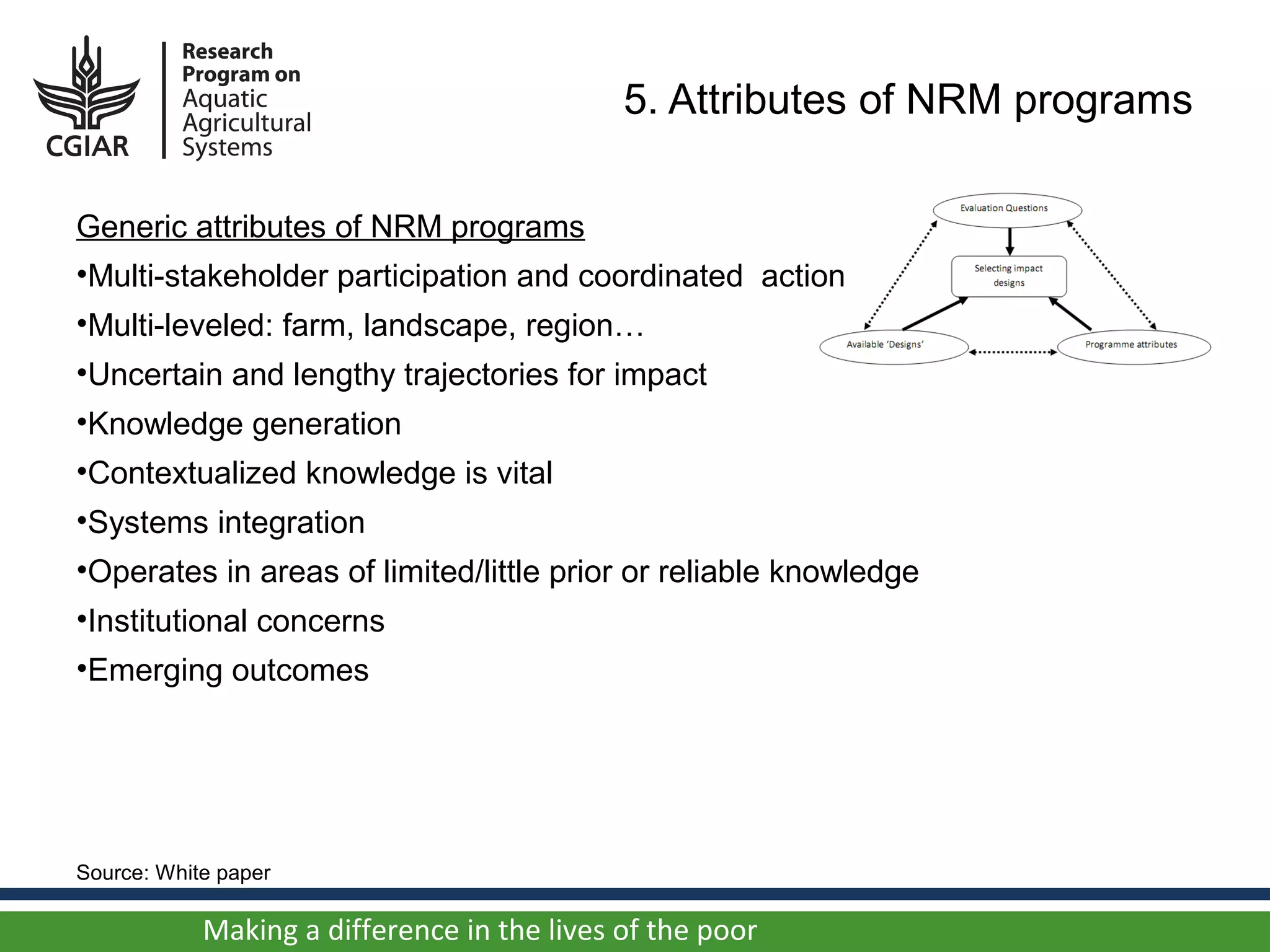
5. Attributes of NRM programs

Generic attributes of NRM programs
•Multi-stakeholder participation and coordinated action
•Multi-leveled: farm, landscape, region…
•Uncertain and lengthy trajectories for impact
•Knowledge generation
•Contextualized knowledge is vital
•Systems integration
•Operates in areas of limited/little prior or reliable knowledge
•Institutional concerns
•Emerging outcomes


Source: White paper

            Making a difference in the lives of the poor
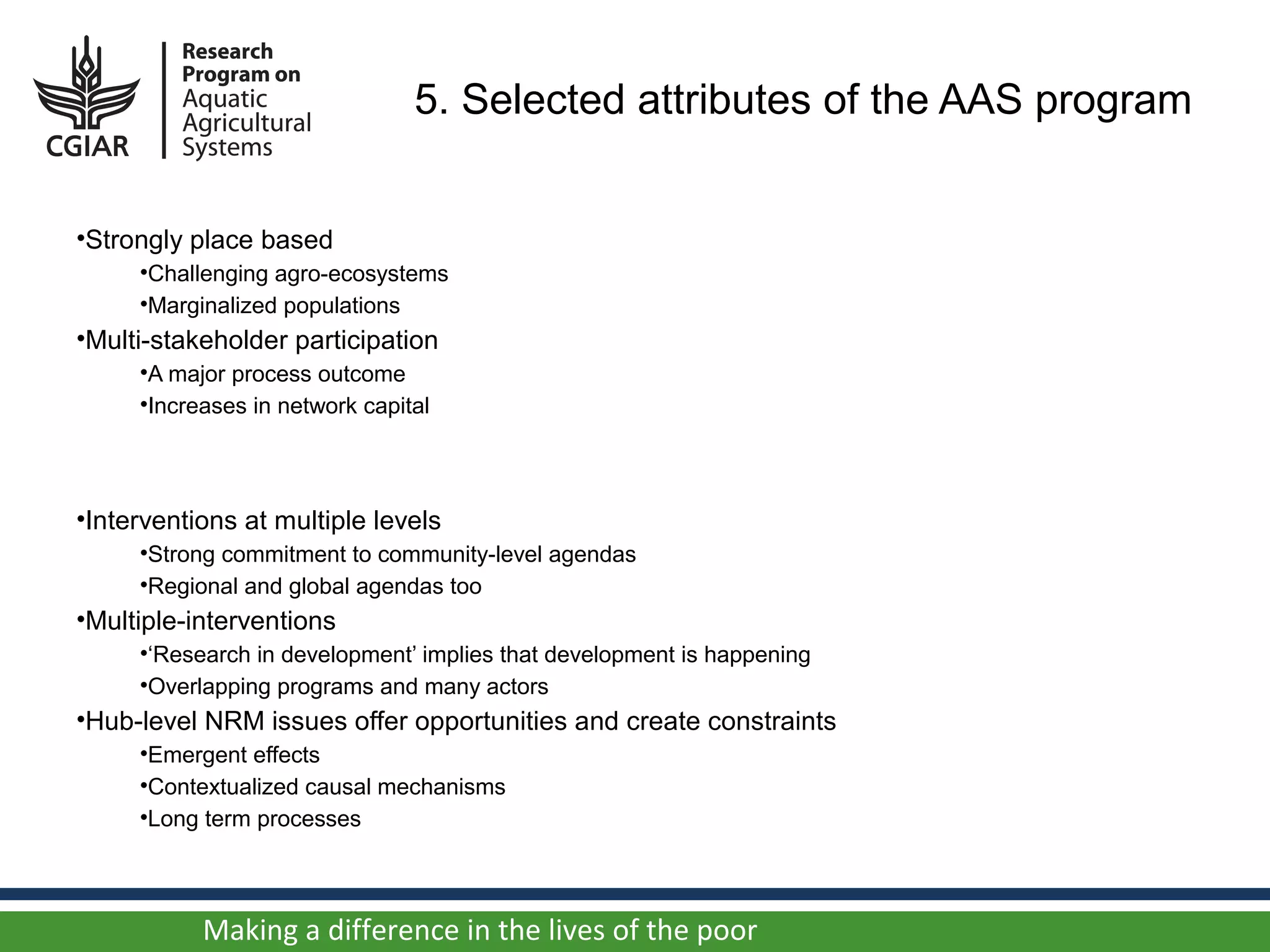
5. Selected attributes of the AAS program


•Strongly place based
     •Challenging agro-ecosystems
     •Marginalized populations
•Multi-stakeholder participation
     •A major process outcome
     •Increases in network capital


•Interventions at multiple levels
     •Strong commitment to community-level agendas
     •Regional and global agendas too
•Multiple-interventions
     •‘Research in development’ implies that development is happening
     •Overlapping programs and many actors
•Hub-level NRM issues offer opportunities and create constraints
     •Emergent effects
     •Contextualized causal mechanisms
     •Long term processes


           Making a difference in the lives of the poor
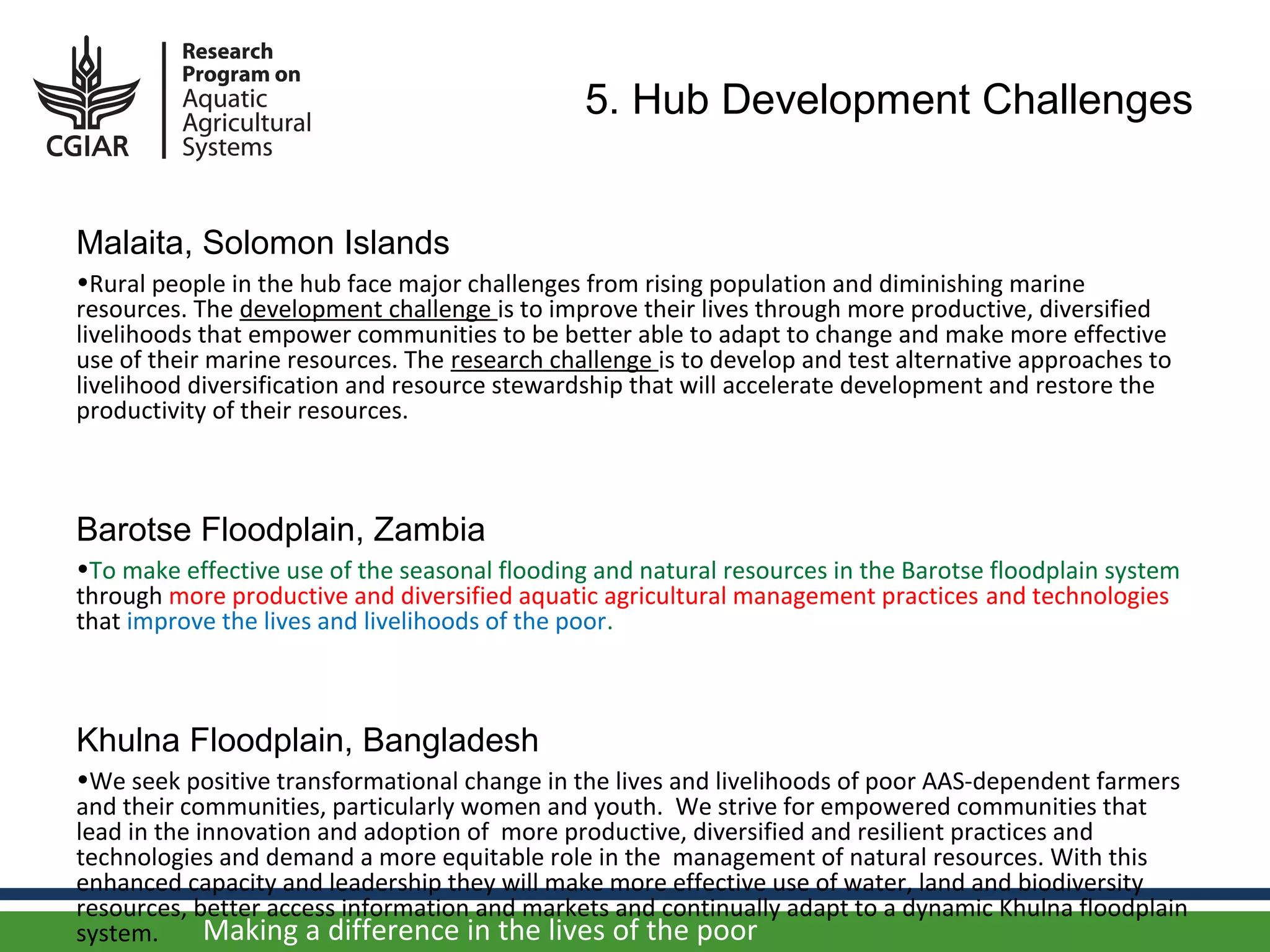
5. Hub Development Challenges


Malaita, Solomon Islands
•Rural people in the hub face major challenges from rising population and diminishing marine
resources. The development challenge is to improve their lives through more productive, diversified
livelihoods that empower communities to be better able to adapt to change and make more effective
use of their marine resources. The research challenge is to develop and test alternative approaches to
livelihood diversification and resource stewardship that will accelerate development and restore the
productivity of their resources.


Barotse Floodplain, Zambia
•To make effective use of the seasonal flooding and natural resources in the Barotse floodplain system
through more productive and diversified aquatic agricultural management practices and technologies
that improve the lives and livelihoods of the poor.


Khulna Floodplain, Bangladesh
•We seek positive transformational change in the lives and livelihoods of poor AAS-dependent farmers
and their communities, particularly women and youth. We strive for empowered communities that
lead in the innovation and adoption of more productive, diversified and resilient practices and
technologies and demand a more equitable role in the management of natural resources. With this
enhanced capacity and leadership they will make more effective use of water, land and biodiversity
resources, better access information and markets and continually adapt to a dynamic Khulna floodplain
system.      Making a difference in the lives of the poor
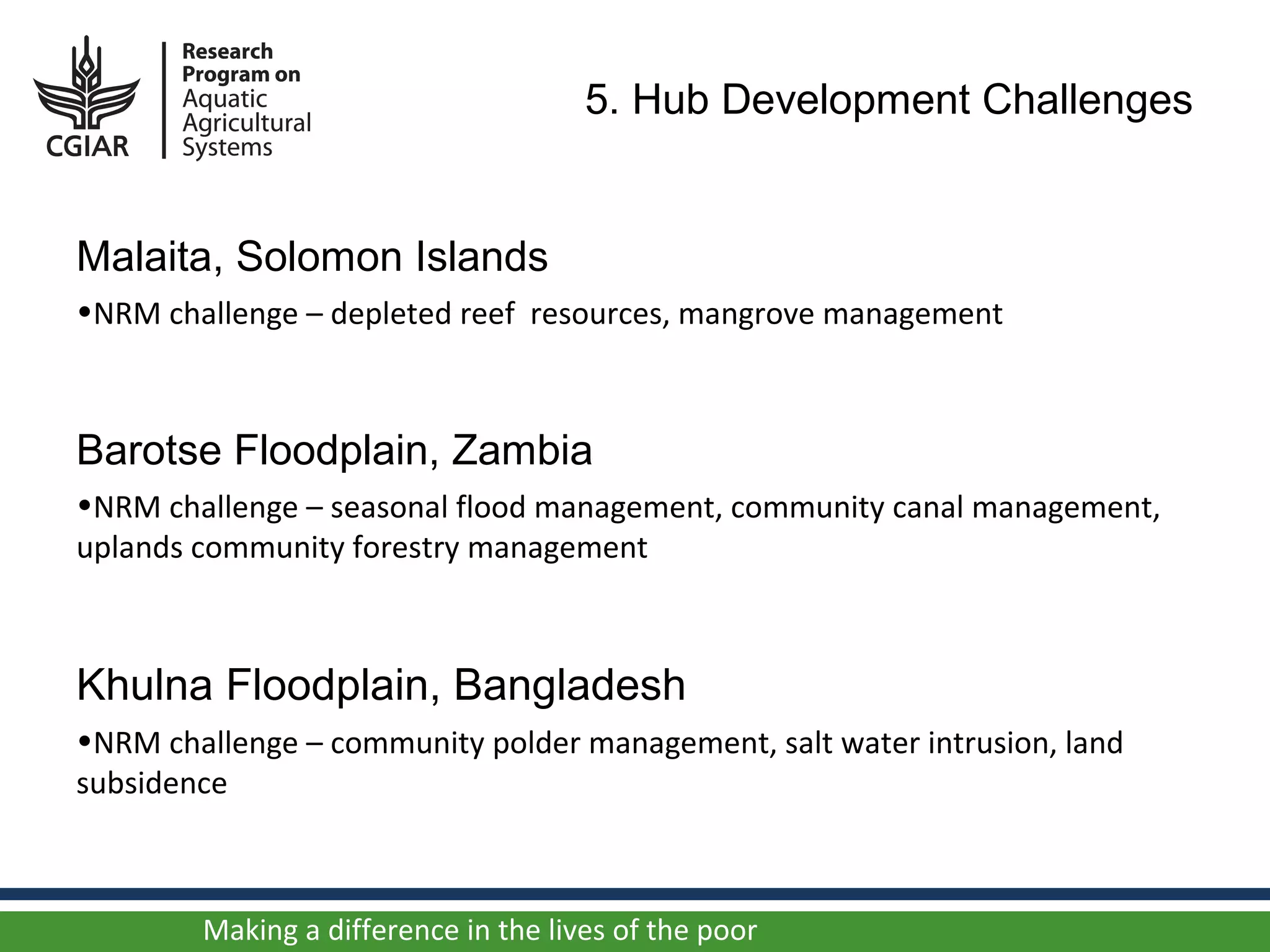
5. Hub Development Challenges


Malaita, Solomon Islands
•NRM challenge – depleted reef resources, mangrove management


Barotse Floodplain, Zambia
•NRM challenge – seasonal flood management, community canal management,
uplands community forestry management


Khulna Floodplain, Bangladesh
•NRM challenge – community polder management, salt water intrusion, land
subsidence


        Making a difference in the lives of the poor
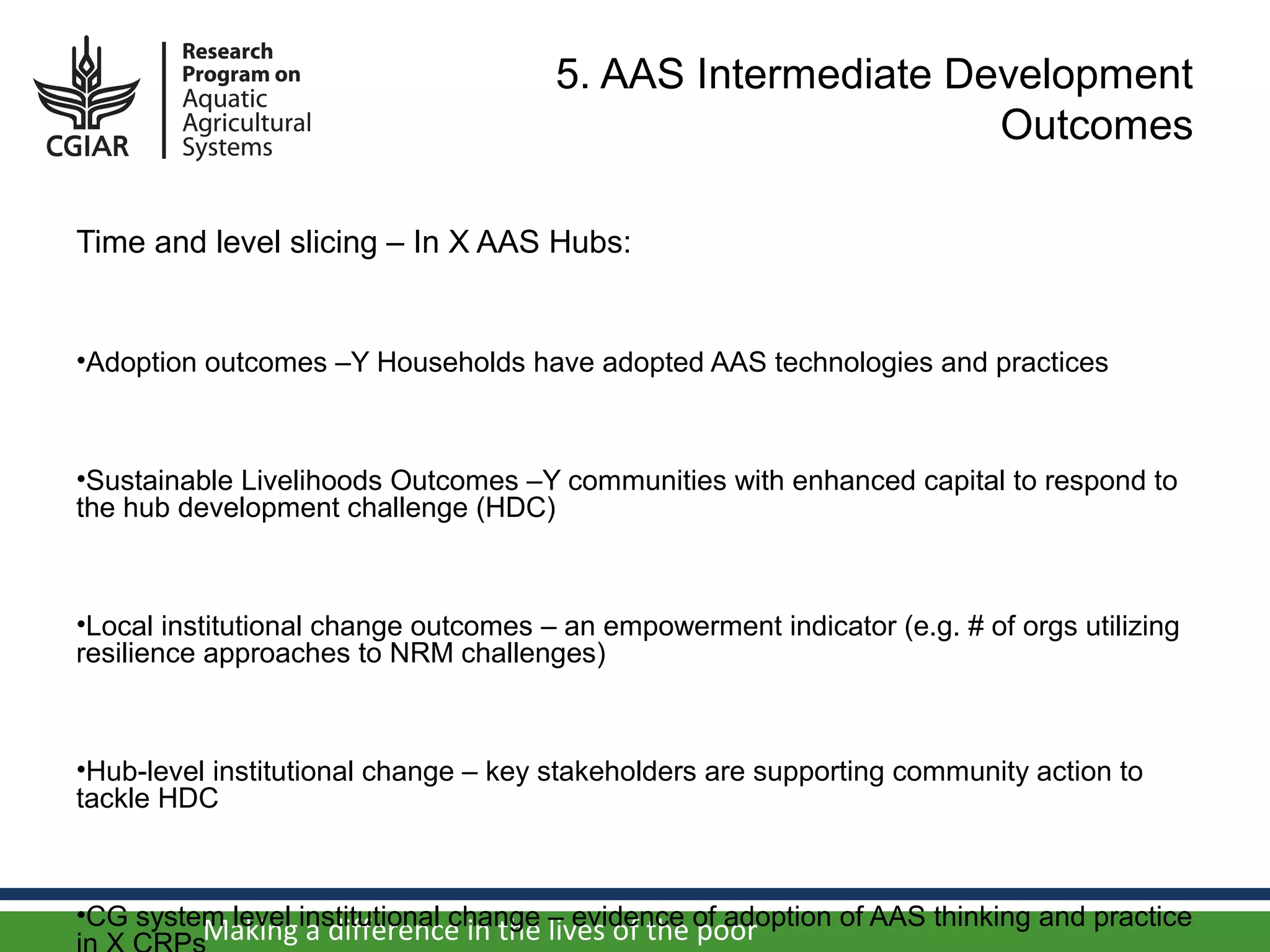
5. AAS Intermediate Development
                                                            Outcomes

Time and level slicing – In X AAS Hubs:


•Adoption outcomes –Y Households have adopted AAS technologies and practices


•Sustainable Livelihoods Outcomes –Y communities with enhanced capital to respond to
the hub development challenge (HDC)


•Local institutional change outcomes – an empowerment indicator (e.g. # of orgs utilizing
resilience approaches to NRM challenges)


•Hub-level institutional change – key stakeholders are supporting community action to
tackle HDC


•CG system level institutional change – evidence of adoption of AAS thinking and practice
         Making a difference in the lives of the poor
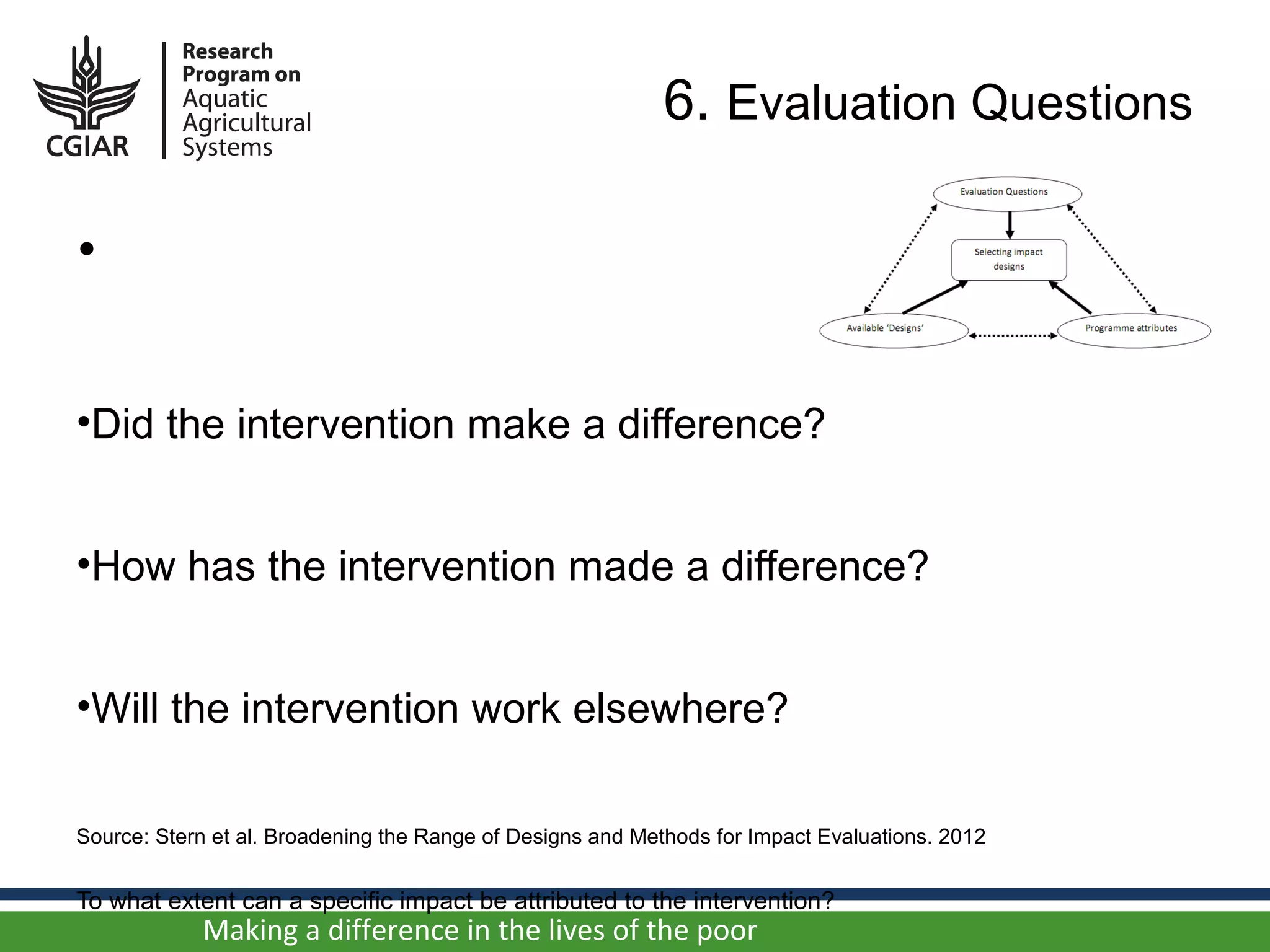
6. Evaluation Questions

•


•Did the intervention make a difference?


•How has the intervention made a difference?


•Will the intervention work elsewhere?

Source: Stern et al. Broadening the Range of Designs and Methods for Impact Evaluations. 2012


To what extent can a specific impact be attributed to the intervention?
            Making a difference in the lives of the poor
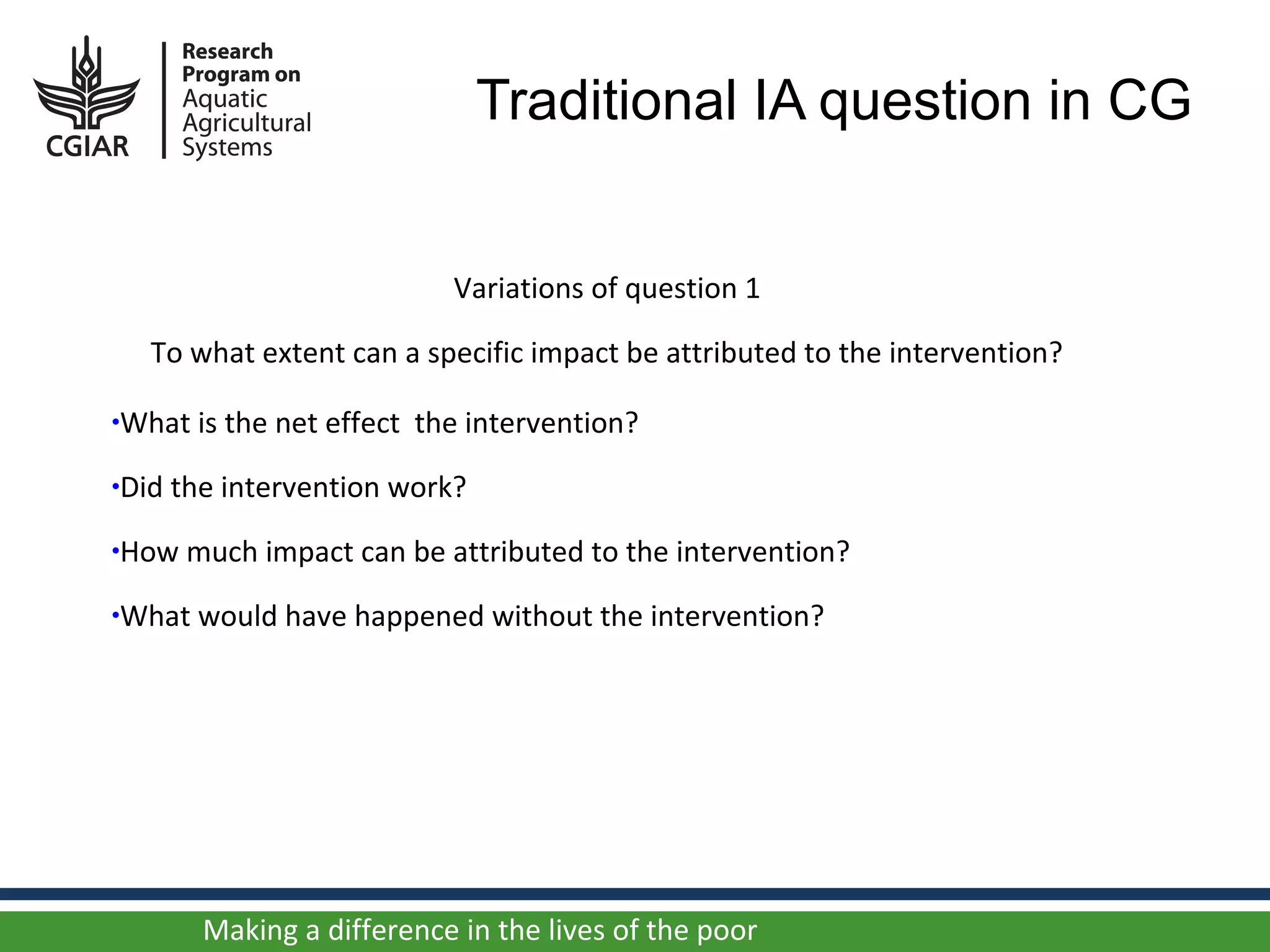
Traditional IA question in CG


                            Variations of question 1

   To what extent can a specific impact be attributed to the intervention?

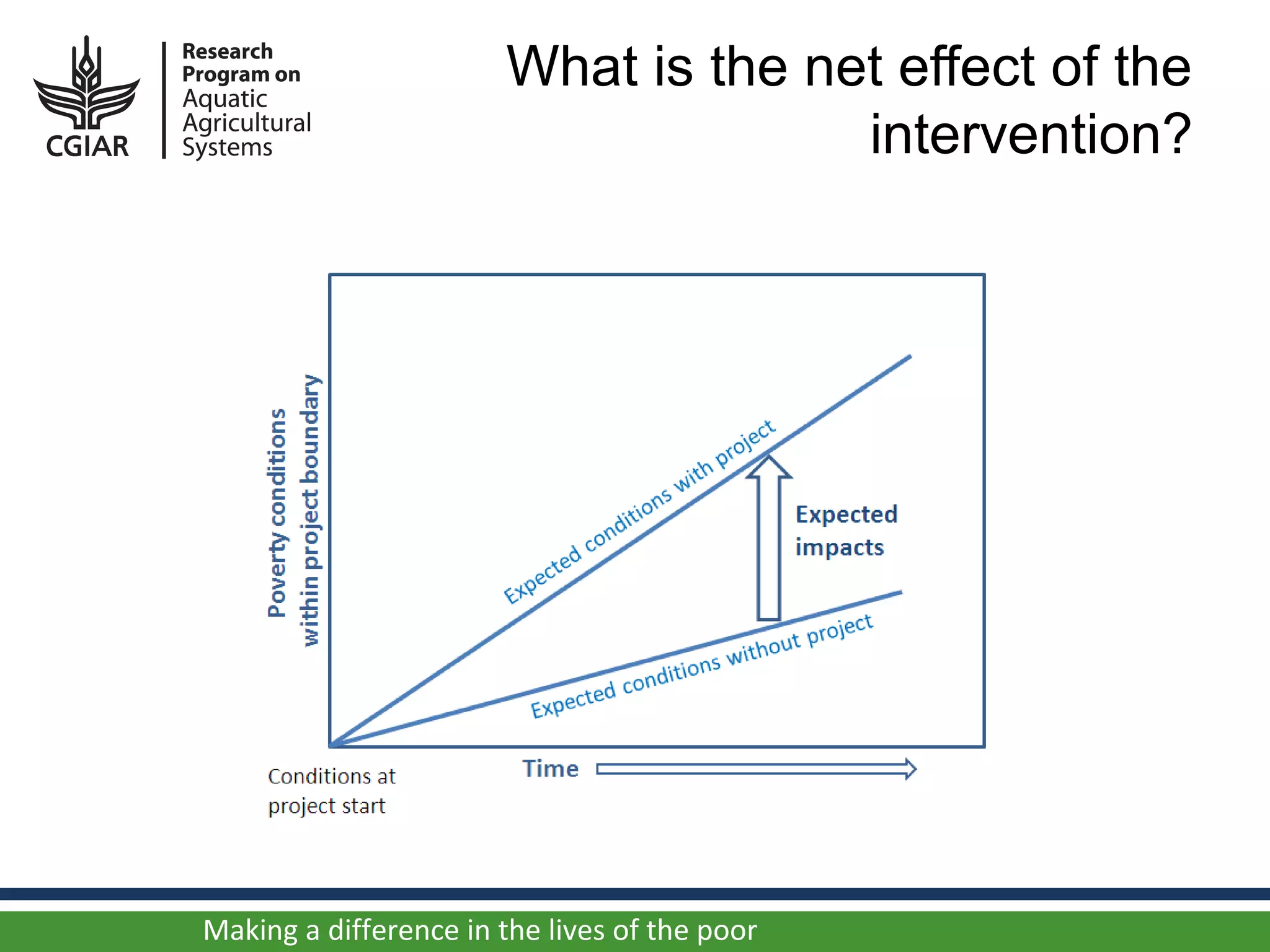
•What is the net effect   the intervention?
•Did the intervention work?

•How much impact can be attributed to the intervention?

•What would have happened without the intervention?


       Making a difference in the lives of the poor
What is the net effect of the
                                      intervention?


Making a difference in the lives of the poor
NRM Evaluation questions

Questions that focus consideration of:
•The continued rationale for the program


•Implementation of the program


•To what extent the program worked (had intended results)


•Why the program works the way it does


•Whether the program will continue to work
      Making a difference in the lives of the poor
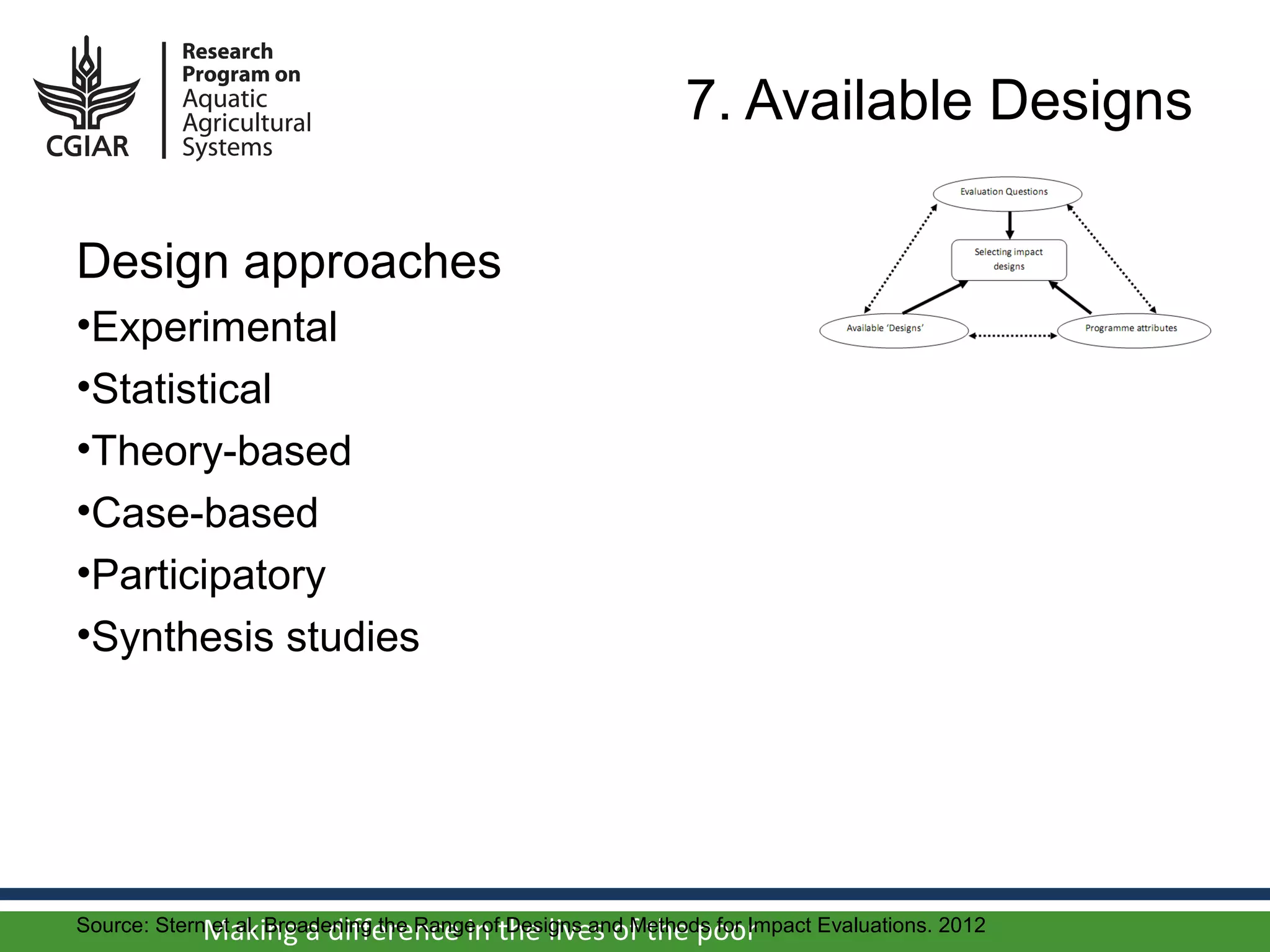
7. Available Designs

Design approaches
•Experimental
•Statistical
•Theory-based
•Case-based
•Participatory
•Synthesis studies


Source: SternMaking a difference in the lives of the poor
             et al. Broadening the Range of Designs and Methods for Impact Evaluations. 2012
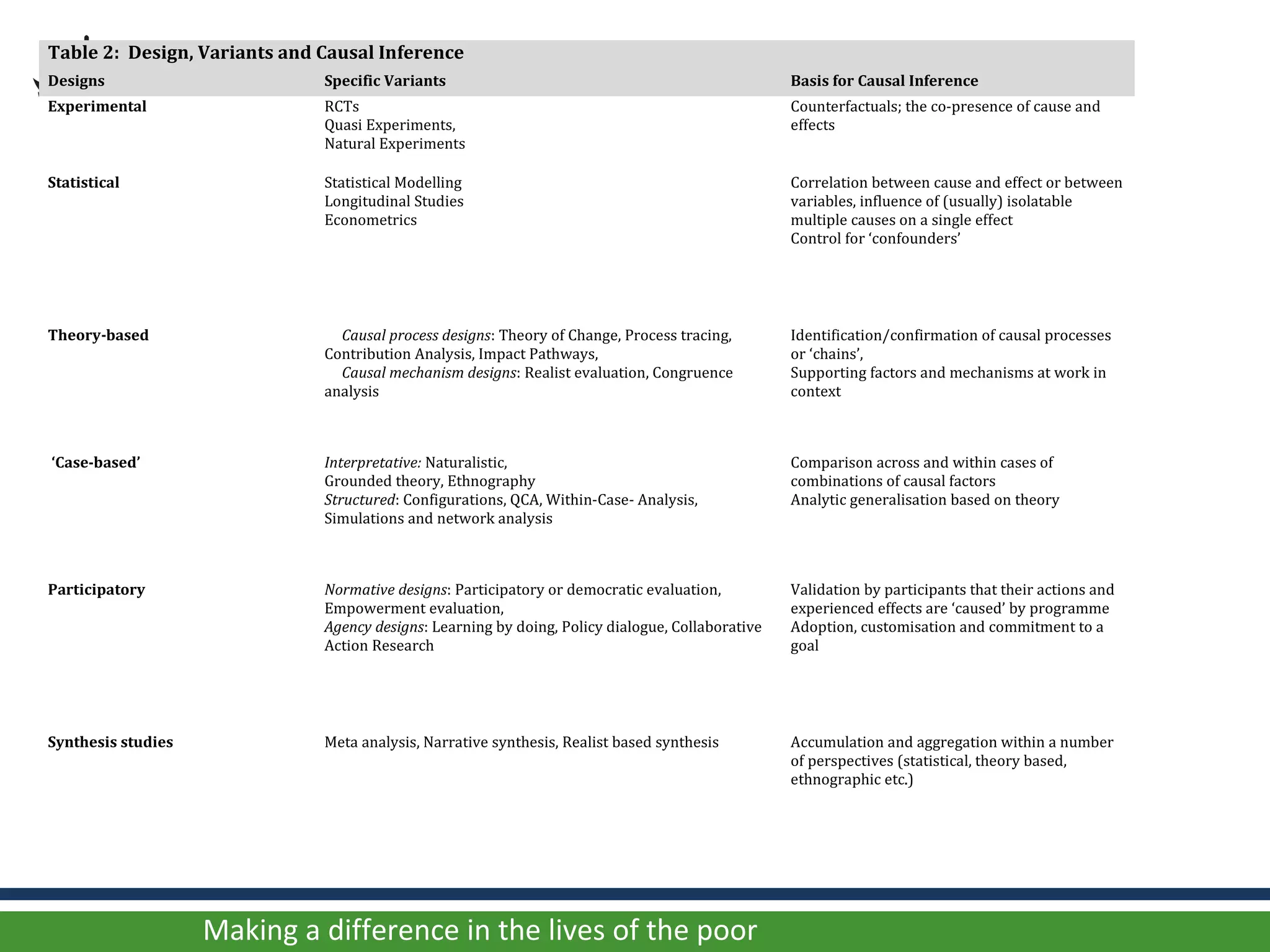
Table 2: Design, Variants and Causal Inference
Designs                       Specific Variants                                                   Basis for Causal Inference
Experimental                  RCTs                                                                Counterfactuals; the co-presence of cause and
                              Quasi Experiments,                                                  effects
                              Natural Experiments

Statistical                   Statistical Modelling                                               Correlation between cause and effect or between
                              Longitudinal Studies                                                variables, influence of (usually) isolatable
                              Econometrics                                                        multiple causes on a single effect
                                                                                                  Control for ‘confounders’


Theory-based                    Causal process designs: Theory of Change, Process tracing,        Identification/confirmation of causal processes
                              Contribution Analysis, Impact Pathways,                             or ‘chains’,
                                Causal mechanism designs: Realist evaluation, Congruence          Supporting factors and mechanisms at work in
                              analysis                                                            context


‘Case-based’                  Interpretative: Naturalistic,                                       Comparison across and within cases of
                              Grounded theory, Ethnography                                        combinations of causal factors
                              Structured: Configurations, QCA, Within-Case- Analysis,             Analytic generalisation based on theory
                              Simulations and network analysis


Participatory                 Normative designs: Participatory or democratic evaluation,          Validation by participants that their actions and
                              Empowerment evaluation,                                             experienced effects are ‘caused’ by programme
                              Agency designs: Learning by doing, Policy dialogue, Collaborative   Adoption, customisation and commitment to a
                              Action Research                                                     goal


Synthesis studies             Meta analysis, Narrative synthesis, Realist based synthesis         Accumulation and aggregation within a number
                                                                                                  of perspectives (statistical, theory based,
                                                                                                  ethnographic etc.)


                    Making a difference in the lives of the poor

Considerations for AAS CRP Impact Evaluation - Workshop on Strengthening Impact Evaluation in Natural Resource Management

  • 1.
    Considerations for AAS CRPImpact Evaluation Workshop on Strengthening Impact Evaluation in Natural Resource Management WorldFish, Penang, Malaysia 4-5 September 2012 Making a difference in the lives of the poor
  • 2.
    Pre-implementation evaluation •Are the objectives well defined so that outcomes can be stated in measurable terms? •Is there a coherent and credible implementation plan that provides clear Performance Logic Chain Evaluation evidence of how implementation is to proceed and how successful implementation can be distinguished from poor implementation? The performance logic chain assessment evaluation •Is the rationale for the deployment of resources clear and commensurate strategy is used to determine the strength and logic with the requirements for achieving the stated outcomes? of the causal model behind the policy, program, or project. Process implementation evaluation What did or did not get implemented as planned? Impact Evaluation Rapid Appraisals … the classic evaluation that provide timely, relevant information to attempts to find out the decision-makers on pressing issues they face changes that occurred, and to in the project and program setting. what they can be attributed The aim of applied research is . . . to facilitate a more rational decision-making process in real-life circumstances Case Studies … use when a manager needs in-depth information to understand more clearly what happened with a policy, program, or project Making a difference in the lives of the poor
  • 3.
    AAS CRP Implementationstrategy Making a difference in the lives of the poor
  • 4.
    1. A frameworkto guide selection of impact designs Making a difference in the lives of the poor
  • 5.
    2. Evaluation Challengefor AAS •Many CG stakeholders view experimental designs for IA as ‘best’ •Mostly experimental or statistical methods based IA NRM- type programs demonstrate little evidence of impact •Tradition of CGIAR IA could result in mis-match of questions and methods that could bias results against AAS program •Demonstrate the validity (legitimacy) of alternate methods for AAS CRP Making a difference in the lives of the poor
  • 6.
    3. Evaluation Goalsof AAS •Accountability •Respect Consortium and Fund needs for demonstration of performance and potential for impact •Learning •Respect AAS program philosophy of a learning, adaptive program Making a difference in the lives of the poor
  • 7.
    4. Consortium EvaluationPerspectives: A Performance Management System Intermediate development outcomes: •represent a change, in the medium term, which is intended to affect positively the welfare of the targeted population or environment resulting, in part, from research carried out by the CGIAR (and its partners) •are attributable to CRP-level activities The CRPs are expected to document these development outcomes through periodic studies on outcome and impact. Source: ISPC. Strengthening Strategy and Results Framework through Prioritization. June 2012 Making a difference in the lives of the poor
  • 8.
    4. Consortium EvaluationPerspectives: A Performance Management System Benefits for the centers are to be able to answer these questions •How are we performing and what impact are we having in achieving the SLOs? •Are we learning and using what we have learned to improve? •What changes can we make within the CG to be able to provide better answers to questions 1 and 2? •CRPs will be held accountable – but be left to implement flexibly Making a difference in the lives of the poor
  • 9.
    Impacts - change in problem - change in opportunities Development - change in actions/behaviour of stakeholders Outcomes - change in productivity - change in equity/empowerment - change in market conditions - change in investments - change in security of assets/habitats Research - recognition/appreciation of research knowledge Outcomes - use of knowledge by partners - mobilisation of new capacity - extension of technology/materials - change in policy environment Outputs - change in knowledge - change in capacity - change in technology - change in materials - change in policy options - change in awareness/understanding Making a difference in the lives of the poor
  • 10.
    5. Attributes ofNRM programs Generic attributes of NRM programs •Multi-stakeholder participation and coordinated action •Multi-leveled: farm, landscape, region… •Uncertain and lengthy trajectories for impact •Knowledge generation •Contextualized knowledge is vital •Systems integration •Operates in areas of limited/little prior or reliable knowledge •Institutional concerns •Emerging outcomes Source: White paper Making a difference in the lives of the poor
  • 11.
    5. Selected attributesof the AAS program •Strongly place based •Challenging agro-ecosystems •Marginalized populations •Multi-stakeholder participation •A major process outcome •Increases in network capital •Interventions at multiple levels •Strong commitment to community-level agendas •Regional and global agendas too •Multiple-interventions •‘Research in development’ implies that development is happening •Overlapping programs and many actors •Hub-level NRM issues offer opportunities and create constraints •Emergent effects •Contextualized causal mechanisms •Long term processes Making a difference in the lives of the poor
  • 12.
    5. Hub DevelopmentChallenges Malaita, Solomon Islands •Rural people in the hub face major challenges from rising population and diminishing marine resources. The development challenge is to improve their lives through more productive, diversified livelihoods that empower communities to be better able to adapt to change and make more effective use of their marine resources. The research challenge is to develop and test alternative approaches to livelihood diversification and resource stewardship that will accelerate development and restore the productivity of their resources. Barotse Floodplain, Zambia •To make effective use of the seasonal flooding and natural resources in the Barotse floodplain system through more productive and diversified aquatic agricultural management practices and technologies that improve the lives and livelihoods of the poor. Khulna Floodplain, Bangladesh •We seek positive transformational change in the lives and livelihoods of poor AAS-dependent farmers and their communities, particularly women and youth. We strive for empowered communities that lead in the innovation and adoption of more productive, diversified and resilient practices and technologies and demand a more equitable role in the management of natural resources. With this enhanced capacity and leadership they will make more effective use of water, land and biodiversity resources, better access information and markets and continually adapt to a dynamic Khulna floodplain system. Making a difference in the lives of the poor
  • 13.
    5. Hub DevelopmentChallenges Malaita, Solomon Islands •NRM challenge – depleted reef resources, mangrove management Barotse Floodplain, Zambia •NRM challenge – seasonal flood management, community canal management, uplands community forestry management Khulna Floodplain, Bangladesh •NRM challenge – community polder management, salt water intrusion, land subsidence Making a difference in the lives of the poor
  • 14.
    5. AAS IntermediateDevelopment Outcomes Time and level slicing – In X AAS Hubs: •Adoption outcomes –Y Households have adopted AAS technologies and practices •Sustainable Livelihoods Outcomes –Y communities with enhanced capital to respond to the hub development challenge (HDC) •Local institutional change outcomes – an empowerment indicator (e.g. # of orgs utilizing resilience approaches to NRM challenges) •Hub-level institutional change – key stakeholders are supporting community action to tackle HDC •CG system level institutional change – evidence of adoption of AAS thinking and practice Making a difference in the lives of the poor
  • 15.
    6. Evaluation Questions • •Didthe intervention make a difference? •How has the intervention made a difference? •Will the intervention work elsewhere? Source: Stern et al. Broadening the Range of Designs and Methods for Impact Evaluations. 2012 To what extent can a specific impact be attributed to the intervention? Making a difference in the lives of the poor
  • 16.
    Traditional IA questionin CG Variations of question 1 To what extent can a specific impact be attributed to the intervention? •What is the net effect the intervention? •Did the intervention work? •How much impact can be attributed to the intervention? •What would have happened without the intervention? Making a difference in the lives of the poor
  • 17.
    What is thenet effect of the intervention? Making a difference in the lives of the poor
  • 18.
    NRM Evaluation questions Questionsthat focus consideration of: •The continued rationale for the program •Implementation of the program •To what extent the program worked (had intended results) •Why the program works the way it does •Whether the program will continue to work Making a difference in the lives of the poor
  • 19.
    7. Available Designs Designapproaches •Experimental •Statistical •Theory-based •Case-based •Participatory •Synthesis studies Source: SternMaking a difference in the lives of the poor et al. Broadening the Range of Designs and Methods for Impact Evaluations. 2012
  • 20.
    Table 2: Design,Variants and Causal Inference Designs Specific Variants Basis for Causal Inference Experimental RCTs Counterfactuals; the co-presence of cause and Quasi Experiments, effects Natural Experiments Statistical Statistical Modelling Correlation between cause and effect or between Longitudinal Studies variables, influence of (usually) isolatable Econometrics multiple causes on a single effect Control for ‘confounders’ Theory-based Causal process designs: Theory of Change, Process tracing, Identification/confirmation of causal processes Contribution Analysis, Impact Pathways, or ‘chains’, Causal mechanism designs: Realist evaluation, Congruence Supporting factors and mechanisms at work in analysis context ‘Case-based’ Interpretative: Naturalistic, Comparison across and within cases of Grounded theory, Ethnography combinations of causal factors Structured: Configurations, QCA, Within-Case- Analysis, Analytic generalisation based on theory Simulations and network analysis Participatory Normative designs: Participatory or democratic evaluation, Validation by participants that their actions and Empowerment evaluation, experienced effects are ‘caused’ by programme Agency designs: Learning by doing, Policy dialogue, Collaborative Adoption, customisation and commitment to a Action Research goal Synthesis studies Meta analysis, Narrative synthesis, Realist based synthesis Accumulation and aggregation within a number of perspectives (statistical, theory based, ethnographic etc.) Making a difference in the lives of the poor

Editor's Notes