Slide - 1Copyright © 2018, 2014, 2010 Pearson Education Inc.A L W A Y S L E A R N I N G
2
Factoring and
Applications
13
Slide - 2Copyright © 2018, 2014, 2010 Pearson Education Inc.A L W A Y S L E A R N I N G
1. Factor trinomials with a coefficient of 1 for
the second-degree term.
2. Factor such trinomials after factoring out the
greatest common factor.
Objectives
13.2 Factoring Trinomials
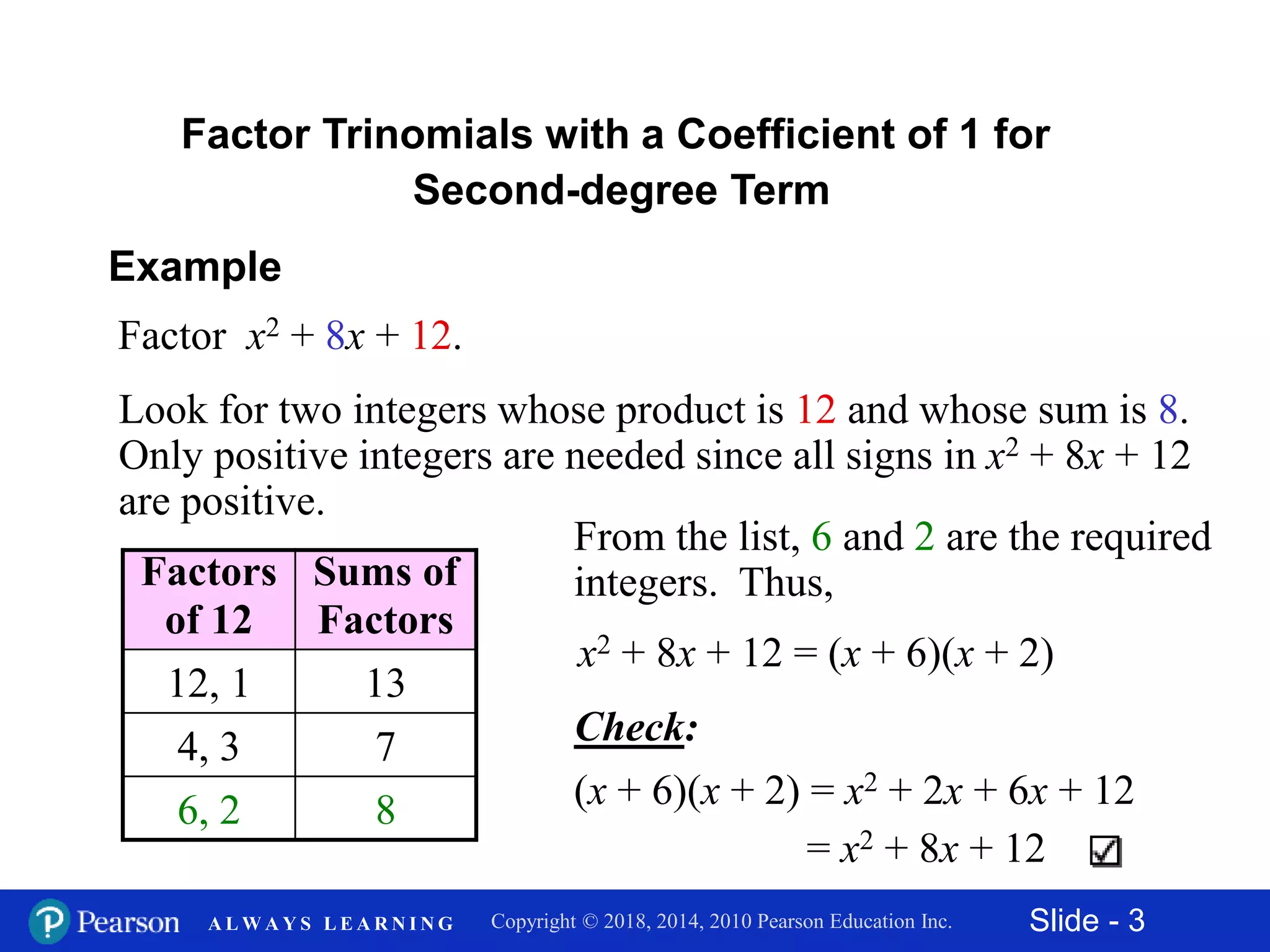
Slide - 3Copyright © 2018, 2014, 2010 Pearson Education Inc.A L W A Y S L E A R N I N G
Example
Factor x2 + 8x + 12.
Look for two integers whose product is 12 and whose sum is 8.
Only positive integers are needed since all signs in x2 + 8x + 12
are positive.
Factor Trinomials with a Coefficient of 1 for
Second-degree Term
Factors
of 12
Sums of
Factors
12, 1 13
4, 3 7
6, 2 8
From the list, 6 and 2 are the required
integers. Thus,
x2 + 8x + 12 = (x + 6)(x + 2)
Check:
(x + 6)(x + 2) = x2 + 2x + 6x + 12
= x2 + 8x + 12
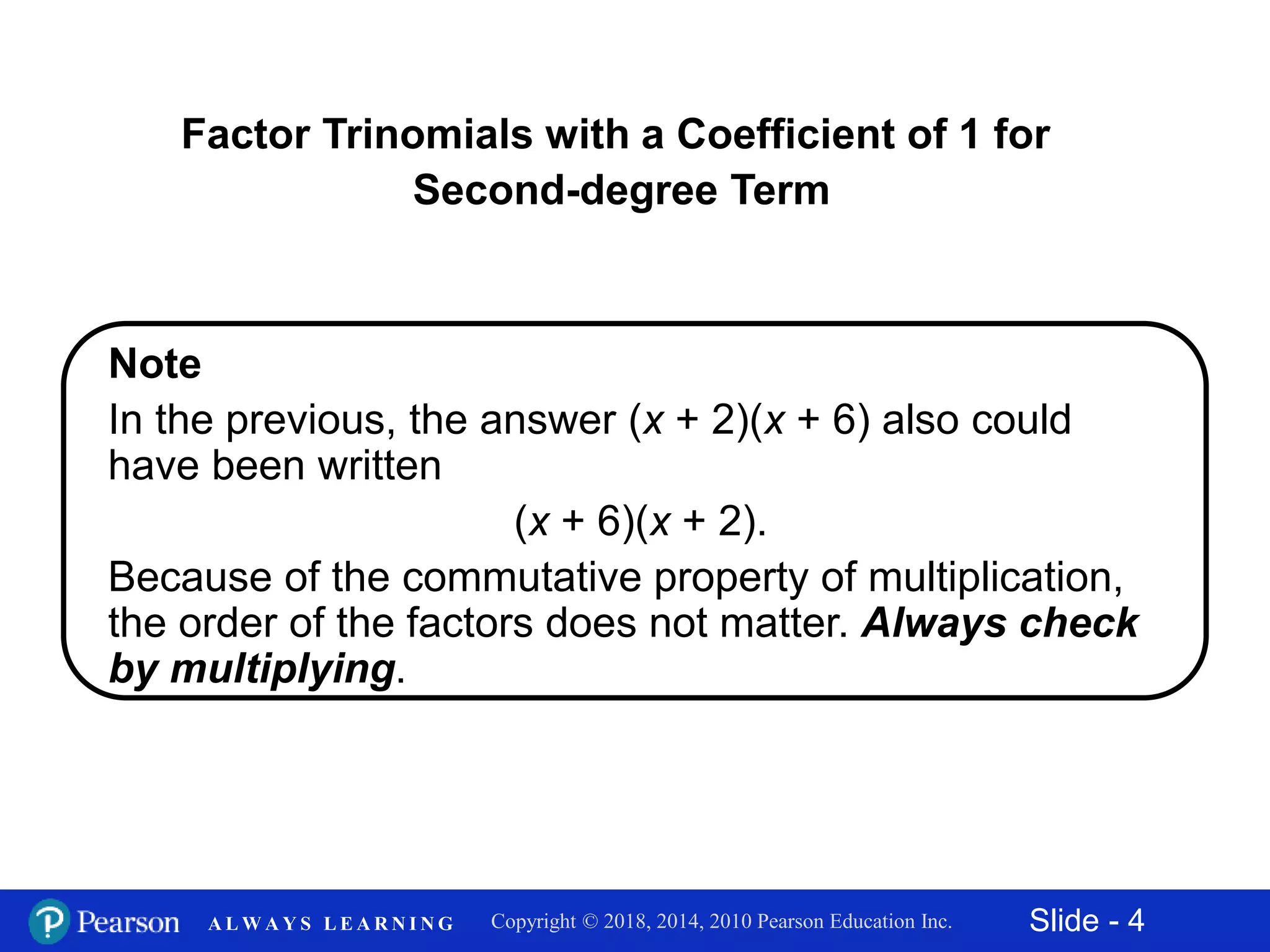
Slide - 4Copyright © 2018, 2014, 2010 Pearson Education Inc.A L W A Y S L E A R N I N G
Note
In the previous, the answer (x + 2)(x + 6) also could
have been written
(x + 6)(x + 2).
Because of the commutative property of multiplication,
the order of the factors does not matter. Always check
by multiplying.
Factor Trinomials with a Coefficient of 1 for
Second-degree Term
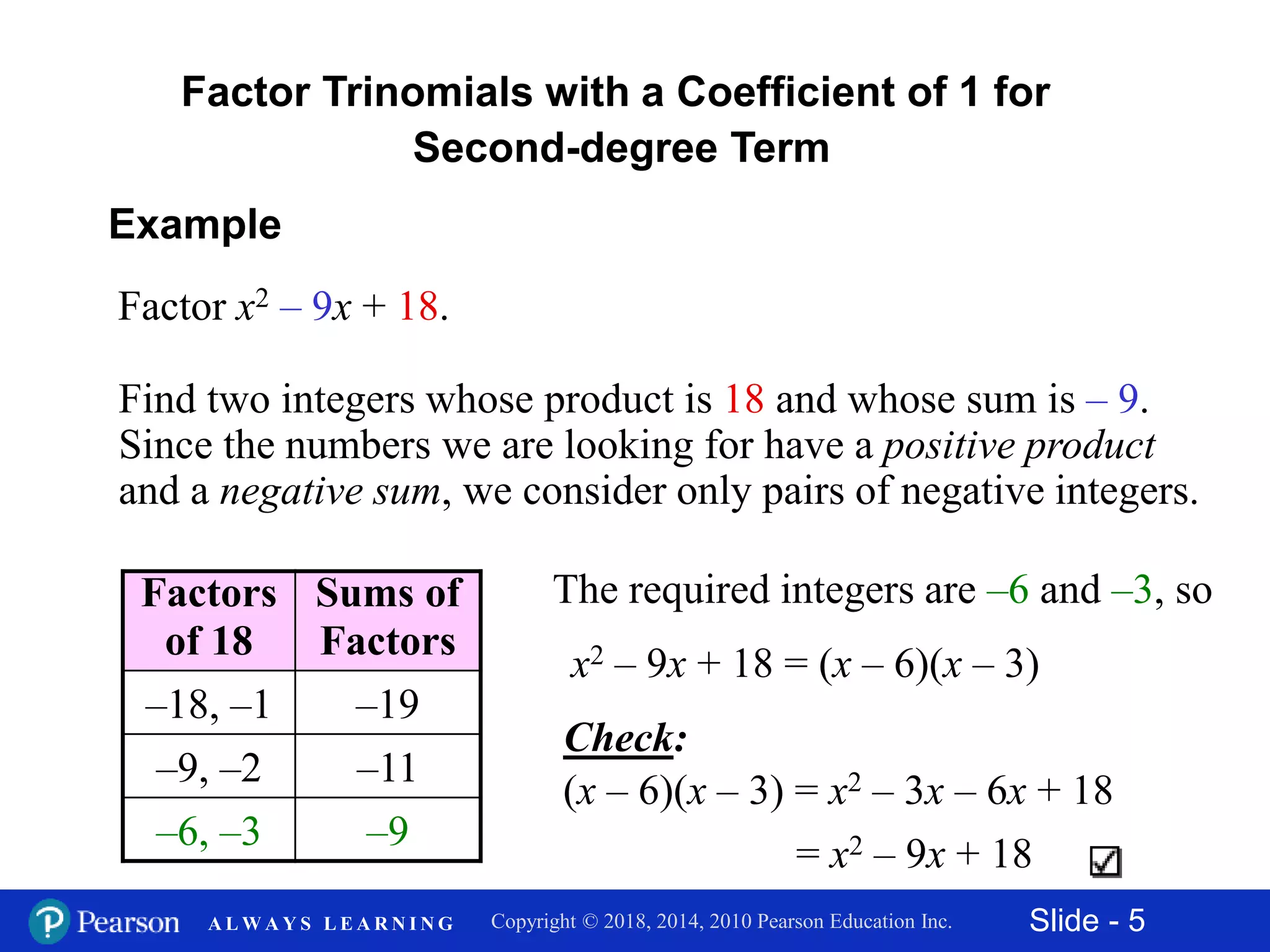
Slide - 5Copyright © 2018, 2014, 2010 Pearson Education Inc.A L W A Y S L E A R N I N G
Example
Factor x2 – 9x + 18.
Find two integers whose product is 18 and whose sum is – 9.
Since the numbers we are looking for have a positive product
and a negative sum, we consider only pairs of negative integers.
Factors
of 18
Sums of
Factors
–18, –1 –19
–9, –2 –11
–6, –3 –9
The required integers are –6 and –3, so
x2 – 9x + 18 = (x – 6)(x – 3)
Check:
(x – 6)(x – 3) = x2 – 3x – 6x + 18
= x2 – 9x + 18
Factor Trinomials with a Coefficient of 1 for
Second-degree Term
Slide - 6Copyright © 2018, 2014, 2010 Pearson Education Inc.A L W A Y S L E A R N I N G
Example
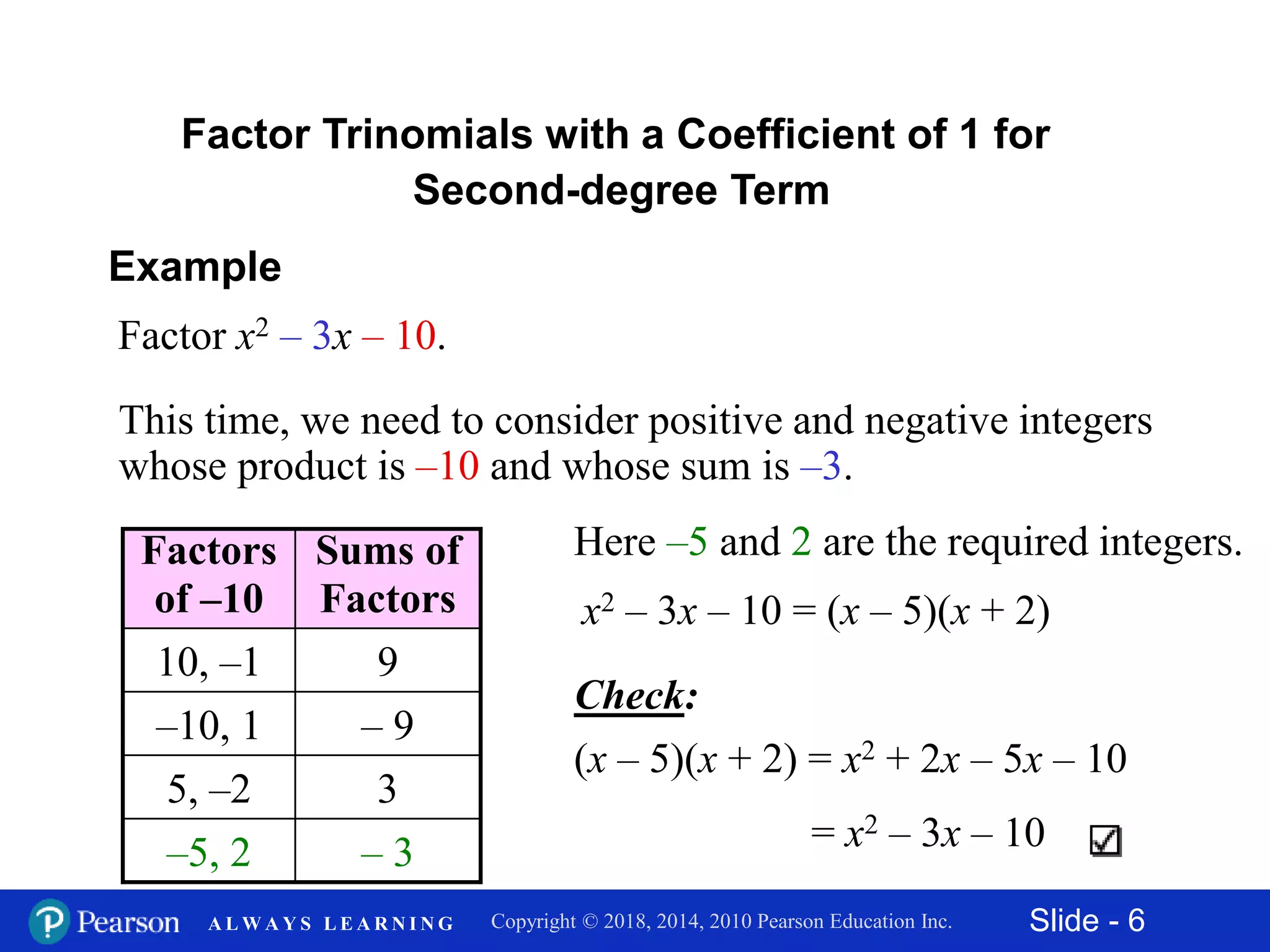
Factor x2 – 3x – 10.
This time, we need to consider positive and negative integers
whose product is –10 and whose sum is –3.
Factors
of –10
Sums of
Factors
10, –1 9
–10, 1 – 9
5, –2 3
–5, 2 – 3
Here –5 and 2 are the required integers.
x2 – 3x – 10 = (x – 5)(x + 2)
Check:
(x – 5)(x + 2) = x2 + 2x – 5x – 10
= x2 – 3x – 10
Factor Trinomials with a Coefficient of 1 for
Second-degree Term
Slide - 7Copyright © 2018, 2014, 2010 Pearson Education Inc.A L W A Y S L E A R N I N G
Example
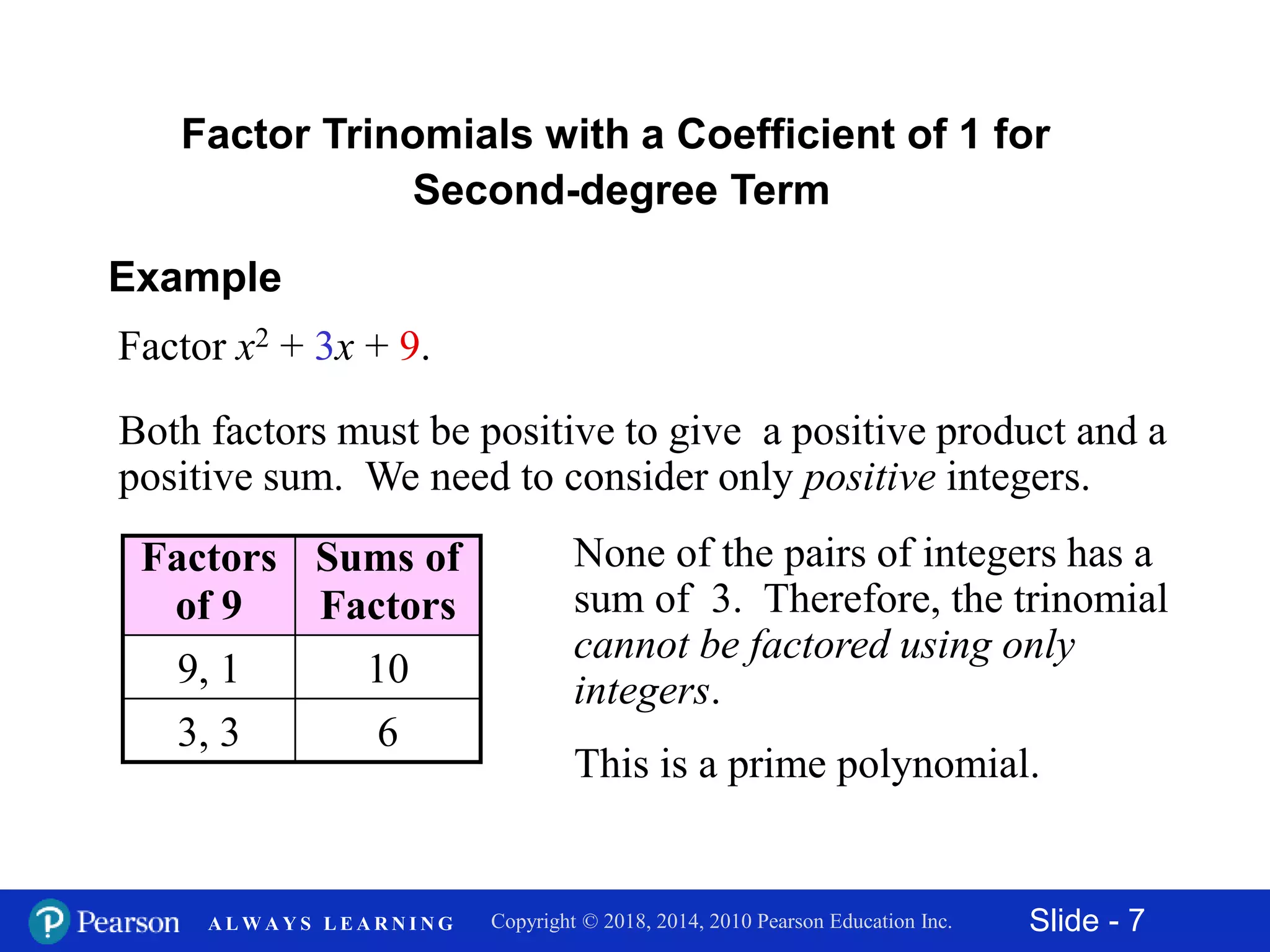
Factor x2 + 3x + 9.
Both factors must be positive to give a positive product and a
positive sum. We need to consider only positive integers.
Factors
of 9
Sums of
Factors
9, 1 10
3, 3 6
None of the pairs of integers has a
sum of 3. Therefore, the trinomial
cannot be factored using only
integers.
This is a prime polynomial.
Factor Trinomials with a Coefficient of 1 for
Second-degree Term
Slide - 8Copyright © 2018, 2014, 2010 Pearson Education Inc.A L W A Y S L E A R N I N G
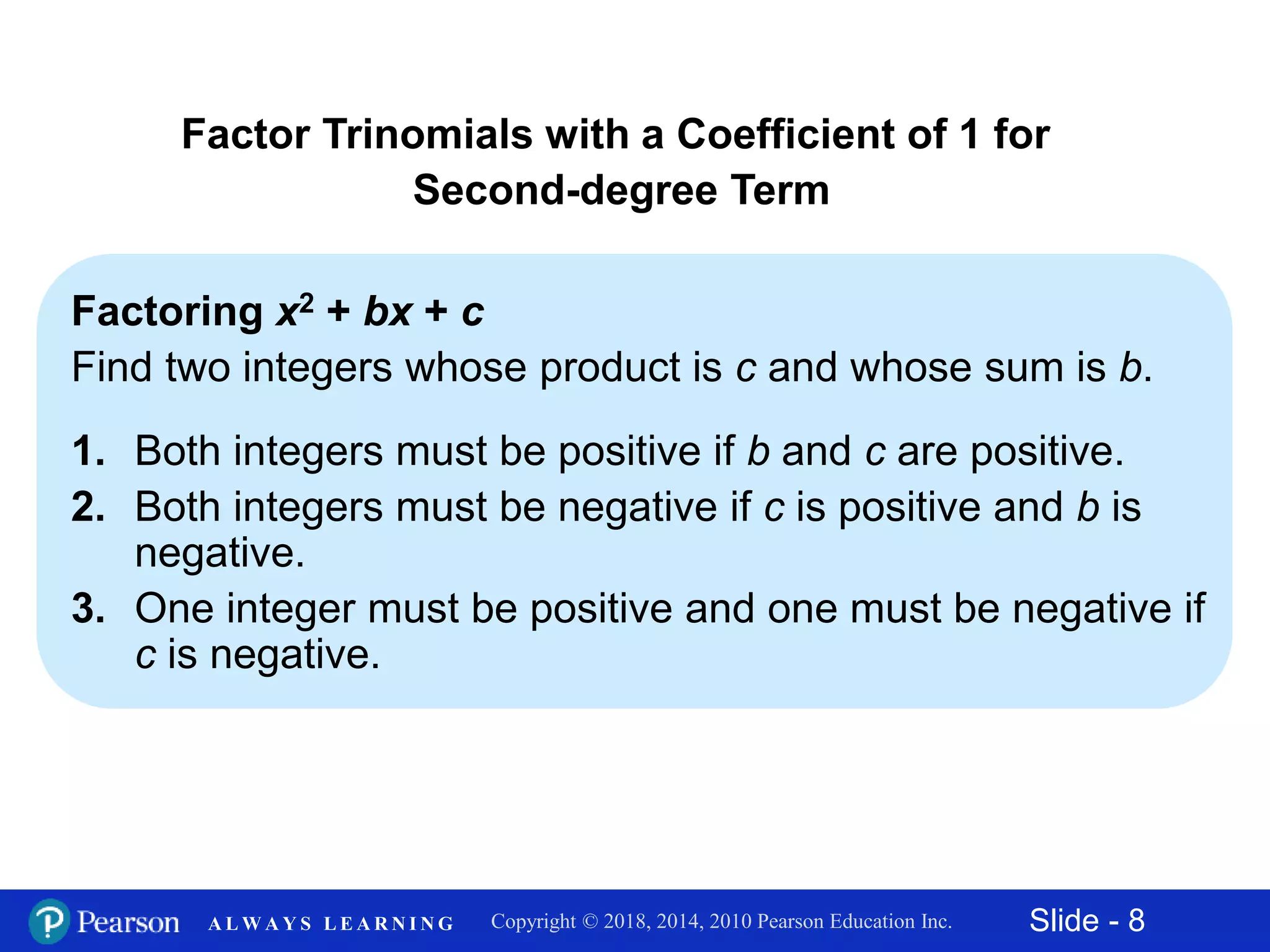
Factoring x2 + bx + c
Find two integers whose product is c and whose sum is b.
1. Both integers must be positive if b and c are positive.
2. Both integers must be negative if c is positive and b is
negative.
3. One integer must be positive and one must be negative if
c is negative.
Factor Trinomials with a Coefficient of 1 for
Second-degree Term
Slide - 9Copyright © 2018, 2014, 2010 Pearson Education Inc.A L W A Y S L E A R N I N G
Example
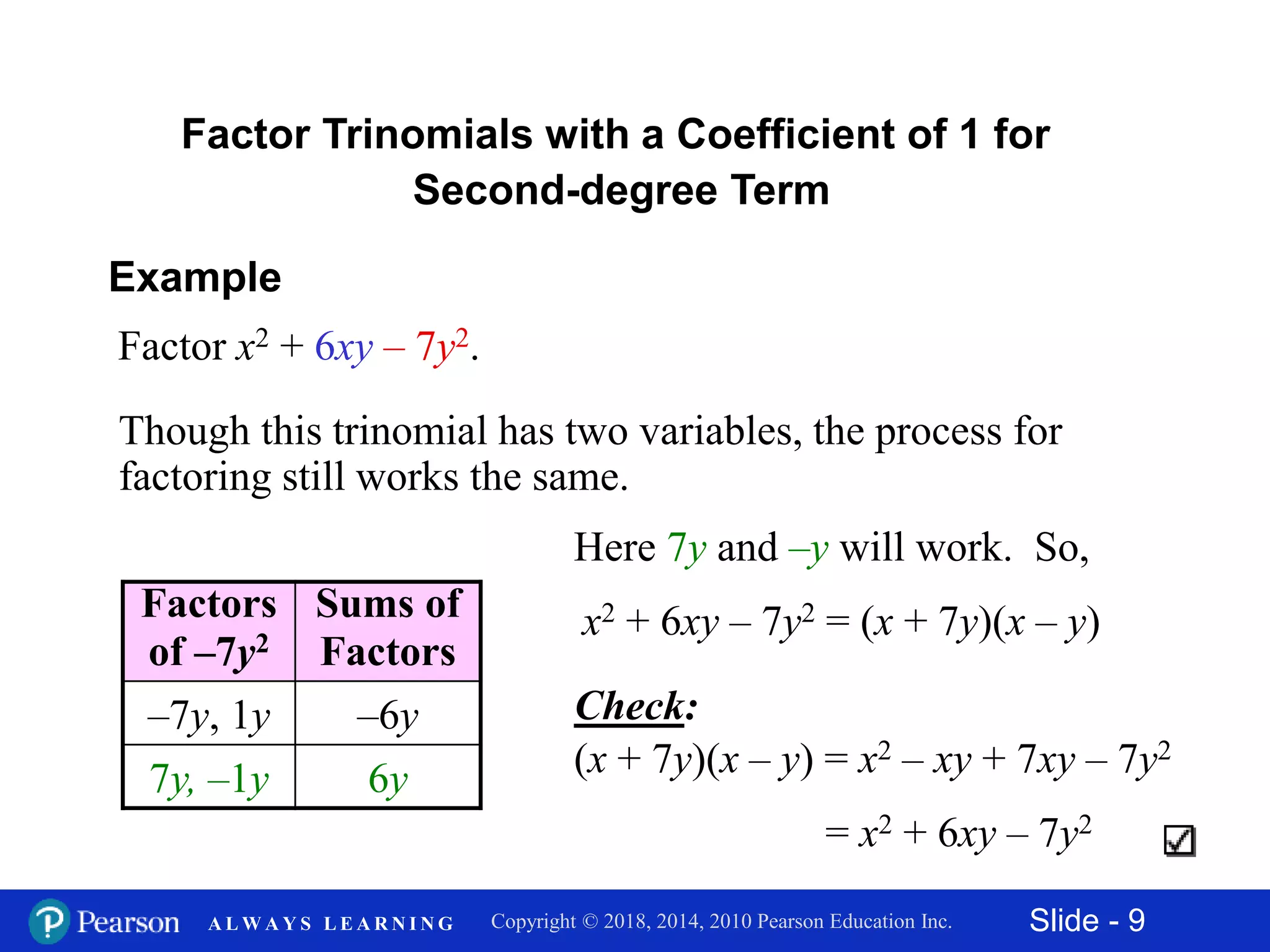
Factor x2 + 6xy – 7y2.
Though this trinomial has two variables, the process for
factoring still works the same.
Factors
of –7y2
Sums of
Factors
–7y, 1y –6y
7y, –1y 6y
Here 7y and –y will work. So,
x2 + 6xy – 7y2 = (x + 7y)(x – y)
Check:
(x + 7y)(x – y) = x2 – xy + 7xy – 7y2
= x2 + 6xy – 7y2
Factor Trinomials with a Coefficient of 1 for
Second-degree Term
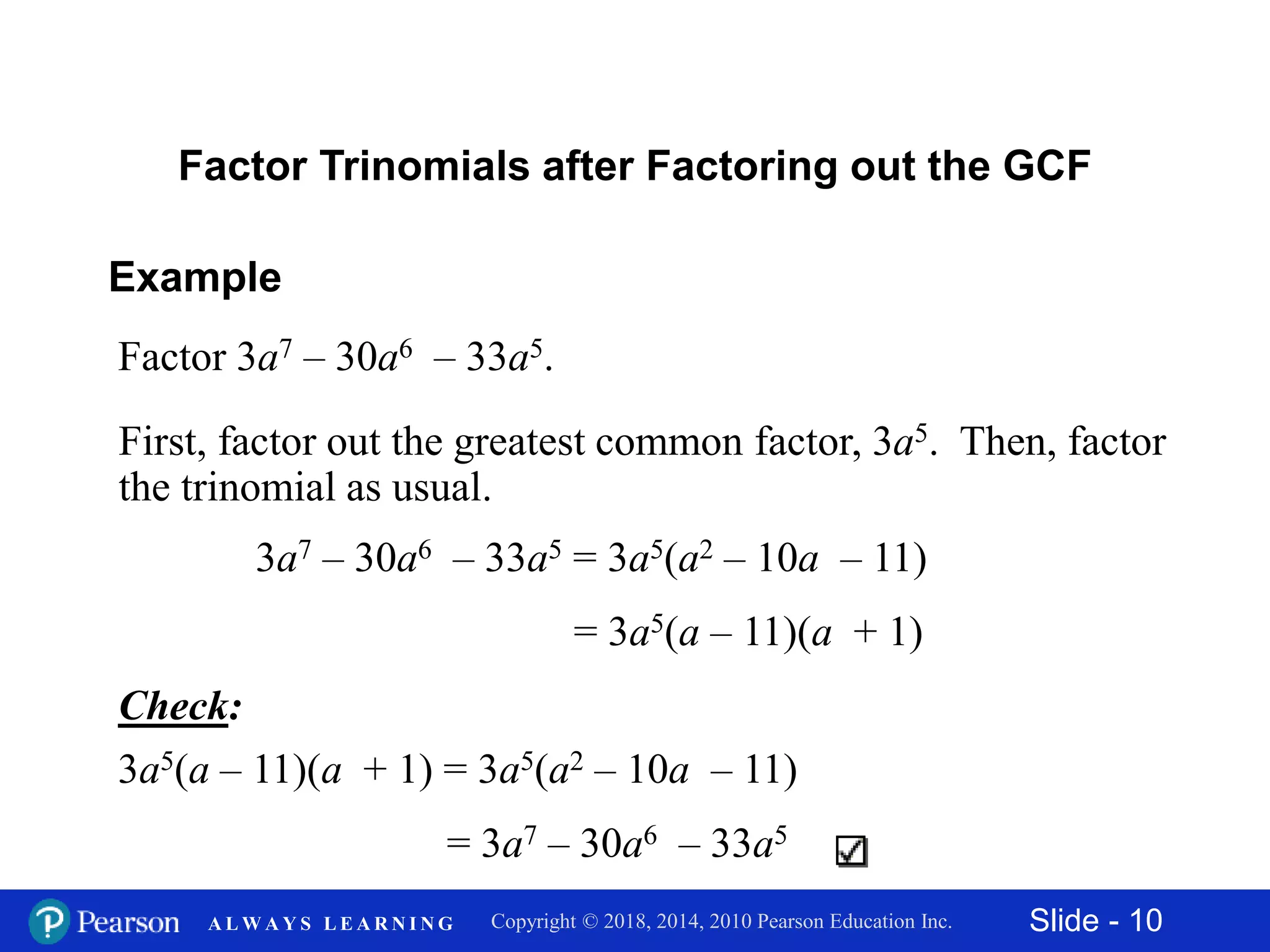
Slide - 10Copyright © 2018, 2014, 2010 Pearson Education Inc.A L W A Y S L E A R N I N G
Example
Factor 3a7 – 30a6 – 33a5.
First, factor out the greatest common factor, 3a5. Then, factor
the trinomial as usual.
Factor Trinomials after Factoring out the GCF
Check:
3a5(a – 11)(a + 1) = 3a5(a2 – 10a – 11)
= 3a7 – 30a6 – 33a5
3a7 – 30a6 – 33a5 = 3a5(a2 – 10a – 11)
= 3a5(a – 11)(a + 1)

Section 13.2 factoring trinomials

  • 1.
    Slide - 1Copyright© 2018, 2014, 2010 Pearson Education Inc.A L W A Y S L E A R N I N G 2 Factoring and Applications 13
  • 2.
    Slide - 2Copyright© 2018, 2014, 2010 Pearson Education Inc.A L W A Y S L E A R N I N G 1. Factor trinomials with a coefficient of 1 for the second-degree term. 2. Factor such trinomials after factoring out the greatest common factor. Objectives 13.2 Factoring Trinomials
  • 3.
    Slide - 3Copyright© 2018, 2014, 2010 Pearson Education Inc.A L W A Y S L E A R N I N G Example Factor x2 + 8x + 12. Look for two integers whose product is 12 and whose sum is 8. Only positive integers are needed since all signs in x2 + 8x + 12 are positive. Factor Trinomials with a Coefficient of 1 for Second-degree Term Factors of 12 Sums of Factors 12, 1 13 4, 3 7 6, 2 8 From the list, 6 and 2 are the required integers. Thus, x2 + 8x + 12 = (x + 6)(x + 2) Check: (x + 6)(x + 2) = x2 + 2x + 6x + 12 = x2 + 8x + 12
  • 4.
    Slide - 4Copyright© 2018, 2014, 2010 Pearson Education Inc.A L W A Y S L E A R N I N G Note In the previous, the answer (x + 2)(x + 6) also could have been written (x + 6)(x + 2). Because of the commutative property of multiplication, the order of the factors does not matter. Always check by multiplying. Factor Trinomials with a Coefficient of 1 for Second-degree Term
  • 5.
    Slide - 5Copyright© 2018, 2014, 2010 Pearson Education Inc.A L W A Y S L E A R N I N G Example Factor x2 – 9x + 18. Find two integers whose product is 18 and whose sum is – 9. Since the numbers we are looking for have a positive product and a negative sum, we consider only pairs of negative integers. Factors of 18 Sums of Factors –18, –1 –19 –9, –2 –11 –6, –3 –9 The required integers are –6 and –3, so x2 – 9x + 18 = (x – 6)(x – 3) Check: (x – 6)(x – 3) = x2 – 3x – 6x + 18 = x2 – 9x + 18 Factor Trinomials with a Coefficient of 1 for Second-degree Term
  • 6.
    Slide - 6Copyright© 2018, 2014, 2010 Pearson Education Inc.A L W A Y S L E A R N I N G Example Factor x2 – 3x – 10. This time, we need to consider positive and negative integers whose product is –10 and whose sum is –3. Factors of –10 Sums of Factors 10, –1 9 –10, 1 – 9 5, –2 3 –5, 2 – 3 Here –5 and 2 are the required integers. x2 – 3x – 10 = (x – 5)(x + 2) Check: (x – 5)(x + 2) = x2 + 2x – 5x – 10 = x2 – 3x – 10 Factor Trinomials with a Coefficient of 1 for Second-degree Term
  • 7.
    Slide - 7Copyright© 2018, 2014, 2010 Pearson Education Inc.A L W A Y S L E A R N I N G Example Factor x2 + 3x + 9. Both factors must be positive to give a positive product and a positive sum. We need to consider only positive integers. Factors of 9 Sums of Factors 9, 1 10 3, 3 6 None of the pairs of integers has a sum of 3. Therefore, the trinomial cannot be factored using only integers. This is a prime polynomial. Factor Trinomials with a Coefficient of 1 for Second-degree Term
  • 8.
    Slide - 8Copyright© 2018, 2014, 2010 Pearson Education Inc.A L W A Y S L E A R N I N G Factoring x2 + bx + c Find two integers whose product is c and whose sum is b. 1. Both integers must be positive if b and c are positive. 2. Both integers must be negative if c is positive and b is negative. 3. One integer must be positive and one must be negative if c is negative. Factor Trinomials with a Coefficient of 1 for Second-degree Term
  • 9.
    Slide - 9Copyright© 2018, 2014, 2010 Pearson Education Inc.A L W A Y S L E A R N I N G Example Factor x2 + 6xy – 7y2. Though this trinomial has two variables, the process for factoring still works the same. Factors of –7y2 Sums of Factors –7y, 1y –6y 7y, –1y 6y Here 7y and –y will work. So, x2 + 6xy – 7y2 = (x + 7y)(x – y) Check: (x + 7y)(x – y) = x2 – xy + 7xy – 7y2 = x2 + 6xy – 7y2 Factor Trinomials with a Coefficient of 1 for Second-degree Term
  • 10.
    Slide - 10Copyright© 2018, 2014, 2010 Pearson Education Inc.A L W A Y S L E A R N I N G Example Factor 3a7 – 30a6 – 33a5. First, factor out the greatest common factor, 3a5. Then, factor the trinomial as usual. Factor Trinomials after Factoring out the GCF Check: 3a5(a – 11)(a + 1) = 3a5(a2 – 10a – 11) = 3a7 – 30a6 – 33a5 3a7 – 30a6 – 33a5 = 3a5(a2 – 10a – 11) = 3a5(a – 11)(a + 1)