Slide - 1Copyright © 2018, 2014, 2010 Pearson Education Inc.A L W A Y S L E A R N I N G
2
Factoring and
Applications
13
Slide - 2Copyright © 2018, 2014, 2010 Pearson Education Inc.A L W A Y S L E A R N I N G
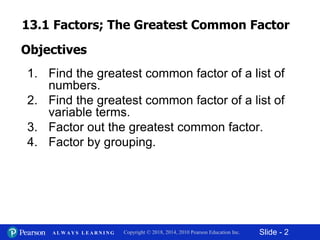
1. Find the greatest common factor of a list of
numbers.
2. Find the greatest common factor of a list of
variable terms.
3. Factor out the greatest common factor.
4. Factor by grouping.
Objectives
13.1 Factors; The Greatest Common Factor
Slide - 3Copyright © 2018, 2014, 2010 Pearson Education Inc.A L W A Y S L E A R N I N G
Find the Greatest Common Factor of a List of Numbers
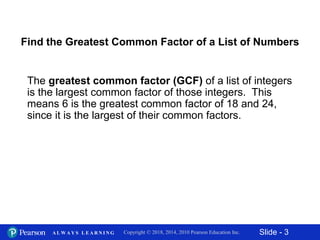
The greatest common factor (GCF) of a list of integers
is the largest common factor of those integers. This
means 6 is the greatest common factor of 18 and 24,
since it is the largest of their common factors.
Slide - 4Copyright © 2018, 2014, 2010 Pearson Education Inc.A L W A Y S L E A R N I N G
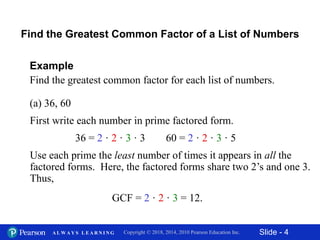
(a) 36, 60
Example
Find the greatest common factor for each list of numbers.
First write each number in prime factored form.
Find the Greatest Common Factor of a List of Numbers
36 = 2 · 2 · 3 · 3 60 = 2 · 2 · 3 · 5
Use each prime the least number of times it appears in all the
factored forms. Here, the factored forms share two 2’s and one 3.
Thus,
GCF = 2 · 2 · 3 = 12.
Slide - 5Copyright © 2018, 2014, 2010 Pearson Education Inc.A L W A Y S L E A R N I N G
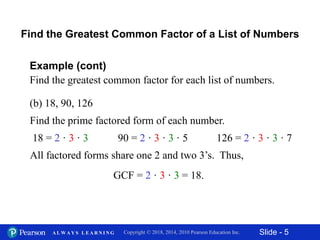
(b) 18, 90, 126
Example (cont)
Find the greatest common factor for each list of numbers.
Find the prime factored form of each number.
Find the Greatest Common Factor of a List of Numbers
18 = 2 · 3 · 3 90 = 2 · 3 · 3 · 5
All factored forms share one 2 and two 3’s. Thus,
GCF = 2 · 3 · 3 = 18.
126 = 2 · 3 · 3 · 7
Slide - 6Copyright © 2018, 2014, 2010 Pearson Education Inc.A L W A Y S L E A R N I N G
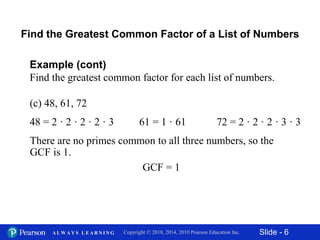
(c) 48, 61, 72
Example (cont)
Find the greatest common factor for each list of numbers.
48 = 2 · 2 · 2 · 2 · 3 61 = 1 · 61
There are no primes common to all three numbers, so the
GCF is 1.
GCF = 1
72 = 2 · 2 · 2 · 3 · 3
Find the Greatest Common Factor of a List of Numbers
Slide - 7Copyright © 2018, 2014, 2010 Pearson Education Inc.A L W A Y S L E A R N I N G
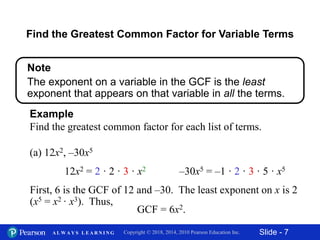
(a) 12x2, –30x5
Example
Find the greatest common factor for each list of terms.
12x2 = 2 · 2 · 3 · x2
First, 6 is the GCF of 12 and –30. The least exponent on x is 2
(x5 = x2 · x3). Thus,
GCF = 6x2.
–30x5 = –1 · 2 · 3 · 5 · x5
Find the Greatest Common Factor for Variable Terms
Note
The exponent on a variable in the GCF is the least
exponent that appears on that variable in all the terms.
Slide - 8Copyright © 2018, 2014, 2010 Pearson Education Inc.A L W A Y S L E A R N I N G
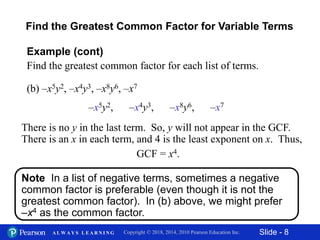
Note In a list of negative terms, sometimes a negative
common factor is preferable (even though it is not the
greatest common factor). In (b) above, we might prefer
–x4 as the common factor.
(b) –x5y2, –x4y3, –x8y6, –x7
Example (cont)
Find the greatest common factor for each list of terms.
There is no y in the last term. So, y will not appear in the GCF.
There is an x in each term, and 4 is the least exponent on x. Thus,
GCF = x4.
–x5y2, –x4y3, –x8y6, –x7
Find the Greatest Common Factor for Variable Terms
Slide - 9Copyright © 2018, 2014, 2010 Pearson Education Inc.A L W A Y S L E A R N I N G
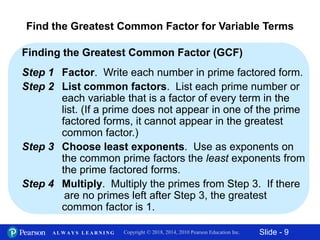
Finding the Greatest Common Factor (GCF)
Step 1 Factor. Write each number in prime factored form.
Step 2 List common factors. List each prime number or
each variable that is a factor of every term in the
list. (If a prime does not appear in one of the prime
factored forms, it cannot appear in the greatest
common factor.)
Step 3 Choose least exponents. Use as exponents on
the common prime factors the least exponents from
the prime factored forms.
Step 4 Multiply. Multiply the primes from Step 3. If there
are no primes left after Step 3, the greatest
common factor is 1.
Find the Greatest Common Factor for Variable Terms
Slide - 10Copyright © 2018, 2014, 2010 Pearson Education Inc.A L W A Y S L E A R N I N G
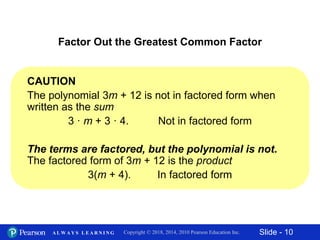
CAUTION
The polynomial 3m + 12 is not in factored form when
written as the sum
3 · m + 3 · 4. Not in factored form
The terms are factored, but the polynomial is not.
The factored form of 3m + 12 is the product
3(m + 4). In factored form
Factor Out the Greatest Common Factor
Slide - 11Copyright © 2018, 2014, 2010 Pearson Education Inc.A L W A Y S L E A R N I N G
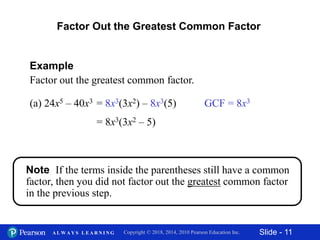
(a) 24x5 – 40x3
Example
Factor out the greatest common factor.
Factor Out the Greatest Common Factor
GCF = 8x3
= 8x3(3x2 – 5)
= 8x3(3x2) – 8x3(5)
Note If the terms inside the parentheses still have a common
factor, then you did not factor out the greatest common factor
in the previous step.
Slide - 12Copyright © 2018, 2014, 2010 Pearson Education Inc.A L W A Y S L E A R N I N G
Example (cont)
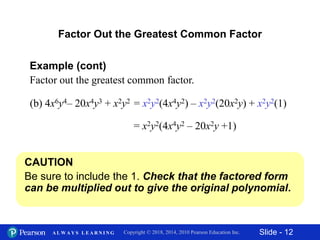
Factor out the greatest common factor.
Factor Out the Greatest Common Factor
CAUTION
Be sure to include the 1. Check that the factored form
can be multiplied out to give the original polynomial.
(b) 4x6y4– 20x4y3 + x2y2 = x2y2(4x4y2) – x2y2(20x2y) + x2y2(1)
= x2y2(4x4y2 – 20x2y +1)
Slide - 13Copyright © 2018, 2014, 2010 Pearson Education Inc.A L W A Y S L E A R N I N G
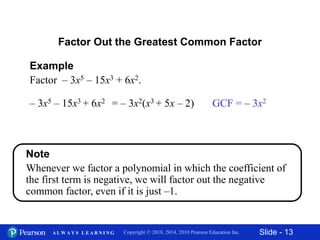
– 3x5 – 15x3 + 6x2
Example
Factor – 3x5 – 15x3 + 6x2.
Factor Out the Greatest Common Factor
GCF = – 3x2= – 3x2(x3 + 5x – 2)
Note
Whenever we factor a polynomial in which the coefficient of
the first term is negative, we will factor out the negative
common factor, even if it is just –1.
Slide - 14Copyright © 2018, 2014, 2010 Pearson Education Inc.A L W A Y S L E A R N I N G
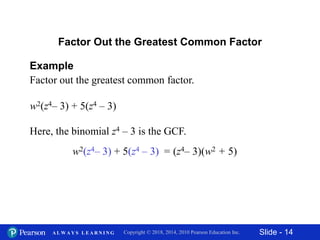
Example
Factor out the greatest common factor.
Factor Out the Greatest Common Factor
w2(z4– 3) + 5(z4 – 3)
Here, the binomial z4 – 3 is the GCF.
w2(z4– 3) + 5(z4 – 3) = (z4– 3)(w2 + 5)
Slide - 15Copyright © 2018, 2014, 2010 Pearson Education Inc.A L W A Y S L E A R N I N G
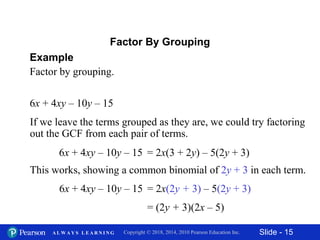
6x + 4xy – 10y – 15
Example
Factor by grouping.
Factor By Grouping
If we leave the terms grouped as they are, we could try factoring
out the GCF from each pair of terms.
6x + 4xy – 10y – 15 = 2x(3 + 2y) – 5(2y + 3)
This works, showing a common binomial of 2y + 3 in each term.
6x + 4xy – 10y – 15 = 2x(2y + 3) – 5(2y + 3)
= (2y + 3)(2x – 5)
Slide - 16Copyright © 2018, 2014, 2010 Pearson Education Inc.A L W A Y S L E A R N I N G
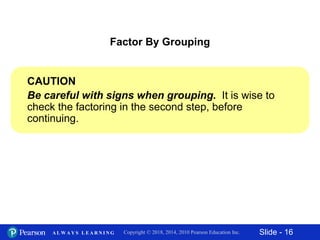
CAUTION
Be careful with signs when grouping. It is wise to
check the factoring in the second step, before
continuing.
Factor By Grouping
Slide - 17Copyright © 2018, 2014, 2010 Pearson Education Inc.A L W A Y S L E A R N I N G
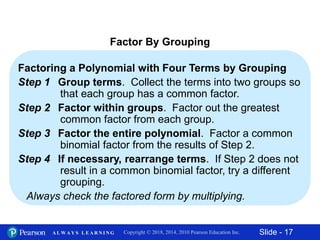
Factor By Grouping
Factoring a Polynomial with Four Terms by Grouping
Step 1 Group terms. Collect the terms into two groups so
that each group has a common factor.
Step 2 Factor within groups. Factor out the greatest
common factor from each group.
Step 3 Factor the entire polynomial. Factor a common
binomial factor from the results of Step 2.
Step 4 If necessary, rearrange terms. If Step 2 does not
result in a common binomial factor, try a different
grouping.
Always check the factored form by multiplying.
Slide - 18Copyright © 2018, 2014, 2010 Pearson Education Inc.A L W A Y S L E A R N I N G
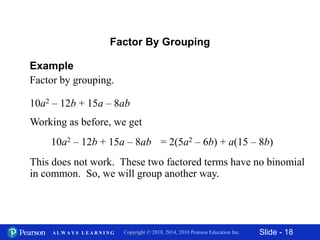
10a2 – 12b + 15a – 8ab
Example
Factor by grouping.
Factor By Grouping
Working as before, we get
This does not work. These two factored terms have no binomial
in common. So, we will group another way.
10a2 – 12b + 15a – 8ab = 2(5a2 – 6b) + a(15 – 8b)
Slide - 19Copyright © 2018, 2014, 2010 Pearson Education Inc.A L W A Y S L E A R N I N G
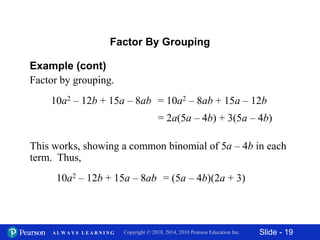
Factor By Grouping
Example (cont)
Factor by grouping.
This works, showing a common binomial of 5a – 4b in each
term. Thus,
10a2 – 12b + 15a – 8ab = (5a – 4b)(2a + 3)
10a2 – 12b + 15a – 8ab = 10a2 – 8ab + 15a – 12b
= 2a(5a – 4b) + 3(5a – 4b)

Section 13.1 greatest common factor; factoring by grouping

  • 1.
    Slide - 1Copyright© 2018, 2014, 2010 Pearson Education Inc.A L W A Y S L E A R N I N G 2 Factoring and Applications 13
  • 2.
    Slide - 2Copyright© 2018, 2014, 2010 Pearson Education Inc.A L W A Y S L E A R N I N G 1. Find the greatest common factor of a list of numbers. 2. Find the greatest common factor of a list of variable terms. 3. Factor out the greatest common factor. 4. Factor by grouping. Objectives 13.1 Factors; The Greatest Common Factor
  • 3.
    Slide - 3Copyright© 2018, 2014, 2010 Pearson Education Inc.A L W A Y S L E A R N I N G Find the Greatest Common Factor of a List of Numbers The greatest common factor (GCF) of a list of integers is the largest common factor of those integers. This means 6 is the greatest common factor of 18 and 24, since it is the largest of their common factors.
  • 4.
    Slide - 4Copyright© 2018, 2014, 2010 Pearson Education Inc.A L W A Y S L E A R N I N G (a) 36, 60 Example Find the greatest common factor for each list of numbers. First write each number in prime factored form. Find the Greatest Common Factor of a List of Numbers 36 = 2 · 2 · 3 · 3 60 = 2 · 2 · 3 · 5 Use each prime the least number of times it appears in all the factored forms. Here, the factored forms share two 2’s and one 3. Thus, GCF = 2 · 2 · 3 = 12.
  • 5.
    Slide - 5Copyright© 2018, 2014, 2010 Pearson Education Inc.A L W A Y S L E A R N I N G (b) 18, 90, 126 Example (cont) Find the greatest common factor for each list of numbers. Find the prime factored form of each number. Find the Greatest Common Factor of a List of Numbers 18 = 2 · 3 · 3 90 = 2 · 3 · 3 · 5 All factored forms share one 2 and two 3’s. Thus, GCF = 2 · 3 · 3 = 18. 126 = 2 · 3 · 3 · 7
  • 6.
    Slide - 6Copyright© 2018, 2014, 2010 Pearson Education Inc.A L W A Y S L E A R N I N G (c) 48, 61, 72 Example (cont) Find the greatest common factor for each list of numbers. 48 = 2 · 2 · 2 · 2 · 3 61 = 1 · 61 There are no primes common to all three numbers, so the GCF is 1. GCF = 1 72 = 2 · 2 · 2 · 3 · 3 Find the Greatest Common Factor of a List of Numbers
  • 7.
    Slide - 7Copyright© 2018, 2014, 2010 Pearson Education Inc.A L W A Y S L E A R N I N G (a) 12x2, –30x5 Example Find the greatest common factor for each list of terms. 12x2 = 2 · 2 · 3 · x2 First, 6 is the GCF of 12 and –30. The least exponent on x is 2 (x5 = x2 · x3). Thus, GCF = 6x2. –30x5 = –1 · 2 · 3 · 5 · x5 Find the Greatest Common Factor for Variable Terms Note The exponent on a variable in the GCF is the least exponent that appears on that variable in all the terms.
  • 8.
    Slide - 8Copyright© 2018, 2014, 2010 Pearson Education Inc.A L W A Y S L E A R N I N G Note In a list of negative terms, sometimes a negative common factor is preferable (even though it is not the greatest common factor). In (b) above, we might prefer –x4 as the common factor. (b) –x5y2, –x4y3, –x8y6, –x7 Example (cont) Find the greatest common factor for each list of terms. There is no y in the last term. So, y will not appear in the GCF. There is an x in each term, and 4 is the least exponent on x. Thus, GCF = x4. –x5y2, –x4y3, –x8y6, –x7 Find the Greatest Common Factor for Variable Terms
  • 9.
    Slide - 9Copyright© 2018, 2014, 2010 Pearson Education Inc.A L W A Y S L E A R N I N G Finding the Greatest Common Factor (GCF) Step 1 Factor. Write each number in prime factored form. Step 2 List common factors. List each prime number or each variable that is a factor of every term in the list. (If a prime does not appear in one of the prime factored forms, it cannot appear in the greatest common factor.) Step 3 Choose least exponents. Use as exponents on the common prime factors the least exponents from the prime factored forms. Step 4 Multiply. Multiply the primes from Step 3. If there are no primes left after Step 3, the greatest common factor is 1. Find the Greatest Common Factor for Variable Terms
  • 10.
    Slide - 10Copyright© 2018, 2014, 2010 Pearson Education Inc.A L W A Y S L E A R N I N G CAUTION The polynomial 3m + 12 is not in factored form when written as the sum 3 · m + 3 · 4. Not in factored form The terms are factored, but the polynomial is not. The factored form of 3m + 12 is the product 3(m + 4). In factored form Factor Out the Greatest Common Factor
  • 11.
    Slide - 11Copyright© 2018, 2014, 2010 Pearson Education Inc.A L W A Y S L E A R N I N G (a) 24x5 – 40x3 Example Factor out the greatest common factor. Factor Out the Greatest Common Factor GCF = 8x3 = 8x3(3x2 – 5) = 8x3(3x2) – 8x3(5) Note If the terms inside the parentheses still have a common factor, then you did not factor out the greatest common factor in the previous step.
  • 12.
    Slide - 12Copyright© 2018, 2014, 2010 Pearson Education Inc.A L W A Y S L E A R N I N G Example (cont) Factor out the greatest common factor. Factor Out the Greatest Common Factor CAUTION Be sure to include the 1. Check that the factored form can be multiplied out to give the original polynomial. (b) 4x6y4– 20x4y3 + x2y2 = x2y2(4x4y2) – x2y2(20x2y) + x2y2(1) = x2y2(4x4y2 – 20x2y +1)
  • 13.
    Slide - 13Copyright© 2018, 2014, 2010 Pearson Education Inc.A L W A Y S L E A R N I N G – 3x5 – 15x3 + 6x2 Example Factor – 3x5 – 15x3 + 6x2. Factor Out the Greatest Common Factor GCF = – 3x2= – 3x2(x3 + 5x – 2) Note Whenever we factor a polynomial in which the coefficient of the first term is negative, we will factor out the negative common factor, even if it is just –1.
  • 14.
    Slide - 14Copyright© 2018, 2014, 2010 Pearson Education Inc.A L W A Y S L E A R N I N G Example Factor out the greatest common factor. Factor Out the Greatest Common Factor w2(z4– 3) + 5(z4 – 3) Here, the binomial z4 – 3 is the GCF. w2(z4– 3) + 5(z4 – 3) = (z4– 3)(w2 + 5)
  • 15.
    Slide - 15Copyright© 2018, 2014, 2010 Pearson Education Inc.A L W A Y S L E A R N I N G 6x + 4xy – 10y – 15 Example Factor by grouping. Factor By Grouping If we leave the terms grouped as they are, we could try factoring out the GCF from each pair of terms. 6x + 4xy – 10y – 15 = 2x(3 + 2y) – 5(2y + 3) This works, showing a common binomial of 2y + 3 in each term. 6x + 4xy – 10y – 15 = 2x(2y + 3) – 5(2y + 3) = (2y + 3)(2x – 5)
  • 16.
    Slide - 16Copyright© 2018, 2014, 2010 Pearson Education Inc.A L W A Y S L E A R N I N G CAUTION Be careful with signs when grouping. It is wise to check the factoring in the second step, before continuing. Factor By Grouping
  • 17.
    Slide - 17Copyright© 2018, 2014, 2010 Pearson Education Inc.A L W A Y S L E A R N I N G Factor By Grouping Factoring a Polynomial with Four Terms by Grouping Step 1 Group terms. Collect the terms into two groups so that each group has a common factor. Step 2 Factor within groups. Factor out the greatest common factor from each group. Step 3 Factor the entire polynomial. Factor a common binomial factor from the results of Step 2. Step 4 If necessary, rearrange terms. If Step 2 does not result in a common binomial factor, try a different grouping. Always check the factored form by multiplying.
  • 18.
    Slide - 18Copyright© 2018, 2014, 2010 Pearson Education Inc.A L W A Y S L E A R N I N G 10a2 – 12b + 15a – 8ab Example Factor by grouping. Factor By Grouping Working as before, we get This does not work. These two factored terms have no binomial in common. So, we will group another way. 10a2 – 12b + 15a – 8ab = 2(5a2 – 6b) + a(15 – 8b)
  • 19.
    Slide - 19Copyright© 2018, 2014, 2010 Pearson Education Inc.A L W A Y S L E A R N I N G Factor By Grouping Example (cont) Factor by grouping. This works, showing a common binomial of 5a – 4b in each term. Thus, 10a2 – 12b + 15a – 8ab = (5a – 4b)(2a + 3) 10a2 – 12b + 15a – 8ab = 10a2 – 8ab + 15a – 12b = 2a(5a – 4b) + 3(5a – 4b)