Slide - 1Copyright © 2018, 2014, 2010 Pearson Education Inc.A L W A Y S L E A R N I N G
2
Exponents and
Polynomials
12
Slide - 2Copyright © 2018, 2014, 2010 Pearson Education Inc.A L W A Y S L E A R N I N G
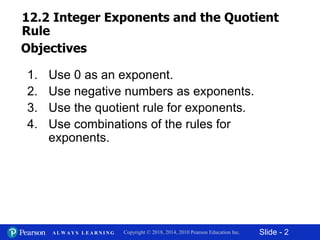
1. Use 0 as an exponent.
2. Use negative numbers as exponents.
3. Use the quotient rule for exponents.
4. Use combinations of the rules for
exponents.
Objectives
12.2 Integer Exponents and the Quotient
Rule
Slide - 3Copyright © 2018, 2014, 2010 Pearson Education Inc.A L W A Y S L E A R N I N G
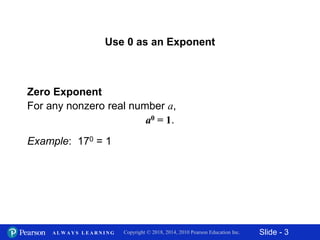
Zero Exponent
For any nonzero real number a,
a0 = 1.
Example: 170 = 1
Use 0 as an Exponent
Slide - 4Copyright © 2018, 2014, 2010 Pearson Education Inc.A L W A Y S L E A R N I N G
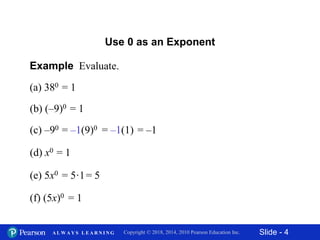
(a) 380
Example Evaluate.
Use 0 as an Exponent
(b) (–9)0
(c) –90 = –1(9)0 = –1(1) = –1
(d) x0 = 1
= 1
= 1
(e) 5x0 = 5·1= 5
(f) (5x)0 = 1
Slide - 5Copyright © 2018, 2014, 2010 Pearson Education Inc.A L W A Y S L E A R N I N G
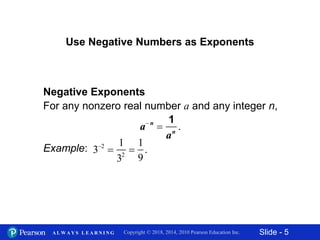
Negative Exponents
For any nonzero real number a and any integer n,
Example:
Use Negative Numbers as Exponents
an

1
an
.
32

1
32

1
9
.
Slide - 6Copyright © 2018, 2014, 2010 Pearson Education Inc.A L W A Y S L E A R N I N G
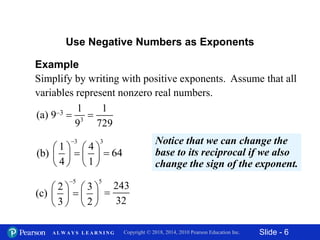
Example
Simplify by writing with positive exponents. Assume that all
variables represent nonzero real numbers.
Use Negative Numbers as Exponents
(a) 9–3
3
1
9

1
729

3
1
(b)
4

 
 
 
3
4
1
 
  
 
64
Notice that we can change the
base to its reciprocal if we also
change the sign of the exponent.
5
2
(c)
3

 
 
 
5
3
2
 
  
 
243
32

Slide - 7Copyright © 2018, 2014, 2010 Pearson Education Inc.A L W A Y S L E A R N I N G
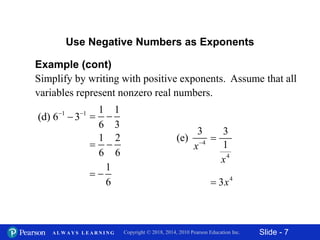
Example (cont)
Simplify by writing with positive exponents. Assume that all
variables represent nonzero real numbers.
Use Negative Numbers as Exponents
1 1
(d) 6 3 

1 1
6 3
 
1 2
6 6
 
1
6
 
4
3
(e)
x
4
3
1
x

4
3x
Slide - 8Copyright © 2018, 2014, 2010 Pearson Education Inc.A L W A Y S L E A R N I N G
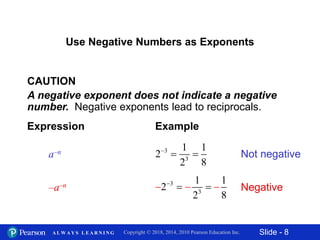
CAUTION
A negative exponent does not indicate a negative
number. Negative exponents lead to reciprocals.
Use Negative Numbers as Exponents
3
3
1 1
2
2 8

 
Expression Example
a–n Not negative
–a–n 3
3
1 1
2
2 8

    Negative
Slide - 9Copyright © 2018, 2014, 2010 Pearson Education Inc.A L W A Y S L E A R N I N G
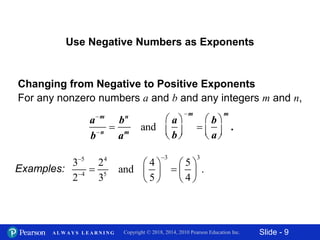
Use Negative Numbers as Exponents
Changing from Negative to Positive Exponents
For any nonzero numbers a and b and any integers m and n,
am
bn

bn
am
and
a
b




m

b
a




m
.
Examples:
3 35 4
4 5
3 2 4 5
and .
2 3 5 4


   
    
   
Slide - 10Copyright © 2018, 2014, 2010 Pearson Education Inc.A L W A Y S L E A R N I N G
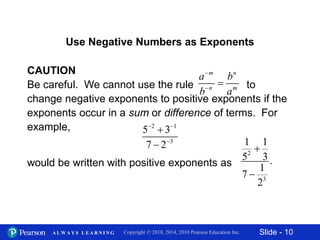
CAUTION
Be careful. We cannot use the rule to
change negative exponents to positive exponents if the
exponents occur in a sum or difference of terms. For
example,
Use Negative Numbers as Exponents
2 1
3
5 3
7 2
 



would be written with positive exponents as
2
3
1 1
5 3 .
1
7
2


m n
n m
a b
b a



Slide - 11Copyright © 2018, 2014, 2010 Pearson Education Inc.A L W A Y S L E A R N I N G
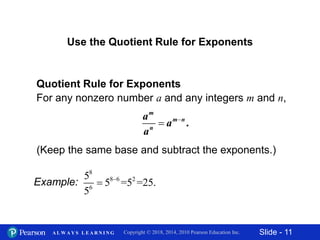
Use the Quotient Rule for Exponents
Quotient Rule for Exponents
For any nonzero number a and any integers m and n,

 .
m
m n
n
a
a
a
Example:
8
8 6 2
6
5
5 =5 =25.
5


(Keep the same base and subtract the exponents.)
Slide - 12Copyright © 2018, 2014, 2010 Pearson Education Inc.A L W A Y S L E A R N I N G
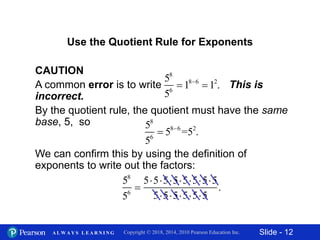
CAUTION
A common error is to write This is
incorrect.
By the quotient rule, the quotient must have the same
base, 5, so
We can confirm this by using the definition of
exponents to write out the factors:
Use the Quotient Rule for Exponents
58
56
 186
 12
.
58
56
 586
=52
.
58
56

55555555
555555
.
Slide - 13Copyright © 2018, 2014, 2010 Pearson Education Inc.A L W A Y S L E A R N I N G
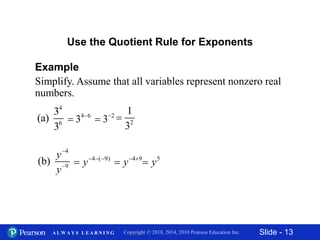
Example
Simplify. Assume that all variables represent nonzero real
numbers.
Use the Quotient Rule for Exponents
4
6
3
(a)
3
4 6
3 
 2
1
3
2
3

4
9
(b)
y
y


4 ( 9)
y  
 5
y4 9
y 

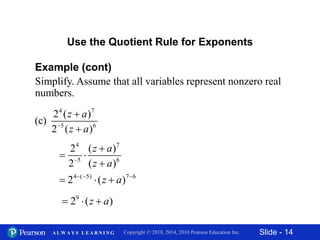
Slide - 14Copyright © 2018, 2014, 2010 Pearson Education Inc.A L W A Y S L E A R N I N G
4 ( 5) 7 6
2 ( )z a  
  
Example (cont)
Simplify. Assume that all variables represent nonzero real
numbers.
Use the Quotient Rule for Exponents
4 7
5 6
2 ( )
(c)
2 ( )
z a
z a


4 7
5 6
2 ( )
2 ( )
z a
z a

 

9
2 ( )z a  
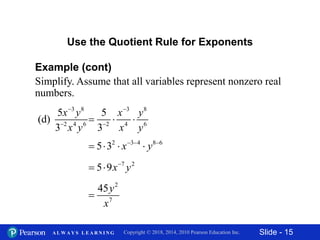
Slide - 15Copyright © 2018, 2014, 2010 Pearson Education Inc.A L W A Y S L E A R N I N G
Example (cont)
Simplify. Assume that all variables represent nonzero real
numbers.
Use the Quotient Rule for Exponents
3 8
2 4 6
5
(d)
3
x y
x y


3 8
2 4 6
5
3
x y
x y


  
2 3 4 8 6
5 3 x y  
   
7 2
5 9x y
 
2
7
45y
x

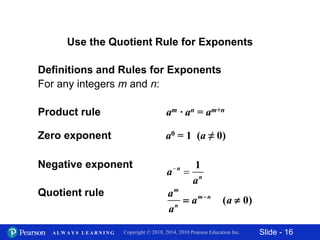
Slide - 16Copyright © 2018, 2014, 2010 Pearson Education Inc.A L W A Y S L E A R N I N G
Definitions and Rules for Exponents
For any integers m and n:
Product rule am · an = am+n
Zero exponent a0 = 1 (a ≠ 0)
Negative exponent
Quotient rule
Use the Quotient Rule for Exponents
an

1
an
am
an
 amn
(a  0)
Slide - 17Copyright © 2018, 2014, 2010 Pearson Education Inc.A L W A Y S L E A R N I N G
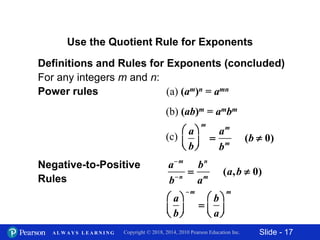
Definitions and Rules for Exponents (concluded)
For any integers m and n:
Power rules (a) (am)n = amn
(b) (ab)m = ambm
(c)
Negative-to-Positive
Rules
Use the Quotient Rule for Exponents
a
b




m

am
bm
(b  0)
a
b




m

b
a




m
am
bn

bn
am
(a,b  0)
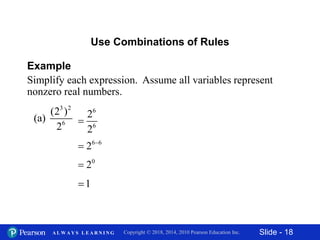
Slide - 18Copyright © 2018, 2014, 2010 Pearson Education Inc.A L W A Y S L E A R N I N G
Example
Simplify each expression. Assume all variables represent
nonzero real numbers.
Use Combinations of Rules
3 2
6
(2 )
(a)
2
6 6
2 

1
6
6
2
2

0
2
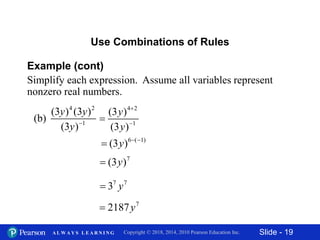
Slide - 19Copyright © 2018, 2014, 2010 Pearson Education Inc.A L W A Y S L E A R N I N G
Example (cont)
Simplify each expression. Assume all variables represent
nonzero real numbers.
Use Combinations of Rules
4 2
1
(3 ) (3 )
(b)
(3 )
y y
y 
4 2
1
(3 )
(3 )
y
y



6 ( 1)
(3 )y  

7
(3 )y
7 7
3 y
7
2187y
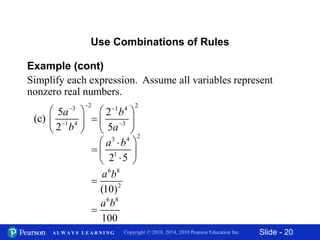
Slide - 20Copyright © 2018, 2014, 2010 Pearson Education Inc.A L W A Y S L E A R N I N G
Example (cont)
Simplify each expression. Assume all variables represent
nonzero real numbers.
Use Combinations of Rules
23
1 4
5
(c)
2
a
b


 
 
 
21 4
3
2
5
b
a


 
  
  23 4
1
2 5
a b 
  
 
6 8
2
(10)
a b

6 8
100
a b


Mat 092 section 12.2 integer exponents

  • 1.
    Slide - 1Copyright© 2018, 2014, 2010 Pearson Education Inc.A L W A Y S L E A R N I N G 2 Exponents and Polynomials 12
  • 2.
    Slide - 2Copyright© 2018, 2014, 2010 Pearson Education Inc.A L W A Y S L E A R N I N G 1. Use 0 as an exponent. 2. Use negative numbers as exponents. 3. Use the quotient rule for exponents. 4. Use combinations of the rules for exponents. Objectives 12.2 Integer Exponents and the Quotient Rule
  • 3.
    Slide - 3Copyright© 2018, 2014, 2010 Pearson Education Inc.A L W A Y S L E A R N I N G Zero Exponent For any nonzero real number a, a0 = 1. Example: 170 = 1 Use 0 as an Exponent
  • 4.
    Slide - 4Copyright© 2018, 2014, 2010 Pearson Education Inc.A L W A Y S L E A R N I N G (a) 380 Example Evaluate. Use 0 as an Exponent (b) (–9)0 (c) –90 = –1(9)0 = –1(1) = –1 (d) x0 = 1 = 1 = 1 (e) 5x0 = 5·1= 5 (f) (5x)0 = 1
  • 5.
    Slide - 5Copyright© 2018, 2014, 2010 Pearson Education Inc.A L W A Y S L E A R N I N G Negative Exponents For any nonzero real number a and any integer n, Example: Use Negative Numbers as Exponents an  1 an . 32  1 32  1 9 .
  • 6.
    Slide - 6Copyright© 2018, 2014, 2010 Pearson Education Inc.A L W A Y S L E A R N I N G Example Simplify by writing with positive exponents. Assume that all variables represent nonzero real numbers. Use Negative Numbers as Exponents (a) 9–3 3 1 9  1 729  3 1 (b) 4        3 4 1        64 Notice that we can change the base to its reciprocal if we also change the sign of the exponent. 5 2 (c) 3        5 3 2        243 32 
  • 7.
    Slide - 7Copyright© 2018, 2014, 2010 Pearson Education Inc.A L W A Y S L E A R N I N G Example (cont) Simplify by writing with positive exponents. Assume that all variables represent nonzero real numbers. Use Negative Numbers as Exponents 1 1 (d) 6 3   1 1 6 3   1 2 6 6   1 6   4 3 (e) x 4 3 1 x  4 3x
  • 8.
    Slide - 8Copyright© 2018, 2014, 2010 Pearson Education Inc.A L W A Y S L E A R N I N G CAUTION A negative exponent does not indicate a negative number. Negative exponents lead to reciprocals. Use Negative Numbers as Exponents 3 3 1 1 2 2 8    Expression Example a–n Not negative –a–n 3 3 1 1 2 2 8      Negative
  • 9.
    Slide - 9Copyright© 2018, 2014, 2010 Pearson Education Inc.A L W A Y S L E A R N I N G Use Negative Numbers as Exponents Changing from Negative to Positive Exponents For any nonzero numbers a and b and any integers m and n, am bn  bn am and a b     m  b a     m . Examples: 3 35 4 4 5 3 2 4 5 and . 2 3 5 4               
  • 10.
    Slide - 10Copyright© 2018, 2014, 2010 Pearson Education Inc.A L W A Y S L E A R N I N G CAUTION Be careful. We cannot use the rule to change negative exponents to positive exponents if the exponents occur in a sum or difference of terms. For example, Use Negative Numbers as Exponents 2 1 3 5 3 7 2      would be written with positive exponents as 2 3 1 1 5 3 . 1 7 2   m n n m a b b a   
  • 11.
    Slide - 11Copyright© 2018, 2014, 2010 Pearson Education Inc.A L W A Y S L E A R N I N G Use the Quotient Rule for Exponents Quotient Rule for Exponents For any nonzero number a and any integers m and n,   . m m n n a a a Example: 8 8 6 2 6 5 5 =5 =25. 5   (Keep the same base and subtract the exponents.)
  • 12.
    Slide - 12Copyright© 2018, 2014, 2010 Pearson Education Inc.A L W A Y S L E A R N I N G CAUTION A common error is to write This is incorrect. By the quotient rule, the quotient must have the same base, 5, so We can confirm this by using the definition of exponents to write out the factors: Use the Quotient Rule for Exponents 58 56  186  12 . 58 56  586 =52 . 58 56  55555555 555555 .
  • 13.
    Slide - 13Copyright© 2018, 2014, 2010 Pearson Education Inc.A L W A Y S L E A R N I N G Example Simplify. Assume that all variables represent nonzero real numbers. Use the Quotient Rule for Exponents 4 6 3 (a) 3 4 6 3   2 1 3 2 3  4 9 (b) y y   4 ( 9) y    5 y4 9 y  
  • 14.
    Slide - 14Copyright© 2018, 2014, 2010 Pearson Education Inc.A L W A Y S L E A R N I N G 4 ( 5) 7 6 2 ( )z a      Example (cont) Simplify. Assume that all variables represent nonzero real numbers. Use the Quotient Rule for Exponents 4 7 5 6 2 ( ) (c) 2 ( ) z a z a   4 7 5 6 2 ( ) 2 ( ) z a z a     9 2 ( )z a  
  • 15.
    Slide - 15Copyright© 2018, 2014, 2010 Pearson Education Inc.A L W A Y S L E A R N I N G Example (cont) Simplify. Assume that all variables represent nonzero real numbers. Use the Quotient Rule for Exponents 3 8 2 4 6 5 (d) 3 x y x y   3 8 2 4 6 5 3 x y x y      2 3 4 8 6 5 3 x y       7 2 5 9x y   2 7 45y x 
  • 16.
    Slide - 16Copyright© 2018, 2014, 2010 Pearson Education Inc.A L W A Y S L E A R N I N G Definitions and Rules for Exponents For any integers m and n: Product rule am · an = am+n Zero exponent a0 = 1 (a ≠ 0) Negative exponent Quotient rule Use the Quotient Rule for Exponents an  1 an am an  amn (a  0)
  • 17.
    Slide - 17Copyright© 2018, 2014, 2010 Pearson Education Inc.A L W A Y S L E A R N I N G Definitions and Rules for Exponents (concluded) For any integers m and n: Power rules (a) (am)n = amn (b) (ab)m = ambm (c) Negative-to-Positive Rules Use the Quotient Rule for Exponents a b     m  am bm (b  0) a b     m  b a     m am bn  bn am (a,b  0)
  • 18.
    Slide - 18Copyright© 2018, 2014, 2010 Pearson Education Inc.A L W A Y S L E A R N I N G Example Simplify each expression. Assume all variables represent nonzero real numbers. Use Combinations of Rules 3 2 6 (2 ) (a) 2 6 6 2   1 6 6 2 2  0 2
  • 19.
    Slide - 19Copyright© 2018, 2014, 2010 Pearson Education Inc.A L W A Y S L E A R N I N G Example (cont) Simplify each expression. Assume all variables represent nonzero real numbers. Use Combinations of Rules 4 2 1 (3 ) (3 ) (b) (3 ) y y y  4 2 1 (3 ) (3 ) y y    6 ( 1) (3 )y    7 (3 )y 7 7 3 y 7 2187y
  • 20.
    Slide - 20Copyright© 2018, 2014, 2010 Pearson Education Inc.A L W A Y S L E A R N I N G Example (cont) Simplify each expression. Assume all variables represent nonzero real numbers. Use Combinations of Rules 23 1 4 5 (c) 2 a b         21 4 3 2 5 b a          23 4 1 2 5 a b       6 8 2 (10) a b  6 8 100 a b 