Section 0-4
The Counting Principle
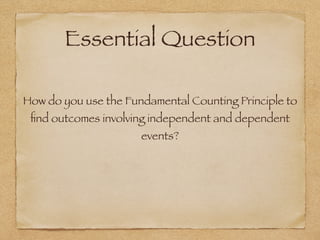
Essential Question
How do you use the Fundamental Counting Principle to
find outcomes involving independent and dependent
events?
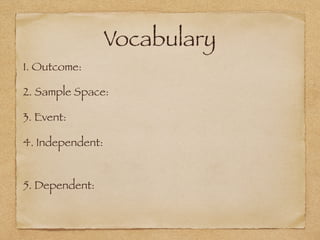
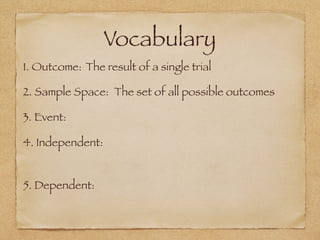
Vocabulary
1. Outcome:
2. Sample Space:
3. Event:
4. Independent:
5. Dependent:
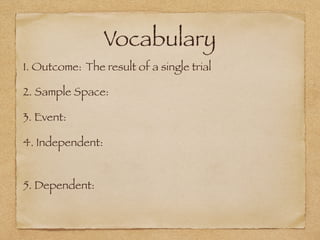
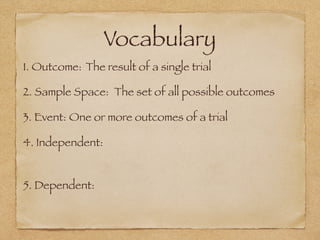
Vocabulary
1. Outcome: The result of a single trial
2. Sample Space:
3. Event:
4. Independent:
5. Dependent:
Vocabulary
1. Outcome: The result of a single trial
2. Sample Space: The set of all possible outcomes
3. Event:
4. Independent:
5. Dependent:
Vocabulary
1. Outcome: The result of a single trial
2. Sample Space: The set of all possible outcomes
3. Event: One or more outcomes of a trial
4. Independent:
5. Dependent:
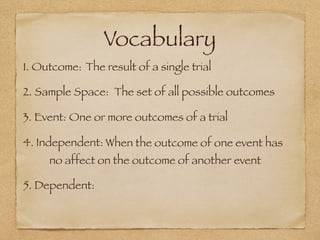
Vocabulary
1. Outcome: The result of a single trial
2. Sample Space: The set of all possible outcomes
3. Event: One or more outcomes of a trial
4. Independent: When the outcome of one event has
no affect on the outcome of another event
5. Dependent:
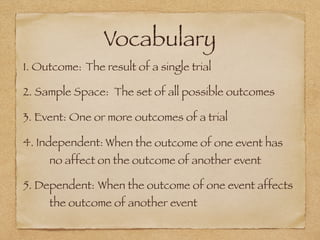
Vocabulary
1. Outcome: The result of a single trial
2. Sample Space: The set of all possible outcomes
3. Event: One or more outcomes of a trial
4. Independent: When the outcome of one event has
no affect on the outcome of another event
5. Dependent: When the outcome of one event affects
the outcome of another event
Vocabulary
5. Fundamental Counting Principle (FCP):
6. Factorial:
Vocabulary
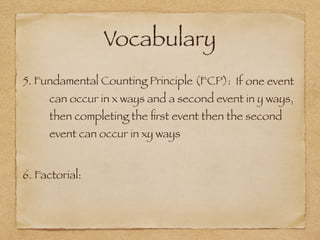
5. Fundamental Counting Principle (FCP): If one event
can occur in x ways and a second event in y ways,
then completing the first event then the second
event can occur in xy ways
6. Factorial:
Vocabulary
5. Fundamental Counting Principle (FCP): If one event
can occur in x ways and a second event in y ways,
then completing the first event then the second
event can occur in xy ways
6. Factorial: n! is the product of all counting numbers
from n down through 1
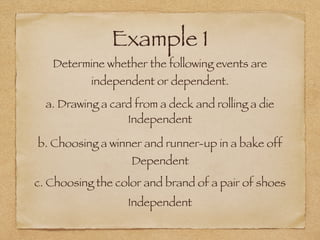
Example 1
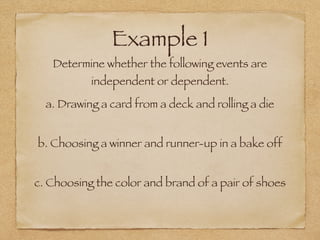
Determine whether the following events are
independent or dependent.
a. Drawing a card from a deck and rolling a die
b. Choosing a winner and runner-up in a bake off
c. Choosing the color and brand of a pair of shoes
Example 1
Determine whether the following events are
independent or dependent.
a. Drawing a card from a deck and rolling a die
b. Choosing a winner and runner-up in a bake off
c. Choosing the color and brand of a pair of shoes
Independent
Example 1
Determine whether the following events are
independent or dependent.
a. Drawing a card from a deck and rolling a die
b. Choosing a winner and runner-up in a bake off
c. Choosing the color and brand of a pair of shoes
Independent
Dependent
Example 1
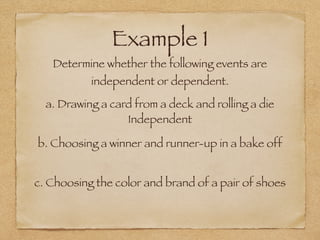
Determine whether the following events are
independent or dependent.
a. Drawing a card from a deck and rolling a die
b. Choosing a winner and runner-up in a bake off
c. Choosing the color and brand of a pair of shoes
Independent
Dependent
Independent
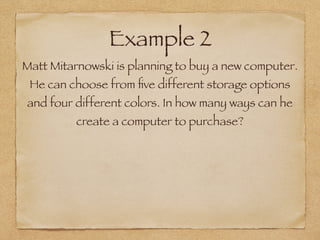
Example 2
Matt Mitarnowski is planning to buy a new computer.
He can choose from five different storage options
and four different colors. In how many ways can he
create a computer to purchase?
Example 2
Matt Mitarnowski is planning to buy a new computer.
He can choose from five different storage options
and four different colors. In how many ways can he
create a computer to purchase?
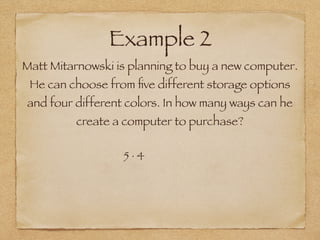
5 ∙ 4
Example 2
Matt Mitarnowski is planning to buy a new computer.
He can choose from five different storage options
and four different colors. In how many ways can he
create a computer to purchase?
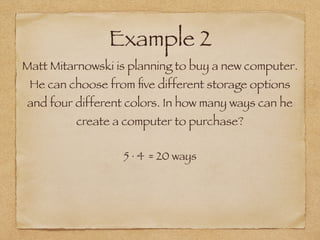
5 ∙ 4 = 20 ways
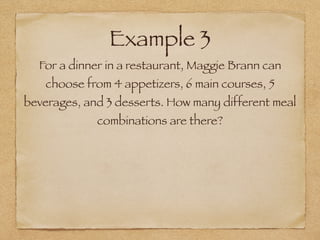
Example 3
For a dinner in a restaurant, Maggie Brann can
choose from 4 appetizers, 6 main courses, 5
beverages, and 3 desserts. How many different meal
combinations are there?
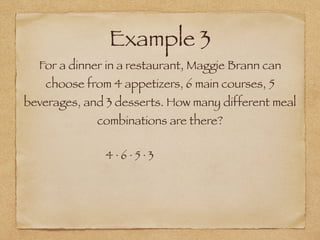
Example 3
For a dinner in a restaurant, Maggie Brann can
choose from 4 appetizers, 6 main courses, 5
beverages, and 3 desserts. How many different meal
combinations are there?
4 ∙ 6 ∙ 5 ∙ 3
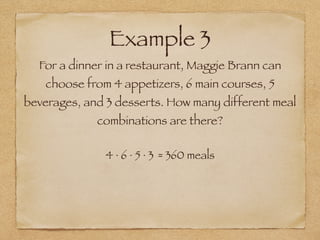
Example 3
For a dinner in a restaurant, Maggie Brann can
choose from 4 appetizers, 6 main courses, 5
beverages, and 3 desserts. How many different meal
combinations are there?
4 ∙ 6 ∙ 5 ∙ 3 = 360 meals
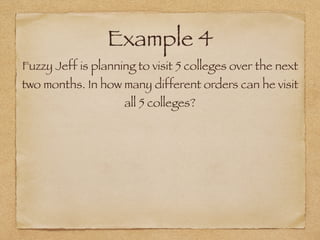
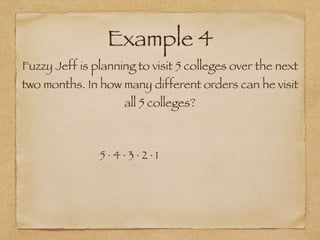
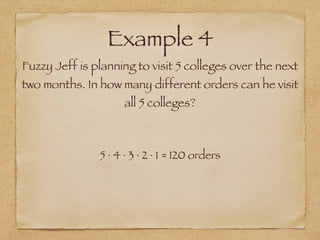
Example 4
Fuzzy Jeff is planning to visit 5 colleges over the next
two months. In how many different orders can he visit
all 5 colleges?
Example 4
Fuzzy Jeff is planning to visit 5 colleges over the next
two months. In how many different orders can he visit
all 5 colleges?
5 ∙ 4 ∙ 3 ∙ 2 ∙ 1
Example 4
Fuzzy Jeff is planning to visit 5 colleges over the next
two months. In how many different orders can he visit
all 5 colleges?
5 ∙ 4 ∙ 3 ∙ 2 ∙ 1 = 120 orders
Summary
Describe the difference between independent and
dependent events.

Section 0-4 Algebra 2

  • 1.
  • 2.
    Essential Question How doyou use the Fundamental Counting Principle to find outcomes involving independent and dependent events?
  • 3.
    Vocabulary 1. Outcome: 2. SampleSpace: 3. Event: 4. Independent: 5. Dependent:
  • 4.
    Vocabulary 1. Outcome: Theresult of a single trial 2. Sample Space: 3. Event: 4. Independent: 5. Dependent:
  • 5.
    Vocabulary 1. Outcome: Theresult of a single trial 2. Sample Space: The set of all possible outcomes 3. Event: 4. Independent: 5. Dependent:
  • 6.
    Vocabulary 1. Outcome: Theresult of a single trial 2. Sample Space: The set of all possible outcomes 3. Event: One or more outcomes of a trial 4. Independent: 5. Dependent:
  • 7.
    Vocabulary 1. Outcome: Theresult of a single trial 2. Sample Space: The set of all possible outcomes 3. Event: One or more outcomes of a trial 4. Independent: When the outcome of one event has no affect on the outcome of another event 5. Dependent:
  • 8.
    Vocabulary 1. Outcome: Theresult of a single trial 2. Sample Space: The set of all possible outcomes 3. Event: One or more outcomes of a trial 4. Independent: When the outcome of one event has no affect on the outcome of another event 5. Dependent: When the outcome of one event affects the outcome of another event
  • 9.
    Vocabulary 5. Fundamental CountingPrinciple (FCP): 6. Factorial:
  • 10.
    Vocabulary 5. Fundamental CountingPrinciple (FCP): If one event can occur in x ways and a second event in y ways, then completing the first event then the second event can occur in xy ways 6. Factorial:
  • 11.
    Vocabulary 5. Fundamental CountingPrinciple (FCP): If one event can occur in x ways and a second event in y ways, then completing the first event then the second event can occur in xy ways 6. Factorial: n! is the product of all counting numbers from n down through 1
  • 12.
    Example 1 Determine whetherthe following events are independent or dependent. a. Drawing a card from a deck and rolling a die b. Choosing a winner and runner-up in a bake off c. Choosing the color and brand of a pair of shoes
  • 13.
    Example 1 Determine whetherthe following events are independent or dependent. a. Drawing a card from a deck and rolling a die b. Choosing a winner and runner-up in a bake off c. Choosing the color and brand of a pair of shoes Independent
  • 14.
    Example 1 Determine whetherthe following events are independent or dependent. a. Drawing a card from a deck and rolling a die b. Choosing a winner and runner-up in a bake off c. Choosing the color and brand of a pair of shoes Independent Dependent
  • 15.
    Example 1 Determine whetherthe following events are independent or dependent. a. Drawing a card from a deck and rolling a die b. Choosing a winner and runner-up in a bake off c. Choosing the color and brand of a pair of shoes Independent Dependent Independent
  • 16.
    Example 2 Matt Mitarnowskiis planning to buy a new computer. He can choose from five different storage options and four different colors. In how many ways can he create a computer to purchase?
  • 17.
    Example 2 Matt Mitarnowskiis planning to buy a new computer. He can choose from five different storage options and four different colors. In how many ways can he create a computer to purchase? 5 ∙ 4
  • 18.
    Example 2 Matt Mitarnowskiis planning to buy a new computer. He can choose from five different storage options and four different colors. In how many ways can he create a computer to purchase? 5 ∙ 4 = 20 ways
  • 19.
    Example 3 For adinner in a restaurant, Maggie Brann can choose from 4 appetizers, 6 main courses, 5 beverages, and 3 desserts. How many different meal combinations are there?
  • 20.
    Example 3 For adinner in a restaurant, Maggie Brann can choose from 4 appetizers, 6 main courses, 5 beverages, and 3 desserts. How many different meal combinations are there? 4 ∙ 6 ∙ 5 ∙ 3
  • 21.
    Example 3 For adinner in a restaurant, Maggie Brann can choose from 4 appetizers, 6 main courses, 5 beverages, and 3 desserts. How many different meal combinations are there? 4 ∙ 6 ∙ 5 ∙ 3 = 360 meals
  • 22.
    Example 4 Fuzzy Jeffis planning to visit 5 colleges over the next two months. In how many different orders can he visit all 5 colleges?
  • 23.
    Example 4 Fuzzy Jeffis planning to visit 5 colleges over the next two months. In how many different orders can he visit all 5 colleges? 5 ∙ 4 ∙ 3 ∙ 2 ∙ 1
  • 24.
    Example 4 Fuzzy Jeffis planning to visit 5 colleges over the next two months. In how many different orders can he visit all 5 colleges? 5 ∙ 4 ∙ 3 ∙ 2 ∙ 1 = 120 orders
  • 25.
    Summary Describe the differencebetween independent and dependent events.