Bobbi-Bear
   Ms. Carter
Bobbi Bear


• http://illuminations.nctm.org/activitydetail.aspx?id=3
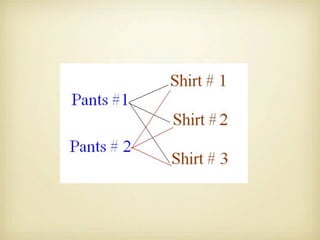
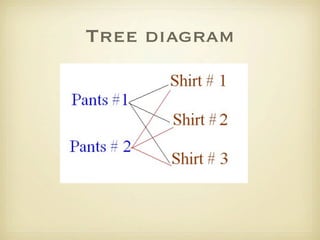
Tree diagram
• When dealing with the occurrence of more
  than one event or activity, it is important to
  be able to quickly determine how many
  possible outcomes exist. 
• For example, if ice cream sundaes come in 5
  flavors with 4 possible toppings, how many
  different sundaes can be made with one
  flavor of ice cream and one topping?   
• When dealing with the occurrence of more
  than one event or activity, it is important to
  be able to quickly determine how many
  possible outcomes exist. 

• For example, if ice cream sundaes come in 5
  flavors with 4 possible toppings, how many
  different sundaes can be made with one
  flavor of ice cream and one topping?   

                 Guesses??
• When dealing with the occurrence of more
  than one event or activity, it is important to
  be able to quickly determine how many
  possible outcomes exist. 

• For example, if ice cream sundaes come in 5
  flavors with 4 possible toppings, how many
  different sundaes can be made with one
  flavor of ice cream and one topping?   

                 Guesses??

                    20!!!
Introduce..
Introduce..


The Fundamental
  Principle of
    Counting
Operations

• The result of an operation is an outcome.

     For example, if we throw a die, one
            possible outcome is 5.

   If we throw a die there are six possible
        outcomes: 1, 2, 3, 4, 5 or 6.
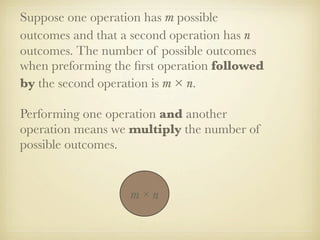
Suppose one operation has m possible
outcomes and that a second operation has n
outcomes. The number of possible outcomes
when preforming the first operation followed
by the second operation is m × n.

Performing one operation and another
operation means we multiply the number of
possible outcomes.


                   m×n
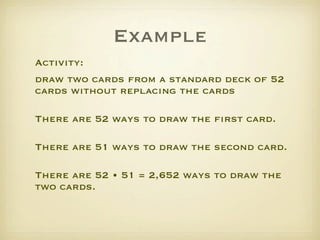
Example
Activity: 
draw two cards from a standard deck of 52
cards without replacing the cards
     
There are 52 ways to draw the first card.
     
There are 51 ways to draw the second card.
     
There are 52 • 51 = 2,652 ways to draw the
two cards.
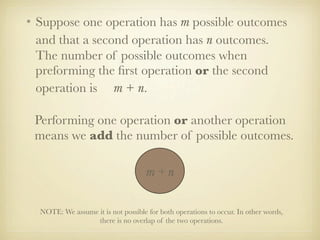
• Suppose one operation has m possible outcomes
  and that a second operation has n outcomes.
  The number of possible outcomes when
  preforming the first operation or the second
  operation is m + n.

 Performing one operation or another operation
 means we add the number of possible outcomes.

                                    m+n

  NOTE: We assume it is not possible for both operations to occur. In other words,
                  there is no overlap of the two operations.
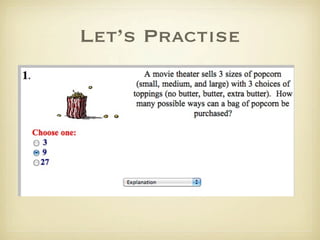
Let’s Practise
Last One!
Permutations
it is an arrangement of a number of
      objects in a definite order.
Example


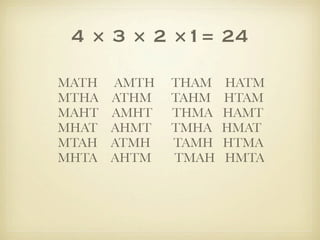
• How many ways are there of arranging all the
  letters of the word MATH?
4 × 3 × 2 ×1= 24

MATH   AMTH   THAM   HATM
MTHA   ATHM   TAHM   HTAM
MAHT   AMHT   THMA   HAMT
MHAT   AHMT   TMHA   HMAT
MTAH   ATMH   TAMH   HTMA
MHTA   AHTM   TMAH   HMTA
Example 1


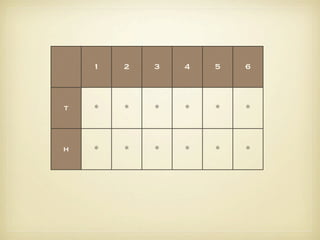
• If a die is thrown and a coin is tossed, how many
  different outcomes are possible?
• Write out all of the outcomes.
Solution
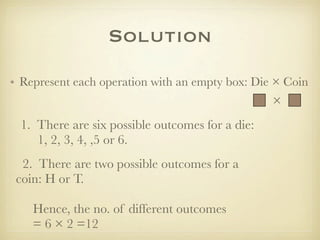
• Represent each operation with an empty box: Die × Coin
                                                  ×
 1. There are six possible outcomes for a die:
    1, 2, 3, 4, ,5 or 6.
  2. There are two possible outcomes for a
 coin: H or T.

    Hence, the no. of different outcomes
    = 6 × 2 =12
1   2   3   4   5   6


t   *   *   *   *   *   *


h   *   *   *   *   *   *
Example 2
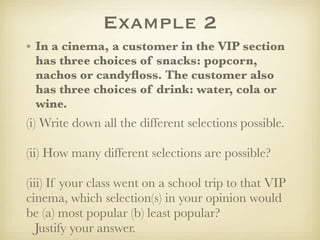
• In a cinema, a customer in the VIP section
  has three choices of snacks: popcorn,
  nachos or candyfloss. The customer also
  has three choices of drink: water, cola or
  wine.
(i) Write down all the different selections possible.

(ii) How many different selections are possible?

(iii) If your class went on a school trip to that VIP
cinema, which selection(s) in your opinion would
be (a) most popular (b) least popular?
   Justify your answer.
Solution
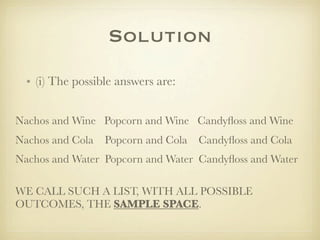
  • (i) The possible answers are:


Nachos and Wine Popcorn and Wine Candyfloss and Wine
Nachos and Cola   Popcorn and Cola   Candyfloss and Cola
Nachos and Water Popcorn and Water Candyfloss and Water

WE CALL SUCH A LIST, WITH ALL POSSIBLE
OUTCOMES, THE SAMPLE SPACE.
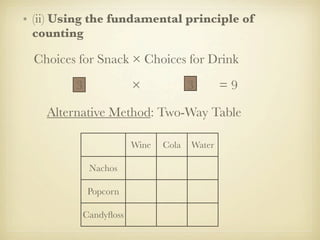
• (ii) Using the fundamental principle of
  counting

 Choices for Snack × Choices for Drink
         3               ×             3       =9

    Alternative Method: Two-Way Table

                         Wine   Cola   Water

              Nachos

              Popcorn

             Candyfloss
(iii)


• In a justify/discuss type of question, there are no
  correct or incorrect answers. If you can back up
  your opinion with a logical statement, you are
  answering the question correctly.
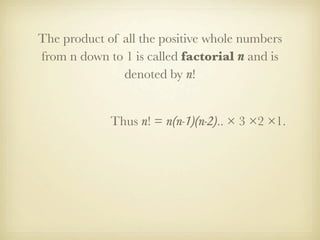
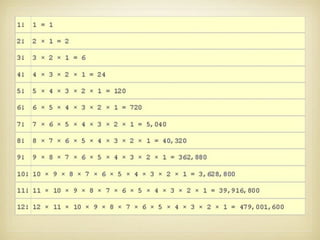
Factorials
The product of all the positive whole numbers
from n down to 1 is called factorial n and is
               denoted by n!


             Thus n! = n(n-1)(n-2).. × 3 ×2 ×1.
Text
Working with
 Factorials
  Let’s Try Dividing!
Example
Example
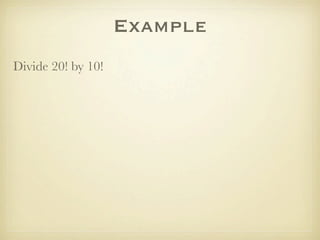
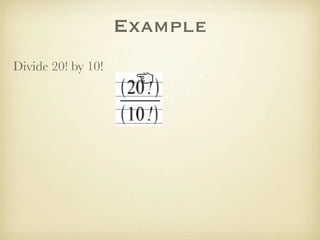
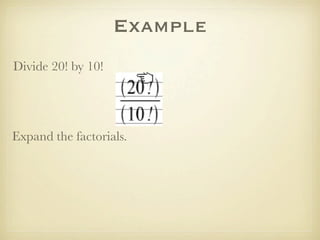
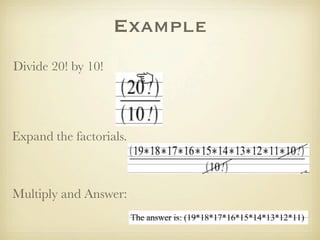
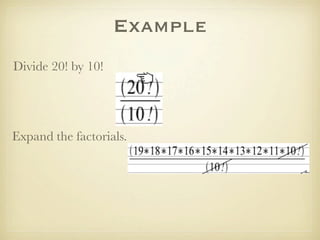
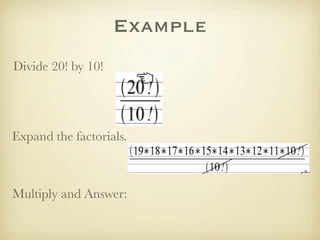
Divide 20! by 10!
Example
Divide 20! by 10!
Example
Divide 20! by 10!


Expand the factorials.
Example
Divide 20! by 10!


Expand the factorials.
Example
Divide 20! by 10!


Expand the factorials.


Multiply and Answer:
Example
Divide 20! by 10!


Expand the factorials.


Multiply and Answer:
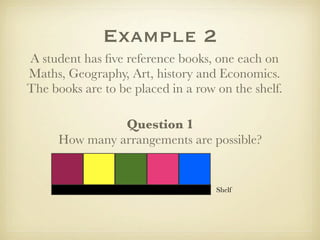
Example 2
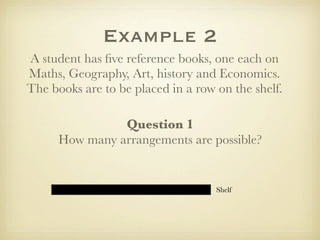
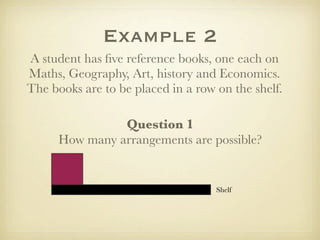
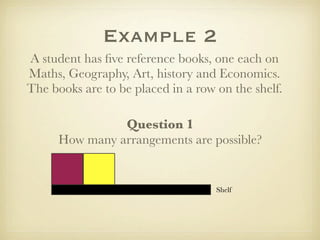
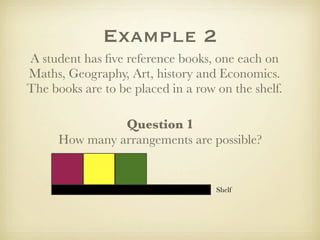
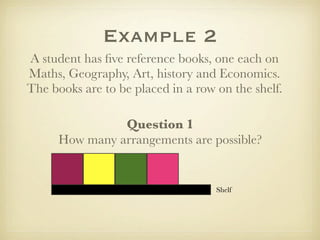
A student has five reference books, one each on
Maths, Geography, Art, history and Economics.
The books are to be placed in a row on the shelf.

                Question 1
      How many arrangements are possible?
Example 2
A student has five reference books, one each on
Maths, Geography, Art, history and Economics.
The books are to be placed in a row on the shelf.

                Question 1
      How many arrangements are possible?
Example 2
A student has five reference books, one each on
Maths, Geography, Art, history and Economics.
The books are to be placed in a row on the shelf.

                Question 1
      How many arrangements are possible?


                                    Shelf
Example 2
A student has five reference books, one each on
Maths, Geography, Art, history and Economics.
The books are to be placed in a row on the shelf.

                Question 1
      How many arrangements are possible?


                                    Shelf
Example 2
A student has five reference books, one each on
Maths, Geography, Art, history and Economics.
The books are to be placed in a row on the shelf.

                Question 1
      How many arrangements are possible?


                                    Shelf
Example 2
A student has five reference books, one each on
Maths, Geography, Art, history and Economics.
The books are to be placed in a row on the shelf.

                Question 1
      How many arrangements are possible?


                                    Shelf
Example 2
A student has five reference books, one each on
Maths, Geography, Art, history and Economics.
The books are to be placed in a row on the shelf.

                Question 1
      How many arrangements are possible?


                                    Shelf
Example 2
A student has five reference books, one each on
Maths, Geography, Art, history and Economics.
The books are to be placed in a row on the shelf.

                Question 1
      How many arrangements are possible?


                                    Shelf
Example 2
A student has five reference books, one each on
Maths, Geography, Art, history and Economics.
The books are to be placed in a row on the shelf.

                Question 1
      How many arrangements are possible?


                                                                Shelf
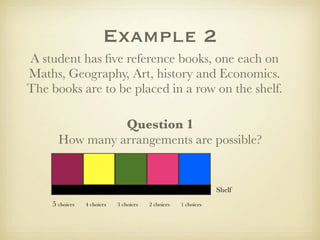
    5 choices   4 choices   3 choices   2 choices   1 choices
Example 2
A student has five reference books, one each on
Maths, Geography, Art, history and Economics.
The books are to be placed in a row on the shelf.

                Question 1
      How many arrangements are possible?


                                                                 Shelf
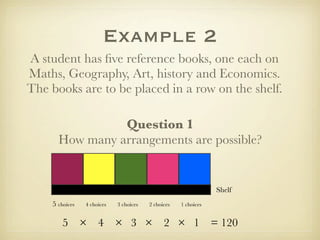
    5 choices   4 choices   3 choices   2 choices   1 choices


        5       ×    4      × 3 ×             2 × 1             = 120

Fundamental Principle of Counting

  • 1.
    Bobbi-Bear Ms. Carter
  • 2.
  • 4.
  • 5.
    • When dealingwith the occurrence of more than one event or activity, it is important to be able to quickly determine how many possible outcomes exist.  • For example, if ice cream sundaes come in 5 flavors with 4 possible toppings, how many different sundaes can be made with one flavor of ice cream and one topping?   
  • 6.
    • When dealingwith the occurrence of more than one event or activity, it is important to be able to quickly determine how many possible outcomes exist.  • For example, if ice cream sundaes come in 5 flavors with 4 possible toppings, how many different sundaes can be made with one flavor of ice cream and one topping?    Guesses??
  • 7.
    • When dealingwith the occurrence of more than one event or activity, it is important to be able to quickly determine how many possible outcomes exist.  • For example, if ice cream sundaes come in 5 flavors with 4 possible toppings, how many different sundaes can be made with one flavor of ice cream and one topping?    Guesses?? 20!!!
  • 8.
  • 9.
    Introduce.. The Fundamental Principle of Counting
  • 10.
    Operations • The resultof an operation is an outcome. For example, if we throw a die, one possible outcome is 5. If we throw a die there are six possible outcomes: 1, 2, 3, 4, 5 or 6.
  • 11.
    Suppose one operationhas m possible outcomes and that a second operation has n outcomes. The number of possible outcomes when preforming the first operation followed by the second operation is m × n. Performing one operation and another operation means we multiply the number of possible outcomes. m×n
  • 12.
    Example Activity:  draw two cardsfrom a standard deck of 52 cards without replacing the cards       There are 52 ways to draw the first card.       There are 51 ways to draw the second card.       There are 52 • 51 = 2,652 ways to draw the two cards.
  • 13.
    • Suppose oneoperation has m possible outcomes and that a second operation has n outcomes. The number of possible outcomes when preforming the first operation or the second operation is m + n. Performing one operation or another operation means we add the number of possible outcomes. m+n NOTE: We assume it is not possible for both operations to occur. In other words, there is no overlap of the two operations.
  • 14.
  • 18.
  • 19.
    Permutations it is anarrangement of a number of objects in a definite order.
  • 20.
    Example • How manyways are there of arranging all the letters of the word MATH?
  • 21.
    4 × 3× 2 ×1= 24 MATH AMTH THAM HATM MTHA ATHM TAHM HTAM MAHT AMHT THMA HAMT MHAT AHMT TMHA HMAT MTAH ATMH TAMH HTMA MHTA AHTM TMAH HMTA
  • 22.
    Example 1 • Ifa die is thrown and a coin is tossed, how many different outcomes are possible? • Write out all of the outcomes.
  • 23.
    Solution • Represent eachoperation with an empty box: Die × Coin × 1. There are six possible outcomes for a die: 1, 2, 3, 4, ,5 or 6. 2. There are two possible outcomes for a coin: H or T. Hence, the no. of different outcomes = 6 × 2 =12
  • 24.
    1 2 3 4 5 6 t * * * * * * h * * * * * *
  • 25.
    Example 2 • Ina cinema, a customer in the VIP section has three choices of snacks: popcorn, nachos or candyfloss. The customer also has three choices of drink: water, cola or wine. (i) Write down all the different selections possible. (ii) How many different selections are possible? (iii) If your class went on a school trip to that VIP cinema, which selection(s) in your opinion would be (a) most popular (b) least popular? Justify your answer.
  • 26.
    Solution •(i) The possible answers are: Nachos and Wine Popcorn and Wine Candyfloss and Wine Nachos and Cola Popcorn and Cola Candyfloss and Cola Nachos and Water Popcorn and Water Candyfloss and Water WE CALL SUCH A LIST, WITH ALL POSSIBLE OUTCOMES, THE SAMPLE SPACE.
  • 27.
    • (ii) Usingthe fundamental principle of counting Choices for Snack × Choices for Drink 3 × 3 =9 Alternative Method: Two-Way Table Wine Cola Water Nachos Popcorn Candyfloss
  • 28.
    (iii) • In ajustify/discuss type of question, there are no correct or incorrect answers. If you can back up your opinion with a logical statement, you are answering the question correctly.
  • 29.
  • 30.
    The product ofall the positive whole numbers from n down to 1 is called factorial n and is denoted by n! Thus n! = n(n-1)(n-2).. × 3 ×2 ×1.
  • 31.
  • 32.
    Working with Factorials Let’s Try Dividing!
  • 33.
  • 34.
  • 35.
  • 36.
    Example Divide 20! by10! Expand the factorials.
  • 37.
    Example Divide 20! by10! Expand the factorials.
  • 38.
    Example Divide 20! by10! Expand the factorials. Multiply and Answer:
  • 39.
    Example Divide 20! by10! Expand the factorials. Multiply and Answer:
  • 40.
    Example 2 A studenthas five reference books, one each on Maths, Geography, Art, history and Economics. The books are to be placed in a row on the shelf. Question 1 How many arrangements are possible?
  • 41.
    Example 2 A studenthas five reference books, one each on Maths, Geography, Art, history and Economics. The books are to be placed in a row on the shelf. Question 1 How many arrangements are possible?
  • 42.
    Example 2 A studenthas five reference books, one each on Maths, Geography, Art, history and Economics. The books are to be placed in a row on the shelf. Question 1 How many arrangements are possible? Shelf
  • 43.
    Example 2 A studenthas five reference books, one each on Maths, Geography, Art, history and Economics. The books are to be placed in a row on the shelf. Question 1 How many arrangements are possible? Shelf
  • 44.
    Example 2 A studenthas five reference books, one each on Maths, Geography, Art, history and Economics. The books are to be placed in a row on the shelf. Question 1 How many arrangements are possible? Shelf
  • 45.
    Example 2 A studenthas five reference books, one each on Maths, Geography, Art, history and Economics. The books are to be placed in a row on the shelf. Question 1 How many arrangements are possible? Shelf
  • 46.
    Example 2 A studenthas five reference books, one each on Maths, Geography, Art, history and Economics. The books are to be placed in a row on the shelf. Question 1 How many arrangements are possible? Shelf
  • 47.
    Example 2 A studenthas five reference books, one each on Maths, Geography, Art, history and Economics. The books are to be placed in a row on the shelf. Question 1 How many arrangements are possible? Shelf
  • 48.
    Example 2 A studenthas five reference books, one each on Maths, Geography, Art, history and Economics. The books are to be placed in a row on the shelf. Question 1 How many arrangements are possible? Shelf 5 choices 4 choices 3 choices 2 choices 1 choices
  • 49.
    Example 2 A studenthas five reference books, one each on Maths, Geography, Art, history and Economics. The books are to be placed in a row on the shelf. Question 1 How many arrangements are possible? Shelf 5 choices 4 choices 3 choices 2 choices 1 choices 5 × 4 × 3 × 2 × 1 = 120