Principles of Counting
Factorial Notation
The Fundamental Counting Principle
The Counting Principle for
Alternative Cases
Permutation
Combination
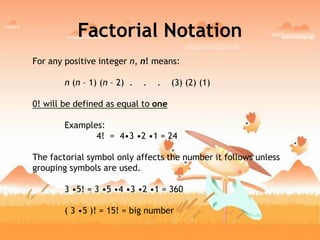
Factorial Notation
For any positive integer n, n! means:
n (n – 1) (n – 2) . . . (3) (2) (1)
0! will be defined as equal to one
Examples:
4! = 4•3 •2 •1 = 24
The factorial symbol only affects the number it follows unless
grouping symbols are used.
3 •5! = 3 •5 •4 •3 •2 •1 = 360
( 3 •5 )! = 15! = big number
The Fundamental Counting
Principle
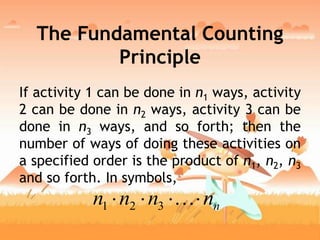
If activity 1 can be done in n1 ways, activity
2 can be done in n2 ways, activity 3 can be
done in n3 ways, and so forth; then the
number of ways of doing these activities on
a specified order is the product of n1, n2, n3
and so forth. In symbols,
nnnnn  321
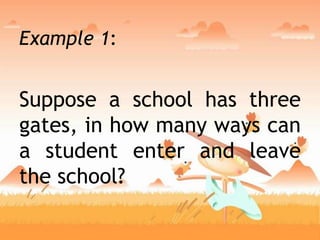
Example 1:
Suppose a school has three
gates, in how many ways can
a student enter and leave
the school?
Example 2:
In a medical study, patients are
classified according to whether they
have blood type A, B, AB or O, and also
according to whether their blood
pressure is low, normal, or high. In
how many different ways can a patient
thus be classified.
Example 3:
A new car dealer offers a car in
four body styles, in ten colors, and
with a choice of three engines. In
how many ways can a person order
one of the cars?
Example 4:
A test consists of 15 multiple
choice questions, with each
question having four possible
answers. In how many different
ways can a student check off one
answer to each question?
Example 5:
How many different 4-digit
numbers can be formed from the
digits 1, 2, 3, 4 and 5 if: (a)
repetition is not allowed? How
many of these numbers are even?
How many are these numbers are
odd? (b) repetition is allowed?
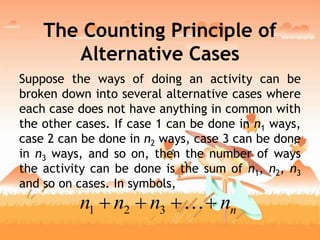
The Counting Principle of
Alternative Cases
Suppose the ways of doing an activity can be
broken down into several alternative cases where
each case does not have anything in common with
the other cases. If case 1 can be done in n1 ways,
case 2 can be done in n2 ways, case 3 can be done
in n3 ways, and so on, then the number of ways
the activity can be done is the sum of n1, n2, n3
and so on cases. In symbols,
nnnnn  321
Permutation
The term permutation refers to the
arrangement of objects with reference
to order or it may be defined as an
arrangement of all or part of a set of
objects.
Linear Permutation
The number of permutations of n
distinct objects taken all together is
n!.
Example:
How many different signals can be
made using five flags if all flags
must be used in each signal?
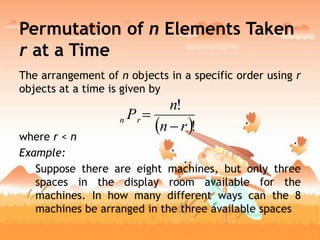
Permutation of n Elements Taken
r at a Time
The arrangement of n objects in a specific order using r
objects at a time is given by
where r < n
Example:
Suppose there are eight machines, but only three
spaces in the display room available for the
machines. In how many different ways can the 8
machines be arranged in the three available spaces
 !
!
rn
n
Prn


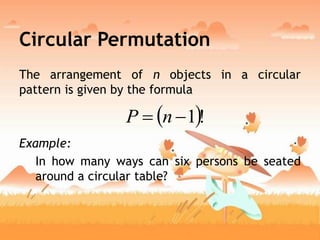
Circular Permutation
The arrangement of n objects in a circular
pattern is given by the formula
Example:
In how many ways can six persons be seated
around a circular table?
 !1 nP
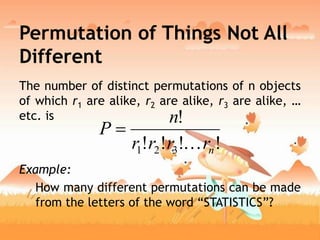
Permutation of Things Not All
Different
The number of distinct permutations of n objects
of which r1 are alike, r2 are alike, r3 are alike, …
etc. is
Example:
How many different permutations can be made
from the letters of the word “STATISTICS”?
!!!!
!
321 nrrrr
n
P


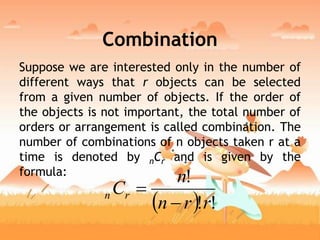
Combination
Suppose we are interested only in the number of
different ways that r objects can be selected
from a given number of objects. If the order of
the objects is not important, the total number of
orders or arrangement is called combination. The
number of combinations of n objects taken r at a
time is denoted by nCr and is given by the
formula:
  !!
!
rrn
n
Crn


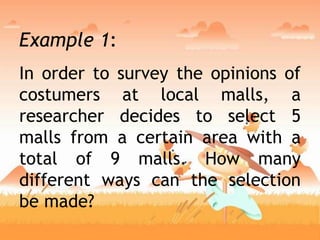
Example 1:
In order to survey the opinions of
costumers at local malls, a
researcher decides to select 5
malls from a certain area with a
total of 9 malls. How many
different ways can the selection
be made?
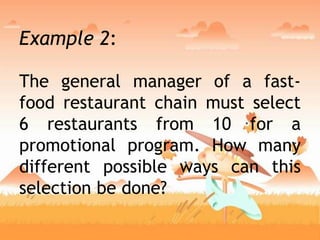
Example 2:
The general manager of a fast-
food restaurant chain must select
6 restaurants from 10 for a
promotional program. How many
different possible ways can this
selection be done?
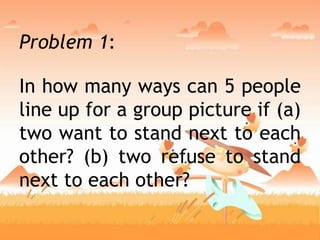
Problem 1:
In how many ways can 5 people
line up for a group picture if (a)
two want to stand next to each
other? (b) two refuse to stand
next to each other?
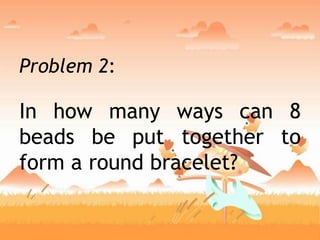
Problem 2:
In how many ways can 8
beads be put together to
form a round bracelet?
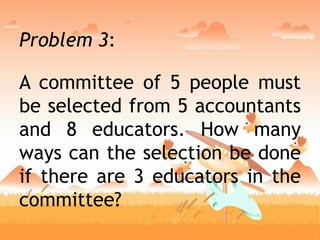
Problem 3:
A committee of 5 people must
be selected from 5 accountants
and 8 educators. How many
ways can the selection be done
if there are 3 educators in the
committee?
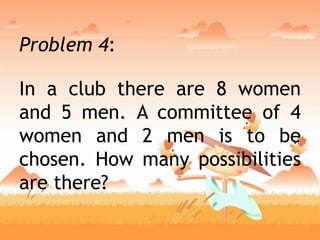
Problem 4:
In a club there are 8 women
and 5 men. A committee of 4
women and 2 men is to be
chosen. How many possibilities
are there?
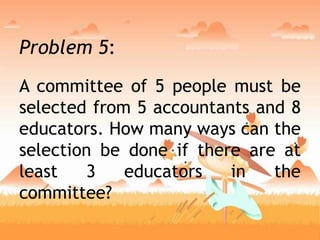
Problem 5:
A committee of 5 people must be
selected from 5 accountants and 8
educators. How many ways can the
selection be done if there are at
least 3 educators in the
committee?
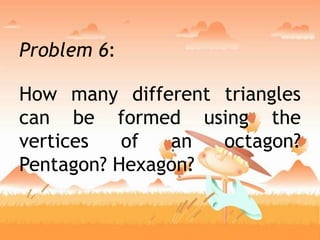
Problem 6:
How many different triangles
can be formed using the
vertices of an octagon?
Pentagon? Hexagon?

STAT: Counting principles(2)

  • 1.
    Principles of Counting FactorialNotation The Fundamental Counting Principle The Counting Principle for Alternative Cases Permutation Combination
  • 2.
    Factorial Notation For anypositive integer n, n! means: n (n – 1) (n – 2) . . . (3) (2) (1) 0! will be defined as equal to one Examples: 4! = 4•3 •2 •1 = 24 The factorial symbol only affects the number it follows unless grouping symbols are used. 3 •5! = 3 •5 •4 •3 •2 •1 = 360 ( 3 •5 )! = 15! = big number
  • 3.
    The Fundamental Counting Principle Ifactivity 1 can be done in n1 ways, activity 2 can be done in n2 ways, activity 3 can be done in n3 ways, and so forth; then the number of ways of doing these activities on a specified order is the product of n1, n2, n3 and so forth. In symbols, nnnnn  321
  • 4.
    Example 1: Suppose aschool has three gates, in how many ways can a student enter and leave the school?
  • 5.
    Example 2: In amedical study, patients are classified according to whether they have blood type A, B, AB or O, and also according to whether their blood pressure is low, normal, or high. In how many different ways can a patient thus be classified.
  • 6.
    Example 3: A newcar dealer offers a car in four body styles, in ten colors, and with a choice of three engines. In how many ways can a person order one of the cars?
  • 7.
    Example 4: A testconsists of 15 multiple choice questions, with each question having four possible answers. In how many different ways can a student check off one answer to each question?
  • 8.
    Example 5: How manydifferent 4-digit numbers can be formed from the digits 1, 2, 3, 4 and 5 if: (a) repetition is not allowed? How many of these numbers are even? How many are these numbers are odd? (b) repetition is allowed?
  • 9.
    The Counting Principleof Alternative Cases Suppose the ways of doing an activity can be broken down into several alternative cases where each case does not have anything in common with the other cases. If case 1 can be done in n1 ways, case 2 can be done in n2 ways, case 3 can be done in n3 ways, and so on, then the number of ways the activity can be done is the sum of n1, n2, n3 and so on cases. In symbols, nnnnn  321
  • 10.
    Permutation The term permutationrefers to the arrangement of objects with reference to order or it may be defined as an arrangement of all or part of a set of objects.
  • 11.
    Linear Permutation The numberof permutations of n distinct objects taken all together is n!. Example: How many different signals can be made using five flags if all flags must be used in each signal?
  • 12.
    Permutation of nElements Taken r at a Time The arrangement of n objects in a specific order using r objects at a time is given by where r < n Example: Suppose there are eight machines, but only three spaces in the display room available for the machines. In how many different ways can the 8 machines be arranged in the three available spaces  ! ! rn n Prn  
  • 13.
    Circular Permutation The arrangementof n objects in a circular pattern is given by the formula Example: In how many ways can six persons be seated around a circular table?  !1 nP
  • 14.
    Permutation of ThingsNot All Different The number of distinct permutations of n objects of which r1 are alike, r2 are alike, r3 are alike, … etc. is Example: How many different permutations can be made from the letters of the word “STATISTICS”? !!!! ! 321 nrrrr n P  
  • 15.
    Combination Suppose we areinterested only in the number of different ways that r objects can be selected from a given number of objects. If the order of the objects is not important, the total number of orders or arrangement is called combination. The number of combinations of n objects taken r at a time is denoted by nCr and is given by the formula:   !! ! rrn n Crn  
  • 16.
    Example 1: In orderto survey the opinions of costumers at local malls, a researcher decides to select 5 malls from a certain area with a total of 9 malls. How many different ways can the selection be made?
  • 17.
    Example 2: The generalmanager of a fast- food restaurant chain must select 6 restaurants from 10 for a promotional program. How many different possible ways can this selection be done?
  • 18.
    Problem 1: In howmany ways can 5 people line up for a group picture if (a) two want to stand next to each other? (b) two refuse to stand next to each other?
  • 19.
    Problem 2: In howmany ways can 8 beads be put together to form a round bracelet?
  • 20.
    Problem 3: A committeeof 5 people must be selected from 5 accountants and 8 educators. How many ways can the selection be done if there are 3 educators in the committee?
  • 21.
    Problem 4: In aclub there are 8 women and 5 men. A committee of 4 women and 2 men is to be chosen. How many possibilities are there?
  • 22.
    Problem 5: A committeeof 5 people must be selected from 5 accountants and 8 educators. How many ways can the selection be done if there are at least 3 educators in the committee?
  • 23.
    Problem 6: How manydifferent triangles can be formed using the vertices of an octagon? Pentagon? Hexagon?