supplier
selection
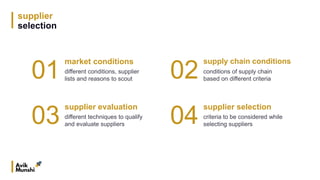
01
market conditions
different conditions, supplier
lists and reasons to scout
03
supplier evaluation
different techniques to qualify
and evaluate suppliers
02
supply chain conditions
conditions of supply chain
based on different criteria
04
supplier selection
criteria to be considered while
selecting suppliers
market
conditions
sole source
concerned supplier is the ‘one and only source’ for the product
single source
concerned supplier is not the only source but your preferred source
oligopoly
interdependent or highly competitive market with similar pricing
supplier
listing
qualified suppliers
central repository of suppliers qualified based on certain criteria
supplier details
basic details of products, services, capabilities and infrastructure
ratings
remarks and ratings based on experience from previous association
reasons to
scout suppliers
new item
goods or service that have not
been procured previously
price
better prices from suppliers with
higher efficiency owing to scale
bad experience
poor delivery or default from any
existing supplier
increased requirement
additional quantity is beyond the
capacity of current suppliers
lead time
shorter lead time with location or
quicker process of supplier
explore options
explore or keep options ready in
case of switch required
supply chain conditions
based on
location
local
within the city, region or same local legislation
domestic
within the same country but different region or legislation
international
overseas or cross border supplier from different country
based on
layers
direct
straight from producer with no intermediate agent
shallow
from seller with an intermediate agent or dealer
extensive
through last mile provider procuring through several layers
impact on
logistics
transport mode
medium of transport such as sea,
air, road or rail
statutory
compliances and paper to be
submitted to legislative authorities
cost
cumulative cost of procurement
with direct and indirect costs
lead time
cumulative lead time subject to
transport and compliances
taxation
applicable taxes and input credit
structure based on legislations
supply risk
disruption or interruption chances
from uncertain events like weather
impact of
product nature
patented
law
access
restricted
know how
restricted
source
restricted
general
available
impact of
product nature
patented
original
equipment
manufacturer
restricted
access
regulatory
authority
restricted
know how
authorized
Service
provider
restricted
source
mining or
refinery
generally
available
appointed
dealer
distributor
oil & gas
note
upstream
onshore and offshore oil rigs from where raw crude oil is extracted
mid-stream
transport and intermediate storage of crude oil for processing
downstream
refining to products like fuel, lubricants, wax and chemicals
supplier evaluation
supplier
screening
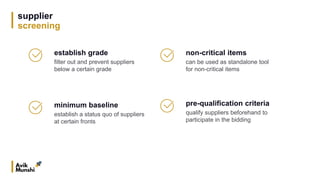
establish grade
filter out and prevent suppliers
below a certain grade
pre-qualification criteria
qualify suppliers beforehand to
participate in the bidding
minimum baseline
establish a status quo of suppliers
at certain fronts
non-critical items
can be used as standalone tool
for non-critical items
supplier
scoring
set total marks
filter out and prevent suppliers
below a certain grade
marks for each factor
divide the total marks by the
number of factors
set factors
for instance, revenue, previous
experience, quality certifications,
after sales, brand value, location,
lead time, warranty..
rate and sum
rate supplier on each parameter
and sum up the score
weighted
scoring
set total marks
filter out and prevent suppliers
below a certain grade
marks for each factor
divide the total marks by the
number of factors
set factors
for instance, revenue, previous
experience, quality certifications,
after sales, brand value, location,
lead time, warranty..
rate
rate supplier on each parameter
independently
factor weightage
assign weightage to each factor
based on the context and item
sum product
multiply scores with respective
weightage and then sum up
normal vs weighed
scoring
Max
Marks
Score Average
Scoring
Weightage
Factor
Weighted
Scoring
Cost 20 20 20 5% 5
Lead Time 20 15 15 20% 15
Warranty 20 15 15 30% 22.5
Quality 20 15 15 40% 30
Service 20 15 15 5% 3.75
Total 100 80 80 100% 76.25
summary
of techniques
screening
preliminary screen to filter out suppliers based on certain
qualification criteria
scoring
assigning score to suppliers based on various parameters
weighted scoring
laying emphasis on more important parameters in scoring
selection
criterion
comprehensive list of factors
factors ranging from technical to financial to be considered
important and complex contracts
small procurements may not necessitate use of all factors
use only most appropriate factors
based on item and context one should consider certain factors
selection
criterion
01 business size
revenue
• Revenue
• Production
02 business type
divisions
• Primary product
• Secondary product
• By-product
• New product
• Experimental product
selection
criterion
03 financial capacity
funds management
• Revenue
• Average order value
• Highest single order value
04 past-experience
preparedness
• Learning curve
• Available formats
• SOPs (Standard Operating
Procedures)
selection
criterion
05 past client references
recommendations
• Recommendations
• Repeat orders
• Duration of association
06 rights and license
intellectual property
• Transfer of rights
• Ownership of IP
• Use license of IP
• Limited use license of IP
selection
criterion
07 technical competence
preparedness
• Equipment
• Talent
• Processes (Standard
Operating Procedures)
08 capacity
value
• Nature of product
• Value (rate) of inventory
• Average Ticket Value
selection
criterion
09 warranty
performance
• Inclusions
• Period
• Logistics
• Corporate warranty or
performance bond
10 after sales
service & support
• Service network
• Extent of support
• Quality of support
• Inclusions
selection
criterion
11 management
approach
• QMS (Quality Management
System)
• ERM (Enterprise Risk
Management)
• Industry certifications
• Certifying authority or agency
12 lifecycle
cost
• Low upfront cost – higher
recurring cost
• High upfront cost – lower
recurring cost
new
courses
business essentials
all fundamentals that you need to know about business along with
an interesting section on evolution of business.
product costing and pricing
calculating product cost with fundamental understanding of business
and various pricing strategies!
plan your business
introductory course about the business landscape and method to fill
up the business canvas.

Section 03 Supplier Selection

  • 1.
    supplier selection 01 market conditions different conditions,supplier lists and reasons to scout 03 supplier evaluation different techniques to qualify and evaluate suppliers 02 supply chain conditions conditions of supply chain based on different criteria 04 supplier selection criteria to be considered while selecting suppliers
  • 2.
    market conditions sole source concerned supplieris the ‘one and only source’ for the product single source concerned supplier is not the only source but your preferred source oligopoly interdependent or highly competitive market with similar pricing
  • 3.
    supplier listing qualified suppliers central repositoryof suppliers qualified based on certain criteria supplier details basic details of products, services, capabilities and infrastructure ratings remarks and ratings based on experience from previous association
  • 4.
    reasons to scout suppliers newitem goods or service that have not been procured previously price better prices from suppliers with higher efficiency owing to scale bad experience poor delivery or default from any existing supplier increased requirement additional quantity is beyond the capacity of current suppliers lead time shorter lead time with location or quicker process of supplier explore options explore or keep options ready in case of switch required
  • 5.
  • 6.
    based on location local within thecity, region or same local legislation domestic within the same country but different region or legislation international overseas or cross border supplier from different country
  • 7.
    based on layers direct straight fromproducer with no intermediate agent shallow from seller with an intermediate agent or dealer extensive through last mile provider procuring through several layers
  • 8.
    impact on logistics transport mode mediumof transport such as sea, air, road or rail statutory compliances and paper to be submitted to legislative authorities cost cumulative cost of procurement with direct and indirect costs lead time cumulative lead time subject to transport and compliances taxation applicable taxes and input credit structure based on legislations supply risk disruption or interruption chances from uncertain events like weather
  • 9.
    impact of product nature patented law access restricted knowhow restricted source restricted general available
  • 10.
    impact of product nature patented original equipment manufacturer restricted access regulatory authority restricted knowhow authorized Service provider restricted source mining or refinery generally available appointed dealer distributor
  • 11.
    oil & gas note upstream onshoreand offshore oil rigs from where raw crude oil is extracted mid-stream transport and intermediate storage of crude oil for processing downstream refining to products like fuel, lubricants, wax and chemicals
  • 12.
  • 13.
    supplier screening establish grade filter outand prevent suppliers below a certain grade pre-qualification criteria qualify suppliers beforehand to participate in the bidding minimum baseline establish a status quo of suppliers at certain fronts non-critical items can be used as standalone tool for non-critical items
  • 14.
    supplier scoring set total marks filterout and prevent suppliers below a certain grade marks for each factor divide the total marks by the number of factors set factors for instance, revenue, previous experience, quality certifications, after sales, brand value, location, lead time, warranty.. rate and sum rate supplier on each parameter and sum up the score
  • 15.
    weighted scoring set total marks filterout and prevent suppliers below a certain grade marks for each factor divide the total marks by the number of factors set factors for instance, revenue, previous experience, quality certifications, after sales, brand value, location, lead time, warranty.. rate rate supplier on each parameter independently factor weightage assign weightage to each factor based on the context and item sum product multiply scores with respective weightage and then sum up
  • 16.
    normal vs weighed scoring Max Marks ScoreAverage Scoring Weightage Factor Weighted Scoring Cost 20 20 20 5% 5 Lead Time 20 15 15 20% 15 Warranty 20 15 15 30% 22.5 Quality 20 15 15 40% 30 Service 20 15 15 5% 3.75 Total 100 80 80 100% 76.25
  • 17.
    summary of techniques screening preliminary screento filter out suppliers based on certain qualification criteria scoring assigning score to suppliers based on various parameters weighted scoring laying emphasis on more important parameters in scoring
  • 18.
    selection criterion comprehensive list offactors factors ranging from technical to financial to be considered important and complex contracts small procurements may not necessitate use of all factors use only most appropriate factors based on item and context one should consider certain factors
  • 19.
    selection criterion 01 business size revenue •Revenue • Production 02 business type divisions • Primary product • Secondary product • By-product • New product • Experimental product
  • 20.
    selection criterion 03 financial capacity fundsmanagement • Revenue • Average order value • Highest single order value 04 past-experience preparedness • Learning curve • Available formats • SOPs (Standard Operating Procedures)
  • 21.
    selection criterion 05 past clientreferences recommendations • Recommendations • Repeat orders • Duration of association 06 rights and license intellectual property • Transfer of rights • Ownership of IP • Use license of IP • Limited use license of IP
  • 22.
    selection criterion 07 technical competence preparedness •Equipment • Talent • Processes (Standard Operating Procedures) 08 capacity value • Nature of product • Value (rate) of inventory • Average Ticket Value
  • 23.
    selection criterion 09 warranty performance • Inclusions •Period • Logistics • Corporate warranty or performance bond 10 after sales service & support • Service network • Extent of support • Quality of support • Inclusions
  • 24.
    selection criterion 11 management approach • QMS(Quality Management System) • ERM (Enterprise Risk Management) • Industry certifications • Certifying authority or agency 12 lifecycle cost • Low upfront cost – higher recurring cost • High upfront cost – lower recurring cost
  • 25.
    new courses business essentials all fundamentalsthat you need to know about business along with an interesting section on evolution of business. product costing and pricing calculating product cost with fundamental understanding of business and various pricing strategies! plan your business introductory course about the business landscape and method to fill up the business canvas.