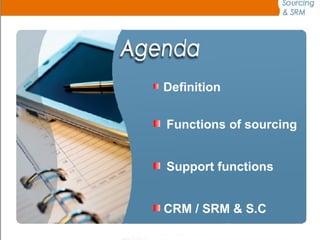
Definition Functions of sourcing Support functions CRM / SRM & S.C
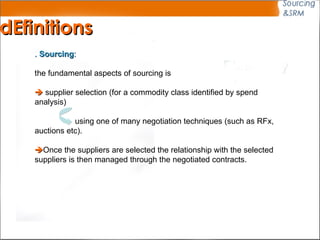
.  Sourcing :   the fundamental aspects of sourcing is    supplier selection (for a commodity class identified by spend analysis)  using one of many negotiation techniques (such as RFx, auctions etc).   Once the suppliers are selected the relationship with the selected suppliers is then managed through the negotiated contracts.  dEfinitions
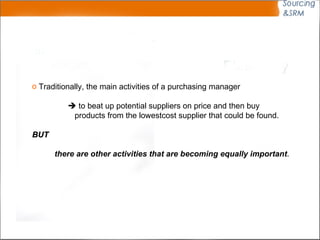
Traditionally, the main activities of a purchasing manager     to beat up potential suppliers on price and then buy products from the lowestcost supplier that could be found.  BUT there are other activities that are becoming equally important .
The procurement function can be broken into five main activity categories: Purchasing 2. Consumption Management 3. Vendor Selection 4. Contract Negotiation 5. Contract Management
Purchasing These activities are the routine activities related to issuing purchase orders for needed products     There are two types of products that a  company buys  : Direct or strategic materials that are needed to produce  the products that the company sells to its customers  Indirect or MRO (maintenance, repair, and operations) products that a company consumes as part of daily operations. The mechanics of purchasing both types of products are largely the same
Ch allenges   One of the greatest challenges of the purchasing activity timely manner and without error   In d ata communication Much of this activity is very predictable and follows well defined routines.
Consumption Management    Understanding of how much of what categories of products are being  bought across the entire company  as well as by each operating unit.    There must be an understanding of how much of what kinds of products are  bought from whom and at what prices.
Vendor Selection There must be an ongoing process to define the procurement capabilities needed to  support the company ’ s business plan and its operating model. This definition will provide insight into the relative importance of vendor capabilities.  The value of these capabilities have to be considered in addition to simply the price of a vendor ’ s product.  The value of product quality, service levels, just in time delivery, and technical support  can only be estimated in light of what is called for by the business plan and the company ’ s operating model.
Once there is an understanding of the current purchasing situation and an appreciation of what a company needs to support its business plan and operating model, a search can be made for suppliers who have both the products and the service capabilities needed.  As a general rule,  a company seeks to narrow down the number of suppliers it  does Business with .  This way it can leverage its purchasing power with a few suppliers and get better prices in return for purchasing higher volumes of product.
Contract Negotiation A core ingredient of sourcing is  negotiation  with suppliers and executions  of the resulting contract.    Understanding of how much of what categories of products are being  bought across the entire company  as well as by each operating unit.    The simplest negotiations are for contracts to purchase indirect products where suppliers are selected on the basis of lowest price.  The most complex negotiations  are for contracts to purchase direct materials  that must meet exacting quality  requirements and where high service levels and technical support are needed.
CAPABILITIES Suppliers of both direct and indirect products need a common set of capabilities capabilities to set up electronic connections for purposes of receiving  orders, sending delivery notifications, sending invoices, and receiving  payments.   make more frequent and smaller deliveries and orders must be filled  accurately and completely. For better inventory management.
RF x The RFI (Request for Information), RFQ (Request for  Quotation), and RFP (Request for Proposal)  : An RFx is a document with an associated process initiated by a buyer in order to  solicit information, competitive quotes, or proposals from multiple suppliers.
Protocols (aka Auctions) A typical flow for negotiation is to get a bid response to the RFQ  from the suppliers and choose the appropriate bid/s that satisfy the  requirements of the purchase at minimum cost.
Contract Management    A company needs the ability to track the performance of its suppliers and  hold them accountable to meet the service levels they agreed to in their contract    Routinely collect data about the performance of suppliers.      Any supplier that consistently falls below requirements should be made  aware of their shortcomings and asked to correct them.
Decision Support for Bid Evaluation A suite of decision support tools, are required for bid evaluation: T ools to elicit a buyer’s preferences for multi-attribute  bid evaluation  based on conjoint analysis and advanced decision analysis techniques ;  A visualization tool to compare multiple bids across different  Attributes , and ; A bid evaluation engine that uses optimization techniques  to identify   a cost minimizing bid set subject to various business rules.
Multi-Attribute Bids    Factors related to the product specification such as price, material quality  and properties, color and size      Factors related to the service specification such as delivery time and cost,  and warranty      Supplier qualification factors such as trading history, experience and reputation.
Bundled “All-or-Nothing” Bids While negotiating prices for procuring, say, weekly demand, it is advantageous  to aggregate demand over several locations and plants, because this leads to a  larger transaction.  An additional advantage is that suppliers can provide a discounted bid on a  bundle because they might have excess inventory in a local warehouse or spare  capacity in the carrier and hence can reduce transportation costs .
Volume Discount Bids Allow the seller to specify the price they charge for an item as a  function of quantity that is being purchased. Bids take the form of supply curves, specifying the price that is to be charged  per unit of item when the quantity of items being purchased lies within a particular quantity interval.
Support Functions Some support functions that are useful for negotiations and contracts are  : Document management Project Management Market Intelligence Collaboration and Workflow
Document Management Files of all types – terms, drawings, schematics, etc. – are important  documents for strategic sourcing.   Additionally, the sourcing documents themselves  –  RFx ’ s, auctions,  projects, contracts, proposals, etc.  –  need to be well managed.
Project Management Most strategic sourcing activities are managed as projects with certain team  members, goals, milestones, tasks, and schedules.  Including : Discussions and any number of file attachment List of the other sourcing documents (RFx, auctions, contracts…) Roles, tasks… Any number of sub-projects providing a complete schedule to the master  project
Market Intelligence A variety of external information helps category managers and other  purchasing staff members perform their jobs.  This external information includes commodity prices, supplier news,  company news, and market intelligence such as industry news and reports.  Market intelligence needs to be provided as a sourcing workbench  as the first  page upon logging into the system.
Collaboration &  Workflow In addition to negotiating and communicating with multiple suppliers,  category managers must collaborate with many people across the enterprise  such as  Engineering  for technical specifications,  Manufacturing  for scheduling  and inventory concerns,  Legal  for contractual terms and conditions, etc.
SUPPLY CHAIN & CRM In the Past :  Push the product to the customer….. Sales forecasts are the essentials of information    Imperfect inventory  management  Nowadays :  The customer pull the demand….. Command makes information present in all the firm by the supply chain    First informations are planning & prevision, while CRM is permanent.
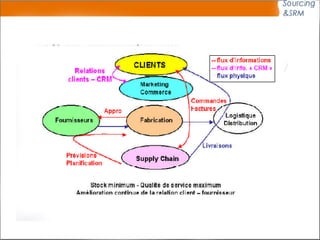
Consequences :  Better inventory management Continual amelioration of quality of service (Kaizen) Continual circulation of information Information flow and physic flow must been well droved together.  Same thing for CRM & SC. Behaving like that, the firm will be really efficient.
 
Convergence between CRM & SC ExAmples Demand Planning :  Good knowledge about customer allow to predict  efficacy and produce at the right moment.   Supply chain is better planned    Less stock & better resources utilization Available-To-Promise (ATP) :  System allowing to the firm to promise at the  command, a quantity from the available inventory. It helps to link between the profile of customer, his preferences and his  buyings history, to propose him a substitution product or a better time.
Command state in real time :  Firms permit to customers to follow the process of their command in real time (In production, on the way..)  Perfect product traceability  (DHL, UPS…) Including the “cost to serve” at the command moment :  The firm can know  the Added Value of each command.  So it cans orient the commands in a way to be winner. By focusing on markets  and customers with higher “life time value” Mobilize the resources for the most benefic customers and products..
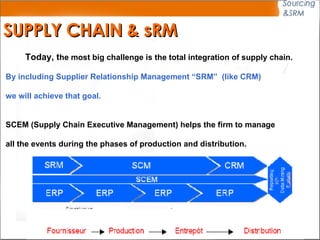
SUPPLY CHAIN & sRM Today, t he most big challenge is the total integration of supply chain. By including Supplier Relationship Management “SRM”  (like CRM)  we will achieve that goal. SCEM (Supply Chain Executive Management) helps the firm to manage  all the events during the phases of production and distribution.
Alert systems are now operational in any phase of SC. Permitting to  detect also any stock rupture. Continual following of SC become more efficient when we manage  a lot of information’s flows.  Reportings helps to treat this flows and analyze it. So, integration of SC impose a perfect coordination between  management tools.
CONCLUSION This chapter provided an overview of the various functionalities that are  required for procurement and sourcing for an enterprise.   Soufiane AL KHATIRI Fadel IDBRAIM www.fadelexpert.ici.ma

Sourcing & SRM

  • 1.
  • 2.
    Definition Functions ofsourcing Support functions CRM / SRM & S.C
  • 3.
    . Sourcing: the fundamental aspects of sourcing is  supplier selection (for a commodity class identified by spend analysis) using one of many negotiation techniques (such as RFx, auctions etc).  Once the suppliers are selected the relationship with the selected suppliers is then managed through the negotiated contracts. dEfinitions
  • 4.
    Traditionally, the mainactivities of a purchasing manager  to beat up potential suppliers on price and then buy products from the lowestcost supplier that could be found. BUT there are other activities that are becoming equally important .
  • 5.
    The procurement functioncan be broken into five main activity categories: Purchasing 2. Consumption Management 3. Vendor Selection 4. Contract Negotiation 5. Contract Management
  • 6.
    Purchasing These activitiesare the routine activities related to issuing purchase orders for needed products  There are two types of products that a company buys : Direct or strategic materials that are needed to produce the products that the company sells to its customers Indirect or MRO (maintenance, repair, and operations) products that a company consumes as part of daily operations. The mechanics of purchasing both types of products are largely the same
  • 7.
    Ch allenges One of the greatest challenges of the purchasing activity timely manner and without error In d ata communication Much of this activity is very predictable and follows well defined routines.
  • 8.
    Consumption Management  Understanding of how much of what categories of products are being bought across the entire company as well as by each operating unit.  There must be an understanding of how much of what kinds of products are bought from whom and at what prices.
  • 9.
    Vendor Selection Theremust be an ongoing process to define the procurement capabilities needed to support the company ’ s business plan and its operating model. This definition will provide insight into the relative importance of vendor capabilities. The value of these capabilities have to be considered in addition to simply the price of a vendor ’ s product. The value of product quality, service levels, just in time delivery, and technical support can only be estimated in light of what is called for by the business plan and the company ’ s operating model.
  • 10.
    Once there isan understanding of the current purchasing situation and an appreciation of what a company needs to support its business plan and operating model, a search can be made for suppliers who have both the products and the service capabilities needed. As a general rule, a company seeks to narrow down the number of suppliers it does Business with . This way it can leverage its purchasing power with a few suppliers and get better prices in return for purchasing higher volumes of product.
  • 11.
    Contract Negotiation Acore ingredient of sourcing is negotiation with suppliers and executions of the resulting contract.  Understanding of how much of what categories of products are being bought across the entire company as well as by each operating unit.  The simplest negotiations are for contracts to purchase indirect products where suppliers are selected on the basis of lowest price. The most complex negotiations are for contracts to purchase direct materials that must meet exacting quality requirements and where high service levels and technical support are needed.
  • 12.
    CAPABILITIES Suppliers ofboth direct and indirect products need a common set of capabilities capabilities to set up electronic connections for purposes of receiving orders, sending delivery notifications, sending invoices, and receiving payments. make more frequent and smaller deliveries and orders must be filled accurately and completely. For better inventory management.
  • 13.
    RF x TheRFI (Request for Information), RFQ (Request for Quotation), and RFP (Request for Proposal) : An RFx is a document with an associated process initiated by a buyer in order to solicit information, competitive quotes, or proposals from multiple suppliers.
  • 14.
    Protocols (aka Auctions)A typical flow for negotiation is to get a bid response to the RFQ from the suppliers and choose the appropriate bid/s that satisfy the requirements of the purchase at minimum cost.
  • 15.
    Contract Management  A company needs the ability to track the performance of its suppliers and hold them accountable to meet the service levels they agreed to in their contract  Routinely collect data about the performance of suppliers.  Any supplier that consistently falls below requirements should be made aware of their shortcomings and asked to correct them.
  • 16.
    Decision Support forBid Evaluation A suite of decision support tools, are required for bid evaluation: T ools to elicit a buyer’s preferences for multi-attribute bid evaluation based on conjoint analysis and advanced decision analysis techniques ; A visualization tool to compare multiple bids across different Attributes , and ; A bid evaluation engine that uses optimization techniques to identify a cost minimizing bid set subject to various business rules.
  • 17.
    Multi-Attribute Bids  Factors related to the product specification such as price, material quality and properties, color and size  Factors related to the service specification such as delivery time and cost, and warranty  Supplier qualification factors such as trading history, experience and reputation.
  • 18.
    Bundled “All-or-Nothing” BidsWhile negotiating prices for procuring, say, weekly demand, it is advantageous to aggregate demand over several locations and plants, because this leads to a larger transaction. An additional advantage is that suppliers can provide a discounted bid on a bundle because they might have excess inventory in a local warehouse or spare capacity in the carrier and hence can reduce transportation costs .
  • 19.
    Volume Discount BidsAllow the seller to specify the price they charge for an item as a function of quantity that is being purchased. Bids take the form of supply curves, specifying the price that is to be charged per unit of item when the quantity of items being purchased lies within a particular quantity interval.
  • 20.
    Support Functions Somesupport functions that are useful for negotiations and contracts are : Document management Project Management Market Intelligence Collaboration and Workflow
  • 21.
    Document Management Filesof all types – terms, drawings, schematics, etc. – are important documents for strategic sourcing. Additionally, the sourcing documents themselves – RFx ’ s, auctions, projects, contracts, proposals, etc. – need to be well managed.
  • 22.
    Project Management Moststrategic sourcing activities are managed as projects with certain team members, goals, milestones, tasks, and schedules. Including : Discussions and any number of file attachment List of the other sourcing documents (RFx, auctions, contracts…) Roles, tasks… Any number of sub-projects providing a complete schedule to the master project
  • 23.
    Market Intelligence Avariety of external information helps category managers and other purchasing staff members perform their jobs. This external information includes commodity prices, supplier news, company news, and market intelligence such as industry news and reports. Market intelligence needs to be provided as a sourcing workbench as the first page upon logging into the system.
  • 24.
    Collaboration & Workflow In addition to negotiating and communicating with multiple suppliers, category managers must collaborate with many people across the enterprise such as Engineering for technical specifications, Manufacturing for scheduling and inventory concerns, Legal for contractual terms and conditions, etc.
  • 25.
    SUPPLY CHAIN &CRM In the Past : Push the product to the customer….. Sales forecasts are the essentials of information  Imperfect inventory management Nowadays : The customer pull the demand….. Command makes information present in all the firm by the supply chain  First informations are planning & prevision, while CRM is permanent.
  • 26.
    Consequences : Better inventory management Continual amelioration of quality of service (Kaizen) Continual circulation of information Information flow and physic flow must been well droved together. Same thing for CRM & SC. Behaving like that, the firm will be really efficient.
  • 27.
  • 28.
    Convergence between CRM& SC ExAmples Demand Planning : Good knowledge about customer allow to predict efficacy and produce at the right moment. Supply chain is better planned  Less stock & better resources utilization Available-To-Promise (ATP) : System allowing to the firm to promise at the command, a quantity from the available inventory. It helps to link between the profile of customer, his preferences and his buyings history, to propose him a substitution product or a better time.
  • 29.
    Command state inreal time : Firms permit to customers to follow the process of their command in real time (In production, on the way..) Perfect product traceability (DHL, UPS…) Including the “cost to serve” at the command moment : The firm can know the Added Value of each command. So it cans orient the commands in a way to be winner. By focusing on markets and customers with higher “life time value” Mobilize the resources for the most benefic customers and products..
  • 30.
    SUPPLY CHAIN &sRM Today, t he most big challenge is the total integration of supply chain. By including Supplier Relationship Management “SRM” (like CRM) we will achieve that goal. SCEM (Supply Chain Executive Management) helps the firm to manage all the events during the phases of production and distribution.
  • 31.
    Alert systems arenow operational in any phase of SC. Permitting to detect also any stock rupture. Continual following of SC become more efficient when we manage a lot of information’s flows. Reportings helps to treat this flows and analyze it. So, integration of SC impose a perfect coordination between management tools.
  • 32.
    CONCLUSION This chapterprovided an overview of the various functionalities that are required for procurement and sourcing for an enterprise. Soufiane AL KHATIRI Fadel IDBRAIM www.fadelexpert.ici.ma