procurement finance
working capital
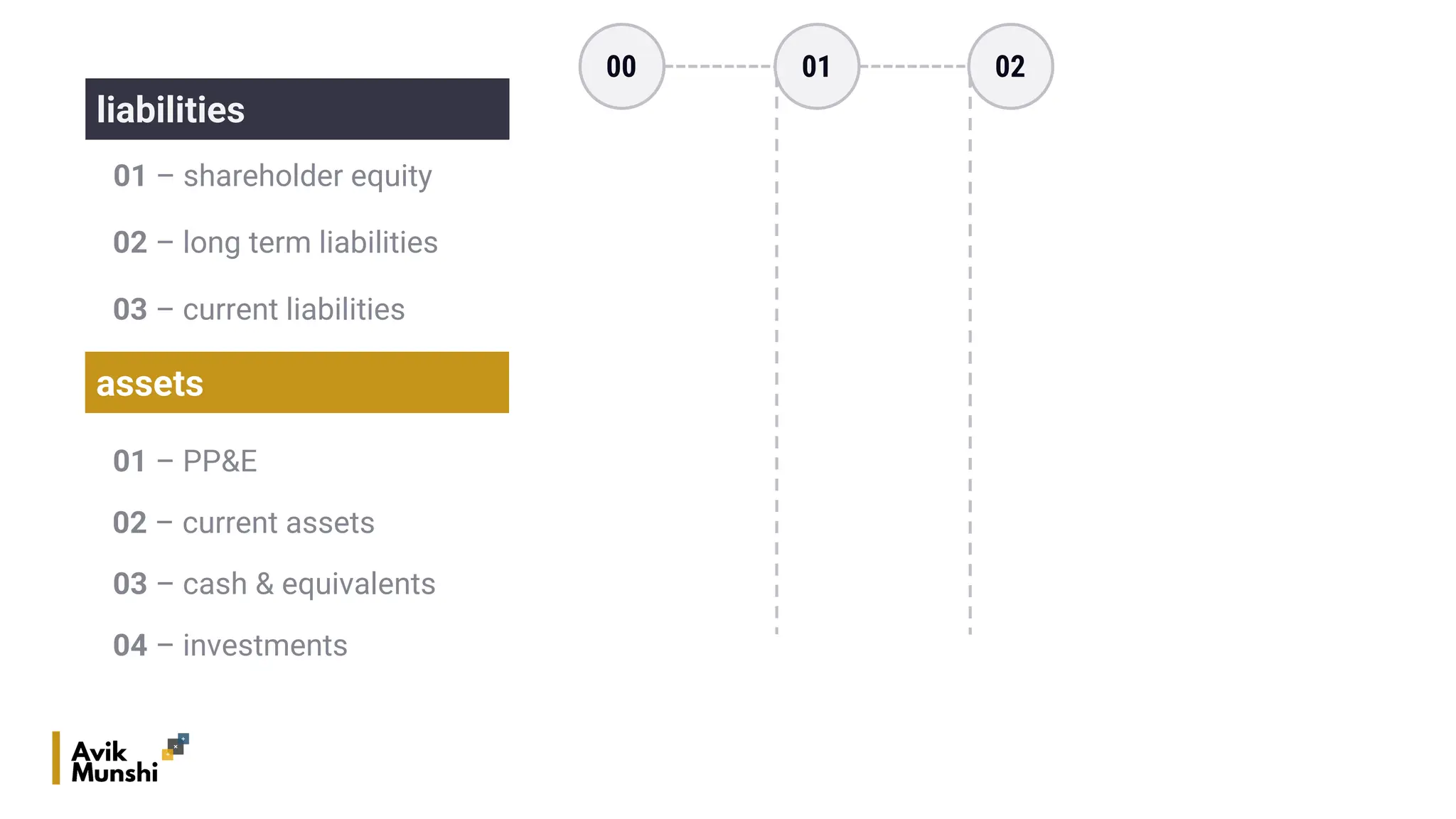
01 – shareholder equity
02 – long term liabilities
liabilities
01 – PP&E
02 – current assets
assets
00 01 02
03 – current liabilities
03 – cash & equivalents
04 – investments
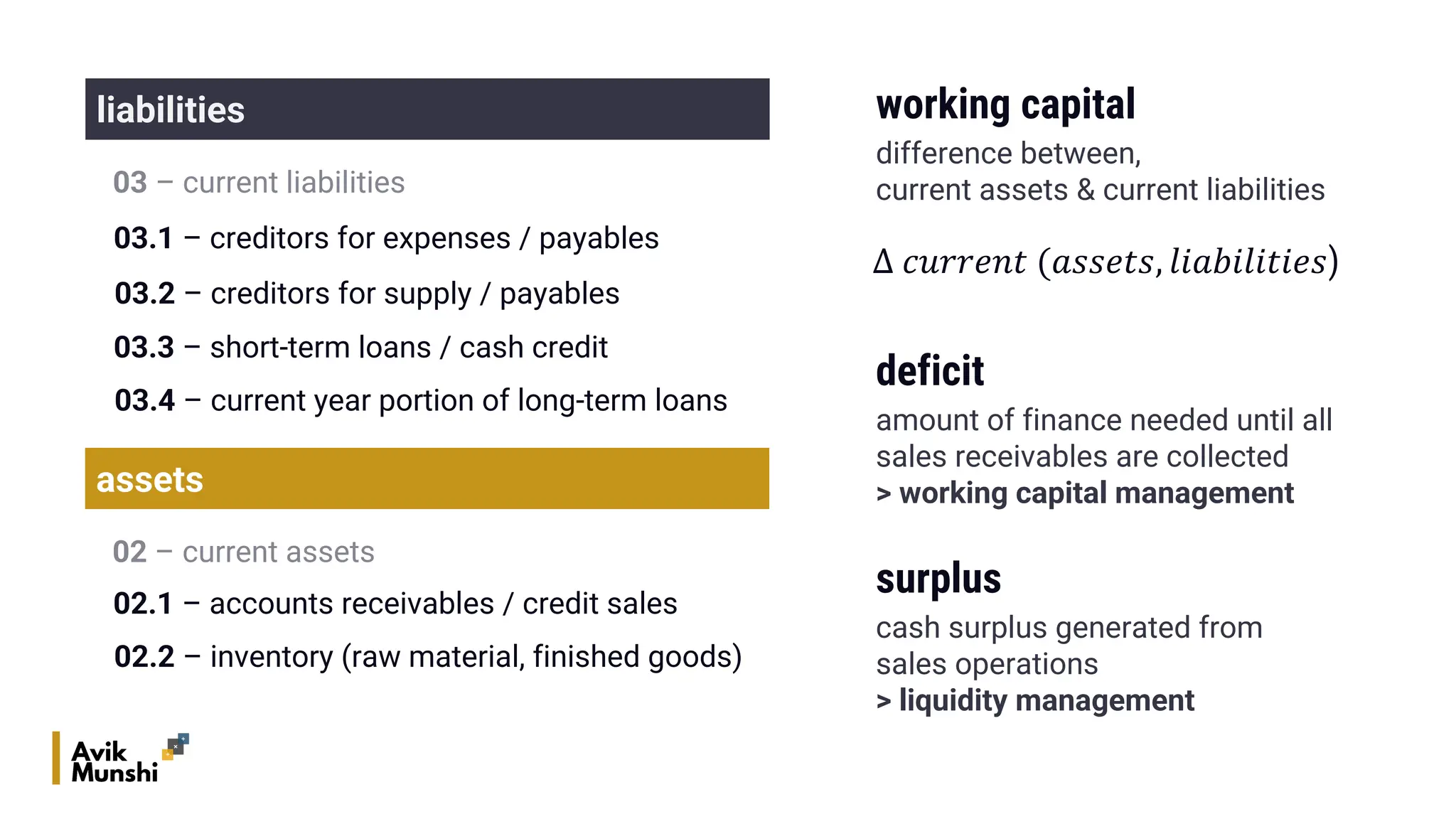
liabilities
02 – current assets
assets
03 – current liabilities
03.1 – creditors for expenses / payables
03.2 – creditors for supply / payables
03.3 – short-term loans / cash credit
03.4 – current year portion of long-term loans
02.1 – accounts receivables / credit sales
02.2 – inventory (raw material, finished goods)
00 01 02
current liabilities to
current assets ratio
accrual accounting
all transactions are not settled in
cash; collections trail sales and
payments trail purchase
business cycle
time required for complete rotation
of one cycle from sales to delivery
followed by cash settlement
constraints
subject to industry practices, market
dynamics, and company policies
liabilities
03 – current liabilities
03.1 – creditors for expenses / payables
03.2 – creditors for supply / payables
03.3 – short-term loans / cash credit
03.4 – current year portion of long-term loans
02 – current assets
assets
02.1 – accounts receivables / credit sales
02.2 – inventory (raw material, finished goods)
working capital
difference between,
current assets & current liabilities
∆ 𝑐𝑢𝑟𝑟𝑒𝑛𝑡 (𝑎𝑠𝑠𝑒𝑡𝑠, 𝑙𝑖𝑎𝑏𝑖𝑙𝑖𝑡𝑖𝑒𝑠)
deficit
amount of finance needed until all
sales receivables are collected
> working capital management
surplus
cash surplus generated from
sales operations
> liquidity management
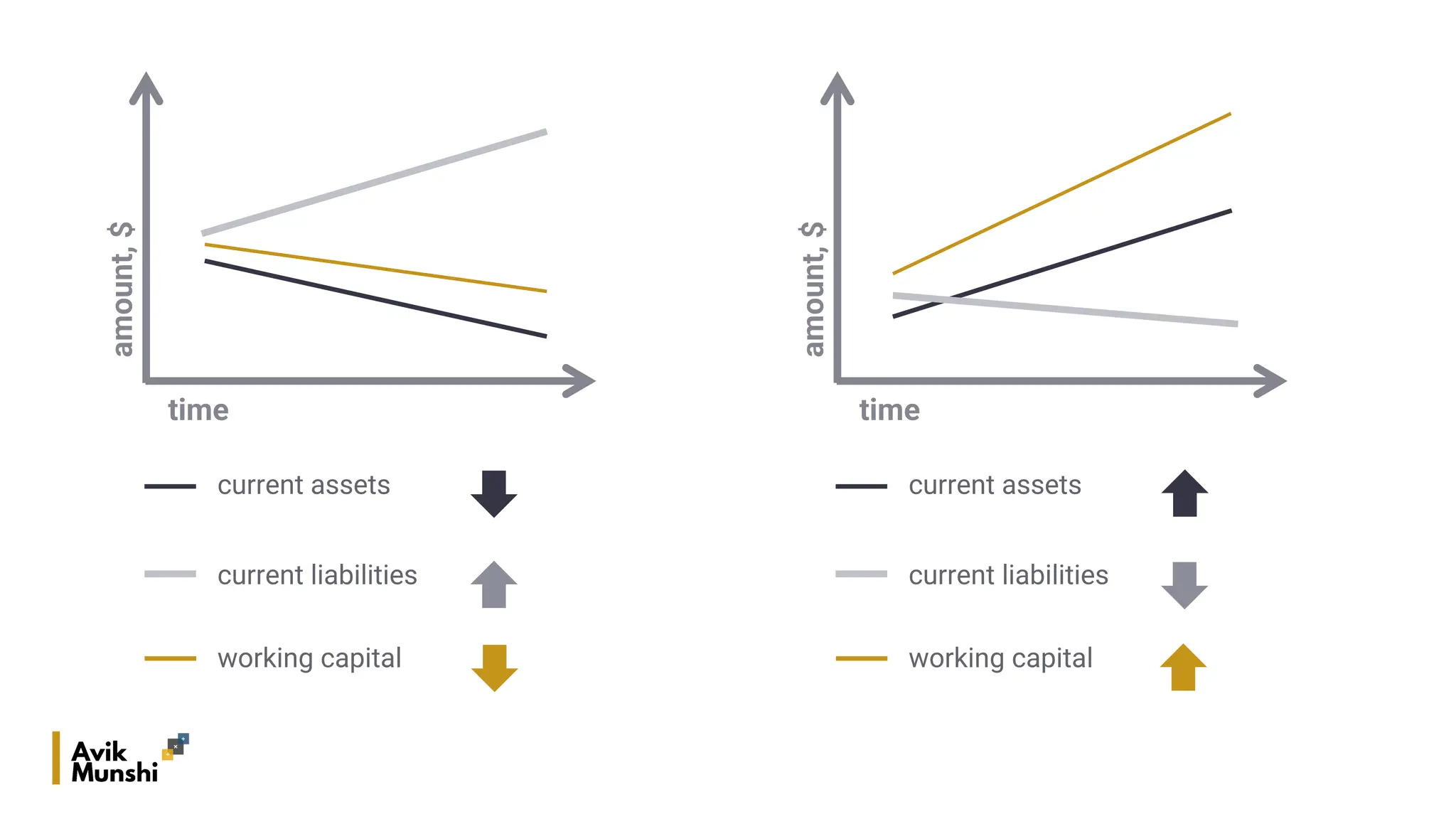
amount,
$
time
working capital
current assets
current liabilities
amount,
$
time
working capital
current assets
current liabilities
amount,
$
time
working capital
current assets
current liabilities
amount,
$
time
working capital
current assets
current liabilities
new
courses
business essentials
all fundamentals that you need to know about business along with
an interesting section on evolution of business.
product costing and pricing
calculating product cost with fundamental understanding of
business and various pricing strategies!
plan your business
introductory course about the business landscape and method to fill
up the business canvas.
business cycle
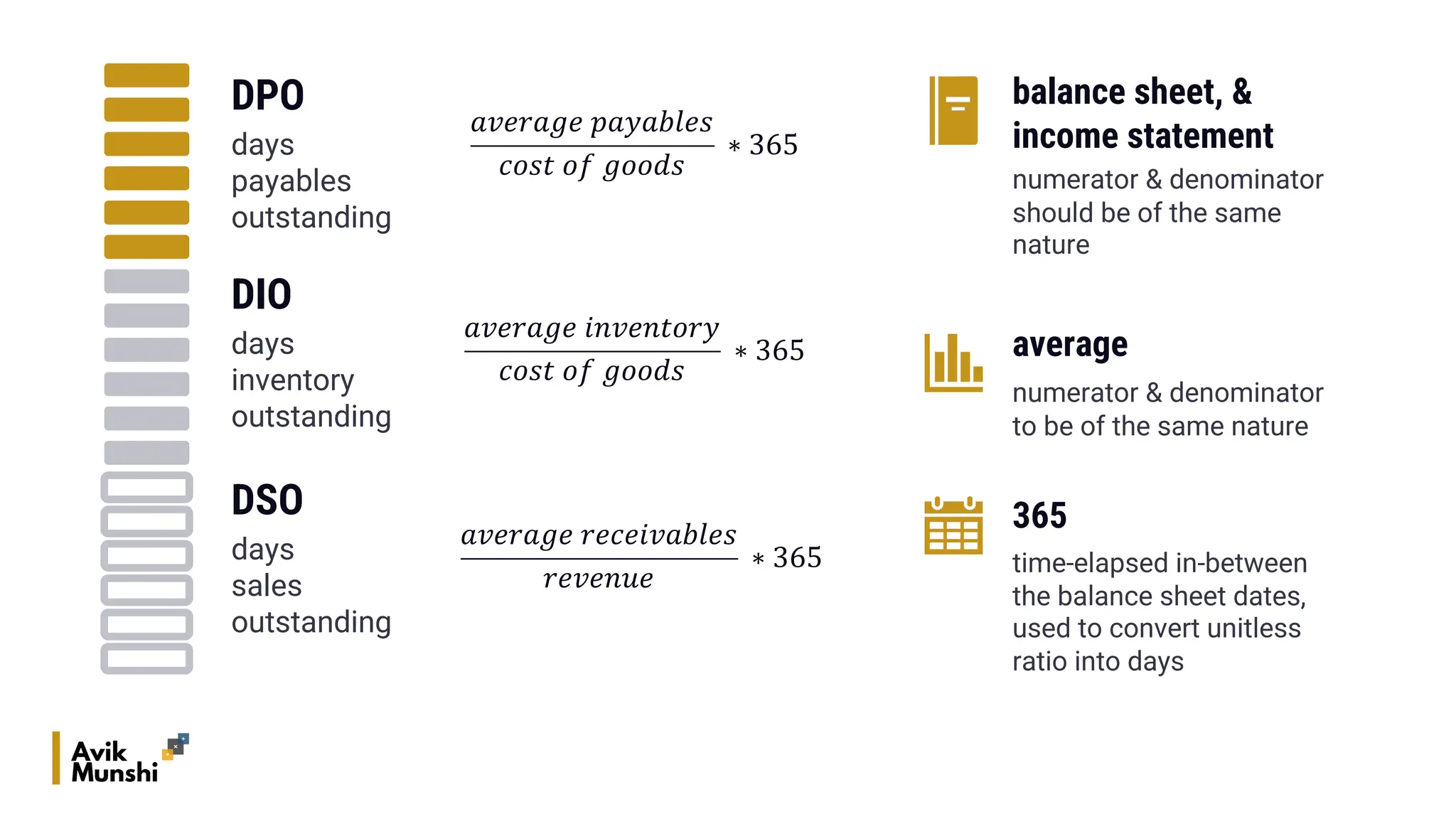
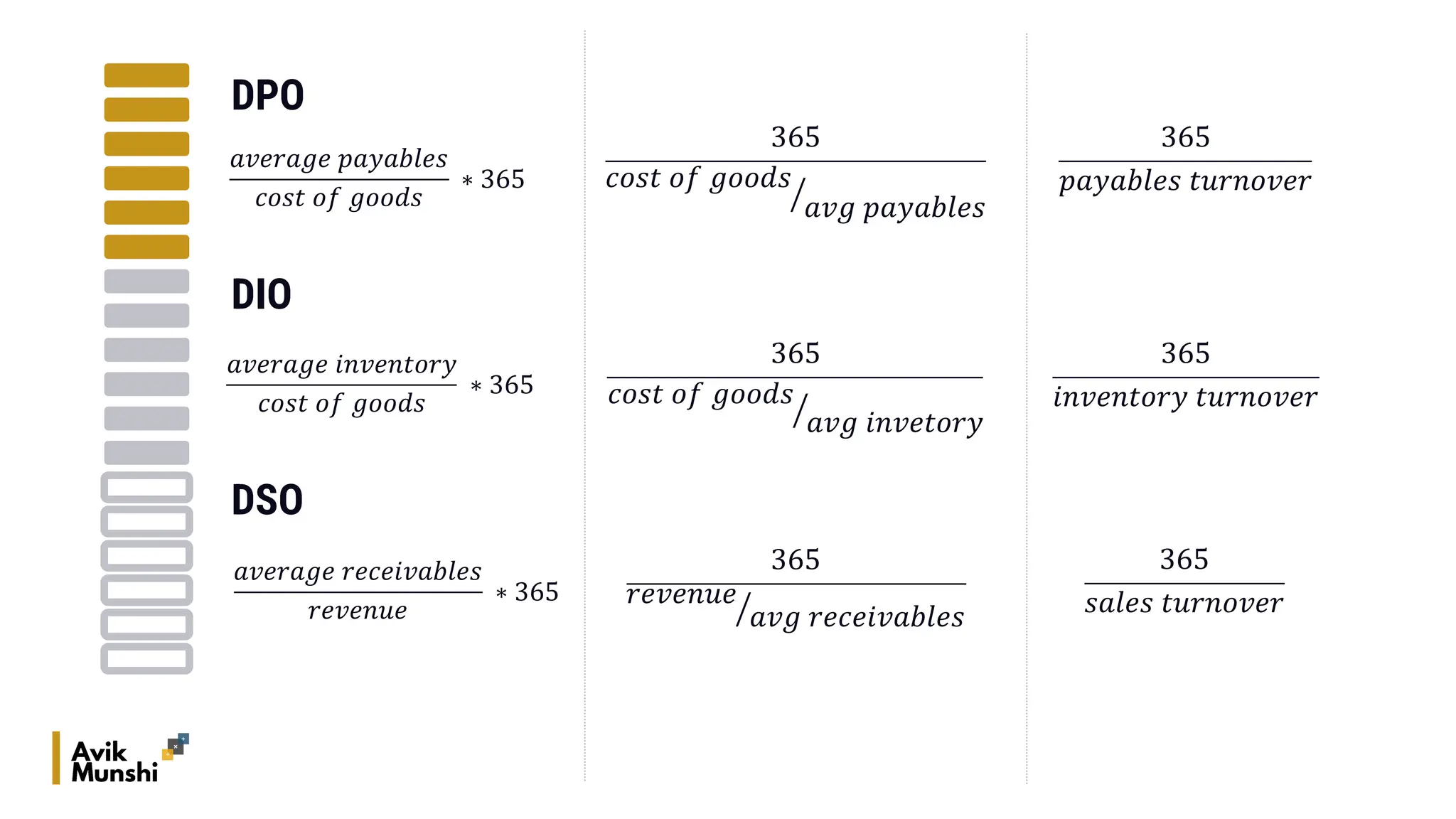
DPO
days
payables
outstanding
DIO
days
inventory
outstanding
DSO
days
sales
outstanding
𝑎𝑣𝑒𝑟𝑎𝑔𝑒 𝑟𝑒𝑐𝑒𝑖𝑣𝑎𝑏𝑙𝑒𝑠
𝑟𝑒𝑣𝑒𝑛𝑢𝑒
∗ 365
𝑎𝑣𝑒𝑟𝑎𝑔𝑒 𝑖𝑛𝑣𝑒𝑛𝑡𝑜𝑟𝑦
𝑐𝑜𝑠𝑡 𝑜𝑓 𝑔𝑜𝑜𝑑𝑠
∗ 365
𝑎𝑣𝑒𝑟𝑎𝑔𝑒 𝑝𝑎𝑦𝑎𝑏𝑙𝑒𝑠
𝑐𝑜𝑠𝑡 𝑜𝑓 𝑔𝑜𝑜𝑑𝑠
∗ 365
average
numerator & denominator
to be of the same nature
balance sheet, &
income statement
numerator & denominator
should be of the same
nature
365
time-elapsed in-between
the balance sheet dates,
used to convert unitless
ratio into days
DSO DIO DPO
+ -
business cycle
# days for which working capital
finance is required ensure
business as usual
zero inventory
in JIT, inventory is consumed in
little or no time, eliminating book
inventory, thus reducing exposure
DSO - DPO balance
ü credit sale - credit purchase
ü advance sale – cash purchase
o advance sale – credit purchase?
industry average
benchmark industry leaders and
compare with industry average
cash conversion cycle
# days required to convert the
invested working capital into
cash proceeds from sales
DPO
DIO
DSO
𝑎𝑣𝑒𝑟𝑎𝑔𝑒 𝑟𝑒𝑐𝑒𝑖𝑣𝑎𝑏𝑙𝑒𝑠
𝑟𝑒𝑣𝑒𝑛𝑢𝑒
∗ 365
𝑎𝑣𝑒𝑟𝑎𝑔𝑒 𝑖𝑛𝑣𝑒𝑛𝑡𝑜𝑟𝑦
𝑐𝑜𝑠𝑡 𝑜𝑓 𝑔𝑜𝑜𝑑𝑠
∗ 365
𝑎𝑣𝑒𝑟𝑎𝑔𝑒 𝑝𝑎𝑦𝑎𝑏𝑙𝑒𝑠
𝑐𝑜𝑠𝑡 𝑜𝑓 𝑔𝑜𝑜𝑑𝑠
∗ 365 * 365
* 365
* 365
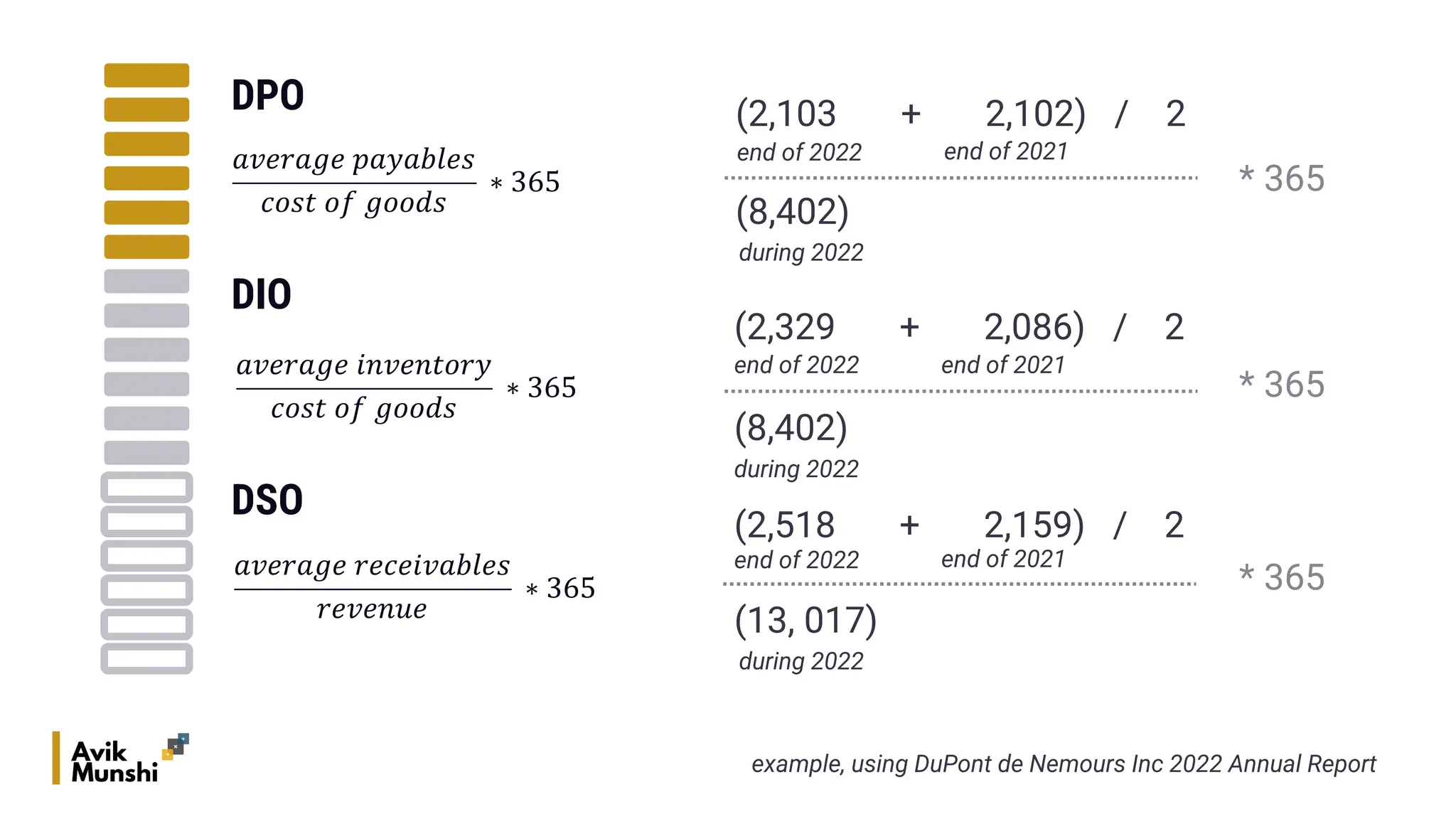
(8,402)
(2,103 + 2,102) / 2
end of 2022 end of 2021
during 2022
(8,402)
(2,329 + 2,086) / 2
end of 2022 end of 2021
during 2022
(13, 017)
(2,518 + 2,159) / 2
end of 2022 end of 2021
during 2022
example, using DuPont de Nemours Inc 2022 Annual Report
DPO
DIO
DSO
* 365
(8,402)
(2,103 + 2,102) / 2
end of 2022 end of 2021
during 2022
* 365
(8,402)
(2,329 + 2,086) / 2
end of 2022 end of 2021
during 2022
* 365
(13, 017)
(2,518 + 2,159) / 2
end of 2022 end of 2021
during 2022
= 91 days
= 96 days
= 65 days
example, using DuPont de Nemours Inc 2022 Annual Report
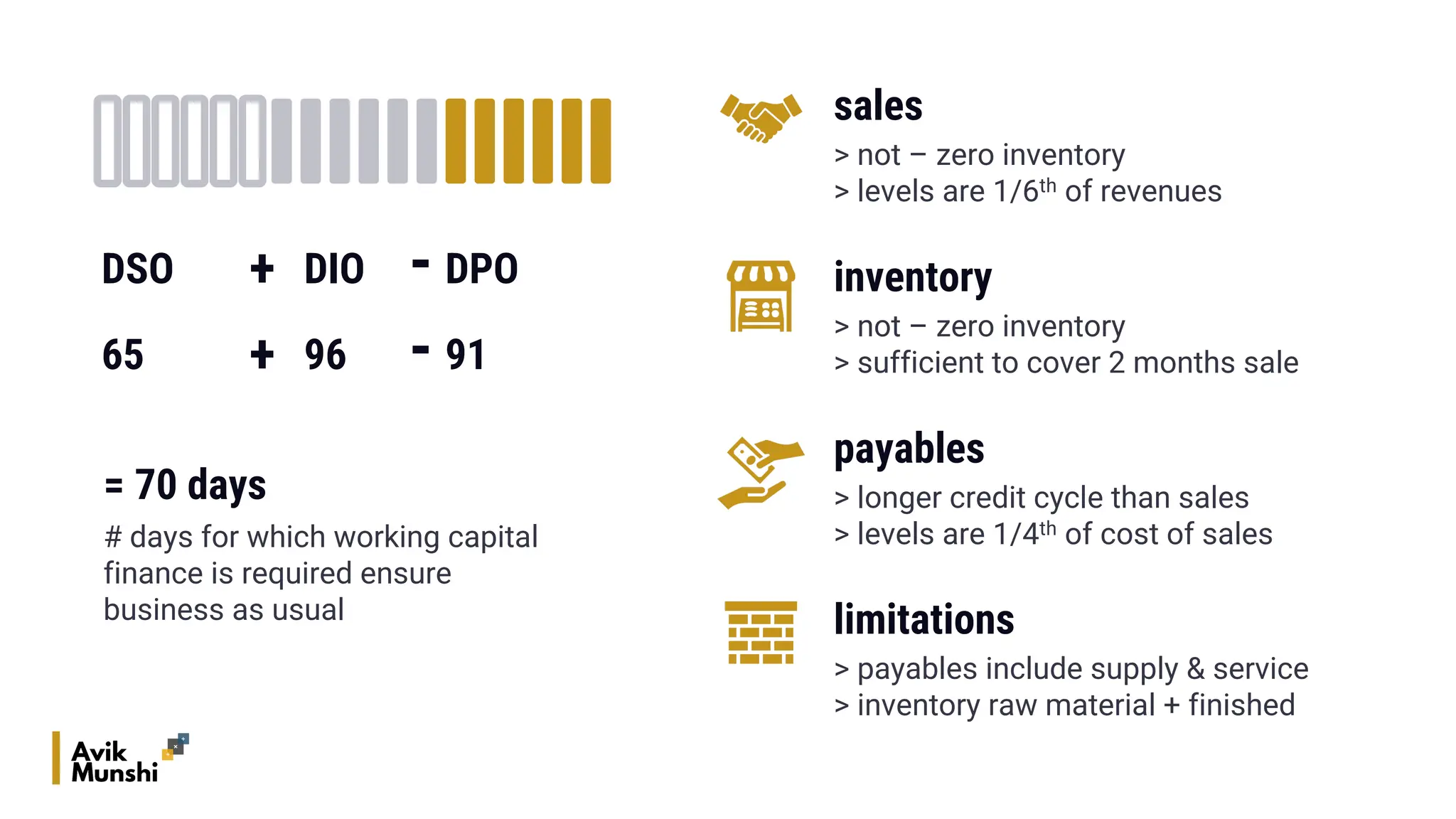
DSO DIO DPO
+ -
= 70 days
# days for which working capital
finance is required ensure
business as usual
inventory
> not – zero inventory
> sufficient to cover 2 months sale
65 96 91
+ -
payables
> longer credit cycle than sales
> levels are 1/4th of cost of sales
sales
> not – zero inventory
> levels are 1/6th of revenues
limitations
> payables include supply & service
> inventory raw material + finished
new
courses
business essentials
all fundamentals that you need to know about business along with
an interesting section on evolution of business.
product costing and pricing
calculating product cost with fundamental understanding of
business and various pricing strategies!
plan your business
introductory course about the business landscape and method to fill
up the business canvas.
the balancing act
DPO
DIO
DSO
𝑎𝑣𝑒𝑟𝑎𝑔𝑒 𝑟𝑒𝑐𝑒𝑖𝑣𝑎𝑏𝑙𝑒𝑠
𝑟𝑒𝑣𝑒𝑛𝑢𝑒
∗ 365
𝑎𝑣𝑒𝑟𝑎𝑔𝑒 𝑖𝑛𝑣𝑒𝑛𝑡𝑜𝑟𝑦
𝑐𝑜𝑠𝑡 𝑜𝑓 𝑔𝑜𝑜𝑑𝑠
∗ 365
𝑎𝑣𝑒𝑟𝑎𝑔𝑒 𝑝𝑎𝑦𝑎𝑏𝑙𝑒𝑠
𝑐𝑜𝑠𝑡 𝑜𝑓 𝑔𝑜𝑜𝑑𝑠
∗ 365
365
7
𝑐𝑜𝑠𝑡 𝑜𝑓 𝑔𝑜𝑜𝑑𝑠
𝑎𝑣𝑔 𝑝𝑎𝑦𝑎𝑏𝑙𝑒𝑠
365
𝑝𝑎𝑦𝑎𝑏𝑙𝑒𝑠 𝑡𝑢𝑟𝑛𝑜𝑣𝑒𝑟
365
7
𝑐𝑜𝑠𝑡 𝑜𝑓 𝑔𝑜𝑜𝑑𝑠
𝑎𝑣𝑔 𝑖𝑛𝑣𝑒𝑡𝑜𝑟𝑦
365
𝑖𝑛𝑣𝑒𝑛𝑡𝑜𝑟𝑦 𝑡𝑢𝑟𝑛𝑜𝑣𝑒𝑟
365
7
𝑟𝑒𝑣𝑒𝑛𝑢𝑒
𝑎𝑣𝑔 𝑟𝑒𝑐𝑒𝑖𝑣𝑎𝑏𝑙𝑒𝑠
365
𝑠𝑎𝑙𝑒𝑠 𝑡𝑢𝑟𝑛𝑜𝑣𝑒𝑟
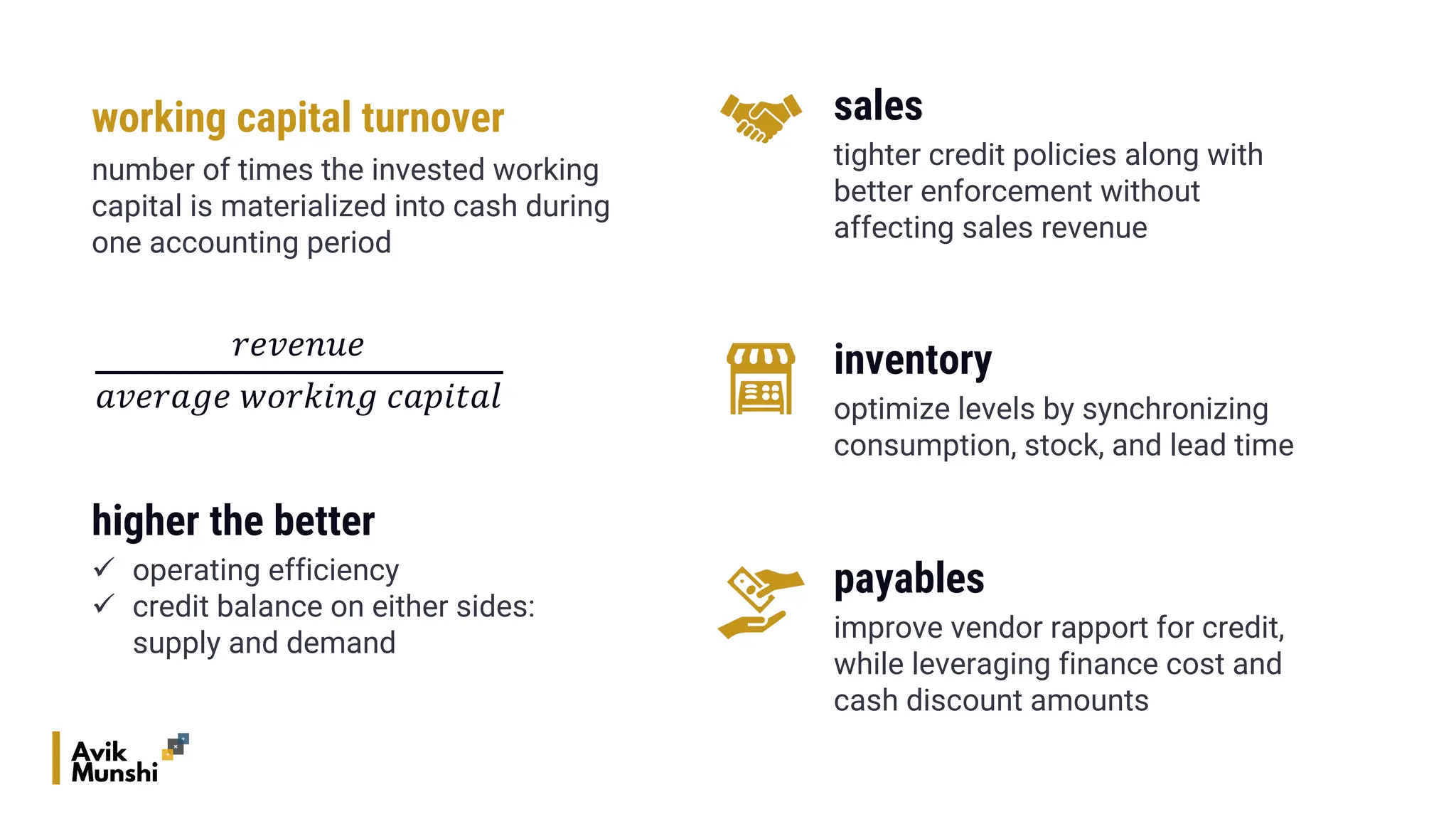
𝑟𝑒𝑣𝑒𝑛𝑢𝑒
𝑎𝑣𝑒𝑟𝑎𝑔𝑒 𝑤𝑜𝑟𝑘𝑖𝑛𝑔 𝑐𝑎𝑝𝑖𝑡𝑎𝑙
working capital turnover
number of times the invested working
capital is materialized into cash during
one accounting period
inventory
optimize levels by synchronizing
consumption, stock, and lead time
payables
improve vendor rapport for credit,
while leveraging finance cost and
cash discount amounts
sales
tighter credit policies along with
better enforcement without
affecting sales revenue
higher the better
ü operating efficiency
ü credit balance on either sides:
supply and demand
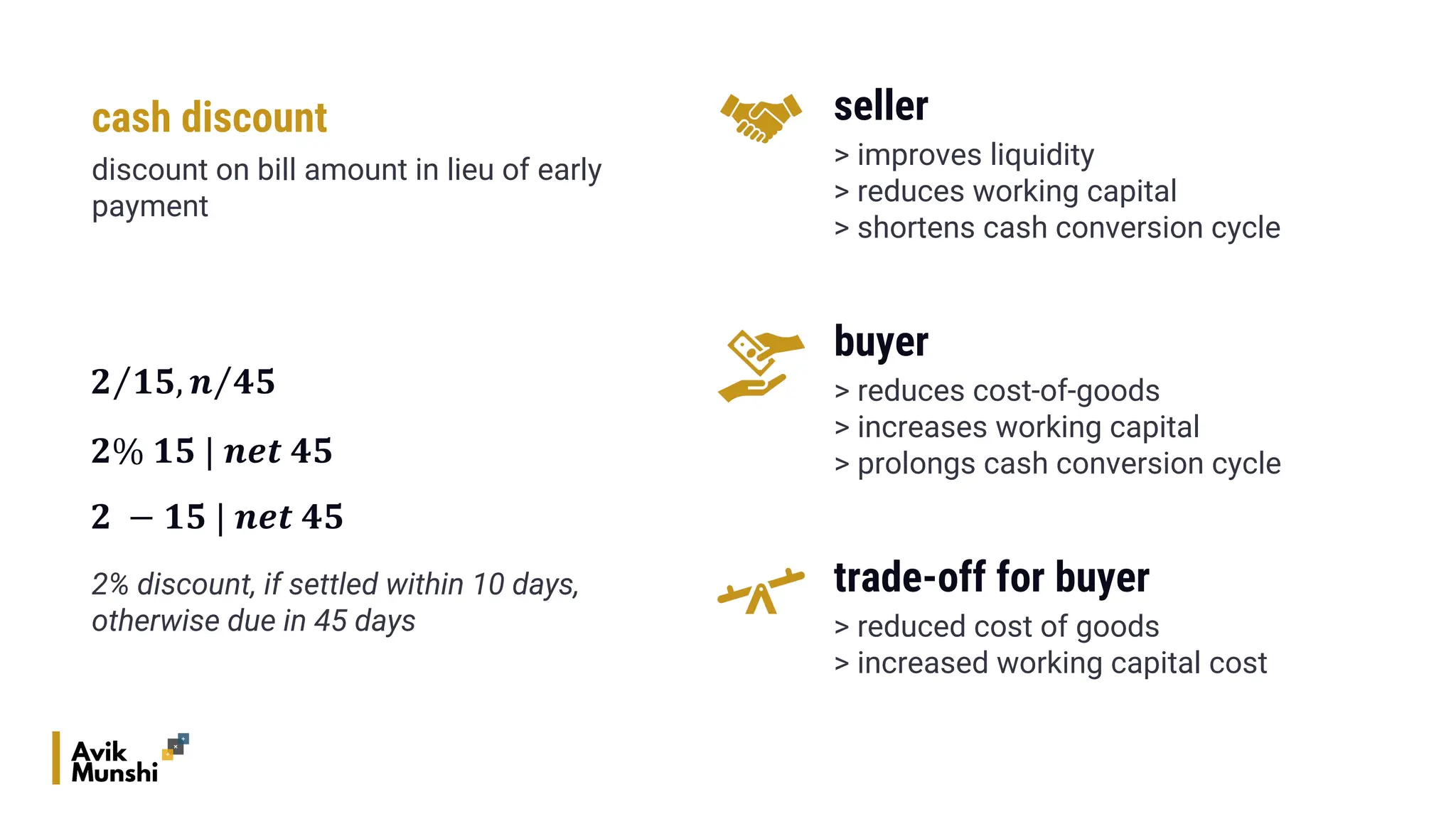
cash discount
discount on bill amount in lieu of early
payment
buyer
> reduces cost-of-goods
> increases working capital
> prolongs cash conversion cycle
seller
> improves liquidity
> reduces working capital
> shortens cash conversion cycle
trade-off for buyer
> reduced cost of goods
> increased working capital cost
𝟐% 𝟏𝟓 | 𝒏𝒆𝒕 𝟒𝟓
𝟐 − 𝟏𝟓 | 𝒏𝒆𝒕 𝟒𝟓
2% discount, if settled within 10 days,
otherwise due in 45 days
⁄
𝟐 𝟏𝟓, ⁄
𝒏 𝟒𝟓
trade-off
using cash to settle vs
using cash for other purposes
𝑑𝑖𝑠𝑐𝑜𝑢𝑛𝑡 %
100% − 𝑑𝑖𝑠𝑐𝑜𝑢𝑛𝑡 %
𝑐𝑎𝑙𝑒𝑛𝑑𝑎𝑟 𝑑𝑎𝑦𝑠
𝑓𝑢𝑙𝑙 𝑠𝑒𝑡𝑡𝑙𝑒𝑚𝑒𝑛𝑡 𝑑𝑎𝑦𝑠 − 𝑑𝑖𝑠𝑐𝑜𝑢𝑛𝑡 𝑑𝑎𝑦𝑠
*
effective savings
quantifying the %discount in %
of interest per annum
2 %
100% − 2 %
365
45 − 15
*
= 0.02 * 12.17 = 0.2434 or 24.34%
litmus test
which interest rate is greater?
24% savings > 18% loan interest
new
courses
business essentials
all fundamentals that you need to know about business along with
an interesting section on evolution of business.
product costing and pricing
calculating product cost with fundamental understanding of
business and various pricing strategies!
plan your business
introductory course about the business landscape and method to fill
up the business canvas.

Procurement Finance

  • 1.
  • 2.
  • 3.
    01 – shareholderequity 02 – long term liabilities liabilities 01 – PP&E 02 – current assets assets 00 01 02 03 – current liabilities 03 – cash & equivalents 04 – investments
  • 4.
    liabilities 02 – currentassets assets 03 – current liabilities 03.1 – creditors for expenses / payables 03.2 – creditors for supply / payables 03.3 – short-term loans / cash credit 03.4 – current year portion of long-term loans 02.1 – accounts receivables / credit sales 02.2 – inventory (raw material, finished goods) 00 01 02
  • 5.
    current liabilities to currentassets ratio accrual accounting all transactions are not settled in cash; collections trail sales and payments trail purchase business cycle time required for complete rotation of one cycle from sales to delivery followed by cash settlement constraints subject to industry practices, market dynamics, and company policies
  • 6.
    liabilities 03 – currentliabilities 03.1 – creditors for expenses / payables 03.2 – creditors for supply / payables 03.3 – short-term loans / cash credit 03.4 – current year portion of long-term loans 02 – current assets assets 02.1 – accounts receivables / credit sales 02.2 – inventory (raw material, finished goods) working capital difference between, current assets & current liabilities ∆ 𝑐𝑢𝑟𝑟𝑒𝑛𝑡 (𝑎𝑠𝑠𝑒𝑡𝑠, 𝑙𝑖𝑎𝑏𝑖𝑙𝑖𝑡𝑖𝑒𝑠) deficit amount of finance needed until all sales receivables are collected > working capital management surplus cash surplus generated from sales operations > liquidity management
  • 7.
    amount, $ time working capital current assets currentliabilities amount, $ time working capital current assets current liabilities
  • 8.
    amount, $ time working capital current assets currentliabilities amount, $ time working capital current assets current liabilities
  • 9.
    new courses business essentials all fundamentalsthat you need to know about business along with an interesting section on evolution of business. product costing and pricing calculating product cost with fundamental understanding of business and various pricing strategies! plan your business introductory course about the business landscape and method to fill up the business canvas.
  • 10.
  • 11.
    DPO days payables outstanding DIO days inventory outstanding DSO days sales outstanding 𝑎𝑣𝑒𝑟𝑎𝑔𝑒 𝑟𝑒𝑐𝑒𝑖𝑣𝑎𝑏𝑙𝑒𝑠 𝑟𝑒𝑣𝑒𝑛𝑢𝑒 ∗ 365 𝑎𝑣𝑒𝑟𝑎𝑔𝑒𝑖𝑛𝑣𝑒𝑛𝑡𝑜𝑟𝑦 𝑐𝑜𝑠𝑡 𝑜𝑓 𝑔𝑜𝑜𝑑𝑠 ∗ 365 𝑎𝑣𝑒𝑟𝑎𝑔𝑒 𝑝𝑎𝑦𝑎𝑏𝑙𝑒𝑠 𝑐𝑜𝑠𝑡 𝑜𝑓 𝑔𝑜𝑜𝑑𝑠 ∗ 365 average numerator & denominator to be of the same nature balance sheet, & income statement numerator & denominator should be of the same nature 365 time-elapsed in-between the balance sheet dates, used to convert unitless ratio into days
  • 12.
    DSO DIO DPO +- business cycle # days for which working capital finance is required ensure business as usual zero inventory in JIT, inventory is consumed in little or no time, eliminating book inventory, thus reducing exposure DSO - DPO balance ü credit sale - credit purchase ü advance sale – cash purchase o advance sale – credit purchase? industry average benchmark industry leaders and compare with industry average cash conversion cycle # days required to convert the invested working capital into cash proceeds from sales
  • 13.
    DPO DIO DSO 𝑎𝑣𝑒𝑟𝑎𝑔𝑒 𝑟𝑒𝑐𝑒𝑖𝑣𝑎𝑏𝑙𝑒𝑠 𝑟𝑒𝑣𝑒𝑛𝑢𝑒 ∗ 365 𝑎𝑣𝑒𝑟𝑎𝑔𝑒𝑖𝑛𝑣𝑒𝑛𝑡𝑜𝑟𝑦 𝑐𝑜𝑠𝑡 𝑜𝑓 𝑔𝑜𝑜𝑑𝑠 ∗ 365 𝑎𝑣𝑒𝑟𝑎𝑔𝑒 𝑝𝑎𝑦𝑎𝑏𝑙𝑒𝑠 𝑐𝑜𝑠𝑡 𝑜𝑓 𝑔𝑜𝑜𝑑𝑠 ∗ 365 * 365 * 365 * 365 (8,402) (2,103 + 2,102) / 2 end of 2022 end of 2021 during 2022 (8,402) (2,329 + 2,086) / 2 end of 2022 end of 2021 during 2022 (13, 017) (2,518 + 2,159) / 2 end of 2022 end of 2021 during 2022 example, using DuPont de Nemours Inc 2022 Annual Report
  • 14.
    DPO DIO DSO * 365 (8,402) (2,103 +2,102) / 2 end of 2022 end of 2021 during 2022 * 365 (8,402) (2,329 + 2,086) / 2 end of 2022 end of 2021 during 2022 * 365 (13, 017) (2,518 + 2,159) / 2 end of 2022 end of 2021 during 2022 = 91 days = 96 days = 65 days example, using DuPont de Nemours Inc 2022 Annual Report
  • 15.
    DSO DIO DPO +- = 70 days # days for which working capital finance is required ensure business as usual inventory > not – zero inventory > sufficient to cover 2 months sale 65 96 91 + - payables > longer credit cycle than sales > levels are 1/4th of cost of sales sales > not – zero inventory > levels are 1/6th of revenues limitations > payables include supply & service > inventory raw material + finished
  • 16.
    new courses business essentials all fundamentalsthat you need to know about business along with an interesting section on evolution of business. product costing and pricing calculating product cost with fundamental understanding of business and various pricing strategies! plan your business introductory course about the business landscape and method to fill up the business canvas.
  • 17.
  • 18.
    DPO DIO DSO 𝑎𝑣𝑒𝑟𝑎𝑔𝑒 𝑟𝑒𝑐𝑒𝑖𝑣𝑎𝑏𝑙𝑒𝑠 𝑟𝑒𝑣𝑒𝑛𝑢𝑒 ∗ 365 𝑎𝑣𝑒𝑟𝑎𝑔𝑒𝑖𝑛𝑣𝑒𝑛𝑡𝑜𝑟𝑦 𝑐𝑜𝑠𝑡 𝑜𝑓 𝑔𝑜𝑜𝑑𝑠 ∗ 365 𝑎𝑣𝑒𝑟𝑎𝑔𝑒 𝑝𝑎𝑦𝑎𝑏𝑙𝑒𝑠 𝑐𝑜𝑠𝑡 𝑜𝑓 𝑔𝑜𝑜𝑑𝑠 ∗ 365 365 7 𝑐𝑜𝑠𝑡 𝑜𝑓 𝑔𝑜𝑜𝑑𝑠 𝑎𝑣𝑔 𝑝𝑎𝑦𝑎𝑏𝑙𝑒𝑠 365 𝑝𝑎𝑦𝑎𝑏𝑙𝑒𝑠 𝑡𝑢𝑟𝑛𝑜𝑣𝑒𝑟 365 7 𝑐𝑜𝑠𝑡 𝑜𝑓 𝑔𝑜𝑜𝑑𝑠 𝑎𝑣𝑔 𝑖𝑛𝑣𝑒𝑡𝑜𝑟𝑦 365 𝑖𝑛𝑣𝑒𝑛𝑡𝑜𝑟𝑦 𝑡𝑢𝑟𝑛𝑜𝑣𝑒𝑟 365 7 𝑟𝑒𝑣𝑒𝑛𝑢𝑒 𝑎𝑣𝑔 𝑟𝑒𝑐𝑒𝑖𝑣𝑎𝑏𝑙𝑒𝑠 365 𝑠𝑎𝑙𝑒𝑠 𝑡𝑢𝑟𝑛𝑜𝑣𝑒𝑟
  • 19.
    𝑟𝑒𝑣𝑒𝑛𝑢𝑒 𝑎𝑣𝑒𝑟𝑎𝑔𝑒 𝑤𝑜𝑟𝑘𝑖𝑛𝑔 𝑐𝑎𝑝𝑖𝑡𝑎𝑙 workingcapital turnover number of times the invested working capital is materialized into cash during one accounting period inventory optimize levels by synchronizing consumption, stock, and lead time payables improve vendor rapport for credit, while leveraging finance cost and cash discount amounts sales tighter credit policies along with better enforcement without affecting sales revenue higher the better ü operating efficiency ü credit balance on either sides: supply and demand
  • 20.
    cash discount discount onbill amount in lieu of early payment buyer > reduces cost-of-goods > increases working capital > prolongs cash conversion cycle seller > improves liquidity > reduces working capital > shortens cash conversion cycle trade-off for buyer > reduced cost of goods > increased working capital cost 𝟐% 𝟏𝟓 | 𝒏𝒆𝒕 𝟒𝟓 𝟐 − 𝟏𝟓 | 𝒏𝒆𝒕 𝟒𝟓 2% discount, if settled within 10 days, otherwise due in 45 days ⁄ 𝟐 𝟏𝟓, ⁄ 𝒏 𝟒𝟓
  • 21.
    trade-off using cash tosettle vs using cash for other purposes 𝑑𝑖𝑠𝑐𝑜𝑢𝑛𝑡 % 100% − 𝑑𝑖𝑠𝑐𝑜𝑢𝑛𝑡 % 𝑐𝑎𝑙𝑒𝑛𝑑𝑎𝑟 𝑑𝑎𝑦𝑠 𝑓𝑢𝑙𝑙 𝑠𝑒𝑡𝑡𝑙𝑒𝑚𝑒𝑛𝑡 𝑑𝑎𝑦𝑠 − 𝑑𝑖𝑠𝑐𝑜𝑢𝑛𝑡 𝑑𝑎𝑦𝑠 * effective savings quantifying the %discount in % of interest per annum 2 % 100% − 2 % 365 45 − 15 * = 0.02 * 12.17 = 0.2434 or 24.34% litmus test which interest rate is greater? 24% savings > 18% loan interest
  • 22.
    new courses business essentials all fundamentalsthat you need to know about business along with an interesting section on evolution of business. product costing and pricing calculating product cost with fundamental understanding of business and various pricing strategies! plan your business introductory course about the business landscape and method to fill up the business canvas.