
INPUT OUTPUT PROCESS
(PROCUREMENT )
Delivered By:
ABDUL FAHIM
BEM/15505
COMPANY INTRODUCTION:
• INTRODUCTION
• Nawan Laboratories (Pvt.) Ltd. Pakistan is a quality
conscious Human & Veterinary pharmaceutical
manufacturer located in Karachi, Pakistan since 1994.
Nawan possesses the expertise, knowledge and technical
know-how to produce and market pharmaceutical
products. Under the modern manufacturing facility, our
experienced and dedicated pharmacists, chemists,
microbiologists, biotechnologists, biochemists & quality
control assurance managers and other skilled personnel
strictly control all processes & ensure quality outcome of
the product.
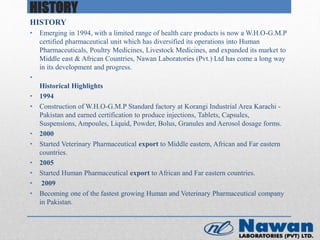
HISTORY
HISTORY
• Emerging in 1994, with a limited range of health care products is now a W.H.O-G.M.P
certified pharmaceutical unit which has diversified its operations into Human
Pharmaceuticals, Poultry Medicines, Livestock Medicines, and expanded its market to
Middle east & African Countries, Nawan Laboratories (Pvt.) Ltd has come a long way
in its development and progress.
•
Historical Highlights
• 1994
• Construction of W.H.O-G.M.P Standard factory at Korangi Industrial Area Karachi -
Pakistan and earned certification to produce injections, Tablets, Capsules,
Suspensions, Ampoules, Liquid, Powder, Bolus, Granules and Aerosol dosage forms.
• 2000
• Started Veterinary Pharmaceutical export to Middle eastern, African and Far eastern
countries.
• 2005
• Started Human Pharmaceutical export to African and Far eastern countries.
• 2009
• Becoming one of the fastest growing Human and Veterinary Pharmaceutical company
in Pakistan.
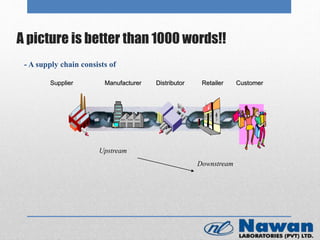
A picture is better than 1000 words!!
- A supply chain consists of
Supplier Manufacturer Distributor Retailer Customer
Upstream
Downstream
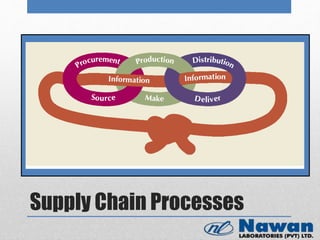
Supply Chain Processes
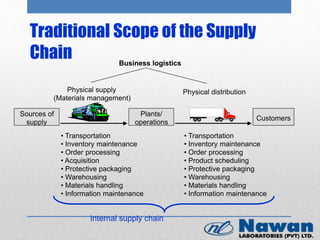
Physical distributionPhysical supply
(Materials management)
Business logistics
Sources of
supply
Plants/
operations
Customers
• Transportation
• Inventory maintenance
• Order processing
• Acquisition
• Protective packaging
• Warehousing
• Materials handling
• Information maintenance
• Transportation
• Inventory maintenance
• Order processing
• Product scheduling
• Protective packaging
• Warehousing
• Materials handling
• Information maintenance
Internal supply chain
Traditional Scope of the Supply
Chain
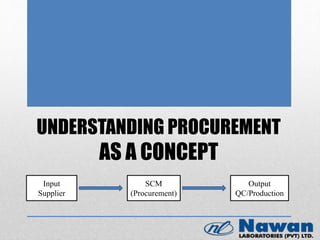
UNDERSTANDING PROCUREMENT
AS A CONCEPT
Input
Supplier
SCM
(Procurement)
Output
QC/Production
SOP (Standard Operating Procedure)
• Procurement steps
• Procurement life cycle in modern businesses usually
consists of 7 steps:
1. Identification of need:
2. Supplier Identification:
3. Supplier Communication:
4. Negotiation:
5. Purchase Orders:
6. Logistics Management: expediting, shipment, delivery
7. Payment:
Purchase Order Contents
1. Total Amount
2. Delivery Date and Terms
3. Payment Terms
4. Bank Guarantees
5. Currency Fluctuation or Exchange Rates
6. Packaging Terms
7. Inspection and Quality
8. Taxes
9. Insurance
10. Warranty Terms
11. Documentation
12. PO Acceptance
13. General Terms and Conditions
Letterhead PO#
Vendor
Ref#
Quote
Ref#
Order
Date
Delivery
Address
Vendor Selection
 Vendor evaluation
 Critical decision
 Find potential vendors
 Determine the likelihood of them becoming
good suppliers
 Vendor Development
 Training
 Establish policies and procedures
Vendor Selection
 Negotiations
 Cost-Based Price Model - supplier opens
books to purchaser
 Market-Based Price Model - price based on
published, auction, or indexed price
Supply Chain Strategies
 Negotiating with many suppliers
 Long-term partnering with few
suppliers
 Just In Time
SUGGESTIONS
Many Suppliers
 Purchasing is typically based on
price
 Suppliers compete with one another
 Supplier is responsible for
technology, expertise, forecasting,
cost, quality, and delivery
Few Suppliers
 Buyer forms longer term relationships with
fewer suppliers
 Create value through economies of scale
and learning curve improvements
 Suppliers more willing to participate in JIT
programs and contribute design and
technological expertise
 Cost of changing suppliers is huge impact
Just In Time (JIT)
 “the right material, at the right time, at the right
place, and in the exact amount”, without the
safety net of inventory.
 The philosophy of JIT is simple:
 the storage of unused inventory is a waste of
resources.
 JIT inventory systems expose hidden cost of keeping
inventory.
Presentation on procurement

Presentation on procurement

  • 1.
    INPUT OUTPUT PROCESS (PROCUREMENT) Delivered By: ABDUL FAHIM BEM/15505
  • 2.
    COMPANY INTRODUCTION: • INTRODUCTION •Nawan Laboratories (Pvt.) Ltd. Pakistan is a quality conscious Human & Veterinary pharmaceutical manufacturer located in Karachi, Pakistan since 1994. Nawan possesses the expertise, knowledge and technical know-how to produce and market pharmaceutical products. Under the modern manufacturing facility, our experienced and dedicated pharmacists, chemists, microbiologists, biotechnologists, biochemists & quality control assurance managers and other skilled personnel strictly control all processes & ensure quality outcome of the product.
  • 3.
    HISTORY HISTORY • Emerging in1994, with a limited range of health care products is now a W.H.O-G.M.P certified pharmaceutical unit which has diversified its operations into Human Pharmaceuticals, Poultry Medicines, Livestock Medicines, and expanded its market to Middle east & African Countries, Nawan Laboratories (Pvt.) Ltd has come a long way in its development and progress. • Historical Highlights • 1994 • Construction of W.H.O-G.M.P Standard factory at Korangi Industrial Area Karachi - Pakistan and earned certification to produce injections, Tablets, Capsules, Suspensions, Ampoules, Liquid, Powder, Bolus, Granules and Aerosol dosage forms. • 2000 • Started Veterinary Pharmaceutical export to Middle eastern, African and Far eastern countries. • 2005 • Started Human Pharmaceutical export to African and Far eastern countries. • 2009 • Becoming one of the fastest growing Human and Veterinary Pharmaceutical company in Pakistan.
  • 4.
    A picture isbetter than 1000 words!! - A supply chain consists of Supplier Manufacturer Distributor Retailer Customer Upstream Downstream
  • 5.
  • 6.
    Physical distributionPhysical supply (Materialsmanagement) Business logistics Sources of supply Plants/ operations Customers • Transportation • Inventory maintenance • Order processing • Acquisition • Protective packaging • Warehousing • Materials handling • Information maintenance • Transportation • Inventory maintenance • Order processing • Product scheduling • Protective packaging • Warehousing • Materials handling • Information maintenance Internal supply chain Traditional Scope of the Supply Chain
  • 7.
    UNDERSTANDING PROCUREMENT AS ACONCEPT Input Supplier SCM (Procurement) Output QC/Production
  • 8.
    SOP (Standard OperatingProcedure) • Procurement steps • Procurement life cycle in modern businesses usually consists of 7 steps: 1. Identification of need: 2. Supplier Identification: 3. Supplier Communication: 4. Negotiation: 5. Purchase Orders: 6. Logistics Management: expediting, shipment, delivery 7. Payment:
  • 9.
    Purchase Order Contents 1.Total Amount 2. Delivery Date and Terms 3. Payment Terms 4. Bank Guarantees 5. Currency Fluctuation or Exchange Rates 6. Packaging Terms 7. Inspection and Quality 8. Taxes 9. Insurance 10. Warranty Terms 11. Documentation 12. PO Acceptance 13. General Terms and Conditions Letterhead PO# Vendor Ref# Quote Ref# Order Date Delivery Address
  • 10.
    Vendor Selection  Vendorevaluation  Critical decision  Find potential vendors  Determine the likelihood of them becoming good suppliers  Vendor Development  Training  Establish policies and procedures
  • 11.
    Vendor Selection  Negotiations Cost-Based Price Model - supplier opens books to purchaser  Market-Based Price Model - price based on published, auction, or indexed price
  • 12.
    Supply Chain Strategies Negotiating with many suppliers  Long-term partnering with few suppliers  Just In Time SUGGESTIONS
  • 13.
    Many Suppliers  Purchasingis typically based on price  Suppliers compete with one another  Supplier is responsible for technology, expertise, forecasting, cost, quality, and delivery
  • 14.
    Few Suppliers  Buyerforms longer term relationships with fewer suppliers  Create value through economies of scale and learning curve improvements  Suppliers more willing to participate in JIT programs and contribute design and technological expertise  Cost of changing suppliers is huge impact
  • 15.
    Just In Time(JIT)  “the right material, at the right time, at the right place, and in the exact amount”, without the safety net of inventory.  The philosophy of JIT is simple:  the storage of unused inventory is a waste of resources.  JIT inventory systems expose hidden cost of keeping inventory.