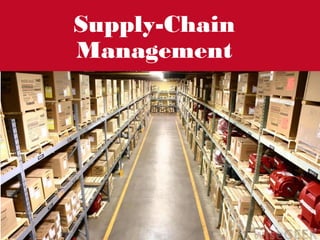
11Supply-Chain
Management
11 - 2
Managing the Supply Chain
Mutual agreement on
goals
Trust
Compatible
organizational cultures
11 - 3
Issues in an Integrated Supply Chain
 Local optimizationLocal optimization - focusing on local
profit or cost minimization based on
limited knowledge
 Incentives (sales incentives, quantityIncentives (sales incentives, quantity
discounts, quotas, and promotions)discounts, quotas, and promotions) -
push merchandise prior to sale
 Large lotsLarge lots - low unit cost but do not
reflect sales
11 - 4
Bullwhip effect - the
increasing fluctuation
in orders that occurs
as orders move
through the supply
chain
Issues that complicate
development of an Integrated
Supply Chain
11 - 5
Opportunities in an Integrated Supply Chain
 Accurate “pull” data
 Lot size reduction
 Single stage control of
replenishment
 Vendor managed inventory (VMI)
 Collaborative planning, forecasting,
and replenishment (CPFR)
 Blanket orders
11 - 6
Opportunities in an Integrated Supply Chain
 Standardization
 Postponement
 Drop shipping and special
packaging
 Pass-through facility
 Channel assembly
11 - 7
E-Procurement
 Uses the internet to facilitate
purchasing
 Electronic ordering and funds
transfer
 Electronic data interchange (EDI)
 Advanced shipping notice
11 - 8
 Online catalogs
1. Catalogs provided by vendors
2. Catalogs published by
intermediaries
3. Exchanges provided by buyers
E-Procurement
11 - 9
E-Procurement
 Auctions
 Maintained by buyers, sellers, or
intermediaries
 Low barriers to entry
 Increase in the potential number of
buyers
 RFQs
 Can make requests for quotes (RFQs)
less costly
 Improves supplier selection
 Real-time inventory tracking
11 - 10
Vendor Selection
 Vendor evaluation
 Critical decision
 Find potential vendors
 Determine the likelihood of them
becoming good suppliers
 Vendor Development
(supply chain as competitive unit)
 Training
 Engineering and production help
 Establish policies and procedures
11 - 11
Vendor Selection
 Negotiations
 Cost-Based Price ModelCost-Based Price Model - supplier
opens books to purchaser
 Market-Based Price ModelMarket-Based Price Model - price
based on published, auction, or
indexed price
 Competitive BiddingCompetitive Bidding - used for
infrequent purchases but may make
establishing long-term relationships
difficult
11 - 12
Logistics Management
 Objective is to obtain efficient
operations through the integration
of all material acquisition,
movement, and storage activities
 Is a frequent candidate for
outsourcing
 Allows competitive advantage to
be gained through reduced costs
and improved customer service
11 - 13
Distribution Systems
 TruckingTrucking
 Moves the vast majority ofMoves the vast majority of
manufactured goodsmanufactured goods
 Chief advantage is flexibilityChief advantage is flexibility
 RailroadsRailroads
 Capable of carrying large loadsCapable of carrying large loads
 Little flexibility thoughLittle flexibility though
containers and piggybackingcontainers and piggybacking
have helped with thishave helped with this
11 - 14
Distribution Systems
 Airfreight
 Fast and flexible for light loads
 May be expensive
 Waterways
 Typically used for bulky, low-value cargo
 Used when shipping cost is more
important than speed
 Pipelines
 Used for transporting oil, gas, and other
chemical products
11 - 15
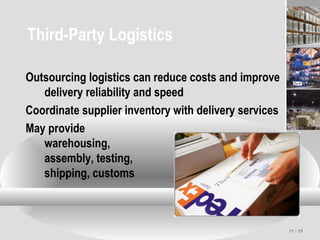
Third-Party Logistics
Outsourcing logistics can reduce costs and improve
delivery reliability and speed
Coordinate supplier inventory with delivery services
May provide
warehousing,
assembly, testing,
shipping, customs
11 - 16
Cost of Shipping Alternatives
 Product in transit is a form of
inventory and has a carrying cost
 Faster shipping is generally more
expensive than slower shipping
 We can evaluate the two costs to
better understand the trade-off
11 - 17
Cost of Shipping Alternatives
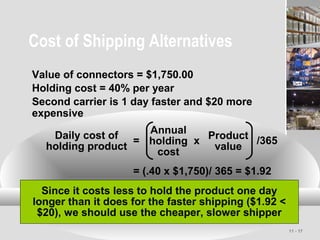
Value of connectors = $1,750.00
Holding cost = 40% per year
Second carrier is 1 day faster and $20 more
expensive
Daily cost of
holding product
= x /365
Annual
holding
cost
Product
value
= (.40 x $1,750)/ 365 = $1.92
Since it costs less to hold the product one day
longer than it does for the faster shipping ($1.92 <
$20), we should use the cheaper, slower shipper
11 - 18
Security and JIT
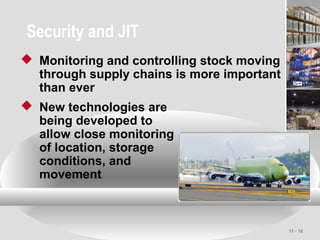
 Monitoring and controlling stock moving
through supply chains is more important
than ever
 New technologies are
being developed to
allow close monitoring
of location, storage
conditions, and
movement
11 - 19
THANK
YOU!
JOY AMOR M. MANO
MBA-1
PHILIPPINE WOMENS UNIVERSITY
S.Y 2014

SUPPLY CHAIN MANAGEMENT

  • 1.
  • 2.
    11 - 2 Managingthe Supply Chain Mutual agreement on goals Trust Compatible organizational cultures
  • 3.
    11 - 3 Issuesin an Integrated Supply Chain  Local optimizationLocal optimization - focusing on local profit or cost minimization based on limited knowledge  Incentives (sales incentives, quantityIncentives (sales incentives, quantity discounts, quotas, and promotions)discounts, quotas, and promotions) - push merchandise prior to sale  Large lotsLarge lots - low unit cost but do not reflect sales
  • 4.
    11 - 4 Bullwhipeffect - the increasing fluctuation in orders that occurs as orders move through the supply chain Issues that complicate development of an Integrated Supply Chain
  • 5.
    11 - 5 Opportunitiesin an Integrated Supply Chain  Accurate “pull” data  Lot size reduction  Single stage control of replenishment  Vendor managed inventory (VMI)  Collaborative planning, forecasting, and replenishment (CPFR)  Blanket orders
  • 6.
    11 - 6 Opportunitiesin an Integrated Supply Chain  Standardization  Postponement  Drop shipping and special packaging  Pass-through facility  Channel assembly
  • 7.
    11 - 7 E-Procurement Uses the internet to facilitate purchasing  Electronic ordering and funds transfer  Electronic data interchange (EDI)  Advanced shipping notice
  • 8.
    11 - 8 Online catalogs 1. Catalogs provided by vendors 2. Catalogs published by intermediaries 3. Exchanges provided by buyers E-Procurement
  • 9.
    11 - 9 E-Procurement Auctions  Maintained by buyers, sellers, or intermediaries  Low barriers to entry  Increase in the potential number of buyers  RFQs  Can make requests for quotes (RFQs) less costly  Improves supplier selection  Real-time inventory tracking
  • 10.
    11 - 10 VendorSelection  Vendor evaluation  Critical decision  Find potential vendors  Determine the likelihood of them becoming good suppliers  Vendor Development (supply chain as competitive unit)  Training  Engineering and production help  Establish policies and procedures
  • 11.
    11 - 11 VendorSelection  Negotiations  Cost-Based Price ModelCost-Based Price Model - supplier opens books to purchaser  Market-Based Price ModelMarket-Based Price Model - price based on published, auction, or indexed price  Competitive BiddingCompetitive Bidding - used for infrequent purchases but may make establishing long-term relationships difficult
  • 12.
    11 - 12 LogisticsManagement  Objective is to obtain efficient operations through the integration of all material acquisition, movement, and storage activities  Is a frequent candidate for outsourcing  Allows competitive advantage to be gained through reduced costs and improved customer service
  • 13.
    11 - 13 DistributionSystems  TruckingTrucking  Moves the vast majority ofMoves the vast majority of manufactured goodsmanufactured goods  Chief advantage is flexibilityChief advantage is flexibility  RailroadsRailroads  Capable of carrying large loadsCapable of carrying large loads  Little flexibility thoughLittle flexibility though containers and piggybackingcontainers and piggybacking have helped with thishave helped with this
  • 14.
    11 - 14 DistributionSystems  Airfreight  Fast and flexible for light loads  May be expensive  Waterways  Typically used for bulky, low-value cargo  Used when shipping cost is more important than speed  Pipelines  Used for transporting oil, gas, and other chemical products
  • 15.
    11 - 15 Third-PartyLogistics Outsourcing logistics can reduce costs and improve delivery reliability and speed Coordinate supplier inventory with delivery services May provide warehousing, assembly, testing, shipping, customs
  • 16.
    11 - 16 Costof Shipping Alternatives  Product in transit is a form of inventory and has a carrying cost  Faster shipping is generally more expensive than slower shipping  We can evaluate the two costs to better understand the trade-off
  • 17.
    11 - 17 Costof Shipping Alternatives Value of connectors = $1,750.00 Holding cost = 40% per year Second carrier is 1 day faster and $20 more expensive Daily cost of holding product = x /365 Annual holding cost Product value = (.40 x $1,750)/ 365 = $1.92 Since it costs less to hold the product one day longer than it does for the faster shipping ($1.92 < $20), we should use the cheaper, slower shipper
  • 18.
    11 - 18 Securityand JIT  Monitoring and controlling stock moving through supply chains is more important than ever  New technologies are being developed to allow close monitoring of location, storage conditions, and movement
  • 19.
    11 - 19 THANK YOU! JOYAMOR M. MANO MBA-1 PHILIPPINE WOMENS UNIVERSITY S.Y 2014

Editor's Notes

  • #3 *There are significant management issues in controlling a supply chain involving many independent organizations *This make supply chain management easier MUTUAL AGREEMENT ON GOALS- this requires more than just an agreement . Partners