Virtual Worlds Building an environment for learning Phillip Long [email_address] Radar Radio 2007
We didn’t start out to do this The initial impetus for the virtual worlds project was: How do we help incoming freshman make more intelligent choices about which residence hall is ‘right’ for them?
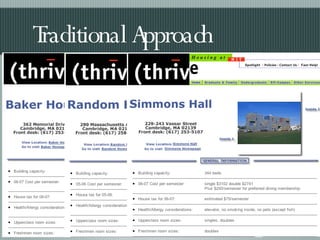
Traditional Approach
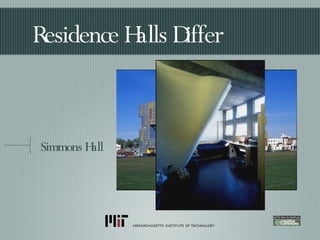
Residence Halls Differ Simmons Hall
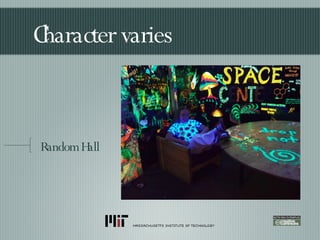
Character varies Random Hall
How do we capture ‘culture’? What can we do to better convey the real differences in  residence hall environments  to incoming freshman? What would a good systems design engineer do?
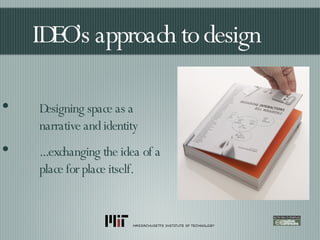
IDEO’s approach to design Designing space as a narrative and identity  ...exchanging the idea of a place for place itself.
Enthnographic Analysis Team of interviewers: student interviewer graphics designer game designer Interview students in different residence halls. What “matters” to them? What do they value? Where/how do they engage with each other in the dorm?
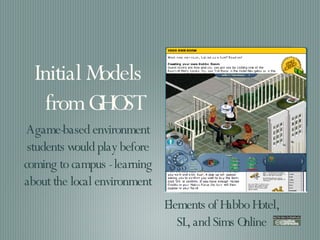
Initial Models from GHOST A game-based environment students would play before coming to campus - learning about the local environment Elements of Habbo Hotel, SL, and Sims Online
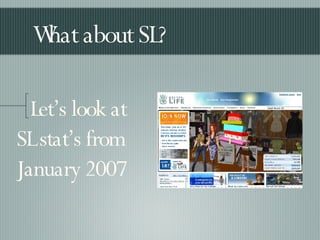
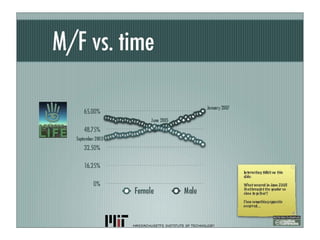
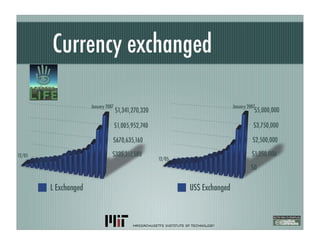
What about SL? Let’s look at SL stat’s from January 2007
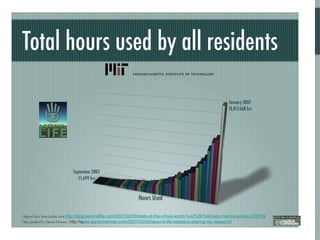
Growth of Second Life Original data from Linden Labs  http://blog.secondlife.com/2007/02/09/state-of-the-virtual-world-%e2%80%93-key-metrics-january-2007/ s   Data graphed by Darren Herman,  http:// w ww.darrenherman.com/2007/02/09/second-life-statistics-sharing-my-research/
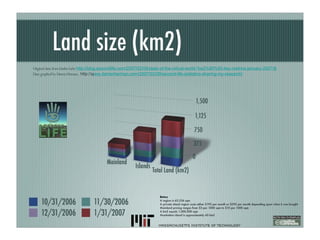
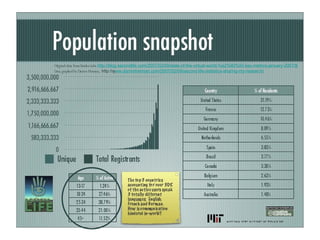
Original data from Linden Labs  http://blog.secondlife.com/2007/02/09/state-of-the-virtual-world-%e2%80%93-key-metrics-january-2007/ s   Data graphed by Darren Herman,  http:// w ww.darrenherman.com/2007/02/09/second-life-statistics-sharing-my-research/
 
 
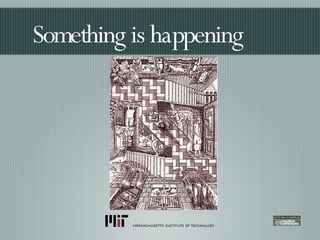
Something is happening
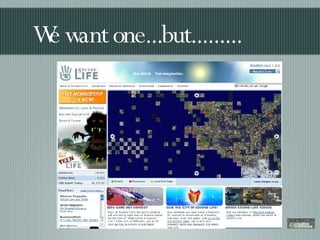
We want one...but.........
We needed to talk to IP Counsel * Research and Collaboration Agreements. We support the Office of Sponsored Programs and individual departments and labs and MIT researchers in structuring and negotiating sponsored research programs, consortiums, and research collaborations, and providing legal counsel on intellectual property, publication, warranty and other issues in connection with these types of agreement. * Inventions. We support the Technology Licensing Office in applying MIT’s intellectual property policies. * Intellectual Property. We support the administration in reviewing and development intellectual property and other policies related to MIT research and information services, infringement and other related actions. * Contracts. We draft, negotiate and review permissions, releases, equipment leases or loans, publishing contracts and indemnification and warranty relating to intellectual property or MIT research. * Licenses. We license educational materials that are both coming into and going out of MIT as well as contracts for the delivery of educational materials for on-line or distance learning programs.
TOS Monster Indemnification
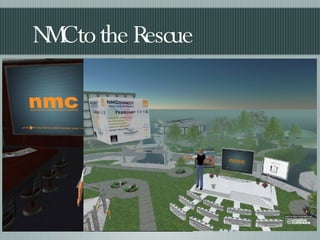
NMC to the Rescue
We’ve finessed the space, now what? Question: Can we call the sim in SL MIT? Issue: Use of the MIT “brand” in the context of commercial software. Answer:  the MIT Island is being controlled by MIT personnel,  as approved by the SL Committee , for the benefit of MIT Affiliates - it’s ‘OK”
Having faculty support is key First Last Title Dept. Email Category William Mitchell Professor Program in Media Arts and Sciences [email_address] Board Kent Larson Director, Changing Places (Architecture&Media Lab)  Department of Architecture [email_address]   Board Takehito  Nagakura Associate Professor  Department of Architecture  [email_address]   Board Henry Jenkins Professor Literature & CMS [email_address] Board Eric Klopfer Assoc. Prof.Dir. TEP DUSP [email_address] Board Irving   Waladawsky-Berger Visiting Professor IBM [email_address] Board Thomas Malone Professor MIT Sloan School [email_address] Board Beth Coleman Assistant Professor Program in Writing [email_address] Board Howie Shrobe Principal Research Scientist CSAIL [email_address] Board
The rules in SL are the same as in RL
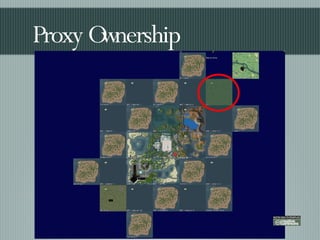
Proxy Ownership
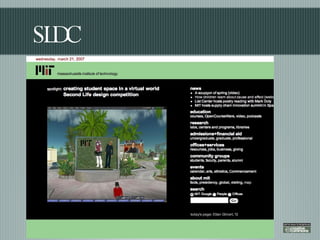
SLDC
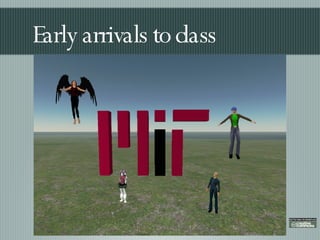
Early arrivals to class
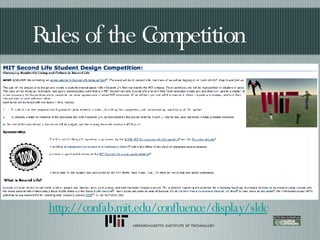
Rules of the Competition http://confab.mit.edu/confluence/display/sldc
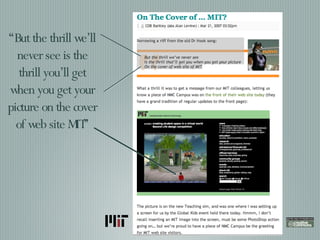
“ But the thrill we’ll never see is the thrill you’ll get when you get your picture on the cover of web site MIT”
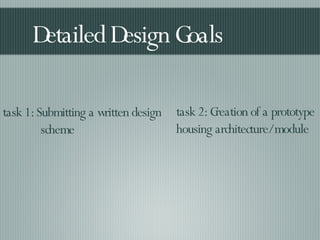
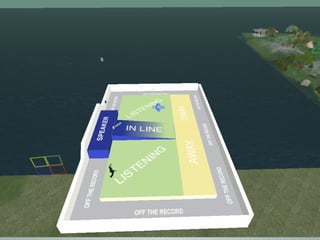
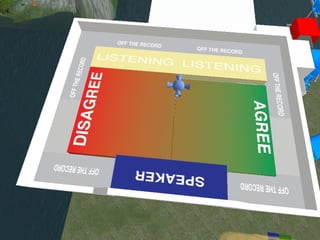
Detailed Design Goals task 1: Submitting a written design scheme task 2: Creation of a prototype housing architecture/module
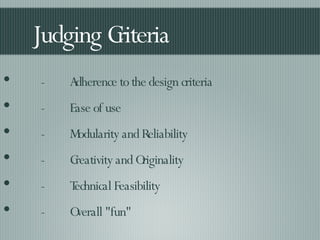
Judging Criteria -  Adherence to the design criteria -  Ease of use -  Modularity and Reliability -  Creativity and Originality -  Technical Feasibility -  Overall "fun"
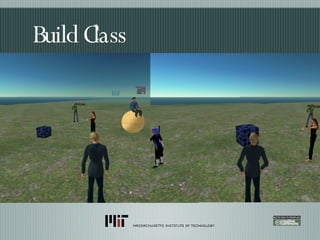
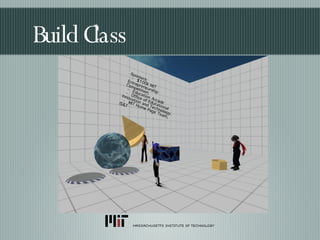
Build Class
Build Class
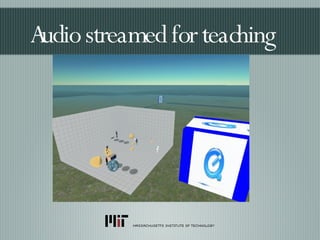
Audio streamed for teaching
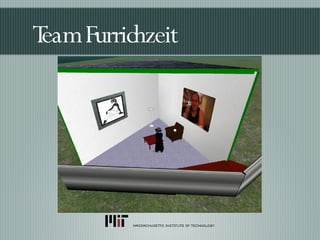
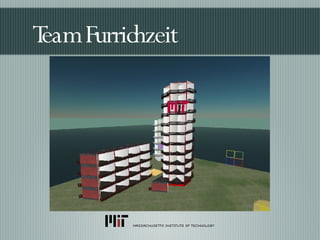
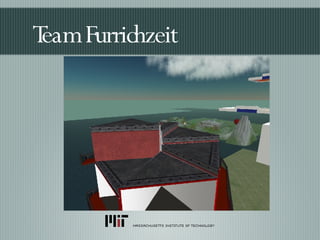
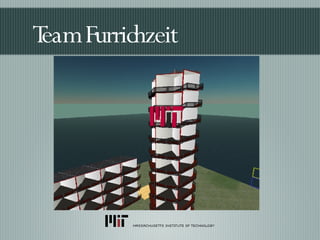
Team Furrichzeit
Team Furrichzeit
Team Furrichzeit
Team Furrichzeit
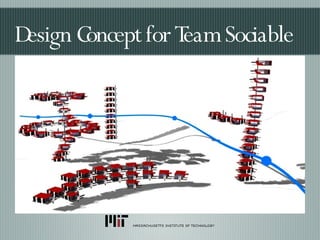
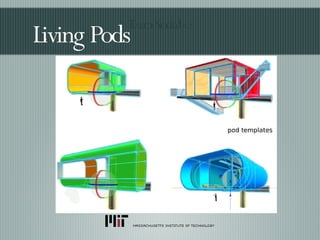
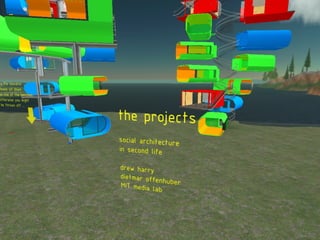
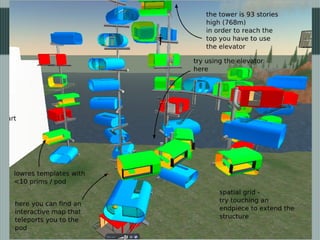
Design Concept for Team Sociable
Living Pods Team Sociable


Cautions What if students build those attributes of their culture that the administration doesn’t currently (want to) see? A former Dean of Undergraduate Students saw “red” in exposing student culture more publicly.
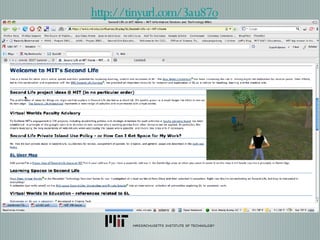
http://tinyurl.com/3au87o
Next Steps -Second Life project list 1. Support for selected fall term classes: e.g., Media Theory and Methods - Henry Jenkins Architecture in Virtual Worlds - from closed plan to open plan to virtual plan - Bill Mitchell 2. Publicly announce the opening of the MIT sim - let’s have a party! 3. Engage with Admissions & Alumni Association to explore ways SL can provide new options 4. For the able-bodied: Living in Second Life with a Disability
What’s next? 5. Initiate research and development around virtual worlds on three fronts:  identity & interoperability new forms of social connection intersection of virtual/physical worlds 6. Projecting the “MIT community” globally
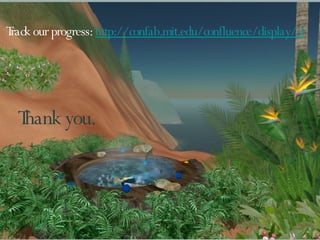
Thank you. Track our progress:  http://confab.mit.edu/confluence/display/sl
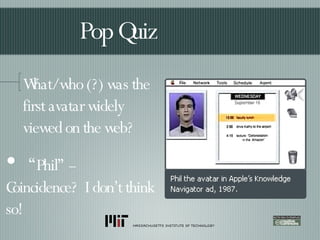
What/who (?) was the first avatar widely viewed on the web? Pop Quiz “ Phil” --  Coincidence?  I don’t think so!

Second Life at MIT

  • 1.
    Virtual Worlds Buildingan environment for learning Phillip Long [email_address] Radar Radio 2007
  • 2.
    We didn’t startout to do this The initial impetus for the virtual worlds project was: How do we help incoming freshman make more intelligent choices about which residence hall is ‘right’ for them?
  • 3.
  • 4.
  • 5.
  • 6.
    How do wecapture ‘culture’? What can we do to better convey the real differences in residence hall environments to incoming freshman? What would a good systems design engineer do?
  • 7.
    IDEO’s approach todesign Designing space as a narrative and identity ...exchanging the idea of a place for place itself.
  • 8.
    Enthnographic Analysis Teamof interviewers: student interviewer graphics designer game designer Interview students in different residence halls. What “matters” to them? What do they value? Where/how do they engage with each other in the dorm?
  • 9.
    Initial Models fromGHOST A game-based environment students would play before coming to campus - learning about the local environment Elements of Habbo Hotel, SL, and Sims Online
  • 10.
    What about SL?Let’s look at SL stat’s from January 2007
  • 11.
    Growth of SecondLife Original data from Linden Labs http://blog.secondlife.com/2007/02/09/state-of-the-virtual-world-%e2%80%93-key-metrics-january-2007/ s Data graphed by Darren Herman, http:// w ww.darrenherman.com/2007/02/09/second-life-statistics-sharing-my-research/
  • 12.
    Original data fromLinden Labs http://blog.secondlife.com/2007/02/09/state-of-the-virtual-world-%e2%80%93-key-metrics-january-2007/ s Data graphed by Darren Herman, http:// w ww.darrenherman.com/2007/02/09/second-life-statistics-sharing-my-research/
  • 13.
    Original data fromLinden Labs http://blog.secondlife.com/2007/02/09/state-of-the-virtual-world-%e2%80%93-key-metrics-january-2007/ s Data graphed by Darren Herman, http:// w ww.darrenherman.com/2007/02/09/second-life-statistics-sharing-my-research/
  • 14.
  • 15.
  • 16.
  • 17.
  • 18.
    We needed totalk to IP Counsel * Research and Collaboration Agreements. We support the Office of Sponsored Programs and individual departments and labs and MIT researchers in structuring and negotiating sponsored research programs, consortiums, and research collaborations, and providing legal counsel on intellectual property, publication, warranty and other issues in connection with these types of agreement. * Inventions. We support the Technology Licensing Office in applying MIT’s intellectual property policies. * Intellectual Property. We support the administration in reviewing and development intellectual property and other policies related to MIT research and information services, infringement and other related actions. * Contracts. We draft, negotiate and review permissions, releases, equipment leases or loans, publishing contracts and indemnification and warranty relating to intellectual property or MIT research. * Licenses. We license educational materials that are both coming into and going out of MIT as well as contracts for the delivery of educational materials for on-line or distance learning programs.
  • 19.
  • 20.
    NMC to theRescue
  • 21.
    We’ve finessed thespace, now what? Question: Can we call the sim in SL MIT? Issue: Use of the MIT “brand” in the context of commercial software. Answer: the MIT Island is being controlled by MIT personnel, as approved by the SL Committee , for the benefit of MIT Affiliates - it’s ‘OK”
  • 22.
    Having faculty supportis key First Last Title Dept. Email Category William Mitchell Professor Program in Media Arts and Sciences [email_address] Board Kent Larson Director, Changing Places (Architecture&Media Lab) Department of Architecture [email_address] Board Takehito Nagakura Associate Professor Department of Architecture [email_address] Board Henry Jenkins Professor Literature & CMS [email_address] Board Eric Klopfer Assoc. Prof.Dir. TEP DUSP [email_address] Board Irving Waladawsky-Berger Visiting Professor IBM [email_address] Board Thomas Malone Professor MIT Sloan School [email_address] Board Beth Coleman Assistant Professor Program in Writing [email_address] Board Howie Shrobe Principal Research Scientist CSAIL [email_address] Board
  • 23.
    The rules inSL are the same as in RL
  • 24.
  • 25.
  • 26.
  • 27.
    Rules of theCompetition http://confab.mit.edu/confluence/display/sldc
  • 28.
    “ But thethrill we’ll never see is the thrill you’ll get when you get your picture on the cover of web site MIT”
  • 29.
    Detailed Design Goalstask 1: Submitting a written design scheme task 2: Creation of a prototype housing architecture/module
  • 30.
    Judging Criteria - Adherence to the design criteria - Ease of use - Modularity and Reliability - Creativity and Originality - Technical Feasibility - Overall "fun"
  • 31.
  • 32.
  • 33.
  • 34.
  • 35.
  • 36.
  • 37.
  • 38.
    Design Concept forTeam Sociable
  • 39.
  • 40.
  • 41.
  • 42.
  • 43.
  • 44.
  • 45.
    Cautions What ifstudents build those attributes of their culture that the administration doesn’t currently (want to) see? A former Dean of Undergraduate Students saw “red” in exposing student culture more publicly.
  • 46.
  • 47.
    Next Steps -SecondLife project list 1. Support for selected fall term classes: e.g., Media Theory and Methods - Henry Jenkins Architecture in Virtual Worlds - from closed plan to open plan to virtual plan - Bill Mitchell 2. Publicly announce the opening of the MIT sim - let’s have a party! 3. Engage with Admissions & Alumni Association to explore ways SL can provide new options 4. For the able-bodied: Living in Second Life with a Disability
  • 48.
    What’s next? 5.Initiate research and development around virtual worlds on three fronts: identity & interoperability new forms of social connection intersection of virtual/physical worlds 6. Projecting the “MIT community” globally
  • 49.
    Thank you. Trackour progress: http://confab.mit.edu/confluence/display/sl
  • 50.
    What/who (?) wasthe first avatar widely viewed on the web? Pop Quiz “ Phil” -- Coincidence? I don’t think so!